
An online permit course is a state-approved driver education class you take on a computer or phone, usually the classroom part of getting your first license. Whether you need one before your learner permit depends on your state and your age. In Florida, anyone under 18 who has never held a license must finish a 6-hour course before applying. In other states, the course comes before the road test, or only applies if you want a license before 18.
This guide explains what these courses are, how the rules differ by state, how the permit test fits in, and how to choose a course that your DMV will accept.
Key Takeaways
- An online permit course is the classroom portion of driver education. It is not the same thing as the permit knowledge test, which your state’s motor vehicle agency gives.
- Rules vary widely. Some states require a course before the permit, some before the road test, and some only if you want a license before age 18.
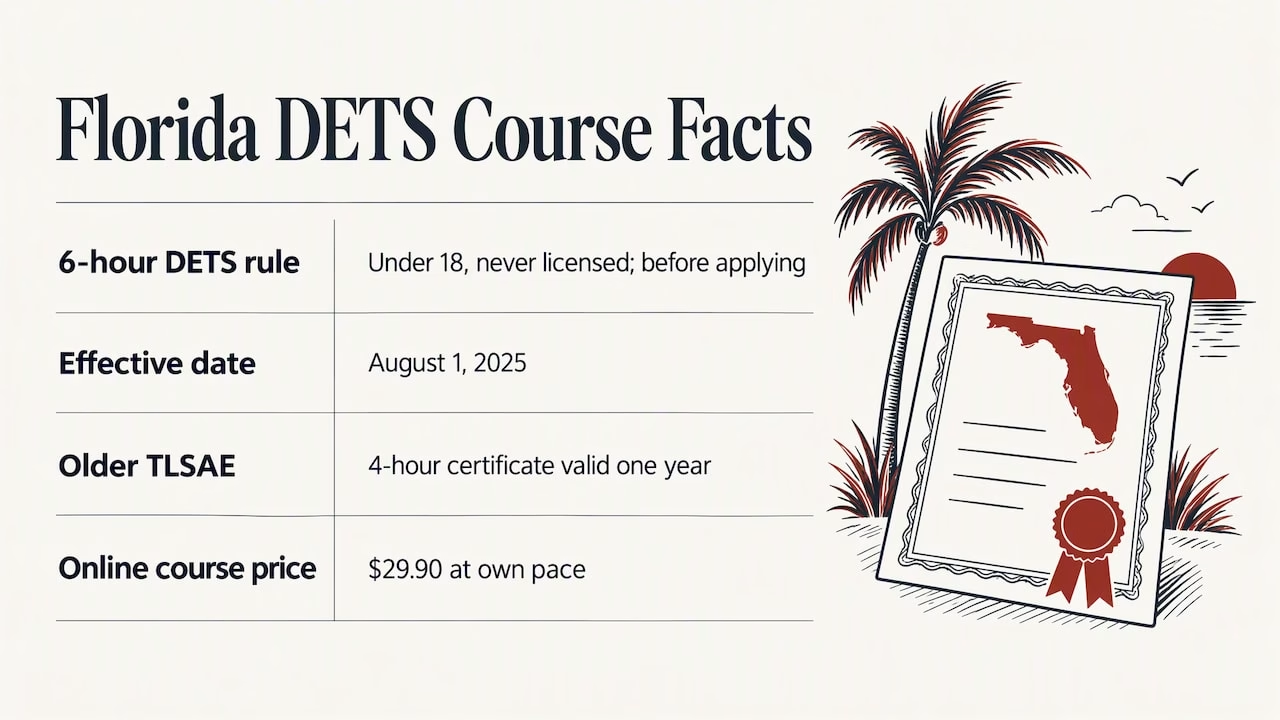
- In Florida, new drivers under 18 must complete a 6-hour DETS course before applying for a license. Our Florida DETS course is $29.90.
- Check that the provider is approved by your state agency before you pay. Then study your state’s official driver manual and take practice tests.
Table of Contents
- What an Online Permit Course Actually Is
- Do You Need a Course Before You Get a Permit?
- Florida: The 6-Hour DETS Course
- What an Online Course Covers and How Completion Works
- Does the Course Include the Permit Test?
- How to Prepare for and Pass the Permit Test
- What to Bring When You Apply
- After You Have the Permit
- How to Choose an Online Permit Course
- Our Perspective
- Start Your Florida Course
- FAQ
- Sources
What an Online Permit Course Actually Is
People search for “online permit course,” “online drivers permit class” and “drivers ed permit course” and mean roughly the same thing: a state-approved class you finish on your own schedule that moves you toward a learner permit or license. The name varies, but the substance is a driver education course delivered over the internet.
There are really three separate pieces, and mixing them up is the most common source of confusion:
- Classroom instruction. Traffic laws, safe driving habits, road signs, and the effects of alcohol and drugs. This is what an online course covers.
- The knowledge test. A multiple-choice exam given by your state. You need to pass it to receive a learner permit.
- Behind-the-wheel practice. Supervised driving with a licensed adult, and in some states a set number of hours with an instructor.
Texas draws the same line. The Texas Department of Public Safety describes online driver education as an approved, flexible option for the classroom phase, kept separate from the permit written exam and the driving practice. Texas even allows a concurrent route: a student begins the classroom instruction, passes the exam, gets a permit, and finishes the remaining classroom hours while practicing.
A learner permit itself is the first stage of graduated driver licensing. According to NHTSA, it allows driving only with a fully licensed driver, while later stages allow more independent driving.
Do You Need a Course Before You Get a Permit?
Sometimes yes, sometimes no. The honest answer is that it is a state-by-state rule, and the date and age matter. Here is how a sample of states handle it, straight from their agencies:
| State | What the agency says |
|---|---|
| Florida | Applicants under 18 who have never held a license must complete a 6-hour DETS course before applying for a license. |
| California | Applicants aged 15½ to under 18 provide a driver education completion or enrollment certificate to apply for an instruction permit. |
| Maine | Ages 15 to 17 must complete a driver education course before applying for a learner’s permit. |
| Washington | Anyone who wants a license before 18 must complete an approved course, and can start the permit application no earlier than 10 days before the course begins. |
| Massachusetts | You do not have to sign up for driver education before the permit exam, but you must complete an approved course to get a license before 18. |
| Indiana | A permit is available at 15 while enrolled in an approved course, or at 16 without enrolling. |
| New York | The pre-licensing course must be done before a road test, and you need a valid learner permit before beginning the course. |
| Connecticut | Adults 18 and older take an eight-hour Safe Driving Practices Course before the road test, with an exception for licenses that expired two or more years ago. |
| Louisiana | Applicants who have never held a license must complete a driver education or pre-licensing course. |
Three patterns come out of that table.
The course can come before the permit. Florida, California and Maine work this way for teens. You finish (or at least enroll in) the course first, then apply.
The course can come after the permit. In New York you need the permit to begin the pre-licensing course, so the order flips.
The course can be optional, with a catch. In Massachusetts and Washington you can skip it, but you then wait until 18 for a license.
Adults are not off the hook everywhere. Connecticut and Louisiana both have course requirements for adult first-time drivers, and Virginia has announced that, beginning January 1, 2027, first-time license applicants ages 18 through 20 will be subject to new driver training requirements. If you are an adult learning to drive, read your state’s adult page, not the teen one.
The quick rule: look up your state’s motor vehicle agency, find the “learner permit” page for your age group, and read the education requirement before you buy anything.
Florida: The 6-Hour DETS Course
Because we are a Florida-focused provider, here is the detail for our home state. Since August 1, 2025, a person under 18 who has never held a driver license from any state, country or jurisdiction must complete a 6-hour Driver Education Traffic Safety (DETS) course before applying for a Florida license, according to the Florida Department of Highway Safety and Motor Vehicles. Some county school board programs can substitute for it.
The same page says the change does not affect people who already held a Florida learner’s license before that date, or those under 18 who held a valid out-of-state license. Those who completed the older 4-hour TLSAE course before the change are allowed to use that certificate for one year after completion. If that year passes without a license, they need the new course.
Our Florida DETS course is $29.90, and you can take it online at your own pace on any device. For a deeper walk-through of the course content and what the certificate does, see our guide to the Florida 6-hour pre-licensing course.
If you are an adult in Florida learning to drive, our article on adult driver education in Florida covers the path for someone starting later in life.
What an Online Course Covers and How Completion Works
Curriculum details differ by state, but most approved courses cover the same ground:
- Traffic laws, right-of-way rules and speed limits
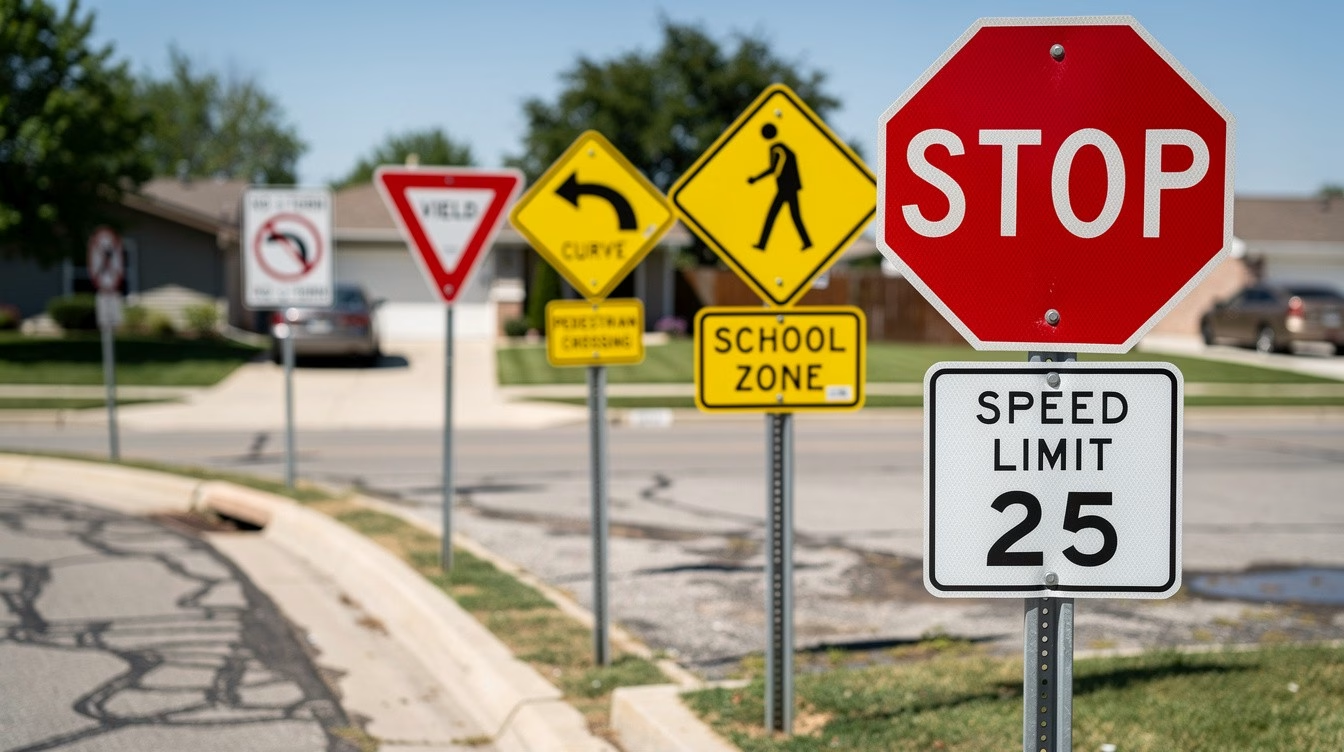
- Road signs, signals and pavement markings
- Safe following distance, lane changes and parking
- Sharing the road with pedestrians, cyclists and motorcycles
- The effects of alcohol, drugs and distraction on driving
- What to do after a crash or at a traffic stop
The typical flow looks like this:
- Confirm your requirement. Read your state agency’s page for your age.
- Choose an approved provider. Verify approval on the state’s own list (more on that below).
- Enroll and work through the modules. Courses are built to be done in sessions. You can stop and pick up where you left off.
- Pass the course assessments. Most courses use short quizzes and a final exam.
- Receive your completion record. Depending on the state, it is reported electronically or issued as a certificate you bring to the DMV.
- Take your state’s knowledge test and apply for your permit, in whatever order your state requires.
How long it takes depends on the state’s required hours. Florida’s DETS course is 6 hours. Other states ask for much more: Texas parent-taught courses run 32 hours and Texas standard courses 32 hours of classroom, while Ohio and California courses are priced and structured differently. Always go by your state’s minimum, because a course that falls short will not be accepted. For a general sense of course length, see our article on how long a driver education course takes.
Does the Course Include the Permit Test?
Usually, no. The knowledge test is an official state exam, and the rules for taking it are set by the agency. A few details show how much it varies:
- In Florida, the Class E Knowledge Exam has 50 multiple-choice questions, and you need 40 correct to pass. Any applicant under 18 can take it online, with a parent proctoring form required.
- In Massachusetts, the online exam has 25 questions, and you must answer 18 correctly within 25 minutes.
- In Arizona, the written test has 30 multiple-choice questions and requires 80% or higher.
- In Hawaii, applicants who are 15 years and 6 months or older can take the knowledge test online.
So the course teaches you the material, and a separate state exam checks it. Some states route the test through third-party administrators or school programs, so ask the provider exactly what their course handles and what you still have to do at the DMV.
How to Prepare for and Pass the Permit Test
The course gives you a solid base, but the test is written from your state’s own driver handbook. A few habits make the difference.
Use the official manual as your main text. Connecticut’s DMV, for example, tells applicants to study the state driver’s manual and use the practice questions in its mobile app. Arizona says the same about its manual and online practice tests. Florida points applicants to the official handbook and a practice test.
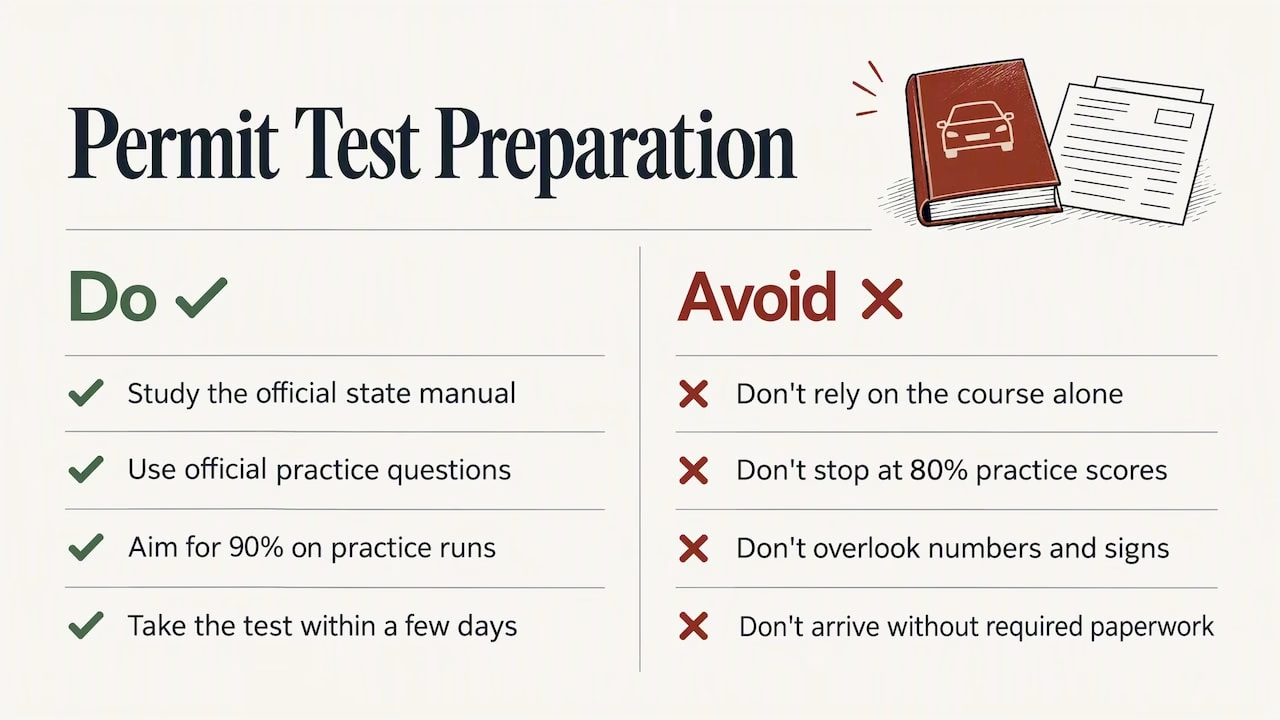
Take practice tests until you score well above the pass mark. If the pass mark is 80%, aim for 90% on practice runs so nerves do not cost you.
Pay extra attention to numbers and signs. Speed limits in school zones, following distances, blood alcohol limits for drivers under 21, and sign shapes and colors are common test material.
Do the test when the course is fresh. Take the exam within a few days of finishing, while the rules are easy to recall.
Check the ID rules before test day. Missing paperwork is the most common reason people leave the DMV without a permit.
What to Bring When You Apply
Paperwork varies, but the same few items appear again and again:
- Proof of identity. Maryland requires proof of identity and a Social Security number, and applicants must be at least 15 years and 9 months old.
- A parent or guardian consent form for minors. Pennsylvania asks for a completed application, a parent or guardian consent form, proof of identity and residency, and the fee.
- Your course completion proof, where your state requires it.
- A vision screening. Massachusetts, for example, has you verify identity, take a vision exam and have a photo taken at a service center before you take the exam.
Fees and exact documents change, so use your state agency’s checklist the week you apply.
After You Have the Permit
The permit is a supervised stage. In Maryland, for example, the supervising driver must be at least 21 and have held a license for at least three years, as the MVA’s learner’s permit page explains. Your state sets its own rules, so check the supervisor age and curfew limits before your first drive.
NHTSA recommends that permit holders drive with a licensed adult and that parents certify 30 to 50 hours of practice, noting that graduated licensing laws vary by state. The reasoning behind graduated licensing is simple: beginners build experience in lower-risk conditions before they face complex driving alone.
In Florida, you need to hold the learner’s license for 12 months or be 18 to take the driving skills test, according to the FLHSMV. Use that time to practice in rain, at night, on highways and in busy parking lots, not just on quiet streets.
How to Choose an Online Permit Course
With a rule that changes by state, picking a provider comes down to a short checklist.
- State approval. Look up the provider on your state agency’s approved list. If you cannot find it, do not enroll.
- The right course name. Florida calls it DETS, other states use “pre-licensing,” “driver education” or “safe driving practices.” Match your state’s term.
- Clear pricing. Look for the full price and what is included, with no add-on fees at checkout.
- A money-back guarantee. It helps if you enroll and then learn the course does not fit your situation.
- Device support. You should be able to start on a phone and continue on a laptop.
- Language support. Read-along features help learners who are more comfortable in another language.
- Reporting. Ask how and when your completion is sent to the state.
Our Perspective
Most people who contact us after buying the wrong course had the same problem: they picked on price or a flashy sale banner and never checked the state rule. Our advice is to start with the requirement, then the approval, then the price.
We build our courses in-house with certified educators and safety specialists, so the content tracks the statutory requirements and real driving conditions. We publish our prices, with no hidden fees, and back each course with a money-back guarantee, because someone preparing for a first permit should not have to worry about the fine print.
We also design for how people actually study. You can learn on a phone between school and practice, or on a laptop at the kitchen table, and our multilingual read-along feature helps families where English is a second language. A calm, self-paced course produces a driver who understands why the rules exist, which is the point of the whole exercise.
the author
Start Your Florida Course
If you are a first-time driver in Florida, the DETS course is the step to take before you apply for a license. It is $29.90, state-approved, and works on any device. You can review it and enroll on our courses page.
We also offer a Florida Mature Driver Insurance Discount Course at $14.50 and a Basic Driver Improvement course at $30 for drivers with a different goal, so you can keep everything with one provider as your needs change. For ticket-related options, see our guide to finding an approved online traffic school.
FAQ
Can I take the permit test online?
In some states, yes. Hawaii allows applicants 15 years and 6 months or older to take the knowledge test online, and Florida allows applicants under 18 to take the Class E exam online with a parent proctoring form. Other states require you to test in person, so check your agency’s page.
Is an online permit course the same as drivers ed?
It is usually the classroom part of drivers ed. Full driver education often also includes behind-the-wheel hours with an instructor or supervised practice with a parent. The online course covers the first piece, and the road practice happens separately.
How long does an online permit course take?
It depends on your state’s required hours. Florida’s DETS course is 6 hours, while other states require much longer programs. Most online courses let you split the time over several days and resume where you stopped.
Do adults need a permit course?
Sometimes. Connecticut requires adults 18 and older to take an eight-hour course before the road test, and Louisiana requires first-time adult applicants to complete a driver education or pre-licensing course. Other states waive the course for adults, so read the adult page for your state.
What if my state does not require a course?
You can still take one. States like Indiana and Massachusetts let some applicants get a permit without enrolling, and a course can still help you pass the knowledge test and start with safer habits. Check whether skipping it delays your license age.
Sources
- Driver Education Traffic Safety (DETS), Florida FLHSMV
- Class E Knowledge Exam and Driving Skills Test, Florida FLHSMV
- Choosing a Driver Education Course, Texas DPS
- Graduated Driver Licensing, NHTSA
- Teen Safe Driving, NHTSA
- Instruction and Learner’s Permits, California DMV
- Learner’s permits, Maine Title 29-A §1304
- Get your learner permit, Washington DOL
- Permit FAQs, Massachusetts
- The Driver Pre-Licensing Course, NY DMV
- Get a DMV Learner’s Permit for Adults, Connecticut
- Class E First Time Driver’s License for Adults, Louisiana
- Permit Test, Arizona MVD
- Online Learner’s Permit Test, Hawaii DOT
- Learner’s Permit, Maryland MVA
- Test Your Knowledge, Pennsylvania DMV
Recommended
- Finding Approved Online Traffic School
- How an Approved Driver Safety Program Works
- Your Guide to Online Driving School and Traffic Safety
- How to Complete a Driver Improvement Course Online
This article is provided for general information and is not a professional advice.