Commercial driver safety training is structured instruction that teaches people who drive for work how to prevent crashes, from defensive driving and backing to vehicle checks and company policies. It is different from the federal entry-level training needed for a first CDL, and it is not a ticket-dismissal shortcut for CDL holders. For fleets, the most practical setup is a mix of online coursework, regular refreshers and hands-on practice, with completion tracked for every driver.
This guide explains who should be trained, what good training covers, where federal rules draw the line, and how to build a program that keeps working after the first week.
Key Takeaways
- Federal safety guidance says structured training belongs in place for employees whose main job is driving on public roads, and it can also help drivers who do not need a CDL.
- Solid programs cover vehicle limits, controls, pre-trip checks, company policy, defensive driving and backing.
- Entry-level driver training (ELDT) is a separate federal requirement for certain first-time CDL applicants and must come from a registered provider.
- Safety training is ongoing. Regular refreshers keep drivers from getting complacent.
- CDL holders generally cannot use traffic school to keep a conviction off their record, so training is for prevention, not paperwork.
Table of Contents
- What commercial driver safety training actually is
- What good training covers
- Safety training versus entry-level driver training (ELDT)
- Will training dismiss a ticket or lower insurance for CDL holders?
- Building a fleet training program that sticks
- Why online training suits fleets
- How to choose a course or provider
- Our perspective
- Put training to work for your drivers
- FAQ
- Sources
What commercial driver safety training actually is
Think of it as the layer of learning that sits on top of a license. A license proves a driver can pass a test. Safety training shows them how to handle the situations that cause crashes in a loaded truck, a delivery van or a service vehicle: tight backing, following distance, fatigue, distraction and aggressive traffic.
OSHA describes driver safety training as a protective measure against crashes and says structured training should be in place for new employees whose primary job responsibilities are driving on public roadways. That makes it an employer topic as much as a driver topic. If someone drives for you, how they were trained is part of your safety program.
Who should take it
The obvious group is CDL holders: tractor-trailer drivers, bus drivers, tanker and hazmat drivers. But the same OSHA page notes that training can also benefit drivers of vehicles where a CDL is not required, such as trucks under 26,000 pounds or vehicles towing a single-axle trailer with a GVWR of up to 10,000 pounds.
In practice, that covers a wide group:
- Delivery and courier drivers in cargo vans and box trucks
- Contractors and trades crews who tow equipment trailers
- Sales and service staff who spend most of the day in company vehicles
- New hires, whatever their experience, because company routes and policies are new to everyone
- Veteran drivers, who benefit most from refreshers
OSHA’s employer guidance also says programs should be scalable: structured training for people who drive as a main duty, and a lighter approach for employees who only occasionally drive their own vehicles for work. You do not need the same course for the route driver and the office manager who makes one bank run a week.
What good training covers
OSHA’s list of topics is a useful checklist when you review any course. Training should address vehicle characteristics, capabilities and limitations; instruments, controls and safety components; preventive maintenance checks; company driving policies; defensive driving; and vehicle backing.
Here is what each one means on the road:
| Topic | What the driver should walk away knowing |
|---|---|
| Vehicle limits | Stopping distance, turning radius, blind spots and how load changes handling |
| Controls and instruments | What each gauge, warning light and safety system is telling them |
| Preventive checks | A repeatable pre-trip routine that catches problems before the route starts |
| Company policy | Your rules on phones, speed, hours, incident reporting and personal use |
| Defensive driving | Space management, hazard scanning and how to avoid other drivers’ mistakes |
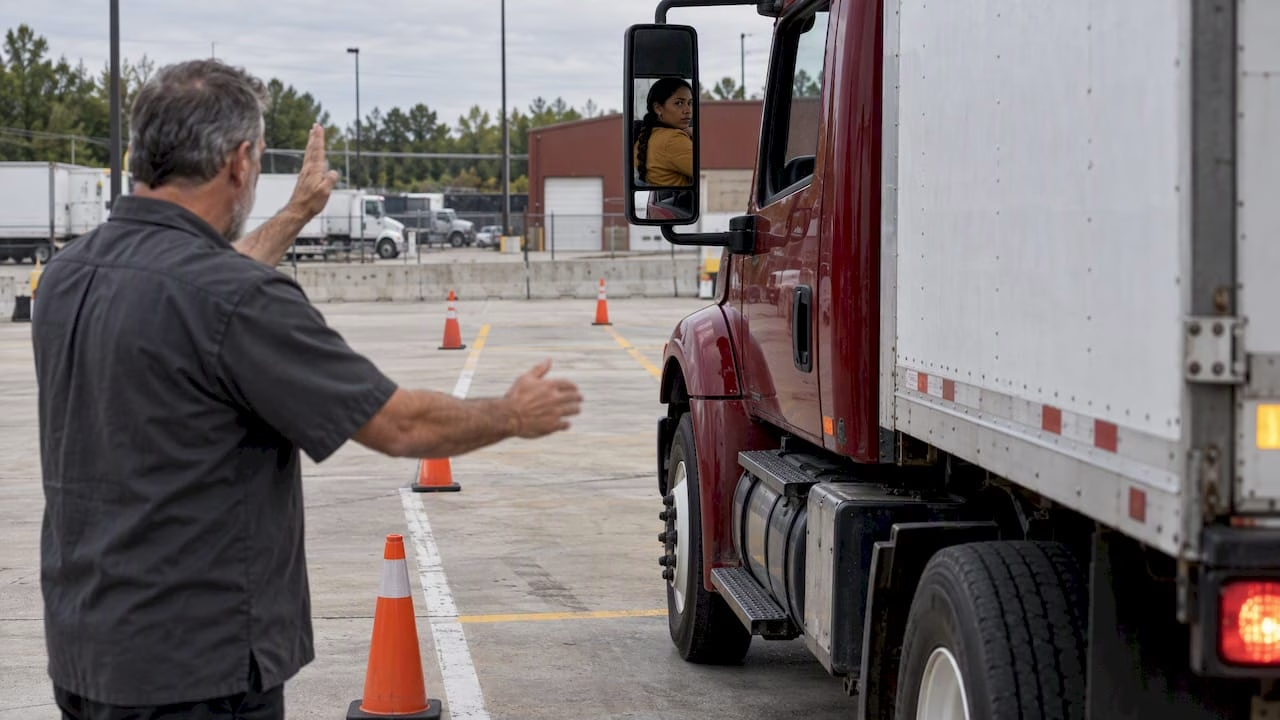
| Backing | Setting up, using a spotter, getting out and looking, and when to reposition |
Notice that company policy is on the list. A generic course cannot teach your rules, so pair any off-the-shelf course with a short briefing on how your fleet operates.
Match the content to your crash causes
The best programs do not teach everything equally. OSHA’s case study of Abbott describes an analysis that found backing up and rear-end collisions were the two leading crash causes, so the program gave those topics extra emphasis. Look at your own incident reports, near misses and claims before choosing modules. If most of your losses happen in yards and loading docks, backing deserves more time than highway fatigue.
Our own guides go deeper on the driving skills themselves: defensive driving for truck drivers, practical truck driving tips and ways to improve commercial driving safety.
Safety training versus entry-level driver training (ELDT)
These two get confused, and mixing them up can cost a new driver time.
ELDT is a federal requirement. According to FMCSA, it applies to first-time Class A or Class B CDL applicants, Class B holders upgrading to Class A, and first-time applicants for the S, P or H endorsements. The training must be completed with a registered provider before the relevant test.
For online theory, FMCSA says providers must make sure content is delivered or prepared by theory instructors who meet the definition in 49 CFR 380.605, and that trainees must score at least 80 percent on the theory assessment. The federal curriculum sets no minimum number of instruction hours, but providers must cover all required topics, including basic operation, safe operating procedures, advanced operating practices, vehicle systems and non-driving activities.
So the split looks like this:
- ELDT: a gate to getting certain licenses or endorsements for the first time. Registered providers only.
- Commercial driver safety training: the ongoing education that helps licensed drivers and employees avoid crashes. Employers choose it, and it applies to new hires and veterans alike.
If you are hiring a driver who has just earned a CDL, ELDT does not replace your onboarding. It is a floor, and your safety program builds on it.
Will training dismiss a ticket or lower insurance for CDL holders?
This is where commercial drivers differ sharply from regular motorists, and where it pays to be straightforward.
For most drivers in many states, a traffic school or defensive driving course can mask a ticket or earn a discount. CDL holders are treated differently. Federal rules generally stop states from using traffic school, deferral or diversion to keep a CDL holder’s traffic conviction off the record, with exceptions for parking, weight and equipment-defect tickets, as one trucking legal resource explains. State practice varies too. Arizona’s statute, for example, lets eligible CDL holders attend defensive driving school, but the department still records the civil traffic violation, and commercial insurers may still consider the citation.
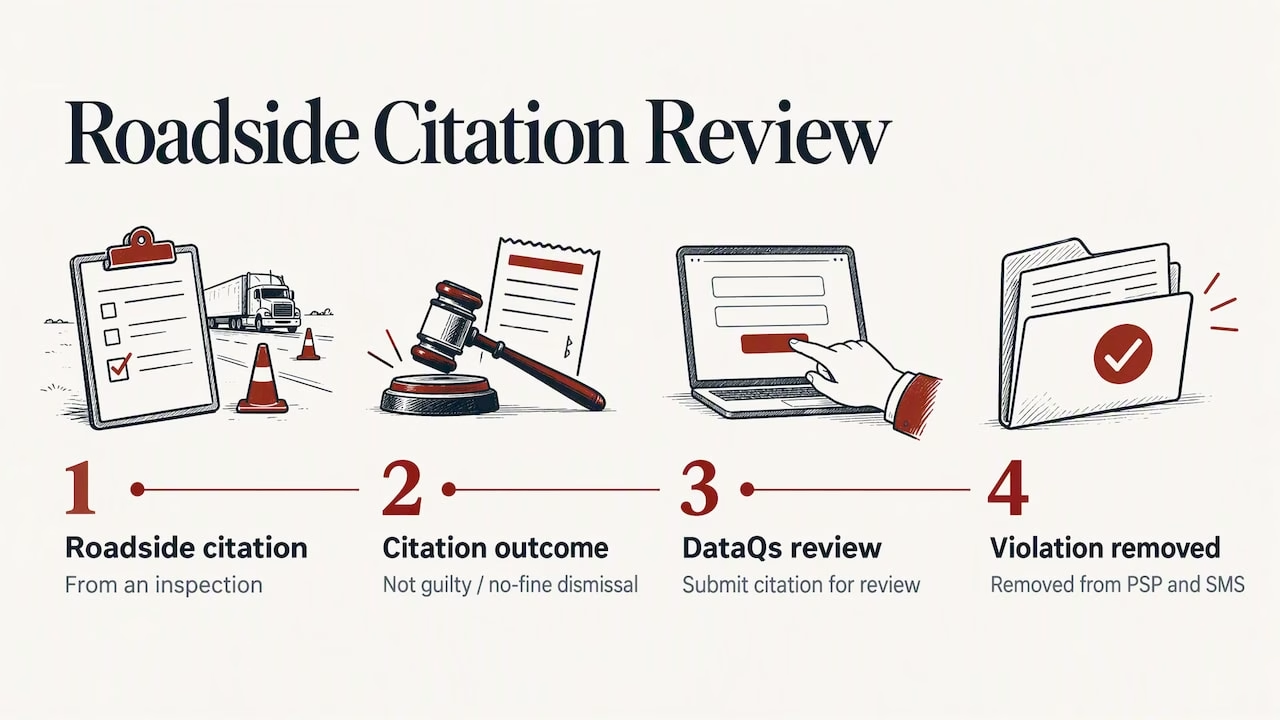
There is one useful route for roadside inspection citations. FMCSA says that when a citation ends in a not-guilty finding or a dismissal without a fine, it can be submitted through DataQs for review, and the violation is removed from PSP and SMS.
The practical message for a CDL holder facing a citation: talk to your carrier and a licensed attorney in the state where you were cited before enrolling in anything. For prevention, though, training is exactly the right tool. Fewer violations and fewer crashes protect both the driving record and the company’s inspection history.
Drivers who hold a standard license and received a ticket in Florida are a different case, and our Basic Driver Improvement guide explains how that works.
Building a fleet training program that sticks
A course on its own does not change behavior. A program does. The research from OSHA’s employer guidance points to a few features that show up in successful fleets.
Start with structure for new drivers
Abbott expanded its training to a half-day in the classroom and a half-day behind the wheel. OSHA’s case study reports a new-hire crash rate about 50 percent lower than that of tenured drivers who did not attend. The takeaway is not that everyone needs exactly that format, but that new drivers who get both knowledge and practice outperform veterans who got neither.
Repeat it for everyone
OSHA’s guidance describes driver safety training as a continuous process, because regular training keeps drivers from becoming complacent. It also describes the Pike Industries program: new-driver classroom training, annual classroom training for veterans and weekly safety talks. According to that guide, vehicle-related workers’ compensation claims dropped from 73 percent of total losses in 2001 to 2 percent in 2003.
A workable rhythm for a small or midsize fleet:
- Onboarding: a full course plus a ride-along or yard practice before solo routes.
- Annual refresher: an online course every driver completes on a set month.
- Weekly or monthly talks: ten-minute topics tied to recent incidents. Our list of driver safety meeting topics gives you a starting point.
- After an incident: targeted retraining on the specific skill involved.
Keep practice sessions small
OSHA’s Abbott report notes that keeping classes a manageable size encourages interaction with the instructor and leaves enough time to practice skills like maneuvering. When you add hands-on sessions to online learning, schedule them in small groups.
Use data to pick the topics
FMCSA’s own planning guidance says accurate crash data collection and reporting are critical to building an effective crash reduction plan. The same logic applies inside a fleet. Track incidents by type, location and driver tenure, then point training at what the numbers show.
It is also worth knowing that FMCSA’s Pre-Employment Screening Program (PSP) reports include 5 years of crash data and 3 years of inspection data, and FMCSA’s analysis found a statistically significant greater improvement in crash rates for the PSP group than for the non-PSP group. Checking history at hiring and training afterward work together.
Why online training suits fleets
Drivers work odd hours, in different cities, on different shifts. Getting everyone into one room is expensive and often impossible. Online training removes most of that friction:
- Flexible timing. Drivers learn at their own pace, between runs or at home.
- Any device. A phone or tablet is enough, so a driver does not need a company computer.
- Consistent content. Every driver gets the same material, which makes your policy easier to enforce.
- Completion records. You can see who finished and who did not, instead of relying on sign-in sheets.
- Language support. Read-along features help drivers who are stronger in another language follow the material.
Online coursework covers the knowledge side well. It does not replace behind-the-wheel coaching, so treat the two as partners. For ELDT specifically, remember that theory must come from a registered provider and that the driving portion needs a qualified instructor.
A note on fatigue
Fatigue deserves its own line in any commercial program. FMCSA and partners describe the North American Fatigue Management Program as a voluntary, interactive web-based training program for commercial truck and bus drivers and carriers that helps them manage fatigue factors and their effects on safety. Training only goes so far if drivers cannot rest properly, so crew logistics matter too. For crews working away from home, work truck parking and lodging with online booking is one way companies plan rest stops for drivers ahead of time.
How to choose a course or provider
Use this checklist when comparing options for your drivers.
- Check the topic list against OSHA’s six areas above. Missing backing or company policy? Plan to fill the gap yourself.
- Confirm who it is for. A course aimed at CDL drivers will not fit a fleet of cargo vans, and the reverse is also true.
- If it is ELDT, confirm the provider is registered and that theory instructors meet the federal definition. Ask how the 80 percent theory assessment is handled.
- Look at the reporting. Can you see completion by driver, and can drivers print or download proof?
- Test it on a phone. If drivers cannot finish a module on a mobile device, they will not finish it.
- Read the refund and fee terms. Prices should be clear up front, with no surprise charges.
- Ask about customization. Your policies and your crash causes should show up somewhere in the training.
What it costs
Price depends on the course type, whether it is ELDT or refresher training, whether you buy for one driver or many, and whether the content is customized. We do not publish fleet pricing, so the best path is to describe your driver count and vehicle types and ask for a quote.
Our perspective
We build driver education for people who need it to work in real life, not just to tick a box. Our courses are developed in-house by certified educators and safety specialists, and we update them as statutory requirements change.
From that experience, we believe the biggest fleet safety gains come from consistency. A driver who completes a clear, state-approved course at their own pace, on a phone if that is what they have, is more likely to finish it and remember it than one who sat through a rushed lecture once. That is why our courses work on any device, offer multilingual read-along features and carry plain pricing with a money-back guarantee.
For fleets, we recommend treating training as a cycle: onboard, refresh, discuss, retrain. Online learning handles the repeatable part so your managers can spend their time on coaching and ride-alongs. Where a standard course does not fit, a custom fleet safety course can bring your own policies and vehicles into the material.
the author
Put training to work for your drivers
We offer state-approved online courses for individual drivers, including Florida’s Basic Driver Improvement course at $30, the Mature Driver Insurance Discount Course at $14.50 and the Wireless Devices Distracted Driver Course at $24.50. You can see every option on our course page.
For companies, our custom fleet safety course is built around your drivers and vehicles. Tell us how many people you need to train and what they drive, and we will work out the right fit.
FAQ
Is commercial driver safety training required by law?
It depends on the type. Entry-level driver training is a federal requirement for first-time Class A and Class B CDL applicants, certain upgrades and first-time S, P or H endorsements. Ongoing safety training is mostly an employer decision, though OSHA guidance recommends structured training for employees who drive as a main job duty.
Can I use online training for my fleet drivers?
Yes, for safety and refresher topics online courses work well because drivers can finish them on their own schedules and you can track completion. For ELDT, theory content must come from a registered provider, and behind-the-wheel training still needs a qualified instructor.
Do drivers without a CDL need safety training?
They can benefit from it. OSHA notes that training can help drivers of trucks under 26,000 pounds and vehicles towing a single-axle trailer with a GVWR of up to 10,000 pounds, even when no CDL is required. Employers can scale the depth of training to how much each person drives.
Can a safety course remove a ticket from my CDL record?
Generally no. Federal rules prevent states from using traffic school or diversion to hide a CDL holder’s conviction, apart from parking, weight and equipment-defect tickets. Speak with your carrier and an attorney in the state where you were cited about your options.
How often should drivers be retrained?
OSHA describes driver safety training as continuous. A common pattern is full training at onboarding, an annual refresher, short regular safety talks and targeted retraining after an incident.
Sources
- OSHA: Motor Vehicle Safety, Driver Safety Training
- OSHA: Guidelines for Employers to Reduce Motor Vehicle Crashes (guide)
- OSHA: Guidelines for Employers to Reduce Motor Vehicle Crashes (publication)
- OSHA: Fleet Safety at Abbott
- FMCSA: ELDT Applicability
- FMCSA: ELDT Frequently Asked Questions
- FMCSA: ELDT Minimum Federal Curricula Summary
- FMCSA: Adjudicated Citations Factsheet
- Arizona Revised Statutes 28-3394.01
- Truck-Owner: How fighting a CDL traffic ticket works
- FMCSA: Pre-Employment Screening Program safety impact analysis
- FMCSA: FY2026 MCSAP Planning Memorandum
- US DOT: FMCSA collaboration on the North American Fatigue Management Program
Recommended
- How to Master Safety Driver Training Programs
- How to Improve Commercial Driving Safety: Essential Tips
- How to Choose the Right Driver Refresher Course
- How to Master Defensive Driving for Truck Drivers
This article is provided for general information and is not a professional advice.