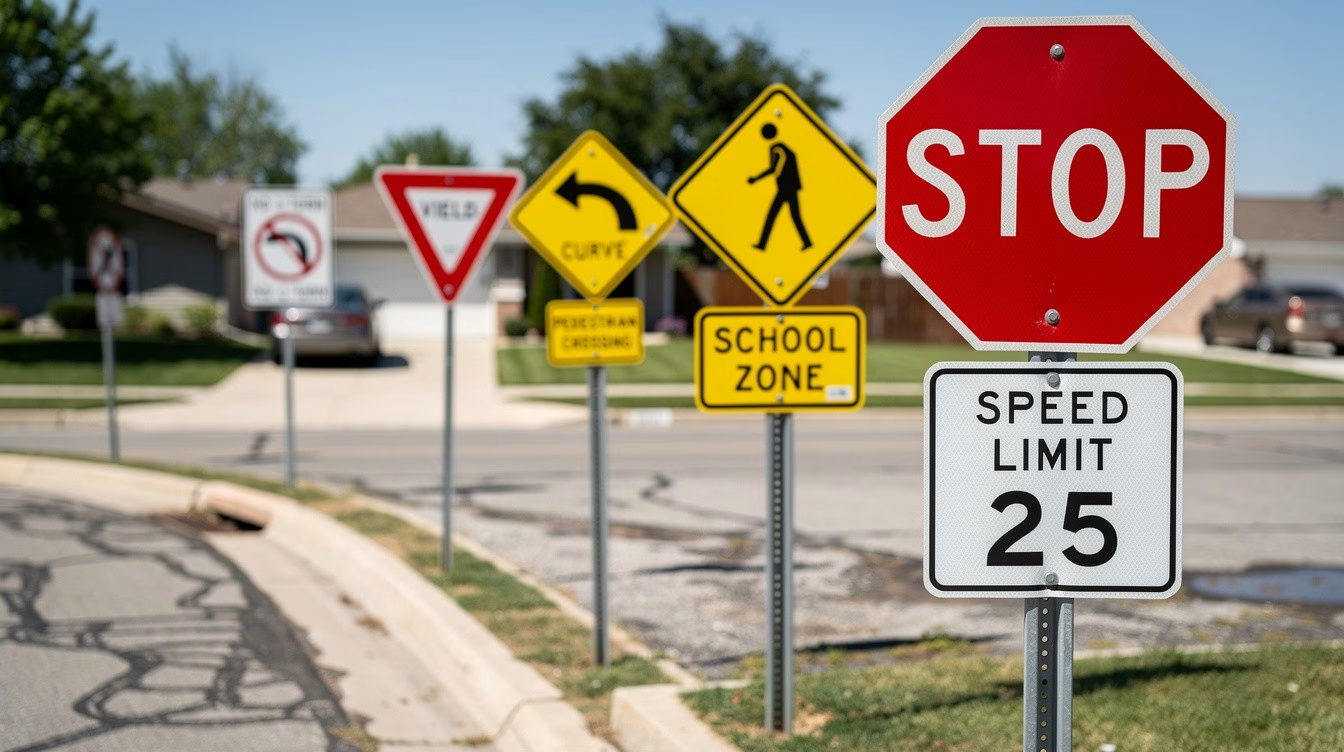
A defensive driving certificate is the proof that you finished a state-approved or court-approved safety course. You earn it by completing the entire course, and what it does for you depends on why you took the class: dismissing a ticket, keeping points off your record, meeting a court order, or qualifying for an insurance discount. In many states, including Florida, the school reports your completion electronically, so the certificate is often a backup copy rather than the thing that does the work.
This guide explains what the certificate is, how long the course takes, how to get it online, how it gets to the right office, and what to check before you pay.
Key Takeaways
- A defensive driving or traffic school certificate proves you completed an approved course. It is only worth something if the course is approved for your state, court or insurer.
- Course length is set by the state or court. Arizona classes run 4 to 4.5 hours, while New York’s classroom point and insurance program is 320 minutes.
- In Florida, approved schools report completions to the state electronically, and the state does not accept paper certificates for licensing purposes.
- If a court ordered the course, you still have to notify the court and give it the documentation it asks for.
- Confirm eligibility and the discount rules with the court, the DMV or your insurer before you enroll.
Table of Contents
- What a defensive driving certificate actually is
- Four reasons people need the certificate
- How long the course takes
- How to get your certificate online
- What happens after you finish: reporting and proof
- Using the certificate for an insurance discount
- New drivers and the driver education certificate
- Our perspective: the certificate is the end of a process, not the goal
- Florida courses we offer
- Mistakes that delay or void a certificate
- FAQ
- Sources
What a defensive driving certificate actually is
The name changes from state to state, but the idea is the same. Georgia’s Department of Driver Services says Driver Improvement and defensive driving are interchangeable terms for a safety course that may be court-ordered or taken for personal education. Arizona’s courts describe defensive driving as a court-administered diversion and education program meant to teach or remind drivers about safe attitudes and techniques.
So “defensive driving certificate,” “traffic school certificate” and “course completion certificate” usually point to the same document. It shows:
- your name and driver license or citation details,
- the name of the approved course and provider,
- the date you completed it,
- in some states, a state or court reference number.
It does not mean you passed a road test, and it is not a license. And It is a record that you sat through and finished a course the authority recognizes.
Why the course exists
The purpose of defensive driving is to teach you to anticipate other people’s mistakes: keeping a safe following distance, scanning ahead, managing speed, and staying away from distractions. We cover the techniques in more detail in our guide to what defensive driving is and why it matters and in defensive driving techniques for Florida drivers. The certificate is simply what turns that learning into something an agency can verify.
Four reasons people need the certificate
The same document serves different goals, and the rules for each are different.
| Goal | What the certificate does | Who decides |
|---|---|---|
| Ticket dismissal or point avoidance | Shows you completed an approved course for an eligible citation | The court or the state licensing agency |
| Court-ordered training | Proves you met the judge’s order | The court |
| Insurance discount | Supports a premium reduction for completing an approved course | Your insurer and state rules |
| New driver requirement | Shows a first-time driver finished the required education | The state licensing agency |
Before you pay for anything, find out which row you are in. A course that satisfies an insurer may not satisfy a judge, and the reverse is also true. Our overview of traffic school and safer driving walks through the differences, and our point reduction course guide covers the ticket side in more depth.
How long the course takes
There is no single national length. The state or court sets it.
- Arizona: classes last 4 to 4.5 hours, excluding breaks and registration.
- New York: classroom courses for the Point and Insurance Reduction Program must be 320 minutes long and cover driver behavior, safety laws and defensive techniques.
- Florida: the length depends on the course type. A Basic Driver Improvement course, a first-time driver course and a mature driver course are different programs with different requirements, so check the course description for your situation.
Online courses let you split that time across several sessions. You still have to finish the whole thing before a certificate is issued. If you want a closer look at the shorter format, see our guide to the four hour driving course.
How to get your certificate online
The process is similar almost everywhere. Here is the order that avoids the most common mistakes.
- Confirm what you need. Read your citation, court notice or insurer letter. Note the deadline, the exact course name and whether the court restricts you to certain providers.
- Check your eligibility. Courts and licensing agencies limit how often you can use a course. In Arizona, for example, students must provide citation paperwork, show government-issued ID and affirm eligibility before they can receive a certificate.
- Choose an approved provider. Only a school approved by your state or court counts. Our guide to finding an approved online traffic school explains what to look for.
- Enroll and pay. Look for a clear, one-time price and a refund policy before you enter your card.
- Finish every module. The certificate comes after you complete the entire class, not after a set number of minutes.
- Confirm the report. Ask the school how and when your completion goes to the state or court, and keep your own copy.
If you want a detailed walk-through of the online experience, see how to complete a driver improvement course online.
What happens after you finish: reporting and proof
This is where people lose time, so it helps to know the pattern.
Electronic reporting
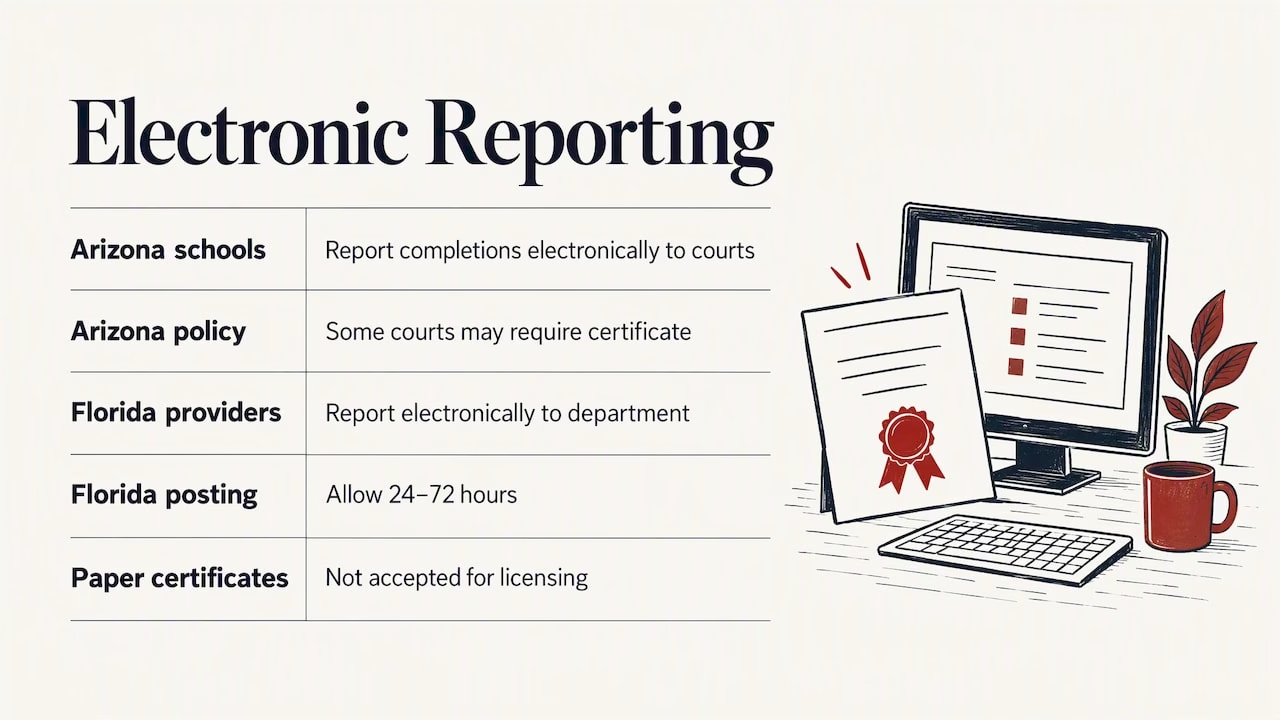
Most approved schools send completions straight to the authority. Arizona’s courts say schools report completions to courts electronically, but some courts may also require you to submit a completion certificate, depending on their policy.
Florida works the same way. The Florida Department of Highway Safety and Motor Vehicles says all approved course providers electronically report school completions to the department, and that you should allow 24 to 72 hours for them to post. It also states that the department does not accept paper certificates for any licensing purpose.
When a court is involved
The same Florida page says that if a court ordered you to attend a driver improvement school, you must notify the court once you finish and give it the documentation it requires. Reporting to the state does not replace that step. Call or check the clerk’s website for the court’s preferred method.
Deadlines
Courts set their own cutoffs. Arizona students must finish the course at least 7 days before their court date. Build in a buffer, because processing is not instant everywhere.
How long your record lasts
In Georgia, Driver Improvement records are retained for three years, after which students must retake the course. If you need the certificate for something recurring, such as a discount, keep a dated copy and put the renewal date on your calendar.
Using the certificate for an insurance discount
A certificate can reduce your premium, but insurers set their own terms. Three things to confirm with your agent before you enroll:
- Which course they accept. Some insurers want a specific state-approved course type, often one for mature drivers.
- What proof they want. Some need the paper or PDF certificate, even if the state gets an electronic report.
- How long the discount lasts. Discounts commonly expire and need a new course.
The California Department of Insurance notes that a mature driver improvement course can lower auto insurance costs, and that older people there can find an approved course through the DMV website or by phone. Its 2019 premium survey lists mature driver course discounts that vary from insurer to insurer, which is a good reminder to ask for your own insurer’s figure rather than assume one.
For more, read our driver safety course insurance discount guide and our page on driving courses for older people.
New drivers and the driver education certificate
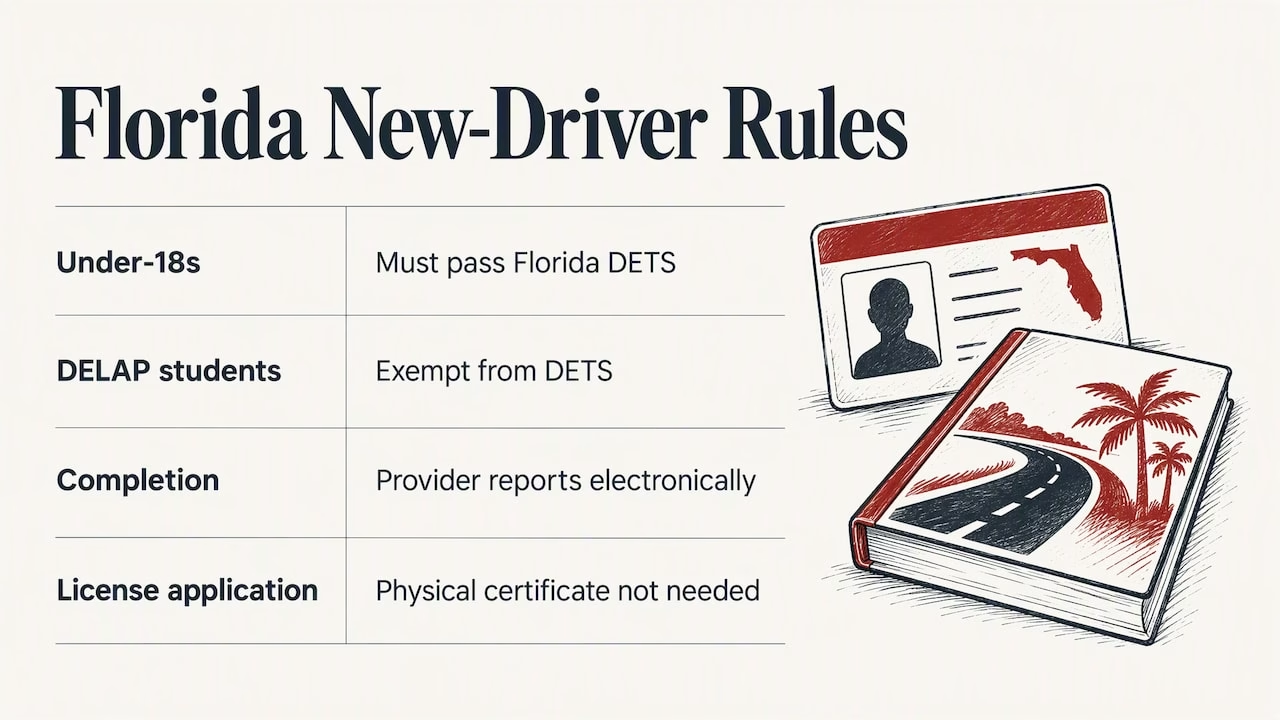
First-time drivers get a different kind of certificate. In Florida, all first-time drivers under 18 must take and pass the DETS course. Students who complete a high school driver education class through the state’s DELAP program are exempt. The provider reports completion electronically, and the department says a physical certificate is not needed when you apply for a license.
Requirements for new drivers differ across states, so check your state licensing agency’s rules for your age. If you are in Florida, our Florida DMV online driving course explainer covers the basics.
Our perspective: the certificate is the end of a process, not the goal
We build courses in-house with certified educators and safety specialists, and we see the same pattern with learners all the time. People start by searching for the certificate, then discover the details matter more than the paper.
Three things we tell every learner:
- Match the course to the requirement. An approved course for your exact situation is worth far more than a cheaper one that your court or insurer will not accept.
- Treat the report as the real proof. In states that report electronically, your completion is recorded when the school submits it. Keep your own copy, but do not wait on a mailed document before checking the official record.
- Choose a provider with clear terms. We publish our prices with no hidden fees and back our courses with a money-back guarantee, because learners should know what they are paying for before they start.
We also designed the courses to work on a phone, tablet or computer, with multilingual read-along features, so you can complete them at your own pace.
— the author
Florida courses we offer
If you are in Florida, here are the state-approved courses we publish prices for:
| Course | Price |
|---|---|
| Basic Driver Improvement (BDI) | $30 |
| Driver Education Traffic Safety Course (DETS) | $29.90 |
| Traffic Laws Substance Abuse Education Course (TLSAE) | $29.95 |
| Mature Driver Insurance Discount Course | $14.50 |
| Wireless Devices Distracted Driver Course | $24.50 |
We also offer an 8-hour Intermediate Driver Improvement course, an 8-hour Aggressive Driver course and custom fleet safety training. You can see the full list on our Florida courses page, and employers can ask about custom fleet safety training.
Ready to start? Browse our courses, pick the one that matches your ticket, court order or insurer, and begin at your own pace.
Mistakes that delay or void a certificate
- Taking an unapproved course. If the provider is not approved by your state or court, the certificate may be rejected.
- Entering the wrong citation or license details. A typo can send your report to the wrong record. Double-check everything before you submit.
- Waiting until the last week. Processing, mailing and court posting all take time.
- Skipping the court notice. A court-ordered student still has to notify the court after finishing.
- Assuming one certificate covers every goal. The ticket, the court and the insurer may each have their own rules.
- Losing track of expiry. If your state or insurer sets a validity period, mark it down when you finish.
FAQ
How many hours is a defensive driving course?
It depends on your state and the reason for the course. Arizona classes run 4 to 4.5 hours, and New York’s classroom program is 320 minutes. Check the exact length with your court, DMV or insurer before you enroll.
How do I get a defensive driving completion certificate online?
Enroll in a course approved for your state or court, complete every module, and confirm how the school reports your completion. Many schools report electronically, and some courts also want a copy of the certificate. Ask the court or agency which they require.
Is a traffic school certificate the same as a defensive driving certificate?
In practice they usually refer to the same kind of document: proof that you finished an approved driver improvement course. The name varies by state. What matters is that the course is approved for your ticket, court or insurer.
Does Florida accept a paper certificate for my license?
No. The Florida Department of Highway Safety and Motor Vehicles says it does not accept paper certificates for any licensing purpose, because approved providers report completions electronically. Allow 24 to 72 hours for the completion to post.
Will a certificate lower my car insurance?
It can, but your insurer decides. Ask which courses it accepts, what proof it needs and how long the discount lasts. Mature driver courses are a common qualifying type.
Sources
- Georgia Department of Driver Services: Defensive Driving Program FAQs
- Arizona Courts: Defensive Driving FAQ
- Arizona Courts: Driving frequently asked questions
- New York DMV: Point and Insurance Reduction Program
- Florida Department of Highway Safety and Motor Vehicles: Driver Improvement Schools
- California Department of Insurance: Driving for Older People
- California Department of Insurance: 2019 Automobile Premium Survey discounts
Recommended
- A Guide to Defensive Driving Courses
- Defensive Driving for Car Insurance Discounts
- Top Reasons: defensive driving course benefits for safer, cheaper driving
- Master These Defensive Driving Techniques Today
This article is provided for general information and is not a professional advice.