Florida’s road signs aren’t optional knowledge-they’re the foundation of safe driving and legal compliance. Traffic sign recognition directly impacts your ability to react correctly in split seconds, whether you’re navigating a busy intersection or a quiet residential street.
At DriverEducators.com, we’ve seen firsthand how drivers who master sign meanings avoid violations and accidents. This guide breaks down every sign category you’ll encounter, plus proven strategies to lock them into memory before your test.
Understanding Florida’s Three Core Sign Types
Regulatory Signs: Commands That Carry Legal Weight
Florida road signs fall into three distinct categories, each serving a specific purpose in traffic control. Regulatory signs use red, white, and black to command driver action-stop, yield, or follow speed limits.
The Florida Department of Transportation maintains this standardized system across the state’s 1,495 miles of interstate highways and 10,601 miles of non-interstate highways, ensuring consistency whether you drive through Miami’s dense urban corridors or the rural panhandle.
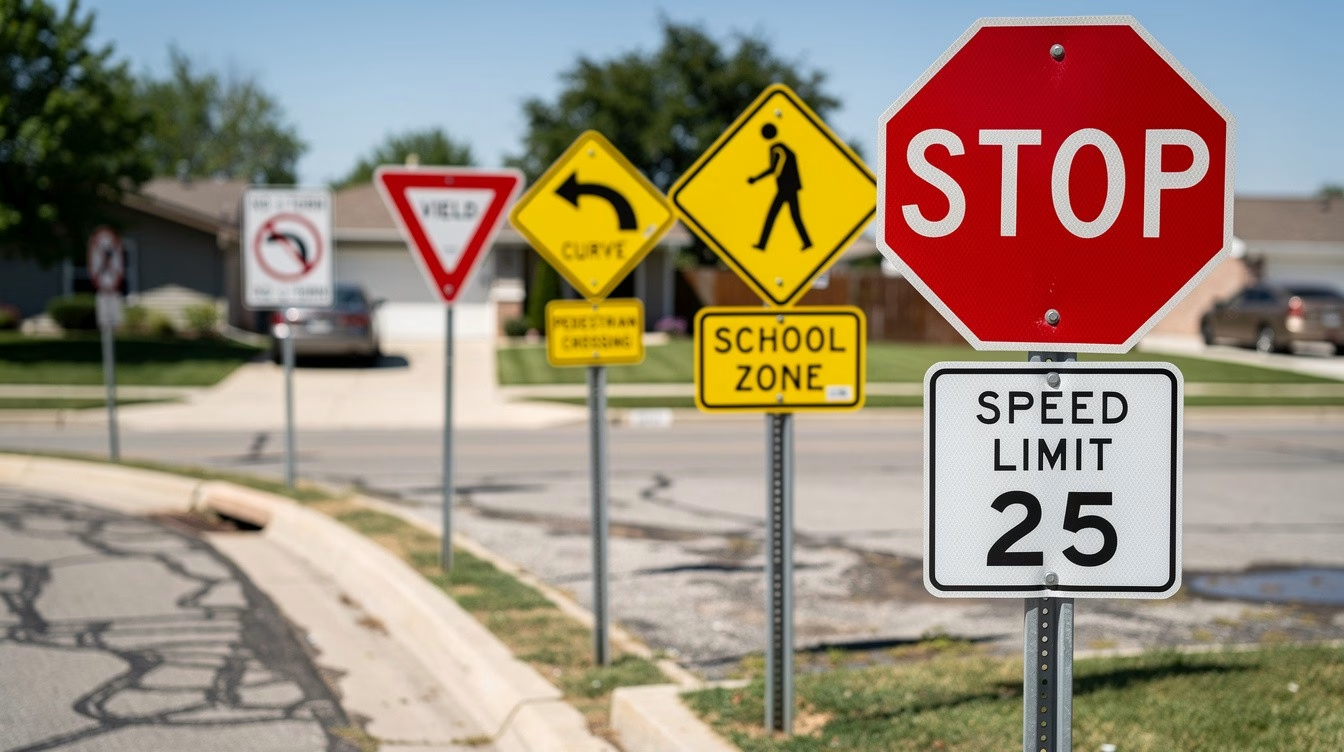
Regulatory signs demand immediate compliance and carry legal weight. Violating them results in citations and points on your license. Stop signs require a complete halt at intersections; yield signs mean you must slow down and give right-of-way to crossing traffic. Speed limit signs set the maximum legal speed for each road section, and Florida enforces these strictly in school zones where limits drop to 20 mph during designated hours. One-way signs restrict traffic flow to a single direction, and do-not-enter signs prohibit access entirely.
Warning Signs: Alerts That Demand Your Attention
Warning signs prepare you for upcoming road conditions without requiring immediate action, though they demand heightened attention. Yellow diamond-shaped signs warn of curves, pedestrian crossings, deer crossings (particularly relevant in rural Florida), and slippery conditions during the frequent rainy season. Construction zone signs alert drivers to lane shifts, reduced speeds, and worker presence-critical information since rough road conditions impact vehicle operating costs.
Informational Signs: Navigation Made Clear
Informational signs display blue, green, or brown backgrounds to guide drivers toward destinations, services, or points of interest. Green directional signs mark highway routes and exits with mileage distances. Blue service signs point to gas stations, restaurants, and rest areas. Brown signs guide visitors to state parks and recreational areas, including Florida’s protected Everglades and coastal preserves.
How Sign Categories Shape Your Response
Knowing which category each sign belongs to helps you respond faster. Regulatory signs demand action, warning signs demand awareness, and informational signs demand navigation decisions. This three-part system works because it trains your brain to process visual information instantly-a skill that separates safe drivers from those who hesitate or miss critical cues. Your next step involves mastering the specific signs within each category that appear most frequently on Florida roads.
Common Road Signs Florida Drivers Must Know
Stop Signs and Yield Signs: The Foundation of Intersection Safety
Stop signs and yield signs represent the foundation of intersection safety in Florida. A stop sign demands a complete halt-your tires must come to a full stop before proceeding, not a rolling stop or gradual deceleration. Yield signs require you to slow down and give right-of-way to crossing traffic, but you don’t need to stop unless vehicles are approaching. The difference matters legally: rolling through a stop sign costs you a citation and points on your license, while improper yielding leads to collision liability and insurance increases.
In Florida’s three largest metro areas-Miami, Tampa Bay, and Orlando-intersection violations account for a significant portion of traffic citations because drivers misinterpret these two signs or fail to execute them correctly. When approaching any intersection, scan for stop and yield signs before you reach the stopping point, identify the sign type, and execute the correct response-full stop or controlled yield-before proceeding.
Speed Limit and School Zone Signs: Enforcement That Intensifies
Speed limit signs control how fast you can legally travel, and Florida enforces these strictly. Standard limits on residential streets run 25 mph, while highway speeds reach 70 mph on interstate corridors like I-75 and I-95. School zone signs drop limits to 20 mph during designated hours-typically 7:30 a.m. to 9:30 a.m. and 2:30 p.m. to 4:00 p.m. on school days-and violations in these zones double your fine.
Speed limit enforcement has intensified in recent years, particularly in school zones and construction areas where visibility matters most. Match your speed to the posted sign before entering the zone, not after. In school zones, reduce speed early and maintain 20 mph even if you don’t see children present. Understanding driver safety principles helps reinforce why these limits exist and how they protect everyone on the road.
One-Way and Do-Not-Enter Signs: Absolute Restrictions
One-way signs restrict traffic flow to a single direction and appear frequently in downtown areas and parking facilities; ignoring them creates head-on collision risks and immediate citations. Do-not-enter signs prohibit access entirely and appear at highway off-ramps, one-way street entrances, and restricted areas; driving past a do-not-enter sign is treated as reckless behavior by law enforcement.
One-way and do-not-enter violations create dangerous situations because they force you into opposing traffic lanes or restricted corridors. Treat these signs as absolute restrictions rather than suggestions-they protect you from head-on collisions and legal liability.
Mastering Recognition Across Florida’s Road Network
Florida’s road network spans 1,495 miles of interstate highways and 10,601 miles of non-interstate highways, all maintained by the Florida Department of Transportation, meaning you’ll encounter these signs hundreds of times during normal driving. The practical skill involves recognizing these signs instantly and responding without hesitation. Your ability to identify and react to stop, yield, speed limit, school zone, one-way, and do-not-enter signs directly determines your safety and legal standing on Florida roads. As you progress through driver education, understanding how these regulatory signs function in real-world traffic situations becomes essential-which is why the next section focuses on the warning signs that alert you to hazards before they become dangerous.
How to Prepare for Florida Road Sign Tests
Start with the Color-Coding Framework
Preparing for a Florida road sign test requires strategic studying that moves beyond passive memorization into active recognition practice. The Florida Department of Transportation official materials provide the exact sign specifications and meanings you’ll encounter on your exam. Spend your first study session identifying the three core categories-regulatory signs in red, white, and black; warning signs in yellow diamonds; informational signs in blue, green, or brown-because this framework accelerates your ability to predict what each sign demands before you read its details.
Many drivers waste time memorizing individual signs without understanding the category system, which means they freeze when encountering a sign variation they haven’t specifically studied. Commit the color-meaning relationship to memory: red always signals prohibition or danger, yellow always warns of upcoming conditions, and blue always indicates services. This color-coding system reduces cognitive load during testing and real-world driving.
Practice Under Test Conditions
Practice tests should simulate actual test conditions by limiting your response time to 5-10 seconds per sign, which matches the split-second recognition you need behind the wheel. Florida’s DMV testing platform typically presents signs without context, so your practice must include isolated sign images rather than full-scenario photos that provide additional environmental clues.
Spend 15-20 minutes daily on focused sign recognition rather than three-hour sessions; distributed practice produces stronger long-term retention than massed practice, according to cognitive learning research. Test yourself on the specific signs most frequently cited in Florida traffic violations: stop signs, yield signs, school zone markers, one-way signs, and do-not-enter signs, since these generate the highest citation rates across Miami, Tampa Bay, Orlando, and Jacksonville metro areas.
Apply Knowledge to Real-World Driving
Real-world application transforms theoretical knowledge into practical skill that actually protects you on Florida’s 12,096 miles of highways. Drive through different neighborhoods and actively point out signs before you reach them-this predictive practice trains your brain to scan effectively and identify signs at safe distances rather than at the moment you must react.
When studying, create flashcard sets organized by location type: urban intersection signs, highway corridor signs, school zone signs, and construction zone signs, because context-dependent learning improves retrieval accuracy. Watch dash-cam footage from Florida drivers navigating various road conditions and pause frequently to identify and name each sign you see; this passive observation combined with active naming creates stronger neural pathways than reading alone.
Achieve Mastery-Level Recognition
Take your practice test multiple times until you consistently score above 85 percent, which indicates mastery-level recognition. The final preparation step involves driving unfamiliar routes in your community while consciously reading every sign aloud before passing it; this verbal rehearsal adds an auditory component that strengthens memory encoding and ensures you can articulate what each sign means rather than simply recognizing its appearance. Consider supplementing your preparation with driver education and traffic safety resources to reinforce your understanding of Florida’s road sign requirements.
Final Thoughts
Traffic sign recognition transforms you from a reactive driver into a proactive one who scans ahead, anticipates hazards, and navigates intersections with confidence rather than hesitation. Each sign you identify instantly represents a split-second decision made correctly, a potential collision avoided, and a violation prevented. This shift in driving behavior directly reduces your crash risk and protects everyone sharing Florida’s 12,096 miles of highways maintained by the Florida Department of Transportation.
Citations for stop sign violations, yield sign failures, and school zone speeding carry real consequences-points on your license, increased insurance premiums, and potential license suspension. Florida enforces these violations strictly across Miami, Tampa Bay, Orlando, and Jacksonville, where traffic density makes violations more visible to law enforcement. Mastering sign meanings keeps your record clean and your insurance costs down while building safer driving habits that last a lifetime.
We at DriverEducators.com understand that sign recognition requires more than self-study, which is why our Florida-approved traffic school programs blend clear explanations with real-life scenarios that reinforce how signs function in actual driving situations. Our certified instructors guide you through the exact signs you’ll encounter on Florida roads, whether you’re completing a Basic Driver Improvement course after a violation or refreshing your knowledge through our Mature Driver Course. Our courses are fully online, self-paced, and available in multiple languages, with your certificate reported directly to the Florida Department of Highway Safety and Motor Vehicles upon completion.