Driving test anxiety is common, and you can manage it. The most reliable fix is realistic practice, a simple calming routine you rehearse before test day, and a clear picture of what the examiner is actually doing. This guide covers each of those, plus the point where anxiety deserves help from a professional.
If you are nervous about your driving test, nothing is wrong with you. The test puts you in a car with a stranger who is scoring you, on a day that matters. Most people would feel their pulse rise.
- Nerves come from being evaluated, not from lack of ability. Worry about failing can pull your attention away from the road.
- Practice as if every drive were the test, with a calm passenger who points out errors, then fix those errors on the next drive.
- Learn one breathing routine, such as box breathing, and use it in the parking lot before you start.
- If a moment gets overwhelming, pull over safely and reset. Do not keep driving while shaking or unable to focus.
- Panic attacks or anxiety that disrupts your sleep and daily life are a reason to talk to a mental health professional.
Table of Contents
- Why a driving test makes people so nervous
- What the examiner is actually doing
- Prepare the way the test will feel
- The week before: a simple plan
- Calm your nerves right before the test
- If anxiety spikes during the test
- When anxiety is more than test nerves
- Our perspective: confidence comes from competence
- Build skills with a state-approved course
- Test day checklist
- FAQ
- Sources
Why a driving test makes people so nervous
A road test combines three things that rarely come together: a task that demands your full attention, an observer who is judging you, and a result that affects your independence. Researchers who studied driving-test anxiety describe worry, self-monitoring and fear of failure as attention-consuming, while physical arousal can produce tension and less coordinated, jerky movements.
That explains a familiar experience. You drive smoothly with a parent, then your hands feel strange the moment the examiner sits down. You are not worse at driving. Part of your attention is now occupied by thoughts like “How am I doing?” and “What if I fail?” The same study describes this kind of self-monitoring and rumination as the way anxiety can cause a choking-like drop in performance.
Knowing this helps in two ways:
- The goal is not to eliminate nerves. It is to give your attention back to the road.
- Every tool below works by either lowering physical arousal or giving your mind something better to do than judge itself.
What the examiner is actually doing
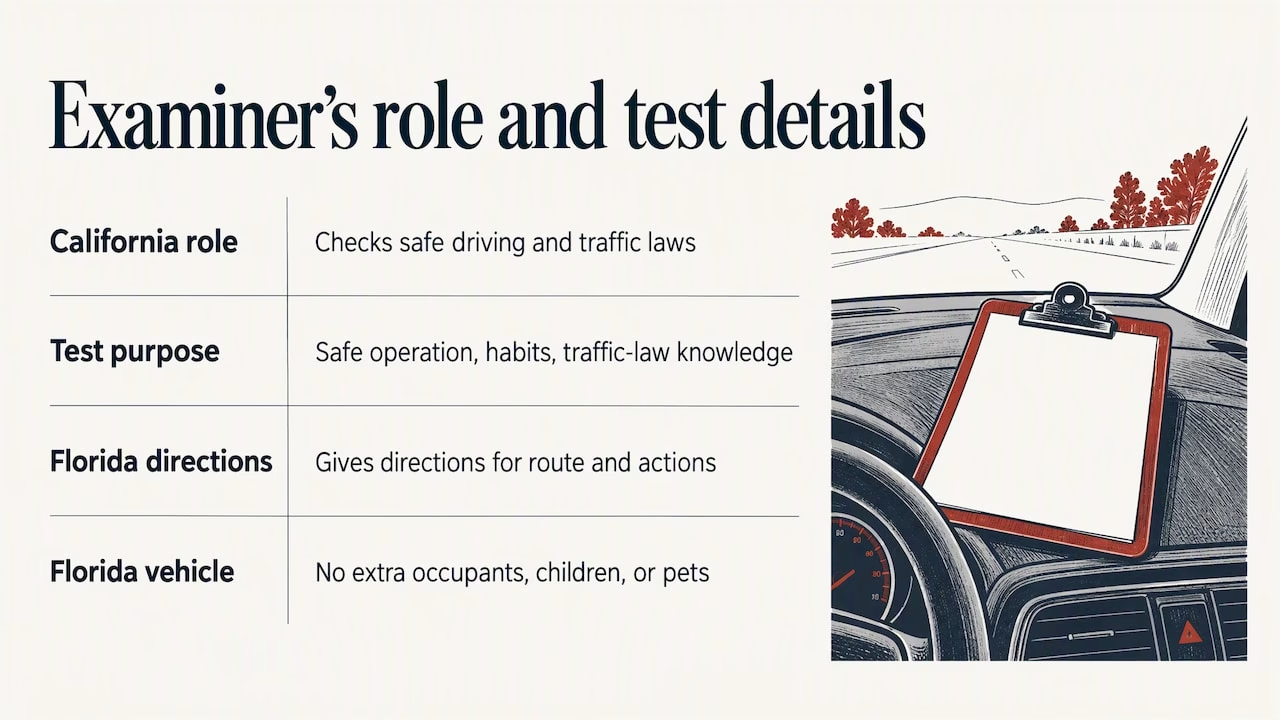
Much of the dread comes from picturing the examiner as someone looking for a reason to fail you. The California DMV describes the examiner’s role differently: they ride along to check that you drive safely and obey traffic laws, not to trick you. The DMV also says the purpose of the behind-the-wheel test is to see whether you can operate a vehicle safely, use safe habits and apply traffic-law knowledge in real situations.
Rules differ by state, so check your own DMV. As an example from Florida, a county road test checklist notes that the examiner will give you directions on where to go and what to do next. You are not guessing at a route. You are following instructions while driving the way you have practiced.
That checklist and a Pinellas County version also say extra occupants, including children, and pets are not permitted in the vehicle during the test. Little surprises like this are exactly what feed anxiety, so read your local checklist a week ahead, not on the morning of.
Prepare the way the test will feel
The California DMV notes that many people take the driving test without enough practice, or without practicing the right way. Confidence is built from evidence. The more times you have driven a test-like route calmly, the less your brain treats test day as a threat.
Run mock tests
The DMV recommends treating practice sessions as though each were a driving test, having a companion calmly point out your errors, asking questions about confusing situations, and correcting those errors on later drives. Here is how to make that work:
- Pick a calm, experienced passenger who will not lecture or panic.
- Ask them to stay quiet while you drive, then give feedback after you park.
- Practice the skills the test covers: turns, lane changes, stops, parking, backing up and observing signs.
- Write down two errors per session and focus on only those during the next drive.
- Repeat in the area around your test location, at the same time of day if you can.
If you want a skills checklist to practice against, our guide on how to pass your road test walks through the essentials.
Start small and build up
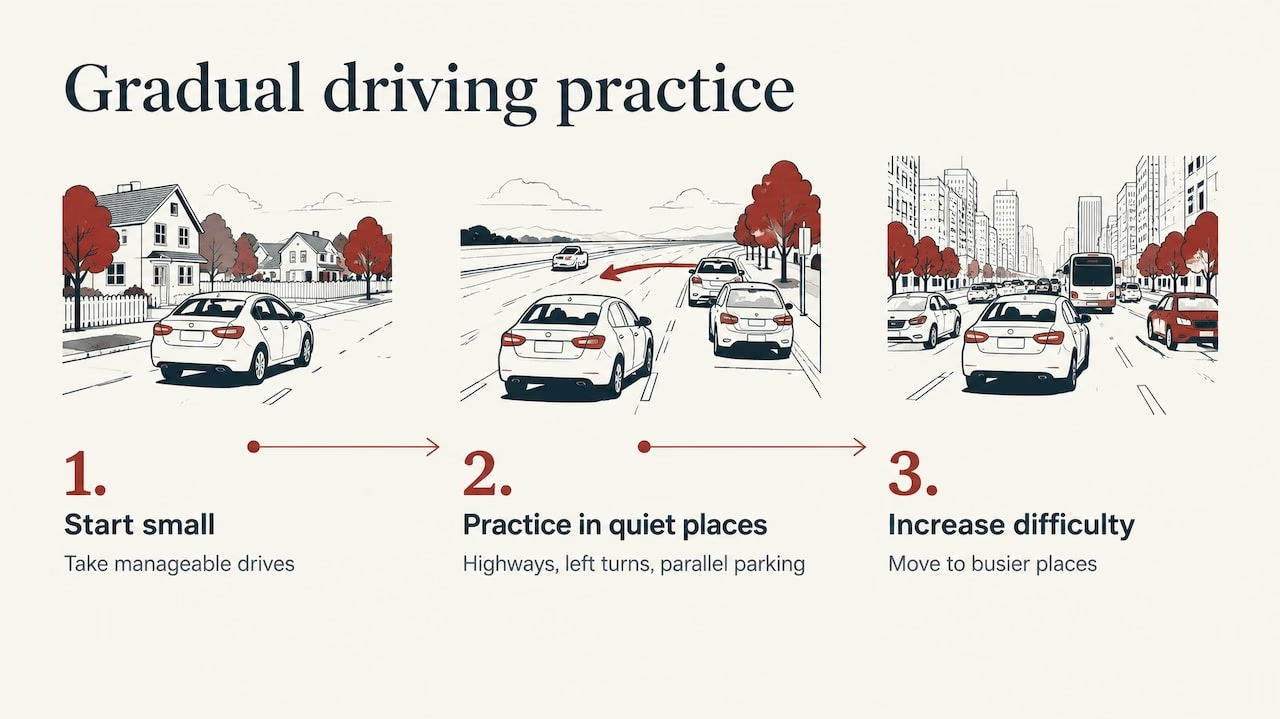
Cleveland Clinic recommends beginning with small, manageable drives and gradually increasing difficulty instead of forcing yourself into the most intense situation right away. If highways, left turns across traffic or parallel parking are your trigger, practice them in quiet places first, then move to busier ones. Our article on overcoming anxiety while learning to drive covers this step-by-step approach in more detail.
Know your triggers
A Cleveland Clinic psychologist advises noticing when anxious feelings occur and why, then choosing techniques that fit those triggers. Keep a short note after each practice drive:
- Where did my chest tighten?
- What was I thinking just before?
- What did I do next, and did it help?
Within a week or two you will see patterns. Maybe it is merging, or the first two minutes of every drive. Now you have something specific to practice instead of a vague dread.
Review the handbook and paperwork
Part of the stress is practical. The DMV says knowledge-test questions come from the Driver Handbook and that there are no trick questions. On the road side, the California Driver Handbook lists what applicants must bring: an old license or permit, a licensed driver 18 or older, proof of insurance and a safe, registered vehicle. Requirements vary by state, so confirm yours with your DMV.
Pack the car the night before. Few things spike adrenaline like discovering a missing document in the parking lot.
The week before: a simple plan
| When | What to do |
|---|---|
| 5 to 7 days out | Do two mock tests on routes near the test site. Note two errors to fix. |
| 3 to 4 days out | Fix those errors. Practice your breathing routine at home, not only in the car. |
| 1 to 2 days out | One light drive. Gather documents. Confirm the appointment time and location. |
| Night before | Pack the car, set two alarms, go to bed on time. No last-minute cramming. |
| Morning of | Eat a normal breakfast, dress comfortably, leave early. |
The goal of the final days is to protect your sleep and keep your routine ordinary. Heavy cramming tells your brain the test is an emergency.
Calm your nerves right before the test
This is the stretch where most readers want help, and it is where a short, practiced routine pays off.
Box breathing
Box breathing is a four-part pattern: breathe in, hold, breathe out, hold, each for the same count. Cleveland Clinic explains that silently counting while you breathe works like a mantra, calming the nervous system and bringing you into the present moment. A common version uses four seconds for each step.
Try it like this:
- Breathe in gently through your nose for four seconds.
- Hold for four seconds.
- Breathe out slowly for four seconds.
- Hold for four seconds.
- Repeat four rounds.
Practice at home for several days so it feels automatic. Do not hold your breath for long if it makes you dizzy. Shorten the count and breathe normally.
Small physical resets
- Unclench your jaw and drop your shoulders. Tension in these spots feeds the jerky movements researchers describe.
- Loosen your grip on the wheel. Hands at a relaxed, firm hold steer better than white knuckles.
- Eat something light and drink water. An empty stomach and heavy caffeine both make jitters worse.
- Arrive early enough to sit in the car for ten minutes without rushing.
Change the story you tell yourself
The research on test anxiety points to rumination as the culprit, so give your mind a job. Narrate small tasks silently: “Mirror, signal, check blind spot, turn.” That keeps your attention on the road instead of on your score. If you make a mistake, treat it as one event, not a verdict. Examiners expect small errors. Reset on the next block.
If anxiety spikes during the test
You can still regain control mid-drive.
- Slow your exhale. One long breath out is enough to take the edge off.
- Focus on the next instruction. Ask the examiner to repeat a direction if you missed it. That is normal and sensible.
- Go back to basics. Mirrors, speed, space around the car.
- Do not dwell on a mistake. One slip rarely decides the outcome, and replaying it causes the next one.
If your anxiety becomes so intense that you cannot concentrate or drive safely, Cleveland Clinic advises pulling over safely. During a test, tell the examiner you need a moment and stop when it is safe to do so. Safety comes first, and it is better to pause than to push through.
When anxiety is more than test nerves
Test-day nervousness fades once the test is over. Fear of driving that does not fade is different. Cleveland Clinic describes fear of driving as anxiety while driving or riding in a vehicle that may interfere with work, socializing, travel and daily life.
Consider talking to a doctor or licensed mental health professional if:
- You have panic attacks, with a pounding heart, shortness of breath or a sense of losing control, when you think about driving or when you drive.
- Anxiety disrupts your sleep for days or weeks.
- You avoid driving, even for things you need or want to do.
- Your preparation keeps falling apart in the same way no matter how much you practice.
The same Cleveland Clinic page lists exposure therapy with a mental health professional and cognitive behavioral therapy (CBT) among the treatment options. Seeking help is not a sign you cannot drive. It is a practical step, just like hiring a driving instructor. If you are in crisis or having thoughts of harming yourself, call or text 988, the Suicide and Crisis Lifeline in the US.
Our perspective: confidence comes from competence
We build driver education courses, and we see the same pattern in new drivers: people are rarely anxious about what they know. They are anxious about what they have not yet seen. A rule they have never applied, a situation they have never rehearsed, a mistake they do not know how to recover from.
That is why we believe in clear, plain-language lessons that you can take at your own pace, on any device, and revisit as often as you want. Our courses are developed in-house by certified educators and safety specialists, so the content stays aligned with statutory requirements and real-world safety. When you understand the reasoning behind a rule, you stop memorizing and start anticipating, and anticipation is what makes a driver calm.
Our advice for any nervous test taker:
- Treat the test as a demonstration of habits you already have, not a performance you have to invent.
- Spend more time on your weakest skill than your strongest one.
- Build defensive habits early: scanning, space cushions and speed control. Our guide to defensive driving techniques is a good place to start, and safe driving tips cover everyday basics.
- Give yourself permission to retake the test if it does not go well. A first attempt is information, not a judgment.
— User
Build skills with a state-approved course
If you are a Florida driver, a structured course can replace guesswork with knowledge. We offer state-approved online options including the Driver Education Traffic Safety Course (DETS) for first-time drivers, plus Basic Driver Improvement, Mature Driver Insurance Discount and Wireless Devices Distracted Driver courses. You can learn on a phone, tablet or computer, use multilingual read-along features, and we offer transparent pricing with no hidden fees and a money-back guarantee.
Browse the full list on our online driving courses page and choose the one that fits your situation. If you are brand new, our guides on your first driving lesson and driving basics for beginners will help you feel settled before you ever sit behind the wheel with an examiner.
Test day checklist
- Documents, insurance proof and a registered, safe vehicle ready, as your state requires.
- Arrive early and sit quietly for a few minutes.
- Run your box breathing routine: four rounds.
- Adjust seat, mirrors and seat belt calmly before you start.
- Listen carefully to each instruction and ask for a repeat if needed.
- Narrate small tasks in your head to stay focused.
- Pull over safely if anxiety becomes unmanageable.
FAQ
Is it normal to be nervous about a driving test?
Yes. A road test involves being observed and scored on a skill that matters to your independence, which is a recipe for anxiety. Research describes worry, self-monitoring and physical arousal as common reactions. A moderate amount of nerves is normal, and practice and breathing routines help keep them manageable.
What should I do if I make a mistake during the test?
Take one slow breath and return your attention to the next instruction. A single error does not automatically end the test, and dwelling on it makes further errors more likely. If you missed a direction, ask the examiner to repeat it.
How many practice drives do I need?
There is no official number, and requirements vary by state. A better measure is whether you can complete a full test-like route several times with few errors and a calm passenger giving feedback. Keep practicing until your corrections stick.
When is test anxiety a sign I should see a professional?
If you have panic attacks, your sleep is affected, or fear of driving disrupts your daily life, talk to a doctor or licensed mental health professional. Treatments such as CBT and exposure therapy are available. Do this alongside your driving practice, not instead of it.
Sources
- Driving anxiety study on worry, self-monitoring and test performance
- California DMV Fast Facts: Preparing for your Driving Test
- California DMV: Prepare for Knowledge and Drive Tests
- California Driver Handbook
- Cleveland Clinic: What Is Driving Anxiety?
- Cleveland Clinic: Amaxophobia, fear of driving
- Cleveland Clinic: How Box Breathing Can Help You Destress
- Florida Driving Skills Road Test Checklist (Pasco County)
- Florida Driving Skills Road Test Checklist (Pinellas County)