
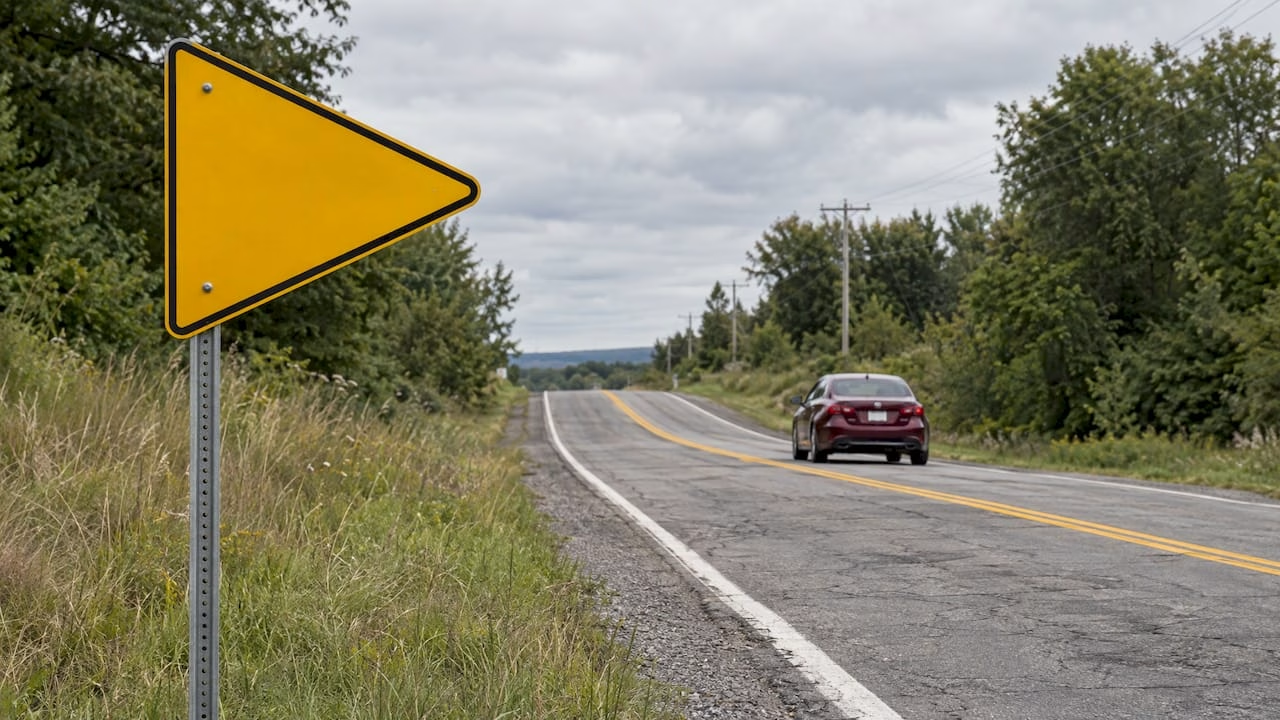
The pennant-shaped sign on U.S. roads is the yellow NO PASSING ZONE sign. It is a long, sideways triangle placed at the start of a stretch of two-lane road where passing is not allowed. When you see it, stay in your lane, do not pull out to pass, and wait until you are clearly past the zone and the road is open to passing. Pennsylvania’s driver manual calls it the only pennant-shaped warning sign, so if you spot that shape, you already know the message.
Below, we explain what the sign looks like, where it is posted, how it connects to the yellow lines on the pavement, and how states treat a violation.
Key Takeaways
- The pennant shape (a long, sideways triangle, yellow, pointing right) means one thing: a no-passing zone begins here.
- It is usually posted on the left side of the road, often with a white DO NOT PASS sign on the right.
- Solid yellow lines on your side of the centerline carry the same rule, even when no sign is in view.
- Penalties for passing in a no-passing zone differ by state, from a modest fine to a formal traffic violation.
- The safest habit is simple: if you are unsure whether passing is legal, do not pass.
Table of Contents
- What the pennant-shaped sign looks like
- What the sign means and what to do
- Where you will see it, and why
- Signs and pavement lines work as a pair
- How the pennant differs from other passing signs
- Penalties for passing in a no-passing zone
- Take the next step with a Florida course
- Habits that keep you out of trouble on two-lane roads
- FAQ
- Sources
What the pennant-shaped sign looks like
Most warning signs are diamonds. The pennant is the exception, which is exactly why it stands out. The federal Manual on Uniform Traffic Control Devices (MUTCD) lists it as W14-3. UpCodes’ summary of the MUTCD sign describes it as an isosceles triangle with the longer axis horizontal and pointing right, installed on the left side of the roadway at the beginning of a no-passing zone.
A few details help you recognize it quickly:
- Color: yellow background with black lettering, the standard color family for warnings.
- Message: the words NO PASSING ZONE, stacked in the triangle.
- Shape: long and narrow, with the point facing the direction you are traveling.
- Position: on the left side of your lane, where it is visible to you and to anyone thinking of pulling out into the oncoming lane.
That last point is the clue behind the design. The sign sits on the side of the road where the passing decision happens, and its shape tells you the message even if you only catch it in your peripheral vision.
What the sign means and what to do
The pennant marks the beginning of a no-passing zone. Pennsylvania’s manual says the related DO NOT PASS sign may be placed where drivers may not pass vehicles going in the same direction. Iowa’s driver’s manual says the pennant warns of a no-passing zone and is located at its beginning.
So what do you do in practice?
- Stop any passing move you have started. If you were thinking about overtaking, abandon the maneuver and keep a safe following distance.
- Stay to the right of the centerline. The Kansas Driving Handbook takes a conservative approach: do not begin or continue passing after the sign, and wait for a clearly legal opportunity.
- Keep your distance. A slow vehicle ahead is frustrating, but tailgating it is not a fix. Leave room so you can see the road and react.
- Look for the end of the zone. Do not assume the zone has ended just because the road looks straight. Watch for the pavement markings to change.
Iowa’s manual adds the reason behind all this: passing areas are set according to how far drivers can see ahead, and passing is allowed only when it is safe. The sign is not a suggestion to be careful. It tells you that, at this point, the road does not give you enough view to pass.
Where you will see it, and why
No-passing zones are not placed at random. The MUTCD says they are established at curves and at other locations where engineering analysis shows passing must be prohibited because of inadequate sight distance or other special conditions.
In plain terms, that means places where you cannot see far enough to be sure the oncoming lane is clear. The Kansas handbook lists the usual trouble spots:
- Hills and hill crests
- Curves
- Intersections
- Railroad crossings
- Bridges, viaducts and tunnels
- Any spot where your view is blocked
Indiana’s rules are even more specific. Its official driver manual prohibits passing when a solid yellow line is on your side, when approaching curves or hill crests, and within 100 feet of intersections, railroad crossings, bridges, viaducts or tunnels.
The common thread is a head-on collision risk. When you pass, you move into the lane where oncoming traffic travels. If you cannot see that lane for long enough, you are gambling with other people’s safety as well as your own.
Signs and pavement lines work as a pair
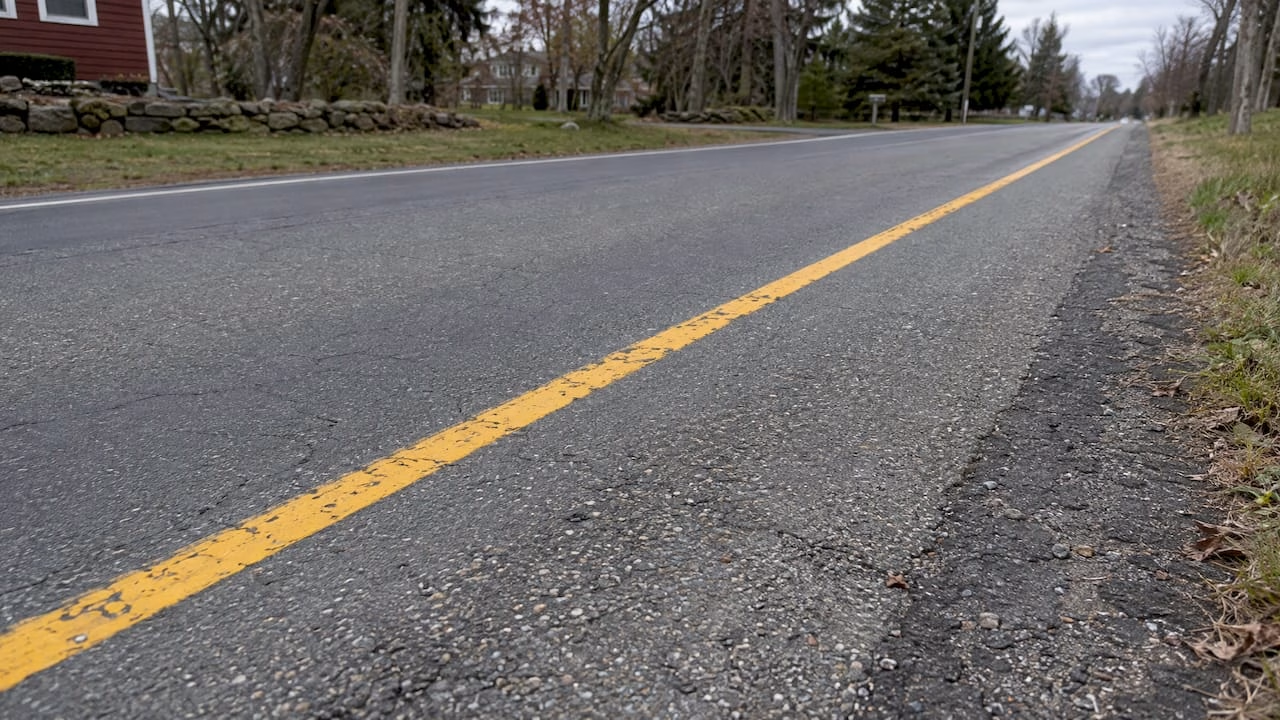
The pennant tells you a zone is starting. The yellow centerline tells you which direction is restricted and keeps telling you for the whole zone. Learn both, because on a long zone you may only see the sign once.
The MUTCD’s pavement-marking rules, as shown in California’s draft 2026 edition text, separate two situations:
| Centerline you see | Who may pass | Who may not pass |
|---|---|---|
| One broken yellow line beside one solid yellow line | Traffic next to the broken line, when safe | Traffic next to the solid line |
| Two solid yellow lines | Nobody | Traffic in both directions |
| Pennant sign posted on your side | Nobody until the zone ends | You, from the sign onward |
Iowa gives the same practical rule for a two-way road: if the solid yellow line is next to you, you may not pass, and if the dashed line is next to you, you may pass only when it is safe.
A good habit is to glance at the line before you glance at the car ahead. If the line on your side is solid, the question is already answered.
How the pennant differs from other passing signs
Drivers often mix up the pennant with the white rectangular sign beside it. They work together, but they are different signs.
| Sign | Shape and color | Where it goes | What it does |
|---|---|---|---|
| NO PASSING ZONE (W14-3) | Yellow pennant | Left side of the road | Warns that a no-passing zone begins |
| DO NOT PASS (R4-1) | White rectangle | Right side of the road | Regulatory sign: passing is not permitted |
| PASS WITH CARE (R4-2) | Rectangular | Where the zone ends | Tells you passing may be allowed, with caution |
The Pennsylvania Code says the W14-3 pennant is the primary sign identifying the beginning of a no-passing zone on a two-lane highway. A right-side DO NOT PASS sign may supplement it, and a PASS WITH CARE sign may be installed at the end. Pennsylvania’s driver manual adds that DO NOT PASS is a regulatory sign, often accompanied by the yellow pennant.
If you want a wider look at how sign shapes and colors fit together, our guides on traffic sign meanings and decoding road symbols walk through the full set.
Penalties for passing in a no-passing zone
There is no single national penalty. Each state writes its own law and sets its own fine, so what applies to you depends on where you are driving. A few official examples show the range:
- Pennsylvania: state law requires drivers to obey clearly visible signs or markings that define a no-passing zone. It prohibits driving on the left side of the roadway, or left of the pavement striping, throughout the zone, subject to statutory exceptions.
- Kansas: the official fine schedule lists $75 for driving on the left in a no-passing zone under K.S.A. 8-1520. Court costs and other fees can change what you actually pay.
- Oregon: Oregon law makes passing in a designated no-passing zone a Class B traffic violation. It allows limited exceptions, such as a left turn or an obstruction, if the driver yields and travels at least 5 mph below the applicable limit.
- Connecticut: state statute treats violating a marked no-passing zone as an infraction. It permits safely passing pedestrians, parked or standing vehicles, animals, bicycles, slow vehicles or right-side obstructions when sight distance is adequate and oncoming traffic is not endangered.
Notice how much the exceptions differ. Do not rely on an exception you half remember from another state. If you think a situation might qualify, the safe answer is still to wait.
A moving violation can also affect your record and, in many places, your insurance. Check your own state’s driver handbook for the exact rules and penalty details.
Our perspective
We build our courses around a simple idea: a sign is only useful if you can read it in a second and know what to do. The pennant is a good example. It is one of the few signs where the shape alone carries the message, and drivers who learn that early make calmer, safer decisions on two-lane roads.
Our courses are developed in-house by certified educators and safety specialists, and we update the content for statutory requirements and real-world safety. That matters for topics like passing, where state rules differ and a vague memory of “what the sign usually means” is not enough. We want you to understand the reason behind the rule: sight distance, oncoming traffic and the time it takes to complete a pass.
We also know that most people take a driver course because life is busy. That is why our state-approved courses work on any device, let you go at your own pace, and include multilingual read-along features. Learning road signs should fit your schedule, not interrupt it.
The strongest drivers are not the ones who know the most trivia. They are the ones who build the habit of slowing down, reading the road and choosing the conservative option when something is unclear.
the author
Take the next step with a Florida course
If you need a state-approved course for a ticket, a first license or an insurance discount, we offer Florida courses you can finish online at your own pace. Current published prices include the Florida Basic Driver Improvement (BDI) course at $30, the Florida Driver Education Traffic Safety Course (DETS) at $29.90, and the Florida Traffic Laws Substance Abuse Education Course (TLSAE) at $29.95. We stand behind them with transparent pricing and a money-back guarantee.

See every option on our Florida courses page, or read how the Florida 8 Hour Driver Improvement Course works.
Habits that keep you out of trouble on two-lane roads
Knowing the sign is the first step. These habits turn knowledge into safe driving:
- Check the line first. A solid yellow line on your side settles the question before you pull out.
- Decide early. Make your passing decision before a curve or hill, not on it. If a zone is about to start, you will not have time to finish.
- Do not speed to finish a pass. The Kansas handbook says passing must be completed safely and without exceeding the speed limit.
- Give yourself space. Following at a safe distance gives you a better view of the road ahead and more choices.
- Be patient. A short wait for a clearly legal opening costs seconds. A bad pass can cost far more.
New drivers often feel pressure from the car behind them. You do not owe anyone a risky pass. Our guides on basic rules every new driver should know and right of way can help you build that confidence, and our overview of signs, signals and roadway markings covers what to expect on Florida roads.
Signs like this one also turn up on the road test. If you are getting ready for your driving exam, this guide to how a driving exam works is useful for understanding how examiners judge whether a manoeuvre is safe and permitted.
FAQ
What message is found on a pennant-shaped sign?
The sign reads NO PASSING ZONE. It is yellow, and it is the only pennant-shaped warning sign in the U.S. system, according to Pennsylvania’s driver manual. It tells you that passing is not allowed from this point on.
Where is the pennant-shaped sign placed?
It is installed on the left side of the roadway at the beginning of a no-passing zone on a two-lane road. A white DO NOT PASS sign may also be posted on the right side. The zones are set up where sight distance is too short to pass safely, such as curves and hills.
Can I ever pass in a no-passing zone?
It depends on the state. Some states allow limited exceptions, such as passing a parked vehicle or an obstruction when no oncoming traffic is endangered. Other rules are stricter, and the details differ. Unless you know your state’s exact exception, stay behind the vehicle until the zone ends.
What is the difference between the pennant sign and a solid yellow line?
The pennant sign marks where a no-passing zone starts. The solid yellow line marks the restriction on the pavement for as long as it lasts. If the solid line is on your side of the centerline, you may not pass, even if you cannot see a sign. Two solid yellow lines mean no passing in either direction.
Sources
- Pennsylvania Driver’s Manual, Chapter 2: Signs
- Iowa Driver’s License Manual
- Kelley Blue Book: What Is a No Passing Zone Sign?
- Kansas Driving Handbook
- FHWA MUTCD 2003 Edition, Chapter 3B
- UpCodes: NO PASSING ZONE Sign (W14-3)
- Indiana Driver’s Manual, Chapter 7
- California MUTCD draft, Chapter 3B Pavement and Curb Markings
- 67 Pa. Code § 212.112, Signs to prohibit passing
- Pennsylvania Consolidated Statutes, Title 75, Chapter 33
- Kansas statute 8-2118, fine schedule
- Oregon ORS 811.420
- Connecticut General Statutes § 14-234
- Driving Exam: What Happens and How to Get One Sooner
Recommended
- Traffic Sign Meanings: Understand the Symbols for Safer Driving
- Traffic Signs Rules Overview: Decoding Road Symbols
- Road Safety Signs: Your Complete Guide
- How to Read Road Safety Signs and Symbols
This article is provided for general information and is not a professional advice.