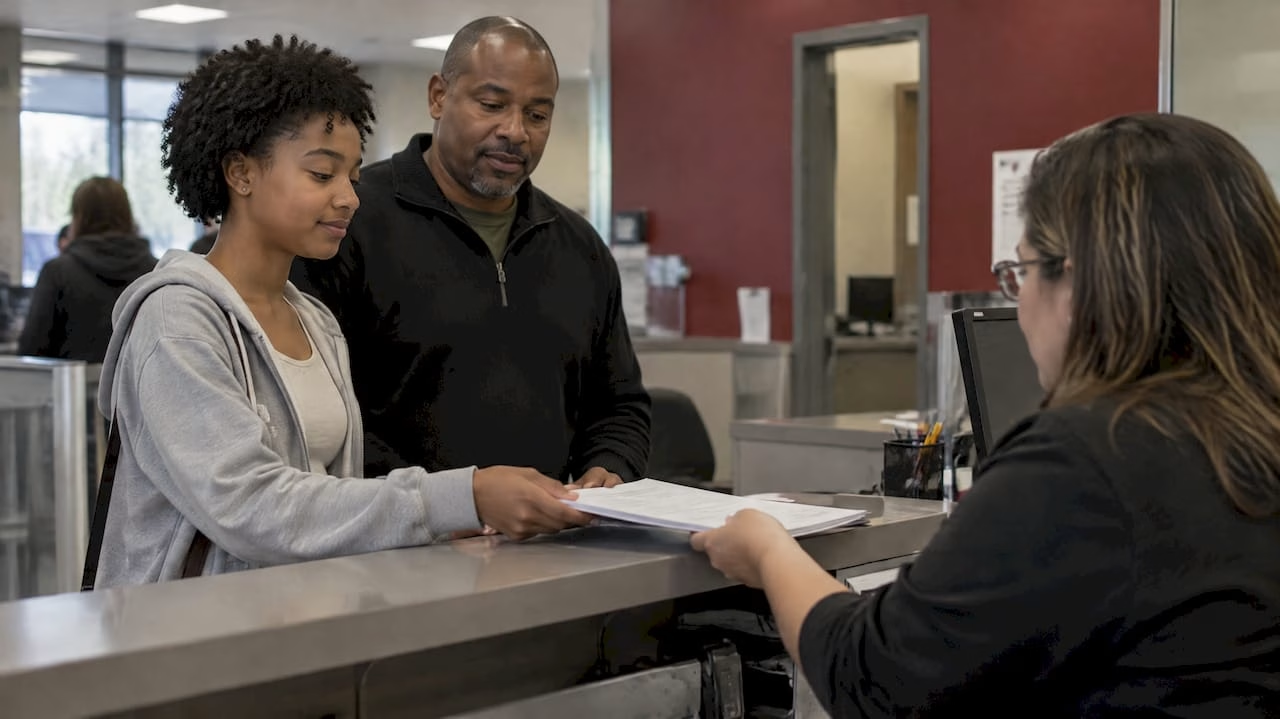
To get a Pennsylvania learner’s permit, you must be at least 16, bring a completed DL-180 application (signed off by a health care provider) to a PennDOT Driver License Center, and pass a vision screening and an 18-question knowledge test. If you are under 18, a parent or guardian must also complete a consent form. This guide walks you through each step, the documents, the fees, the rules once you have the permit, and what comes next.
Key Takeaways
- You cannot apply before your 16th birthday. The medical section of the form can be completed up to six months before it.
- The knowledge test has 18 multiple-choice questions, and you need 15 correct answers to pass.
- A permit holder must always be accompanied by a licensed driver who is at least 21 years old.
- Before the junior license road test, you hold the permit for six months and log 65 hours of supervised practice, including 10 at night and 5 in poor weather.
- Remote testing exists only as a limited pilot for some rural high schools, so plan to test in person.
Table of Contents
- Who can apply for a PA learner’s permit
- The forms you need before you go
- Documents to bring to the Driver License Center
- Fees
- What the tests cover
- Rules for driving with a PA learner’s permit
- From permit to junior license
- Our perspective: why practice matters more than the test
- Where our courses fit in
- Common mistakes that delay a permit
- FAQ
- Sources
Who can apply for a PA learner’s permit
The minimum age is 16. Pennsylvania does not issue a permit to a 15-year-old, and an application cannot be submitted before the applicant’s 16th birthday. The permit is for anyone who has never held a license before.
The timing of the medical exam matters. The same PennDOT chapter says the physical examination for the application must be completed no more than six months before that birthday. If you get the exam too early, the form may not be accepted, and you will repeat the visit to your provider.
If you are under 18, you need a parent, guardian or other eligible adult to complete the Parent or Guardian Consent Form (DL-180TD). PennDOT’s step-by-step page notes that proper identification is required for that adult, and that proof of the relationship is needed if last names differ.
The forms you need before you go
Two forms drive the whole process:
- Non-Commercial Learner’s Permit Application (DL-180). A health care provider must approve it. The back of the form also lists the documents that can prove your date of birth, and the fees.
- Parent or Guardian Consent Form (DL-180TD). Required if you are under 18.
Do not mail the application. PennDOT says to bring it with you to the Driver License Center. Download both forms from PennDOT’s site rather than picking up copies of unknown origin, so you know you have the current versions.
Documents to bring to the Driver License Center
PennDOT’s application steps list what you carry in:
- Your completed DL-180, and the DL-180TD if you are under 18
- Original proof of date of birth and identity (photocopies are not accepted)
- Your Social Security card, which must be signed
- The applicable fee
A valid U.S. passport can serve as one proof of identity, and both the standard passport and the passport card are accepted. Applicants over 18 must also present two proofs of residency. Applicants who are not U.S. citizens have a longer document list, including immigration paperwork, so check the official instructions before you leave home.
A practical habit: lay every document out the night before, and check each one against the list on the back of the DL-180. A missing original is the most common reason a visit ends without a permit.
Fees
The fee on the application is $6.00 for each class of permit requested. Most teens apply for one class, which is a standard car permit. The same form lists additional charges that can apply, such as a photo ID if you need one, so read the fee table on the form you download and bring the exact amount PennDOT asks for.
Fees change from time to time. The form you download from PennDOT is the number to trust, not a figure copied from a third-party site.
What the tests cover
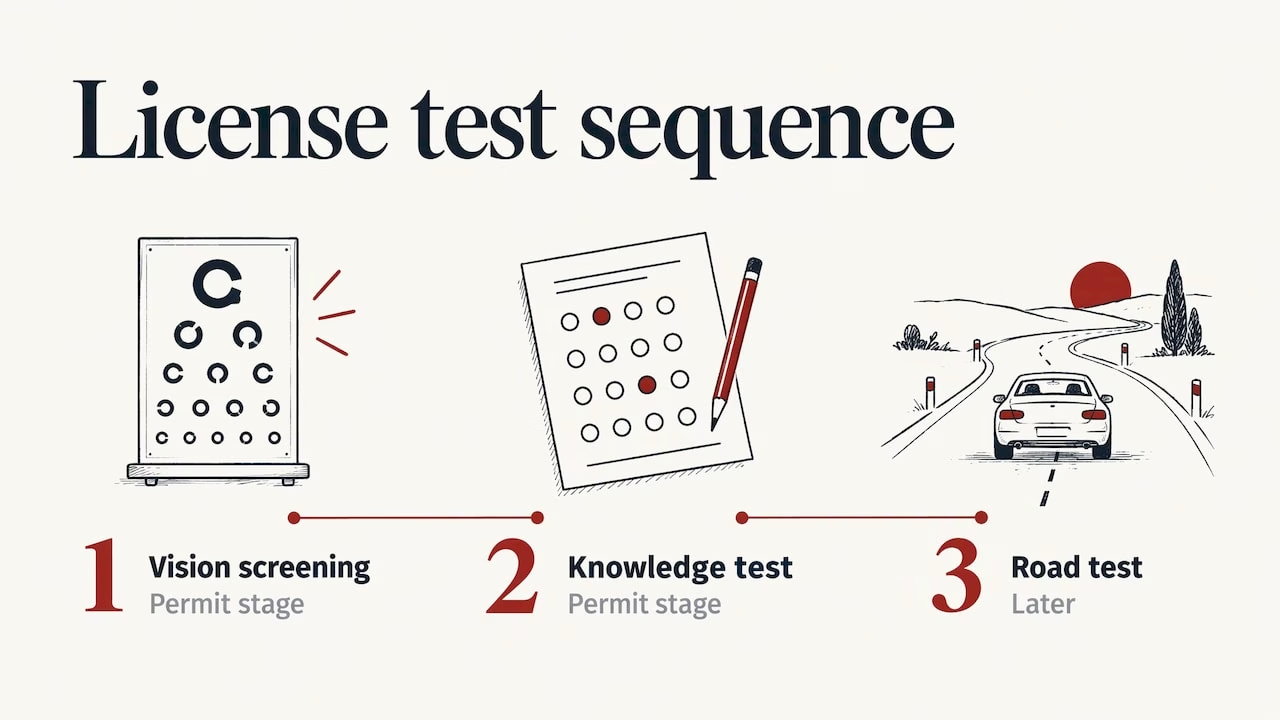
You take three checks on the way to a license. At the permit stage, you take two of them: a vision screening and the knowledge test. The road test comes later.
The knowledge test
The test has 18 multiple-choice questions, and you must answer 15 correctly to pass. That means you can miss three. The questions come from the Pennsylvania Driver’s Manual, so the manual is your study guide.
A simple study plan that works for most teens:
- Read the manual’s chapters on road signs, right-of-way and speed limits first, since those are the areas where small details trip people up.
- Take practice quizzes until you pass them consistently, not just once.
- Review every question you miss and find the rule in the manual.
- Sleep well and eat before your appointment. A rushed, nervous test is the one most likely to go wrong.
If you fail, the examiner returns your paperwork to you, and you can try again. Keep your forms safe, since they are needed for the retest.
Can you take the test online?
For most people, no. You take the test in person at a Driver License Center. There is one exception: in November 2025, PennDOT started a two-year pilot that lets students at select rural high schools take the knowledge test at school using secure remote-testing software. PennDOT says the aim is to reduce barriers such as long travel distances and limited transportation. If you attend a school that takes part, ask your school office. Otherwise, plan on visiting a center.
Rules for driving with a PA learner’s permit
Once you hold the permit, you can practice, but only under conditions. PennDOT’s Young Driver page sets them out.
| Rule | What it means |
|---|---|
| Supervision | A licensed driver at least 21 years old must accompany you at all times |
| Night restriction | No driving between 11 PM and 5 AM, with limited exceptions |
| Passengers | Limits apply to passengers under 18 |
| Permit length | Valid for one year |
| Practice | 65 hours total, including 10 at night and 5 in poor weather |
The nighttime exceptions cover employment, volunteer or charitable service, and only if you carry the proper documentation. Without that paperwork, the exception does not protect you.
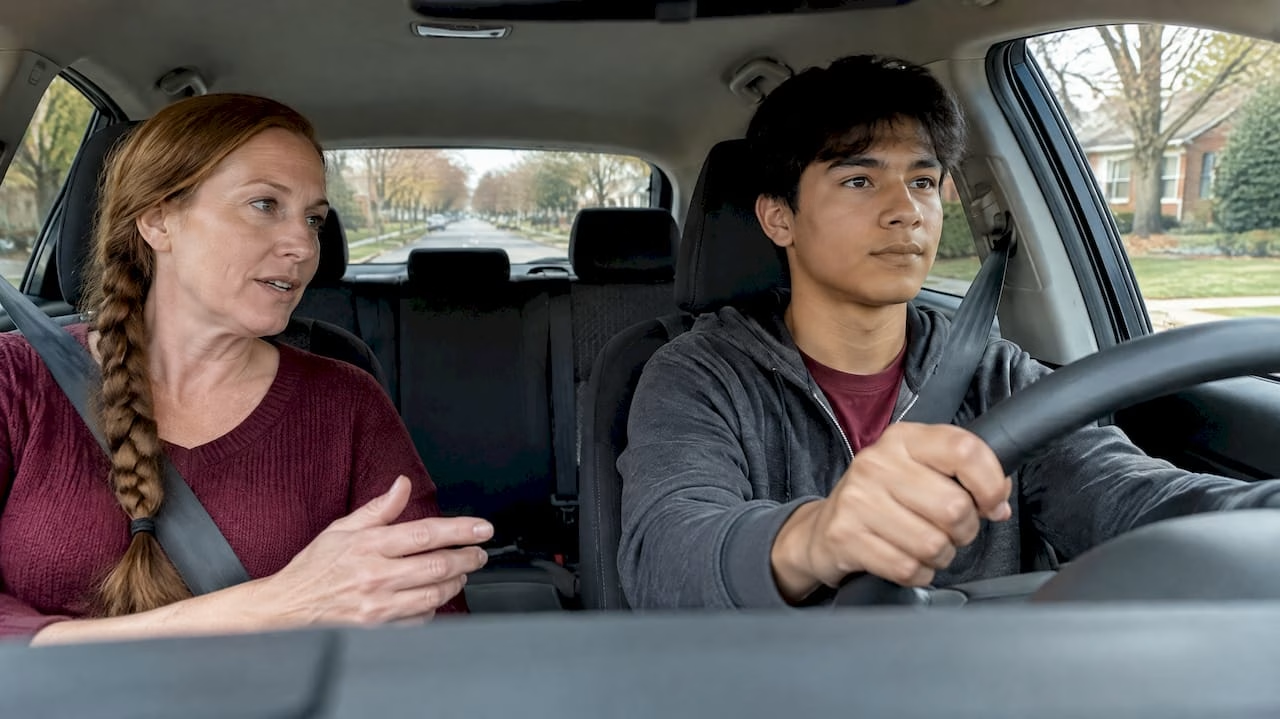
The supervision rule is the one families get wrong most often. “Accompanied” means the licensed adult is in the vehicle with you, not nearby and not available by phone. Choose a supervisor who is calm, who will give clear instructions, and who is comfortable correcting you as you drive.
Turning 65 hours into real skill
Sixty-five hours sounds long, but it passes quickly if you plan it. A weekly schedule helps. Here is one way to split the time:
- First weeks: empty parking lots and quiet residential streets. Work on smooth braking, turning and parking.
- Middle stretch: busier roads, intersections, merging and lane changes.
- Specific hours: schedule the 10 night hours and the 5 poor-weather hours on purpose. Rain and darkness do not arrive when you need them, so use them when they do.
- Final weeks: the maneuvers your road test will cover, such as parallel parking and three-point turns.
Keep a written log with dates, times, conditions and what you worked on. It keeps you honest and helps your parent or guardian certify the hours later.
Some families also like to see how practice drives went afterward. A teen driver tracker can show trips, arrivals and speed alerts, which gives you something concrete to talk about after each drive.
From permit to junior license
The permit is the first stage of Pennsylvania’s graduated licensing system. According to PennDOT’s young driver guidance, to move to a junior driver’s license you must:
- Hold your learner’s permit for six months.
- Complete the 65 hours of supervised practice.
- Pass the road test.
The PennDOT guide for junior licenses also expects a clean record. Applicants must not have been convicted of a Vehicle Code violation for one year, and a parent or guardian must give consent.
Because the permit lasts one year and you must hold it for six months, you have a window of about six months in which to book and pass the road test. Do not leave it to the last week. If the permit expires before you pass, you will have to start again.
Our perspective: why practice matters more than the test
We write driver education for a living, so we see the same pattern again and again. Learners study for the test and then stop studying. Passing 15 of 18 questions proves you know the rules. It does not prove you can apply them at 45 mph in the rain with a truck merging beside you.
That is why we build our courses in-house, with certified educators and safety specialists who keep the content current with statutory requirements. Our courses work on any device, include multilingual read-along features, and let you learn at your own pace, so a busy family can fit lessons around school, work and practice drives.
Our advice is simple. Use the manual to pass the knowledge test. Then treat the 65 hours as the real course, and add structured instruction on top of it. Defensive habits such as scanning ahead, keeping a safe following distance and managing distraction are easier to build when someone has explained why they matter. A new driver who understands those habits keeps a clean record from the first day.
the author
Where our courses fit in
Our state-approved courses are currently offered for Florida, with other states listed on our site, and we do not offer Pennsylvania permit testing. If you or your teen are in Florida, our guides to the Florida learner’s permit and the Florida permit test explain that state’s process, and our teen driver lessons cover habits that apply anywhere.
For drivers who need a state-approved course, our published Florida prices are:
- Florida Basic Driver Improvement (BDI): $30
- Florida Driver Education Traffic Safety Course (DETS): $29.90
- Florida Traffic Laws Substance Abuse Education Course (TLSAE): $29.95
- Florida Wireless Devices Distracted Driver Course: $24.50
- Florida Mature Driver Insurance Discount Course: $14.50
There are no hidden fees, and our money-back guarantee backs every course. You can see the full list on our course page.
Browse our state-approved online courses and start whenever it suits you, on a phone, tablet or computer.
Common mistakes that delay a permit
Most delays come from paperwork, not from the test. Watch for these:
- Medical exam done too early. It must fall within six months before your 16th birthday.
- Photocopies. Proof of identity and date of birth must be originals.
- Unsigned Social Security card. PennDOT requires it to be signed.
- Missing consent form. Under 18, the DL-180TD is required.
- Name mismatch. If your last name differs from your parent’s, bring proof of the relationship.
- Mailing the form. The application is submitted in person.
A fifteen-minute check of your folder at home saves a second trip to the center.
FAQ
What is needed for a PA learner’s permit?
You need to be at least 16, with a completed DL-180 approved by a health care provider, and a DL-180TD if you are under 18. Bring original identity documents, your signed Social Security card and the fee. You then pass the vision and knowledge tests.
What are the rules for driving with a permit in PA?
You must always be accompanied by a licensed driver who is at least 21. Also you may not drive between 11 PM and 5 AM except for limited, documented exceptions, and passenger limits apply for people under 18. And you also need 65 supervised hours before the road test.
Can I take my PA permit test online?
Generally no. The knowledge test is taken in person at a Driver License Center. PennDOT is running a pilot that lets students at select rural high schools test at school with remote-testing software, so ask your school if it takes part.
Can a 15-year-old get a learner’s permit in Pennsylvania?
No. You cannot apply before your 16th birthday. You can, however, have the medical section of the application completed up to six months before that date, so you are ready to apply on the day you turn 16.
How long is a PA learner’s permit valid?
The permit is valid for one year. You must hold it for six months and complete 65 hours of supervised practice before you can take the road test for a junior license.
Sources
- Chapter 1: Non-Commercial Learner’s Permit Information (PennDOT)
- Applying for a Learner’s Permit (PennDOT)
- Non-Commercial Learner’s Permit Application DL-180 (PennDOT)
- Chapter 1: Testing (PennDOT)
- Remote Learner’s Permit Knowledge Testing Pilot (PennDOT)
- Young Driver (PennDOT)
Recommended
- Learner’s Permit for Teens: What to Expect
- Florida Teen Drivers License: Your Complete Guide
- Guide: what age can you get a permit and start driving today – DriverEducators.com
- Florida Online Drivers Ed for Teenagers A Parent’s Guide
This article is provided for general information and is not a professional advice.