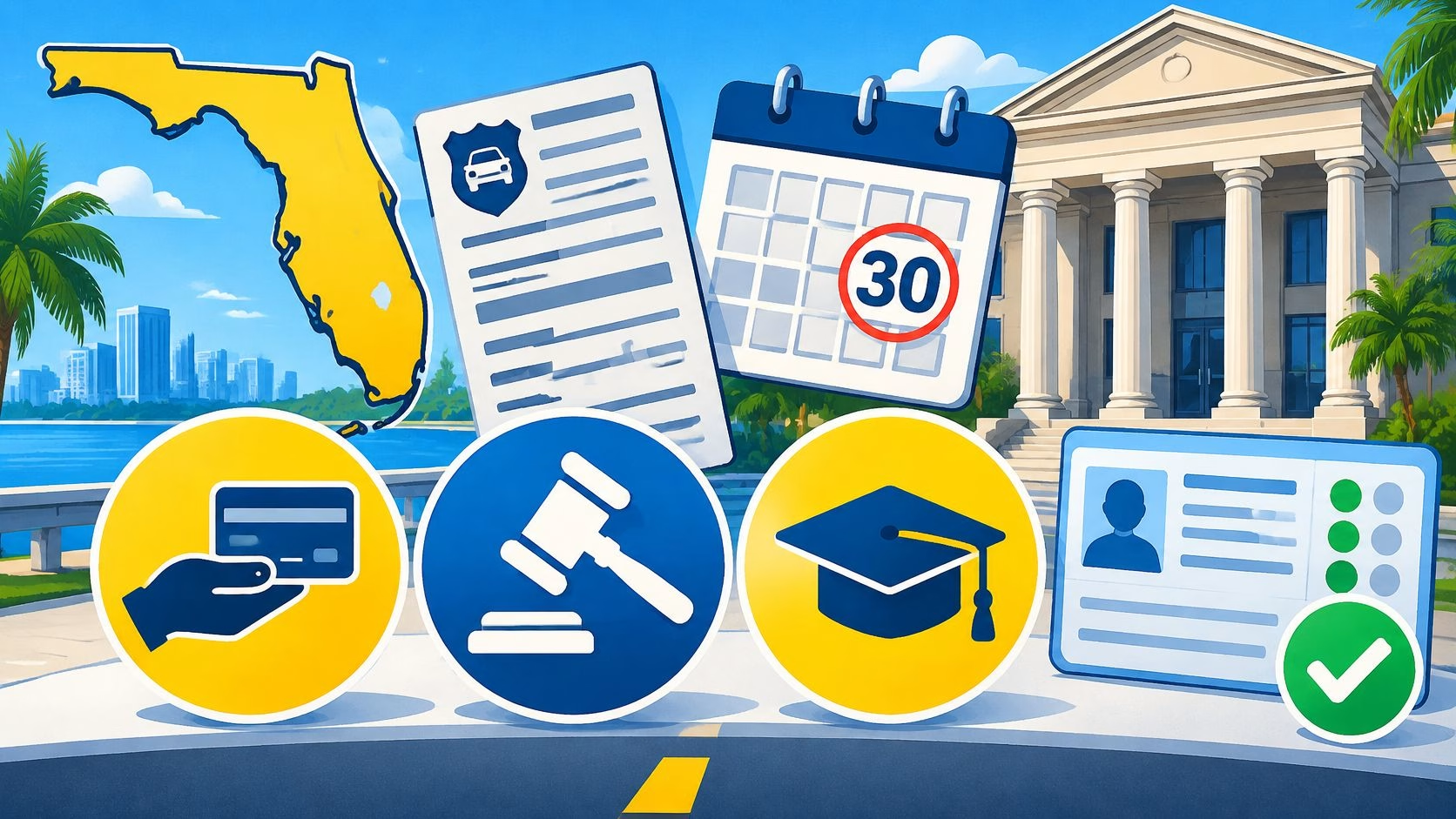
Florida gives you 30 days from the citation date to pay, contest, or elect an eligible driver-improvement course through the county clerk, and paying alone is treated as a conviction. Taking traffic school isn’t enough to protect your record unless the clerk election, payment, eligibility, and completion proof all clear.
The popular advice to just take an online class leaves out the steps that decide your case. A certificate proves you finished instruction. It doesn’t prove the court accepted your election, received your money, or recorded your compliance.
Treat Florida traffic court rules as a court process with an education requirement, not an education purchase with automatic court clearance. Your next move should address the clerk step that’s still open.
What Florida Traffic Court Rules Decide First
A completed course does not close a citation by itself. Before you choose a class, decide which lawful response you’re making and what record outcome you’re trying to achieve.
The available paths aren’t interchangeable. Paying addresses the civil penalty, contesting asks the court to decide the charge, and a valid school election creates a conditional route to withholding adjudication and points.
Start with the issuing county
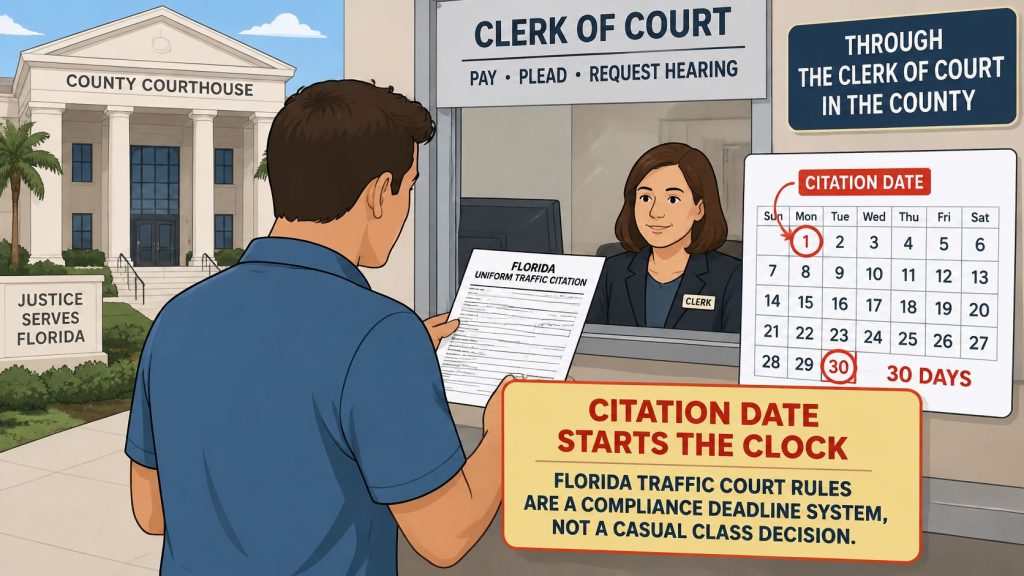
Florida Courts directs traffic-ticket questions to the clerk in the county where the citation was issued; if you can’t identify that county, contact FLHSMV for help, according to the Florida Courts contact guidance. Don’t send documents to the county where you live merely because it’s more convenient.
Pull out the citation before opening a registration page. Identify the issuing county, citation number, alleged violation, and any instructions about a required appearance.
Use the citation and calendar together before making your choice.
Separate the court decision from the course decision
Think of the clerk’s acceptance as the authorization to use school for this citation. Think of the certificate as evidence that you performed the education requirement attached to that authorization.
That distinction changes the questions you ask:
- Instead of asking whether any class will work, ask which course the citation or court requires.
- Instead of asking whether registration was successful, ask whether the clerk accepted the school election.
- Instead of asking whether the certificate arrived, ask whether the correct county recorded it.
- Instead of assuming payment settled everything, confirm the disposition attached to that payment.
Practical rule: Keep every receipt until the clerk confirms compliance and the driving record reflects the intended result.
Say you finish a class after work and receive an electronic certificate. That email answers an education question, not a court-status question. You still need evidence connecting the certificate to the correct citation and an accepted election.
Don’t buy reassurance. Build a file that lets you prove what you elected, what you paid, what you completed, and what the clerk received.
Citation Choices Deadlines and Record Results
| Choice | Deadline | What you must do | Record result |
|---|---|---|---|
| Pay the citation | 30 days from the citation date | Pay the civil penalty through the issuing county clerk | Conviction; applicable points are added |
| Elect Basic Driver Improvement | Elect and pay within 30 days; finish by the court date | Elect an FLHSMV-approved course with the clerk, pay required fine and fees, complete on time, and submit proof if required | Adjudication withheld, civil penalty reduced 18 percent, no points on that eligible violation |
| Contest at a hearing | Date set by the citation or clerk | Appear and present the case; a missed mandatory appearance can default | Judge decides guilt, dismissal, or another lawful disposition |
| Court-ordered or mandatory course | Deadline in the court order | Complete the ordered program, notify the court, and file required documents | Completion alone does not close the case |
| Commercial driver license holder | Election unavailable for point avoidance | Cannot use school election to avoid points, even in a noncommercial vehicle | Points apply if the violation is convicted or paid as a conviction |
| Speed more than 30 mph over the limit | Election unavailable | Follow the required hearing or other lawful response instructions; school election is not an option | Points follow a conviction or payment treated as a conviction |
| Miss the 30-day window | After day 30 | Election is generally forfeited; nonpayment can add fines or suspend the license | School option lost; points or suspension can follow |
| Repeat election | Once in any 12 months and eight times lifetime | Screen prior elections before enrolling | Over the cap, the point-avoidance election is unavailable |
The deadline, payment-as-conviction rule, 18 percent civil-penalty reduction, and speeding exclusion in this lookup are described in FLHSMV’s driving-record guidance. The school benefit is conditional on eligibility, timely election and payment, and completion within the court’s allowed period.
Read the row as a complete transaction
Don’t select only the favorable record result and overlook the obligations beside it. A driver who wants the school outcome must complete the school-election transaction, not pay the ordinary ticket balance and later purchase instruction.
Ask the clerk to identify the payment amount associated with the election. The civil-penalty reduction doesn’t mean the entire amount you owe, including every fee, receives the same reduction.
Likewise, a hearing date and a course-completion date serve different purposes. A scheduled appearance isn’t permission to ignore a separate education deadline.
Don’t confuse an old ticket with an expired obligation
If you’ve left a citation unresolved, establish its current status before choosing a response. Our explanation of the statute of limitations on Florida traffic tickets helps distinguish questions about ticket age from obligations already attached to a case.
Keep unrelated vehicle requirements separate, too. If your ticket also prompts you to address a rebuilt vehicle’s condition, Seat Belt Repair’s guide to safety checks before your rebuilt inspection can support that inspection preparation, but it isn’t a substitute for answering the citation.
Your compliance file should connect the documents that establish the chosen outcome:
- Citation and clerk instructions identify the case and required response.
- Payment receipt and election confirmation establish what the clerk accepted.
- Course certificate and submission confirmation establish completion and delivery.
The useful question isn’t whether you’ve done something about the ticket. It’s whether you’ve satisfied the entire row that applies to you.
Which Cases Allow School and Which Do Not
Screen the citation before paying for a course. Eligibility belongs to the driver and the charge, not to the convenience of the course website.
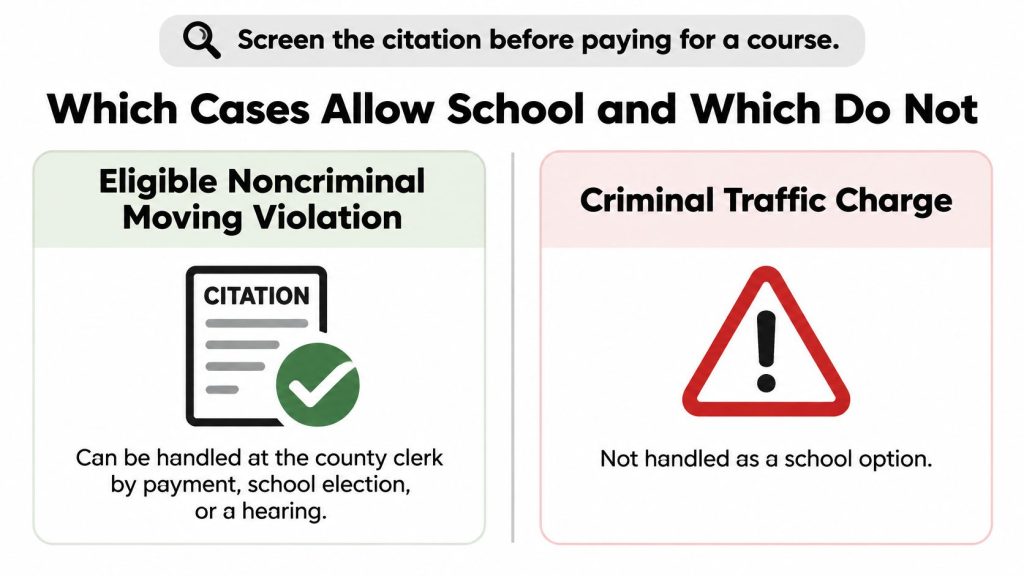
Under Florida’s civil traffic statutes, commercial driver-license holders can’t use the school election to avoid points even in a noncommercial vehicle, certain charges require mandatory hearings, and criminal traffic matters follow different procedures. A course purchase doesn’t change those classifications.
Use the distinction below before treating your ticket as an ordinary school election.
Eligible civil violations and excluded cases
An eligible noncriminal moving violation can offer a school-election path through the clerk. That doesn’t make every moving violation eligible, and having a personal rather than work-related trip doesn’t remove a commercial-license restriction.
Read the actual violation code, not just the officer’s handwritten description. If the citation requires a hearing, follow that instruction rather than assuming an online payment or registration replaces the appearance.
Criminal traffic charges require a different response. They may involve a signed promise to appear, and the basic voluntary course isn’t a way to dispose of the criminal case.
If a DUI arrest has also created a bond question, Blandon Bail Bonds, Inc. provides a resource to compare Florida DUI bond premiums. Keep release arrangements separate from the defense of the charge and any later education order.
Mandatory education isn’t the voluntary election
A judge may order a particular improvement program. In that situation, the order identifies what you must complete, and you must notify the court and supply the required documentation afterward.
Don’t substitute a basic course because its title sounds close enough. Match the program to the order before registration, especially when the court specifies a higher-level course.
Finish your eligibility review with this case-specific screen:
- Violation classification: Is this a civil infraction or a criminal traffic charge?
- License status: Does your license category exclude the election?
- Election history: Are you still eligible to make another election?
- Hearing requirement: Does the citation require an appearance?
- Court deadline: What date controls the required education?
- Payment status: Has the correct amount been accepted?
- Proof method: Exactly how must this clerk receive completion documentation?
If any answer is unclear, resolve it with the issuing clerk before enrolling. For criminal charges or a disputed legal restriction, get advice from a Florida attorney rather than treating course registration as legal protection.
How to Elect and Complete the Course on Time
The driver, not the school, owns every date. Follow the court process in order so you don’t finish an otherwise suitable course without an accepted election behind it.
The FLHSMV driver-improvement-school guidance requires election and payment within 30 days, completion by the court’s deadline, and limits voluntary elections to once during any 12-month period and eight times during a lifetime.
Keep the sequence visible while you work through the clerk’s instructions.
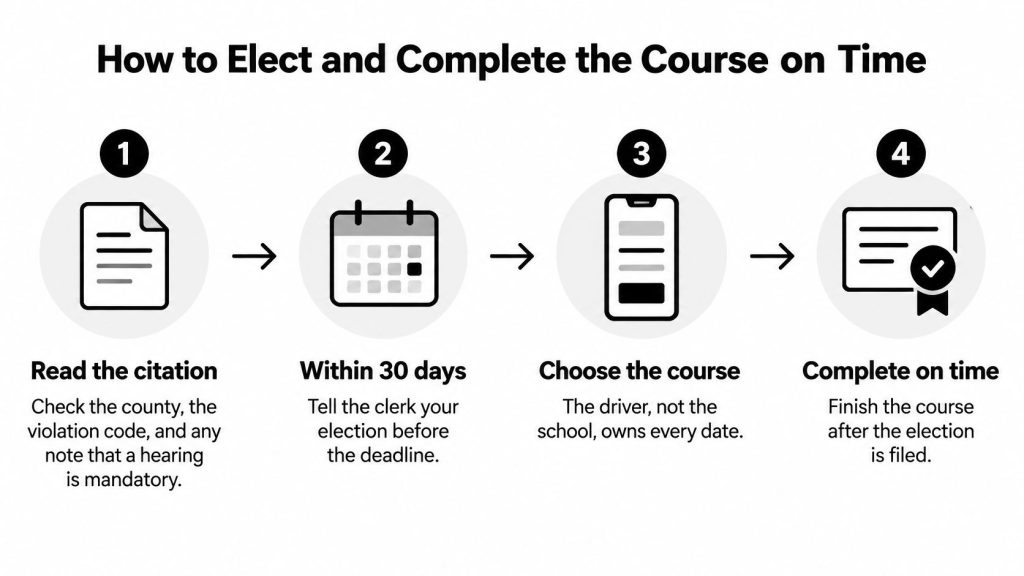
Follow the clerk-to-certificate sequence
-
Read the citation completely. Identify the county, violation code, case or citation number, and any mandatory-hearing notation. Check that you’re reviewing the correct ticket if you received multiple citations.
-
Make the election and required payment. Use the issuing county clerk’s designated process. Don’t assume an ordinary payment transaction includes a school election unless the confirmation specifically establishes that choice.
-
Obtain acceptance and the completion deadline. Save the election confirmation and write down the date the court requires completion. If the confirmation is unclear, ask the clerk whether the school election has been accepted.
-
Register for the approved course that fits the case. Use identifying information that matches your citation and license. Complete the lessons, final exam, and any other required assessments before the court deadline.
-
Submit proof and verify receipt. Follow the clerk’s exact submission method, whether that involves a designated portal or another accepted process. Check that the submission belongs to the right case and that the clerk recorded compliance.
-
Retain a complete compliance file. Keep the citation, county instructions, payment receipt, election acceptance, certificate, and submission confirmation together. Save readable copies rather than relying on an email subject line or an unfinished browser session.
Missing election or payment deadlines can forfeit the school option or trigger suspension for nonpayment. Failing to finish on time can lead to a guilty adjudication and points, even when you’ve already spent time studying.
Build margin into your own schedule
Don’t plan to finish at the last available moment. Allow yourself time to correct an identifying-information error, complete an assessment, or resolve a submission problem.
We require registration information including your name, driver license, and email address because that information generates the completion certificate. Enter it carefully; accurate course completion is easier to document when the certificate and citation identify the same driver.
A court-ordered program needs the same scheduling discipline, but the order controls the program and reporting obligations. Preserve that order in your file so you can demonstrate that you completed what the judge required, not merely a course you selected yourself.
Hearings Pleas and the Reduced Civil Penalty
Paying, contesting, electing school, and completing a judge-ordered program produce different court outcomes. Choose based on the charge and the result you intend, not on which button is easiest to click.
A hearing is the contest path. It isn’t an automatic repair for a missed school election, and requesting one doesn’t guarantee dismissal or permission to take school.
Compare the decision you’re making
| Path | What you’re asking the court to recognize |
|---|---|
| Payment | Satisfaction of the civil penalty under the payment disposition |
| Contest | A decision on the alleged violation after the court hears the case |
| Valid school election | The statutory school-election disposition after all conditions are met |
| Judge-ordered course | Compliance with the education terms of a court order |
For an eligible violation, Florida’s school-election statute provides withheld adjudication, no assessed points, and an 18 percent reduction in the civil penalty when the statutory requirements are satisfied. That’s a legal disposition, not a discount code a school can apply to an already mishandled ticket.
Withheld adjudication also isn’t the same as dismissal. Be precise when asking the clerk what the case shows, because those terms describe different outcomes.
Prepare for the path you actually chose
If you’re contesting, organize the citation, relevant photographs or documents, and the factual issues you want the judge to consider. Our guide on how to fight a traffic ticket in Florida can help you prepare that decision without confusing it with a voluntary school election.
A driver comparing advice across state lines should be especially careful with plea terminology. Fiscella Law LLC’s resource on understanding Illinois traffic court plea options concerns Illinois practice, not permission to use those procedures in a Florida county.
A hearing notice, a payment receipt, and a school certificate answer different questions. Don’t use one as proof that you’ve satisfied the others.
Calendar a required appearance separately from an education deadline. If you live outside Florida, don’t assume online course access changes where the citation is administered or excuses an appearance.
If your election window has passed, ask the clerk what lawful responses remain available in the case’s current posture. Don’t purchase a course on the assumption that finishing it will revive an expired election.
When the judge orders a different program, read the written order before registering. Ask for clarification if the program name, completion date, or proof requirement isn’t clear; guessing can leave you with a certificate that doesn’t establish compliance.
How Points Land on a Florida Driving Record
Failing to stop for a school bus is listed as a 4-point violation in FLHSMV’s points and suspension guidance, which also identifies a school-related election option. That example shows why a blanket promise that traffic school erases points is inadequate.
The violation matters, but so does the way the court disposes of it. Review both before deciding what record consequence to expect.
Accumulation can become a license problem
Florida point totals that suspend a license
| Points accumulated | Time window | Suspension length |
|---|---|---|
| 12 points | 12 months | 30 days |
| 18 points | 18 months | 3 months |
| 24 points | 36 months | 1 year |
These suspension bands make a citation more than an immediate payment decision. A driver with existing points needs to understand the cumulative record consequence, not just the fine printed on the newest ticket.
Use our explanation of the Florida traffic ticket point system to understand how violation values and case outcomes fit together. Then check your own record rather than estimating it from memory.
Check the disposition, not just the course entry
For a valid eligible school election, the objective is to prevent points from being assessed for that violation. It isn’t a general service that removes unrelated points already attached to other cases.
Keep these distinctions clear:
- Course completion establishes that you finished the educational requirement.
- Court disposition establishes how the citation was resolved.
- Driving-record entry shows what FLHSMV has recorded from the case.
- Suspension status requires its own verification if you have a notice or unresolved restriction.
Suppose your certificate is accurate but your record shows points you didn’t expect. Start by asking whether the court entered the intended disposition, rather than immediately retaking the course.
If the clerk’s record doesn’t show compliance, address the missing court item. If the clerk confirms the correct disposition but the driving record doesn’t match, obtain the clerk’s documentation and ask FLHSMV what correction or update is needed.
Don’t assume a record discrepancy authorizes you to drive while a suspension remains active. Confirm your license status through the appropriate official channel and complete any outstanding reinstatement requirements.
The practical objective is a consistent chain of records: the citation identifies the violation, the clerk records the lawful disposition, and the driving record reflects that result. Your course certificate supports that chain, but it doesn’t replace it.
Why a Finished Course Can Still Leave a Case Open
Why is my license still suspended after I finished traffic school? Because the missing item may be the election, cleared payment, eligibility, or county reporting rather than the course itself.
FLHSMV’s traffic-citation guidance distinguishes the election, payment, timely completion, and proof obligations; it also identifies mandatory-course situations involving convictions such as reckless driving, racing, school-bus violations, and specified traffic-signal violations. Those mandatory requirements aren’t interchangeable with an ordinary voluntary point-withholding election.
Use this checklist to locate the unresolved obligation.
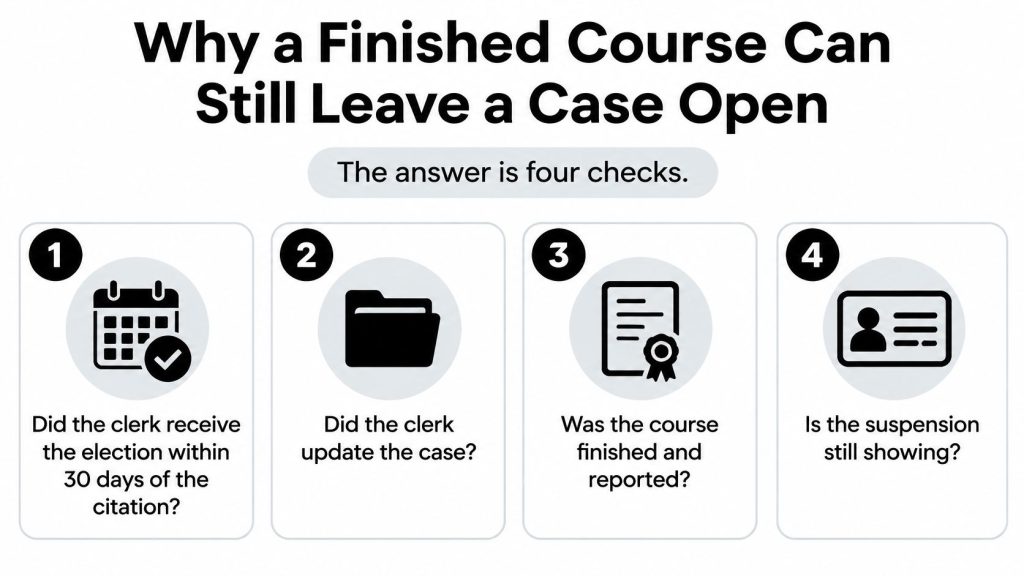
Route the problem to the office that owns it
| Failed check | Who to contact | What to have ready |
|---|---|---|
| Election wasn’t accepted | Issuing county clerk | Citation and election confirmation |
| Payment didn’t clear | Issuing county clerk | Receipt and payment transaction details |
| Eligibility is disputed | Clerk, with legal advice when needed | License status, violation, and election history |
| Completion isn’t recorded | Clerk and course provider | Certificate and submission evidence |
| License status doesn’t match court status | FLHSMV, with clerk documentation | Current record and court clearance information |
Pull the county and citation or case number from the ticket before contacting anyone. Ask the clerk whether the election, payment, and proof were accepted, and whether any other obligation remains outstanding.
Then compare the court response with your driving record. If you discover a mismatch, fix the specific missing item instead of repeating every step or buying another class.
Our guide to submitting a Florida traffic school certificate can help you organize the county-proof step. Keep the upload receipt or other submission confirmation with the certificate.
Common compliance questions
Does electronic reporting automatically clear my county case?
No. Provider reporting doesn’t replace your responsibility to verify that the clerk received and accepted the required proof. Ask about the citation’s compliance status, not merely whether the school sent information.
Should I retake the course if the clerk can’t find my certificate?
First verify the name, license information, citation number, issuing county, and submission destination. A missing or misdirected document calls for a reporting correction, not an automatic repeat enrollment.
Can the school fix an unaccepted election?
The clerk controls the court election. We can address course records and certificate questions, but we can’t turn an unaccepted election into an accepted court disposition.
Who can help with a certificate question?
You can contact us at 888-237-5669 about course documentation. Have your registration information and certificate available so the question can be tied to the correct student record.
Before you drive: A certificate in your inbox isn’t confirmation that a suspension has been cleared.
Busy professionals and out-of-state drivers should use the same document trail. Flexible study access helps you finish instruction, but only the relevant offices can confirm court compliance and current driving privileges.
Elect the Course and Register Before Day 30
If you’re eligible and still within the election window, complete the clerk step first, then register promptly. Don’t spend the remaining time shopping for a course while the court response remains unfinished.
The FLHSMV Basic Driver Improvement provider guidance says drivers seeking the voluntary point-avoidance option must elect within 30 days of the citation date, notify the issuing county clerk before taking the course, and pay the required election fee. Enrollment can’t backdate that decision.
Choose the program that matches your case
We offer Florida’s Basic Driver Improvement Course, also called Florida Four-Hour Traffic School, for drivers handling an eligible moving violation. BDI School is a Florida HSMV-approved Basic Driver Improvement school, and our course is approved for all Florida courts and counties.
After the clerk confirms your election, you can register and start the course online. The learning is self-paced and available in English, Spanish, or Portuguese, so choose the language that lets you understand the material accurately rather than just move through it quickly.
If your court order names a different program, compare the intermediate, aggressive-driver, and mature-driver options against the written requirement. Don’t assume those categories are interchangeable or that a basic course satisfies a longer or differently named order.
Before you begin, have these items available:
- Accepted election or court order: This establishes why you’re taking the program.
- Correct registration details: Match your name and driver license information to your official documents.
- Completion deadline: Plan study time around the court’s date.
- Submission instructions: Know where the certificate must go before you finish.
Make registration the start of compliance, not the end
Start studying once you’ve confirmed the correct route. Leave time for the final exam and other required assessments, then preserve the completion documentation with your clerk records.
If you’re already late, resolve the court status before paying for instruction you hope will repair the problem. A course can meet an applicable education requirement, but it can’t independently restore an expired election or clear an unrelated obligation.
The best next action is specific: secure the accepted election, select the matching course, finish it, and verify the court’s receipt of proof. Keep your documents until the official record matches the outcome you’re entitled to receive.
BDISchool offers Florida’s Basic Driver Improvement Course to help eligible drivers meet their traffic-school requirement and protect their driving record. Confirm your election and payment with the county clerk, then visit BDISchool to register and start the course that matches your citation.