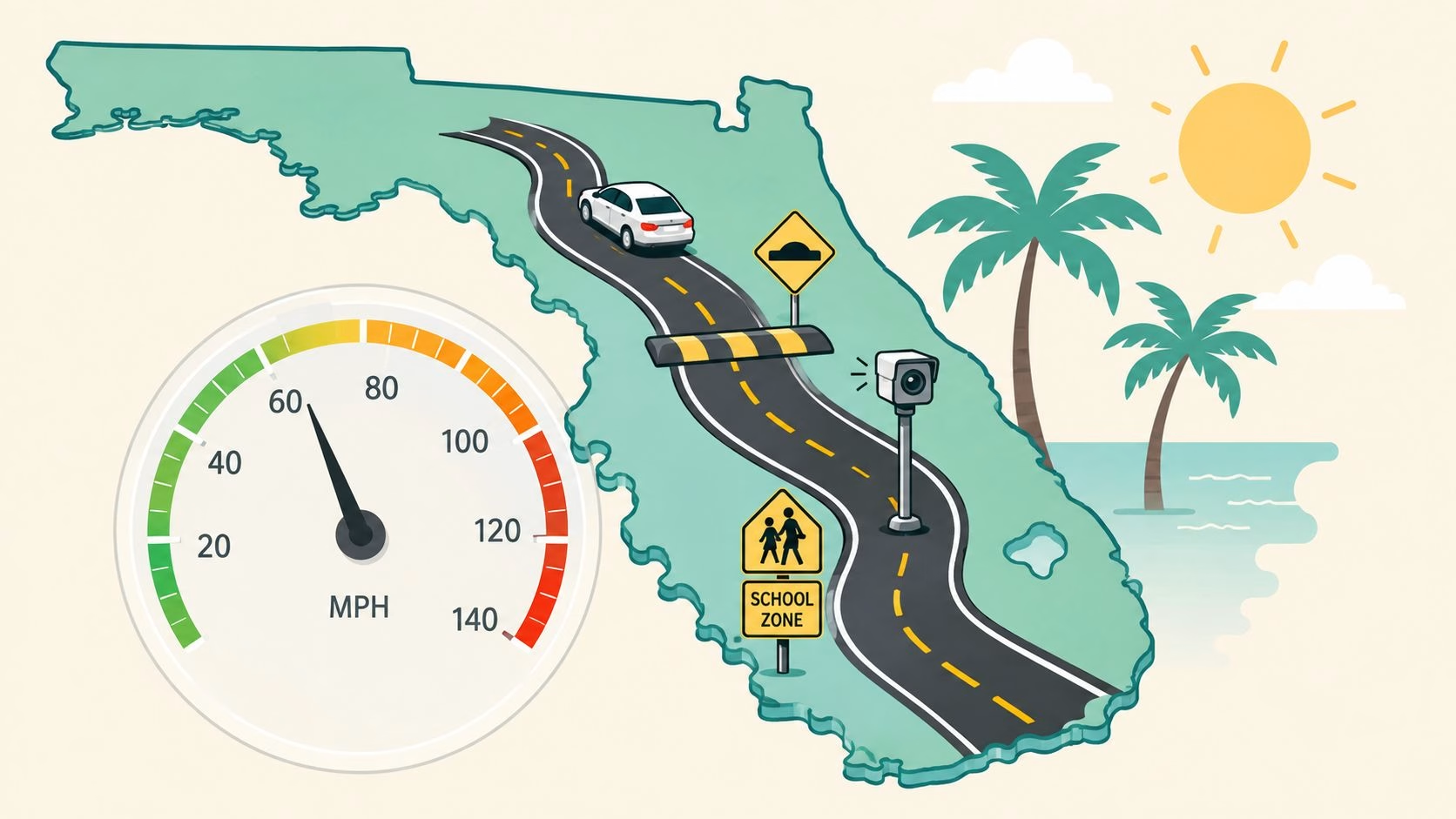
A 1% increase in average speed is associated with about a 4% increase in fatal crashes, according to the World Bank’s summary of the Power Model. That relationship explains why speed management is about much more than reading a posted sign and keeping the vehicle just below it. It’s about choosing a speed that gives you enough time, traction, visibility, and control for the road you’re using.
For Florida drivers, that distinction matters every day. A driver may travel on a limited-access highway, pass through a school zone, enter a residential street, and share a narrow road with pedestrians or cyclists during one trip. The posted limit provides a legal boundary, but safe operating speed also depends on weather, traffic, road design, visibility, and the people around you.
This guide uses practical instruction and Florida examples to explain how speed management works, why small speed changes affect crash harm, and how better decisions can protect both lives and driving records.
Why Speed Management Saves Lives
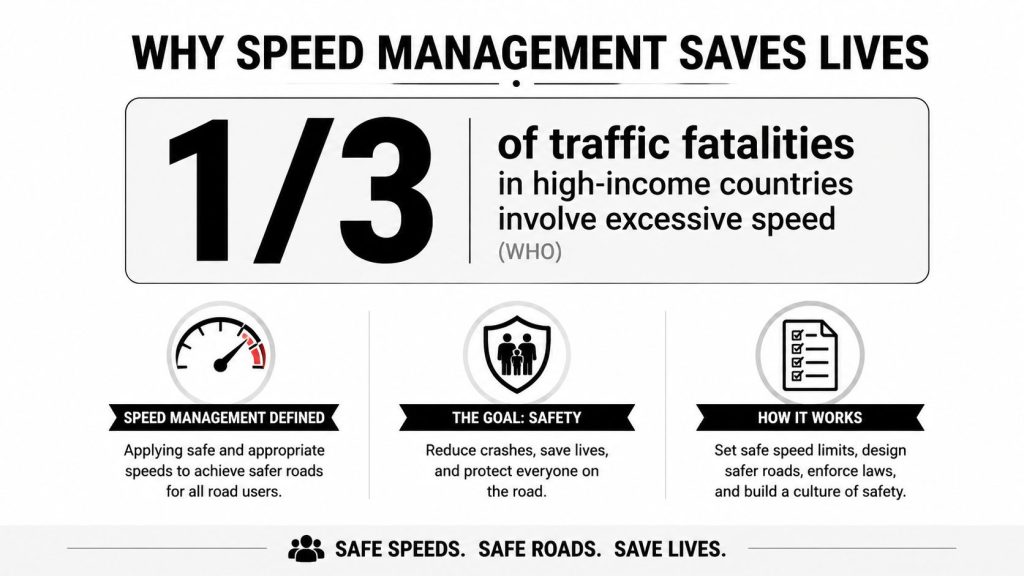
The World Health Organization says excessive and inappropriate speed contributes to around one third of road traffic fatalities in high-income countries and up to one half in low- and middle-income countries. Its speed-management guidance also identifies speed as an essential contributing factor in around 30% of fatal accidents globally. These figures make speed management one of the most established priorities in road safety policy. WHO speed-management guidance
What speed management really means
Speed management isn’t just a campaign telling everyone to drive slowly. It’s a coordinated approach that helps people travel at speeds appropriate for the road and its surroundings.
The WHO defines it through several connected actions:
- Setting reasonable limits: Authorities choose limits that reflect road function, design, traffic conditions, and safety risks.
- Designing for appropriate speeds: Features such as lane layout, crossings, curves, and traffic-calming treatments can encourage drivers to slow down without relying only on signs.
- Enforcing compliance: Patrols, technology, and other enforcement tools deter speeding that creates crash risk.
- Educating drivers: Communication helps high-risk drivers understand why speed changes, rather than treating every limit as an arbitrary rule.
A posted limit is therefore only one part of the safety system. A dry, open highway and a rain-soaked residential street may have different legal limits, but both still require the driver to evaluate current conditions.
Why Florida roads require judgment
Florida’s roads combine high-speed travel with places where a small mistake can seriously harm someone outside a vehicle. A school zone may contain children, crossing guards, buses, and parents maneuvering unpredictably. A residential area may include pedestrians, cyclists, parked vehicles, driveways, and limited sight distance.
Practical rule: Treat the posted limit as the maximum permitted speed under ordinary conditions, not as a promise that the speed is safe everywhere and at all times.
A driver who understands what causes most car accidents is better prepared to recognize how speed interacts with distraction, following distance, poor visibility, and sudden hazards. Good speed management protects more than physical safety. It can also reduce the likelihood of a citation, collision, insurance consequences, and damage to your driving record.
The Four Pillars of Speed Management
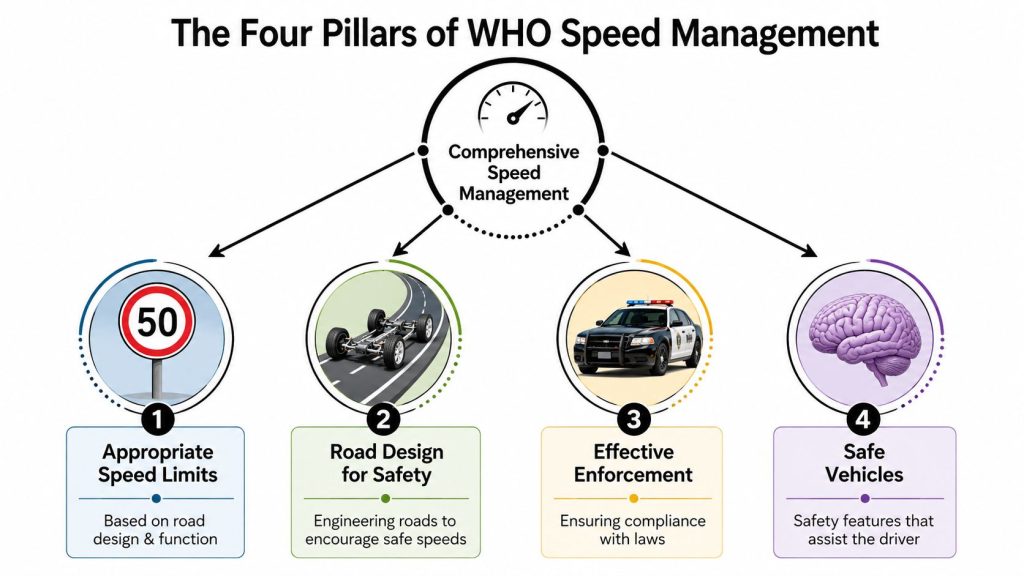
The WHO presents speed management as a system built around safe limits, road design, enforcement, and education, with vehicle technology supporting safer decisions. Drivers encounter all four parts, even when they don’t think of them as one connected framework. WHO speed-management manual
Appropriate limits
A speed limit should reflect how a road functions, who uses it, and what types of conflicts can occur. Florida’s driver handbook lists standard examples including 20 mph in school zones, 30 mph in municipal, business, and residential areas, 55 mph on streets and highways, and 70 mph on limited-access highways. It also states that Florida’s maximum speed limit is 70 mph, and that the minimum speed on highways posted at 70 mph is 50 mph. Florida driver handbook speed-limit information
Those numbers don’t replace observation. A residential street may require a speed below its posted limit when pedestrians are present or visibility is blocked. A highway driver must also avoid traveling so slowly that the vehicle creates a dangerous speed difference with surrounding traffic.
For a clearer explanation of Florida requirements, review Florida speed limit laws before relying on assumptions from another state.
Road design for safety
Engineers can influence speed through the shape and appearance of a road. Narrower lanes, raised crossings, speed humps, tighter curves, signs, and changes in roadside appearance can encourage drivers to operate more slowly. These features help align the speed drivers choose with the speed the surrounding environment can safely tolerate.
The gap between a posted limit and a safe operating speed becomes especially important. A broad, straight road may invite speed even when people cross it regularly. A compact street with visible pedestrians may communicate the need for greater caution before a driver reads a sign.
Enforcement and education
Enforcement gives speed limits practical force. Police patrols, cameras, and other technologies can identify or deter behavior that puts road users at risk. Education adds the reasoning that a ticket alone can’t provide, particularly for drivers who repeatedly underestimate stopping distance or overestimate their vehicle’s ability to avoid a crash.
Modern vehicle technology can assist with alerts, braking, stability, and driver awareness. It can’t cancel the laws of traction, reaction time, or impact energy. The driver remains responsible for selecting a survivable speed.
How Small Speed Increases Create Big Risks
Speed risk does not rise in a simple, one-to-one pattern. The World Bank’s summary of the Power Model reports that a 1% increase in average speed is associated with about a 2% increase in injury crashes, a 3% increase in severe crashes, and a 4% increase in fatal crashes. World Bank road-safety analysis
A small change on the speedometer can therefore create a much larger change in the chance that a collision causes serious harm. “I’m only going a little faster” focuses on the size of the increase, while overlooking its effect on crash severity.
| Speed Increase | Injury Crash Risk | Severe Crash Risk | Fatal Crash Risk |
|---|---|---|---|
| 1% | About 2% higher | About 3% higher | About 4% higher |
Why stopping becomes harder
Higher speed affects reaction distance, braking distance, and impact energy at the same time. You travel farther while recognizing a hazard, cover more pavement before braking begins, and reach an obstacle with greater kinetic energy. Wet pavement, worn tires, poor lighting, and heavy traffic shrink the remaining margin.
Use a stopping distance calculator to see how reaction time and braking distance work together. The posted limit provides a legal reference, but a safe operating speed may need to be lower when road conditions, traffic mix, or vehicle capability reduce available space.
A separate speed-management benchmark reports that a 5% reduction in average speed can cut fatal road-traffic crashes by about 20%. The same WHO material reports that every 1 km/h increase in speed produces about a 3% increase in injury crashes and a 4% to 5% increase in fatal crashes. WHO speed-management flyer
European road-safety synthesis data says 40% to 60% of drivers typically exceed speed limits, while 10% to 20% exceed them by more than 10 km/h. Frequent behavior can feel acceptable, but common behavior does not automatically provide a safe model for your conditions.
A speed limit isn’t less important because other drivers ignore it. Your vehicle still needs time and space to stop.
Enforcement focuses on modest violations because a small increase can change a crash outcome. Speed management helps drivers prevent ordinary mistakes from becoming fatal ones.
Practical Speed Management Techniques for Florida Drivers
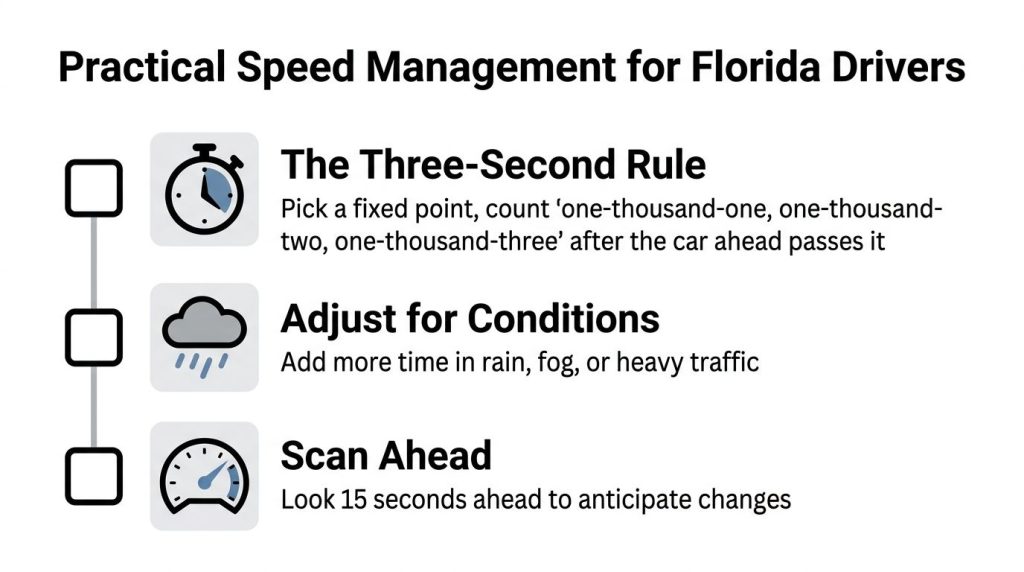
The safest speed decision happens before an emergency appears. Scan far enough ahead to notice brake lights, merging traffic, crosswalk activity, construction, curves, and lane changes while you still have room to respond.
Build a usable following gap
Start with the three-second rule. Choose a fixed object, such as a sign or light pole, and begin counting when the vehicle ahead passes it. You should reach that object only after counting “one-thousand-one, one-thousand-two, one-thousand-three.”
That gap is a starting point, not a guarantee. Add more time in rain, fog, heavy traffic, darkness, poor visibility, or whenever the vehicle ahead has a larger stopping capability than yours. A loaded vehicle, unfamiliar road, or tired driver also deserves more space.
The two-second rule can help new drivers understand the basic idea of timed following distance, but Florida conditions often call for a larger cushion.
Match speed to current conditions
A posted limit doesn’t require you to maintain that speed when conditions deteriorate. Slow below the limit when heavy rain reduces visibility, standing water affects traction, workers or barriers narrow a construction zone, or pedestrians and cyclists are difficult to see.
In a school zone during pickup, watch for children moving between vehicles, buses stopping, and drivers turning or backing unexpectedly. In a residential neighborhood, reduce speed early when parked cars, driveways, sidewalks, and cyclists restrict your view.
A compact electric vehicle, golf cart, or other low-speed vehicle may have different operating characteristics from a passenger car. For readers comparing those differences, Solana EV’s golf cart speed and performance guide provides useful context about how vehicle capability affects speed decisions.
Anticipate instead of reacting
Look well ahead and ease off the accelerator before a developing problem becomes urgent. Smooth deceleration preserves space, reduces abrupt lane changes, and gives following drivers more time to respond.
Merging onto a high-speed highway requires the opposite judgment. Entering far below the flow can create a speed differential that makes merging difficult, while accelerating beyond a safe speed creates its own risk. Use the acceleration lane to build an appropriate speed, check gaps, signal, and merge without forcing another driver to brake hard.
Good speed management is proactive. You’re not waiting for a hazard to prove that you should have slowed down.
When Speed Management Fails Consequences and Solutions
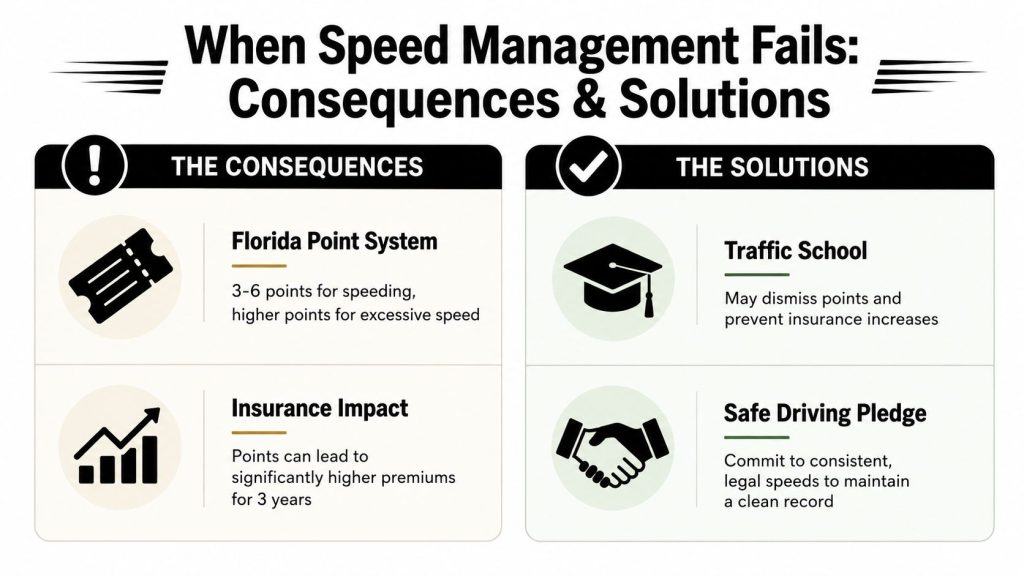
A speeding decision can create two separate problems. First, it can increase the chance and severity of a collision. Second, it can affect your legal and financial position through a citation, points, insurance consequences, or a required educational program.
Florida drivers should treat a moving violation as a signal to correct the behavior, not only as a bill to resolve. The right response depends on the violation, the court or licensing requirements, and your personal driving history.
 0″ height=”450″ />
Match the course to the situation
A recent moving violation may make the 4-hour Basic Driver Improvement course appropriate for drivers who need an approved option to avoid points and insurance increases, when permitted by their circumstances.
A court order or need for deeper instruction may call for the 8-hour Intermediate Driver Improvement course. This format gives drivers more time to examine habits, judgment, and defensive techniques.
Repeated aggressive behavior or road rage is addressed through the 8-hour Aggressive Driver Course, which focuses on responsibility and behavior change, not just reviewing signs.
Drivers aged 55 and older may consider the 6-hour Mature Driver Course as a safety refresher and a potential route toward an insurance discount, subject to insurer requirements.
BDISchool offers these Florida-approved online courses in English, Spanish, and Portuguese. Students can complete the self-paced material from a convenient device, then receive an electronic certificate reported directly to the FLHSMV.
Take the consequence seriously
A course can’t erase the need for safer choices behind the wheel. It can, however, provide structured instruction after a mistake and help you understand how speed, attitude, attention, and road conditions work together.
Check your eligibility before registering, especially if a court gave you a specific deadline or course requirement. Completing the wrong course, missing a deadline, or assuming that every ticket qualifies for the same option can create additional trouble.
Your Next Steps to Better Speed Management
The central lesson is simple. Speed management means choosing a safe operating speed, not merely staying near a posted number. You need to account for road design, traffic mix, visibility, weather, vehicle capability, and the likely consequences if something goes wrong.
Small increases can produce disproportionate increases in crash harm, while a modest reduction in average speed can meaningfully reduce fatal-crash risk. The practical response is to create space, scan ahead, slow early, and treat school zones, residential streets, construction areas, and highway merges as different driving environments.
Choose your next action
- After a recent ticket: Review the 4-hour Basic Driver Improvement course and confirm that it fits your violation and eligibility.
- After a court order: Check the 8-hour Intermediate Driver Improvement course requirements and complete the assigned program by the required deadline.
- After aggressive-driving behavior: Select the 8-hour Aggressive Driver Course to address the decision-making and attitude behind the violation.
- For a mature-driver refresher: Consider the 6-hour Mature Driver Course and ask your insurer whether completion qualifies for a discount.
- For a general skills refresh: Use defensive-driving education to revisit following distance, hazard scanning, speed selection, and Florida traffic rules.
Frequently asked questions
Does the posted speed limit always equal a safe speed?
No. It establishes the legal maximum under ordinary conditions, but rain, poor visibility, congestion, road work, pedestrians, cyclists, and vehicle limitations may require a lower speed.
Can a driver-improvement course dismiss points?
A course may help a driver avoid or address points when Florida law, the violation, and the driver’s eligibility allow it. Confirm the specific requirements before enrolling.
How do I know which course to take?
Start with the reason for enrollment. A recent moving violation, court order, aggressive-driving requirement, insurance-discount goal, or general refresher may lead to a different course.
How are course certificates delivered?
BDISchool’s course information states that certificates are issued electronically and reported directly to the FLHSMV. Keep your registration details and completion records for your files.
Online, self-paced learning makes it easier to fit driver education around work, family, and other responsibilities. The lessons can turn a citation or refresher course into better speed choices on the next Florida drive.
BDISchool offers Florida-approved online driver-improvement courses that address speed management, defensive driving, court requirements, and safer long-term habits. Visit BDISchool to choose the course that fits your situation, study in English, Spanish, or Portuguese, and take the next step toward protecting your driving record and everyone who shares the road.