

Colorado does not run one statewide program that lets you take a course and wipe points off a ticket. Today, whether a course helps depends on the court that holds your case, and a new state law is about to add a points waiver run by the Department of Revenue (DOR). The safest path is to confirm what your court accepts, take a course that is state-approved, and keep your certificate and court dates straight. We build state-approved online courses for exactly this kind of requirement, and the steps below show where a course fits and where it does not.
Key Takeaways
- A course can help with a Colorado ticket only when the court or prosecutor handling your case allows it. Read your citation and call or visit that court first.
- A course does not change the fine. In Longmont, for example, the class does not reduce fines and costs, and you still appear in court.
- Colorado’s HB24-1250 creates a points waiver for approved driving improvement courses. It takes effect on the earlier of January 1, 2027, or when DOR finishes its rules.
- Suspension thresholds for drivers 21 and older are 12 points in 12 months or 18 points in 24 months, counted by violation date.
- Do not pay a ticket you want to contest. Paying is an admission of guilt.
Table of Contents
- Does Colorado Have a Point Reduction Course?
- Three Different Things a Course Can Do
- How Courts Handle It: A Real Example
- Know Which Court Has Your Ticket
- Do Not Pay If You Want to Use a Course
- How Many Points Put Your License at Risk
- Step by Step: Using a Course the Right Way
- What About Insurance?
- Our Perspective
- Start Your Course With Confidence
- Frequently Asked Questions
- Sources
Does Colorado Have a Point Reduction Course?
Not in the way many drivers expect. In some states a single rule lets anyone who is eligible take a course and keep a ticket off the record. Colorado leaves most of that decision to the local court or prosecutor. A city or county court may offer a class as part of a plea deal, or it may not.
That is why two drivers with the same speeding ticket can get different answers. One lives in a city whose prosecutor offers a traffic safety class. The other is cited in a county where the court never does.
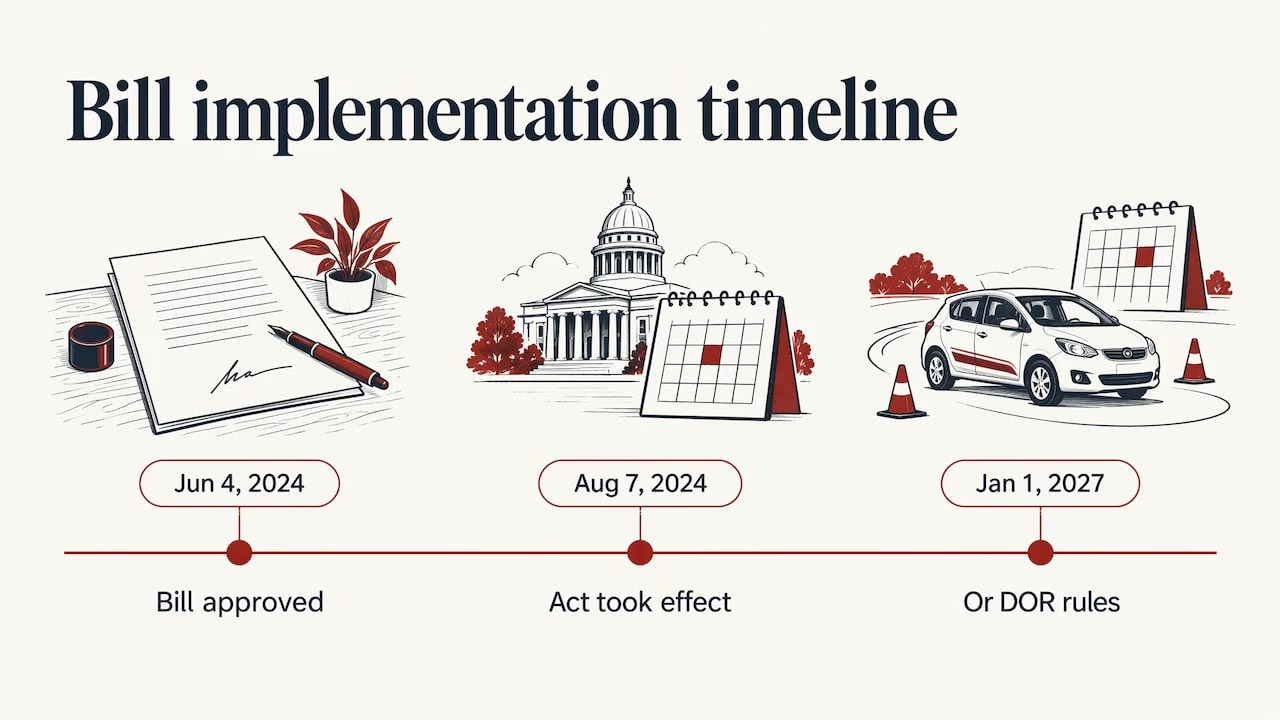
What has changed is the law behind the scenes. HB24-1250 directs DOR to let a driver convicted of a traffic infraction or misdemeanor traffic offense obtain a points waiver after completing an approved driving improvement course. The bill was approved on June 4, 2024, and the act took effect August 7, 2024. The waiver provision itself starts on the earlier of January 1, 2027, or the date DOR promulgates its rules.
The statute leaves key details to DOR rulemaking: how many points can be waived, how often you can claim a waiver, how to file a claim, what an approved course must contain, and related fees. Until those rules are published, nobody can honestly tell you the exact number of points a course will remove. Check the DOR site for the published rules before you rely on any figure.
Three Different Things a Course Can Do
People use “point reduction” for three separate outcomes. Knowing which one you need keeps you from paying for the wrong thing.
| Goal | Who decides | What a course does |
|---|---|---|
| Get a charge reduced or dismissed | The municipal or county court and its prosecutor | May be offered as part of a plea; the court sets the terms |
| Waive suspension points on your DMV record | DOR, under HB24-1250 rules | Will count once the waiver is in effect and the course is approved |
| Lower your insurance cost | Your insurance company | Some insurers discount for a course; ask yours which courses they accept |
A court-offered class helps with the first. The state waiver is aimed at the second. The third is a separate conversation with your insurer. One certificate may serve more than one goal, but only if the court, DOR or insurer accepts that specific course.
For a wider look at how courses compare with other ways to clear points, see our guide to point dismissal options and our explainer on traffic school versus driver improvement.
How Courts Handle It: A Real Example
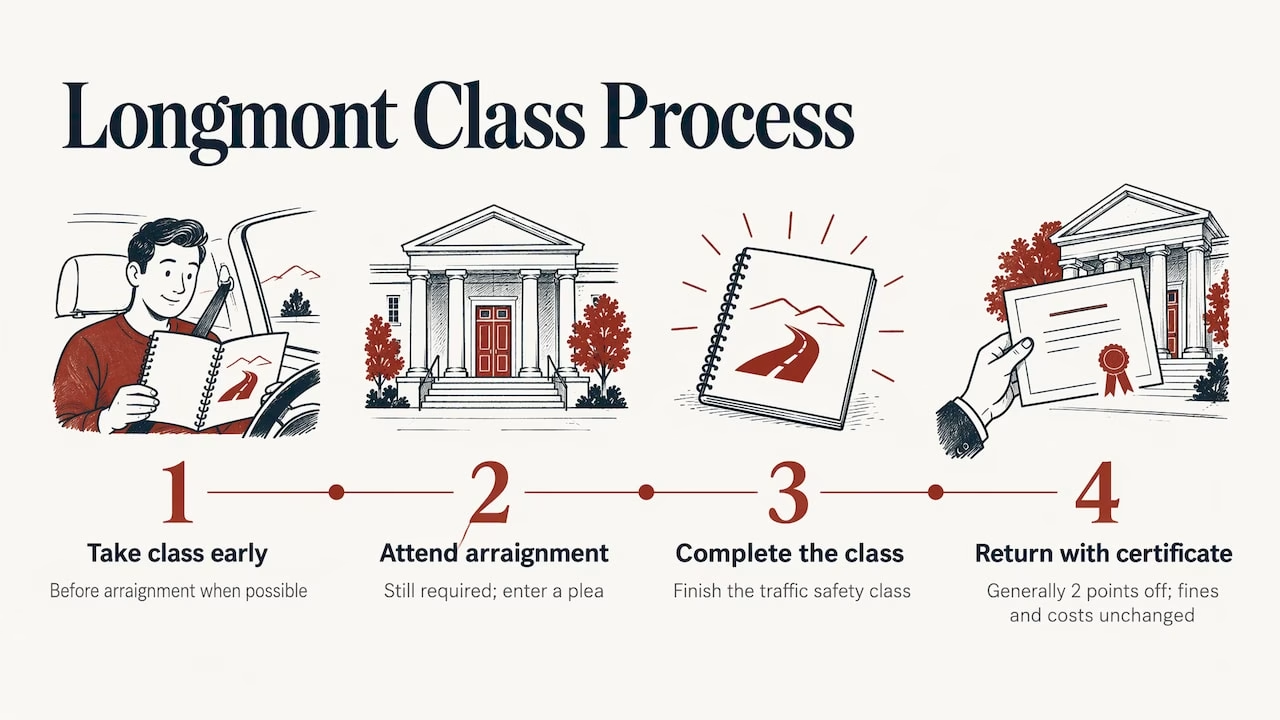
Longmont shows how local this is. According to the city’s Traffic Safety Class page, the City Prosecutor may offer the class in a traffic case. Attending can yield one point beyond the standard plea offer, generally a two-point reduction from the original charge.
The same page spells out what the class does not do. You must still attend your arraignment (your first court appearance, where you enter a plea). You appear again after finishing the class and bring your certificate. Fines and costs are not reduced. The court encourages taking the class before arraignment when possible.
 That is one city’s process. Another court may offer nothing, or something different. Treat Longmont as an illustration of the pattern, not a rule for your case.
Know Which Court Has Your Ticket
DOR explains that summonses and municipal citations go to the local court shown on the ticket, while parking and photo-radar tickets are handled by the issuing city or agency. Your first job is to find that court name and phone number on the citation.
When you contact the clerk or prosecutor, ask:
- Does this court accept a defensive driving or traffic safety course for my charge?
- Which courses or providers does it accept, and must the course be state-approved?
- Do I need to take it before or after my arraignment?
- What exactly do I need to bring to court (certificate, proof of enrollment)?
- Does the course change the charge, the points, the fine, or only some of these?
Write down the answers and the name of the person who gave them. Court practices differ, and a written note protects you if there is a mix-up later.
Do Not Pay If You Want to Use a Course
This is the mistake that costs the most points. DOR warns that paying a ticket is an admission of guilt. If you want to contest it or ask for a plea involving a class, you do not pay. You appear in court on the date printed on the citation.
DOR also notes that an eligible state penalty assessment paid online or postmarked within 20 days receives a reduction in points added to your driving record, with the financial charge staying the same. The page does not give the size of that reduction. That is a different route from a course: it means accepting the ticket and the guilty finding. If you are weighing it, read the DOR ticket-payment page for the current terms.
Two more timing facts matter:
- Tickets more than 40 days old have already been referred to court and can no longer be paid through the DMV, per the same DOR page.
- Missing your date has its own penalty. The Centennial Municipal Court says a cited driver must pay the penalty assessment before the citation date or appear on the scheduled date, and failure to appear may result in a default guilty finding.
A course never moves your court date. Follow the deadline on the citation even if you plan to take a class.
How Many Points Put Your License at Risk
Points matter most when you are near suspension. The Colorado DOR point-suspension guidance sets these limits:
| Driver age | Suspension threshold |
|---|---|
| 21 and older | 12 or more points in 12 months, or 18 or more in 24 months |
| 18 to 20 | 9 or more points in 12 months, 12 or more in 24 months, or 14 or more at any point between ages 18 and 21 |
The windows are counted from the date of the violation, not the date of conviction. That detail trips people up. A ticket you got last spring may count in a window even if your court date is months later.
If you are already close to a limit, a new ticket is where a court-approved class can matter most. A lower-point plea may keep you under the threshold. To see how many points typical violations carry, use our breakdown of Colorado traffic ticket points.
If you do receive a suspension notice, DOR’s hearing process is separate from your traffic case. The hearing cannot relitigate whether you were guilty of the tickets. It can review the point calculation, mitigating circumstances and a request for restricted driving privileges. If you face a possible suspension, consider speaking with a licensed Colorado attorney about your hearing options.
Step by Step: Using a Course the Right Way
- Read the citation. Note the court, the appearance date, the charge and whether a payment option is shown.
- Do not pay yet. If you might use a course or contest the ticket, paying ends that option.
- Contact the court or prosecutor. Ask the questions listed above. Confirm that an online course is accepted.
- Choose a state-approved course. Our courses are state-approved and designed to be completed online at your own pace on any device. We also offer multilingual read-along features, which help if English is not your first language.
- Finish before your next court step when the court allows it. Longmont, for one, encourages taking the class before arraignment when possible.
- Keep your certificate. Bring it to court as instructed. Keep a copy.
- Appear on your date. The class does not replace your appearance, and fines and costs may still apply.
- Check your record afterward. Confirm the outcome with the court, and watch your driving record for the points you expect.
What About Insurance?
A course may also help with what you pay for coverage, but that depends on your insurer. Companies set their own discount rules, so ask yours three things before you enroll: whether they discount for a course, which courses they accept, and what proof they need. Do this separately from your court conversation. A course accepted by a court is not automatically one your insurer will credit.
If you are a mature driver, the same question applies. Ask your insurer about eligibility and the course it requires.
Our Perspective
Drivers come to us worried about two things: the points and the paperwork. In Colorado the paperwork is the harder part, because the answer sits with the court on your ticket. We think the calmest way through is to get the facts first, then take a course that is state-approved so you are not redoing it.
We write our courses in-house with certified educators and safety specialists, and we keep content current with statutory requirements. That matters in a year when Colorado is putting a points waiver into practice. When rules are being written, you want a provider that tracks them.
We also built the experience around ease. Our pricing is transparent with no hidden fees, the course works on a phone, tablet or computer, and a money-back guarantee backs it. You can learn at your own pace and stop when life gets busy.
Our advice is simple: call the court, keep your dates, and finish your course on time. A course is one part of keeping your record clean, and it works best when the rest is handled.
the author
Start Your Course With Confidence
Once your court or insurer confirms what it accepts, you can enroll online and work through the material when it suits you. Our courses are state-approved, priced openly with no hidden fees, and covered by a money-back guarantee. See what we offer on our courses page, or read how traffic school for point reduction works in practice.
 We also build custom fleet safety training for employers who want their drivers trained consistently.
Frequently Asked Questions
Can a course remove points from my Colorado license right now?
That depends on your court. Colorado has no single statewide ticket course, and a prosecutor may offer a class as part of a plea in some courts. The new DOR points waiver under HB24-1250 begins on the earlier of January 1, 2027, or when DOR completes its rules, so check DOR for the current status.
How many times can I take a safe driver course?
The law does not give a usable number. HB24-1250 leaves it to DOR rules to say how often a driver may claim a points waiver. Courts and insurers also set their own limits, so ask each one.
Does a course reduce my fine?
Not necessarily. Longmont’s court states that fines and costs are not reduced by its traffic safety class. Ask your own court what a course changes in your case.
Should I pay the ticket or go to court?
If you want to contest the ticket or ask about a class, do not pay. DOR says paying is an admission of guilt. Appear on the date printed on your citation, and consider a Colorado attorney if you are near a suspension threshold.
Sources
- HB24-1250 session law (Colorado General Assembly)
- HB24-1250 bill page (Colorado General Assembly)
- Paying a Ticket or Penalty Assessment in Colorado (DMV)
- Traffic Safety Class (City of Longmont)
- Municipal Court (City of Centennial)
- Point Suspensions (Colorado Department of Revenue)
- DMV Administrative Hearing Process (Colorado DMV)
Recommended
- Point Reduction Class: Cut Points and Save on Insurance
- Your Guide to a Point Reduction Course
- 7 Ways to Reduce Points on Your Driving Record
- Colorado Traffic Ticket Points: What Each Violation Costs
This article is provided for general information and is not a professional advice.