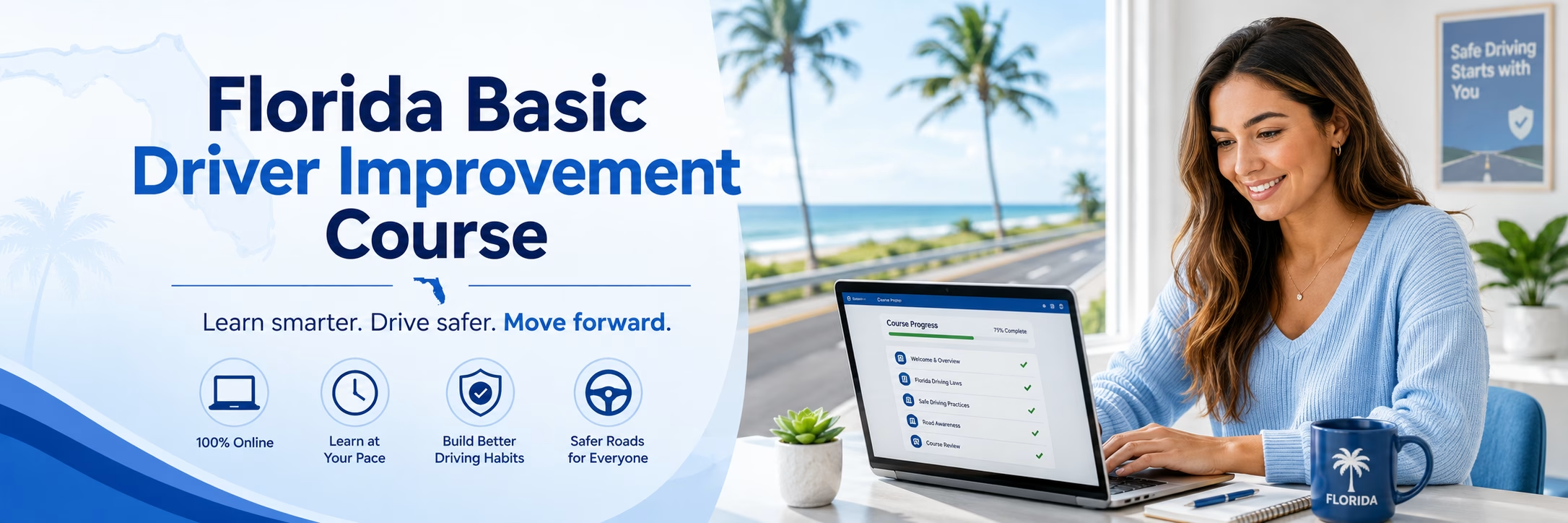

A multilingual driver’s ed course lets you learn traffic laws, safe-driving habits and test material in a language you read comfortably, then prove it on the exam or to the court. If you drive in Florida, our state-approved online courses are built for that: they run on any device, move at your pace and include multilingual read-along features. Below you will find how language support works across the US, what to check before you enroll, and which course matches your situation.
Key Takeaways
- Language support in the US is set state by state. Course material, the knowledge test and the road test can each follow different language rules.
- Many states still give the road test in English only, so a course that teaches you the English driving terms alongside your own language prepares you better.
- Our Florida courses are state-approved, work on phones, tablets and computers, and include multilingual read-along features.
- Prices are published up front: for example, $30 for Basic Driver Improvement and $14.50 for the Mature Driver Insurance Discount Course, with a money-back guarantee and no hidden fees.
- Match the course to your reason for taking it: a first license, a ticket, a court order, an insurance discount or a company fleet.
Table of Contents
- What a multilingual driver’s ed course actually is
- Why language access is a safety issue, not a convenience
- How language support differs from state to state
- Online versus in-person: what can move to your screen
- Choosing the right course for your situation
- A short checklist before you enroll
- Making the most of a multilingual course
- Our perspective
- Start your course
- FAQ
- Sources
What a multilingual driver’s ed course actually is
The phrase covers three different things, and it helps to separate them.
- Course content in your language. The lessons on traffic laws, right of way, signs and safe following distance are readable or listenable in a language you know well.
- Instructor or interpreter support. In a classroom setting, an instructor who speaks your language, or an interpreter provided by the state or the school.
- Test language options. The language in which the DMV gives you the written knowledge test, and whether any help is allowed on the road test.
A good course should help with the first, and a good student plan covers the other two. Lessons you understand fully are the foundation: you cannot drive safely by memorizing answers to questions you did not follow.
Who benefits
- New drivers and recent arrivals learning US rules for the first time, including adults who drove for years in another country.
- Drivers with a ticket who need to complete a course for dismissal or point reduction and want to understand every module, not click through it.
- People with a court requirement, where the course must be completed correctly the first time.
- Older drivers who want an insurance discount and prefer to read at their own speed in the language they use at home.
- Fleet managers with drivers who speak several languages and need everyone trained to the same safety standard.
Why language access is a safety issue, not a convenience
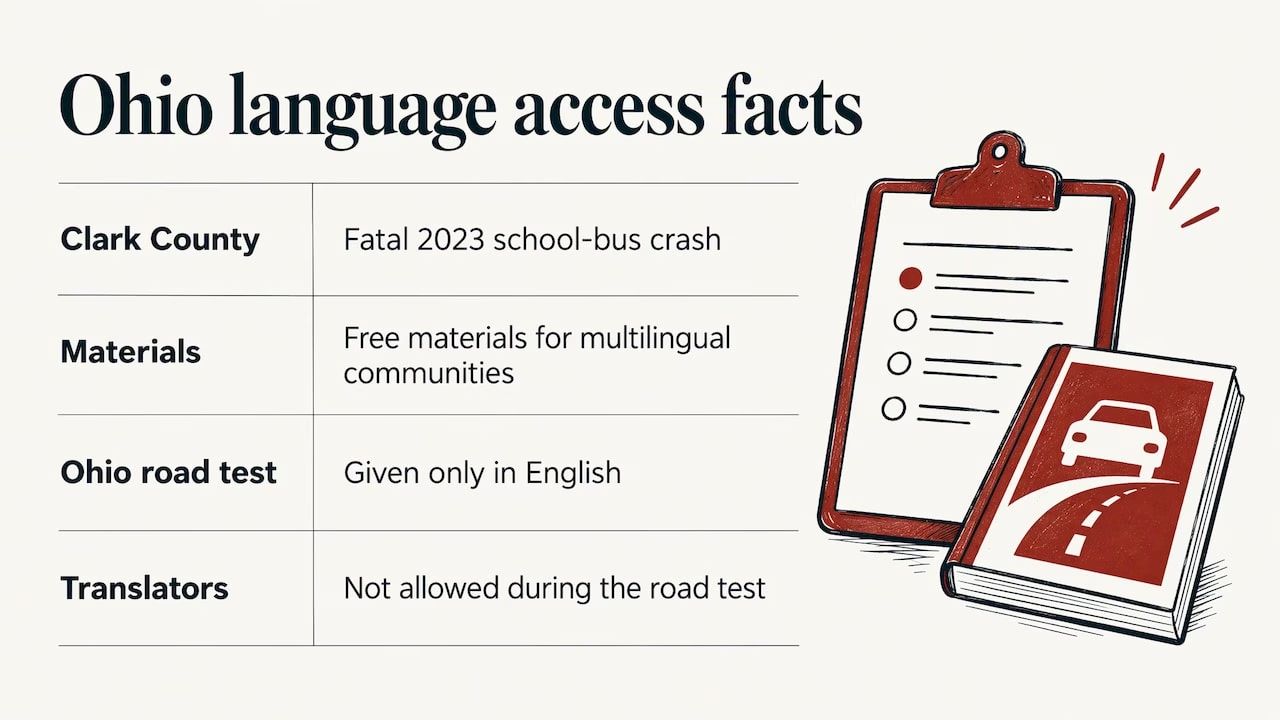
Ohio’s driver-training program offers a clear example. After a fatal 2023 school-bus crash in Clark County, state officials worked with the Haitian community in Springfield to build free materials so multilingual communities get better access to driving information, according to the Ohio Traffic Safety Office’s curriculum outline. The same document notes that Ohio’s road test is given only in English and that translators are not allowed during it.
That last point matters wherever you live. In Portland, Maine, a driving school owner told the Press Herald she pushes students to learn basic English driving terms because the road test is in English, as reported in the Portland Press Herald’s 2024 coverage. The practical lesson: learn the concepts in the language you understand best, then learn the English words you will hear on the road and on the test, such as yield, merge, right of way and school zone.
How language support differs from state to state
There is no national rule. The examples below show how much the details vary, and why you should check your own state’s motor vehicle agency before you plan.
| State | What the official sources say |
|---|---|
| Ohio | The 40-question knowledge test is offered in Arabic, Chinese, English, French, Haitian Creole, Japanese, Russian, Somali and Spanish, in text and audio, plus American Sign Language. For other languages you can schedule a proctored test with an interpreter. (Ohio BMV) |
| Connecticut | The permit knowledge test is offered in nine languages. If yours is not among them, you may use a published foreign-language dictionary, and no translators are allowed during the test. (CT DMV) |
| New Jersey | State law requires the license exam in English and the three other languages most commonly spoken in the state, verified at least every five years. (P.L. 2020, c.148) |
| Maine | The state’s Bureau of Motor Vehicles provides interpreters free of charge to students in approved driver education programs. (Maine Public) |
| North Carolina | A bill introduced in the 2025-2026 session would require driver’s education materials and the written test in 25 languages plus English. Check the legislature’s page for its current status. (NC Legislative Reference Service) |
Two patterns stand out. First, the knowledge test is where most states offer translated versions. Second, the road test and commercial licenses are far more restricted: Connecticut, for example, offers its commercial general knowledge test only in English and Spanish, per the same CT DMV language-access FAQ.
Free state materials and how they fit in
Ohio’s Traffic Safety Office publishes curriculum slides, an instructor guide and other resources free of charge, designed to be taught with a translator, according to its English Language Learners page. Such materials are a good starting point for community trainers. If you need a structured, state-approved course that records your completion and issues the certificate a court, DMV or insurer expects, you need an approved provider for your state.
Online versus in-person: what can move to your screen
Florida shows how this works. Since August 1, 2025, anyone under 18 who has never held a license from any state, country or jurisdiction must complete a 6-hour Driver Education Traffic Safety (DETS) course before applying, and the course can be taken in person or online, according to the Florida Highway Safety and Motor Vehicles DETS FAQ. Earlier TLSAE completions may be used for one year after completion under that guidance.
Online study gives multilingual learners three real advantages:
- You control the pace. Pause a lesson, replay a section on right of way, or return to it the next day.
- You can read and listen together. Read-along features show the text while it is spoken, which helps you connect the written English you will see on signs and tests to the language you know.
- You study when it suits you. Work shifts, family and long commutes do not need to be rearranged.
For a comparison of formats, see our guides on online traffic school versus classroom and self-paced courses compared with classroom training.
Choosing the right course for your situation
The right multilingual course depends on why you need it. Here is how our Florida catalog maps to the common reasons.
| Your situation | Course | Published price |
|---|---|---|
| First license, under 18, never licensed anywhere | Driver Education Traffic Safety Course (DETS) | $29.90 |
| First-time driver substance-abuse education | Traffic Laws Substance Abuse Education Course (TLSAE) | $29.95 |
| Ticket or point reduction | Basic Driver Improvement (BDI) | $30 |
| Insurance discount for mature drivers | Mature Driver Insurance Discount Course | $14.50 |
| Distracted-driving violation | Wireless Devices Distracted Driver Course | $24.50 |
| Intermediate improvement, aggressive driving | 8-Hour IDI and 8-Hour Aggressive Driver Course | See the course page |
| Company drivers | Custom fleet safety course | See the fleet page |
Prices are those published on our site as of 2026. Each is a one-time payment for the course.
New drivers
If you are applying for a first Florida license, start with our DETS course. The Driver Education Traffic Safety Course Guide walks through what it covers, and Enrolling in a Florida DETS Course lists the steps.
Ticketed drivers and court requirements
A ticket or a court order comes with a specific requirement: a particular course, approved by the particular authority, finished by a deadline. Your citation or court paperwork tells you which one applies. Our Basic Driver Improvement guide explains the course, and Traffic School Versus Driver Improvement Explained clarifies terms that often confuse people. Read the name of the course on your paperwork first, then match it exactly. For court-ordered cases, the court’s instruction is the final word on what you must complete.
Insurance discounts
Our Mature Driver Insurance Discount Course costs $14.50. Our guide on how to claim the Florida mature driver discount explains the process. Eligibility and the size of any discount are set by the state and your insurer, so confirm both with your insurance company when you enroll.
Fleet managers
When drivers speak different languages, the risk is uneven understanding of the same safety rules. We build custom fleet safety courses so a company can train its drivers to one standard.
A short checklist before you enroll
- Confirm the course name. Match the exact title on your ticket, court order or DMV notice.
- Confirm state approval for your state and your purpose.
- Check the language features. Look for read-along support so you can follow text and audio together.
- Check device compatibility. You should be able to continue on a phone or tablet.
- Check the price and guarantee. Look for a clear published price, no hidden fees and a money-back guarantee.
- Plan for the English you will meet. Practice the signs and driving terms the road test uses.
Our guide to course features for driver training goes deeper on each point, and how state-approved online driver education works explains approval and reporting.
Making the most of a multilingual course
The first session sets the pattern. Read each lesson in the language you are most comfortable with, then replay it and notice the English term for each rule. Write the ten or fifteen terms you meet most often: yield, merge, no passing zone, school zone, one way, detour, shoulder, intersection, pedestrian crosswalk, right of way. A short list you review every day beats a long list you never open.
Study in blocks of 20 to 30 minutes. Because a state-approved course tracks your progress, you can stop at any point and return later. Use the end-of-lesson quizzes to find weak spots, then go back to those lessons rather than moving on.
Bring someone along when you can. Family members who already drive can ask you questions while you work through the material, and that kind of practice mirrors what an examiner or a traffic situation will demand.
Our perspective
We develop our courses in-house, with certified educators and safety specialists, because the person who writes a lesson should understand both the statute behind it and the driver who has to apply it.
Language should never be the reason someone fails to understand a rule that protects them on the road. That is why we offer multilingual read-along features alongside full mobile compatibility, so a lesson can be heard and read at the same time, on the device a learner already owns.
We also believe the price and the promise should be plain. Our courses are published with their prices, there are no hidden fees, and our money-back guarantee stands behind every enrollment. A driver should be able to focus on learning, not on the fine print.
the author
Start your course
If you drive in Florida, choose the course that matches your paperwork and begin whenever you are ready: our courses are state-approved, self-paced and work on any device, with multilingual read-along features and no hidden fees.
See every Florida option, with its price, on our online traffic school and driver education courses page, or go straight to the Florida course list.
FAQ
Can I take the DMV knowledge test in my own language?
Often yes, but it depends on the state. Ohio offers its knowledge test in nine languages in text and audio, and Connecticut offers it in nine languages too, according to their official pages. If your language is not offered, some states allow a proctored test with an interpreter or a printed dictionary. Check your state’s motor vehicle agency for the current list.
Is the road test given in languages other than English?
In many states it is not. Ohio gives the road test in English only with no translators allowed, per its Traffic Safety Office. Learn the common English driving terms alongside the rules, and practice them before test day.
Can driver’s education be completed online?
The classroom portion often can. Florida’s 6-hour DETS course, required for first-time drivers under 18, can be delivered online or in person, per the state’s highway safety department. Our DETS course is available online for $29.90.
Does a course help with insurance costs?
Our Mature Driver Insurance Discount Course is designed for that purpose and costs $14.50. The discount itself comes from your insurer under your state’s rules, so confirm your eligibility with your insurance company before you enroll.
Can my company train multilingual drivers?
Yes. We offer a custom fleet safety course so every driver receives the same safety training. Visit our fleet training page to discuss what your team needs.
Sources
- Ohio Traffic Safety Office curriculum outline
- Portland Press Herald, multilingual driving schools in Portland
- Ohio BMV, driver license knowledge test
- Connecticut DMV, language assistance FAQs
- New Jersey P.L. 2020, c.148
- Maine Public, Maine’s multilingual driving schools
- NC Legislative Reference Service, S606 summary
- Ohio Traffic Safety Office, English Language Learners
- Florida HSMV, DETS course FAQ
Recommended
- Spanish Course Versus English Course Compared
- Online Traffic School Spanish: Learn and Earn Your Certificate in Your Language
- Best Online Course Features for Driver Training
- What a Good Driver Education Course Covers
This article is provided for general information and is not a professional advice.