
A traffic school money-back guarantee protects the tuition you pay the school. It does not return the fine, bail or administrative fee you pay the court, and those are separate payments that follow the court’s rules, not the school’s. Once you know which money goes where, you can enroll with confidence. At DriverEducators.com, our state-approved online courses come with transparent pricing, no hidden fees and a money-back guarantee, so the school side of your cost is covered.
Key Takeaways
- A school guarantee covers tuition. Fines, bail and court administrative fees are paid to the court and are governed by the court’s rules.
- Courts generally refuse to refund their own fees once you start traffic school or if you turn out to be ineligible, so check eligibility first.
- Eligibility rules differ by state and county. Confirm yours with the court or the state agency before you pay anyone.
- Finishing an approved course on time is what keeps points and conviction reporting off your record. A refund does not do that.
- Our Florida courses list their prices openly, for example $30 for Basic Driver Improvement (BDI), and carry a money-back guarantee.
Table of Contents
- Three payments, three different refund rules
- What a good guarantee should mean for you
- Why the timing of your refund request matters
- Check eligibility before you pay anyone
- What actually protects your record and your rates
- A simple routine for a worry-free enrollment
- Choosing the right course for your reason
- Our perspective on guarantees
- Ready to enroll with a guarantee behind you
- FAQ
- Sources
Three payments, three different refund rules
Most confusion about “traffic school refunds” comes from treating one ticket as one bill. It is usually three.
- The fine or bail. This is what you pay the court for the citation. Choosing traffic school typically means you still pay it.
- The court’s traffic school fee. Some courts charge a separate administrative fee for letting you attend.
- The school’s tuition. This is what you pay the course provider, and it is the only part a school’s money-back guarantee can reasonably address.
California shows this clearly. The San Francisco Superior Court lists bail, a $52 non-refundable administrative fee and tuition paid separately to the school as distinct costs. The Santa Cruz Superior Court says there are no refunds of fees paid to the court for traffic school, and that the school’s enrollment fee is separate from what you owe the court.
The practical lesson: budget the court costs as spent money, and treat the school’s guarantee as protection for the course itself. Florida works the same way in principle. Your clerk of court handles citation costs, and your course provider handles tuition. Our Florida traffic school cost guide breaks down what each part usually involves.
What a good guarantee should mean for you
A money-back guarantee is a promise about the course, so it should remove the risk of paying for something you cannot use. Here is what that looks like in practice for the readers we serve.
- You enrolled and then learned you do not need the course. A judge dismissed the ticket, the court changed your options, or your insurer no longer requires it.
- You chose the wrong course for your situation. Many drivers are unsure whether they need a Basic Driver Improvement course, a mature driver course or a substance abuse course.
- You want a clear price. You see the full tuition before checkout, with no add-ons appearing later.
This is why we publish our prices openly and stand behind our courses with a money-back guarantee. Our Florida offerings, as listed on our site, are:
| Course | Price |
|---|---|
| Florida Basic Driver Improvement (BDI) | $30 |
| Florida Driver Education Traffic Safety Course (DETS) | $29.90 |
| Florida Traffic Laws Substance Abuse Education Course (TLSAE) | $29.95 |
| Florida Wireless Devices Distracted Driver Course | $24.50 |
| Florida Mature Driver Insurance Discount Course | $14.50 |
The full list, including the Intermediate Driver Improvement course, is on our courses page.
Why the timing of your refund request matters
Court rules, not school policies, often decide whether you can still undo a decision. The clearest example comes from Arizona’s courts. If you have not begun the class, you may be eligible for a refund. Once the course begins, you give up your option to go to court and to receive a refund of class fees. The same FAQ says the class must be finished at least 7 days before your court date.
The Arizona Supreme Court’s defensive driving page adds that a student who has started a course is not granted a refund, while a student who never began may be eligible if they contact the school.
Three habits protect you in any state:
- Decide before you click “start.” Starting a course can be a point of no return for the court option.
- Write down your court date and your deadline. Many courts give you a fixed window, often about 90 days, and some allow no extension. Santa Cruz, for example, allows 90 days with no extension or grace period.
- Keep your receipts. Keep one for the court payment and one for the school payment, so each refund question goes to the right place.
Check eligibility before you pay anyone
The most expensive traffic school mistake is enrolling when you are not eligible. A school can only teach the course. The court or state decides whether completing it counts.
Courts say this plainly. The San Francisco court lists its requirements, including a valid license, an eligible infraction, no traffic school in the past 18 months, no alcohol or drug-related violation and a speed no more than 25 mph over the limit. It warns that ineligible students who enroll will not have their fees refunded and that the conviction will be reported to the DMV. Sacramento’s court gives the same warning: attend while ineligible and the conviction is reported, with no refund of fees paid.
Arizona sets its own rules. Its courts say you cannot have attended defensive driving for a citation in the past 12 months, the citation must be on the eligible list, and only one violation can be handled per course. Serious-injury and fatal accidents are not eligible.
These are examples, not a universal rule. Your state, and sometimes your county, sets its own. Start with these two pages on our site:
- Do you meet driver improvement eligibility? explains how to confirm you qualify.
- How often can you take traffic school? covers the waiting periods between courses.
If your citation notice is unclear about your options, contact the court that issued it. It is the authority that decides.
What actually protects your record and your rates
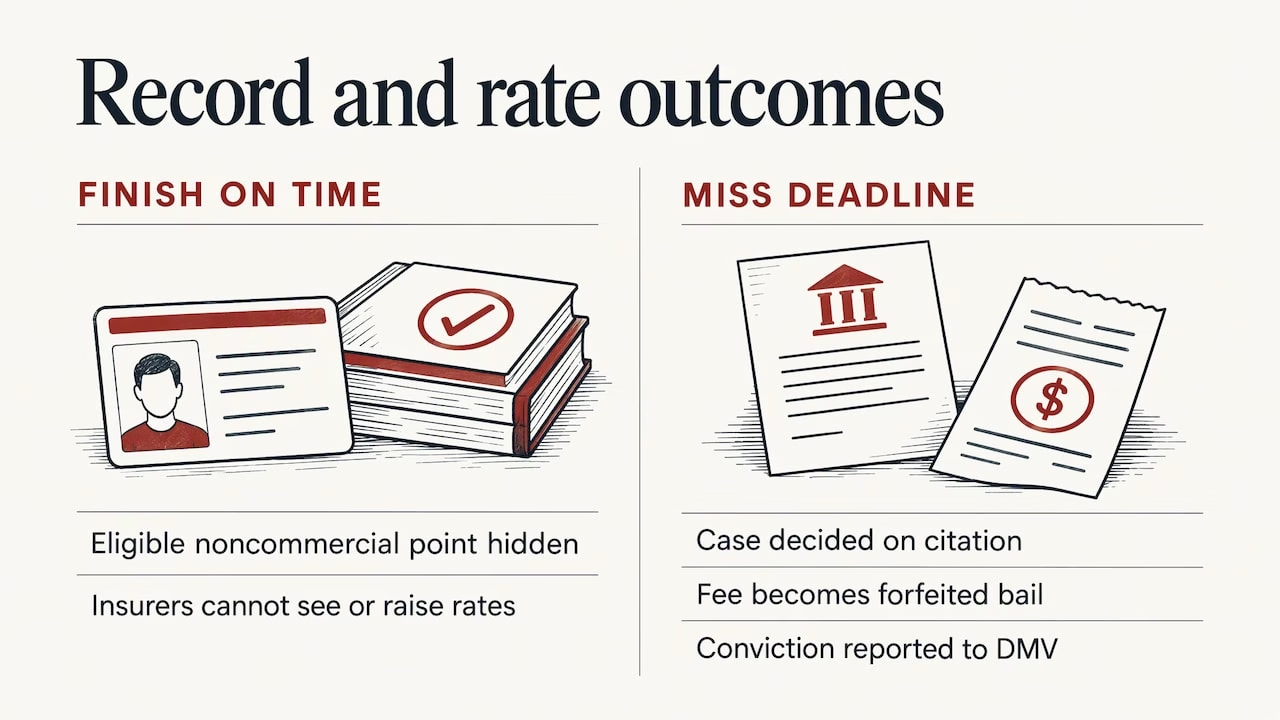
A refund returns money. It does not remove points or stop an insurance increase. Completion is what does that, when you are eligible and finish on time.
California’s court self-help guide explains the outcome. If you have a noncommercial license and finish traffic school, the point will not show on your DMV record, so insurers cannot see it or raise your rates because of it. Commercial license rules are different. The San Francisco court’s agreement form adds the other side: if you do not complete by the due date, the case is decided on the citation, the administrative fee becomes forfeited bail and a conviction is reported to the DMV.
That is why the best use of a guarantee is as a safety net while you finish on time, not as a reason to wait. If your goal is lower premiums, see how an online driving course to lower insurance fits your situation. For the effect on what you owe the court, read does traffic school reduce ticket cost?
A simple routine for a worry-free enrollment
Follow these steps in order and you keep both your money and your options.
- Read the citation. Look for the court, the deadline and any wording about traffic school or a driver improvement course.
- Confirm eligibility with the court or state agency. Check your last course date, the type of violation and your license type.
- Handle the court’s part. Pay what the court requires and note its fees. These are separate from tuition.
- Choose the course your situation calls for. Ticket point reduction, a court order, a first-time driver requirement and an insurance discount each point to a different course.
- Compare the full tuition. Look for a published price with no hidden fees.
- Finish well before your deadline. Our courses are mobile friendly and self-paced, so you can complete them in short sessions on any device.
- Keep your completion records. You will want them if the court or your insurer asks.
For Florida drivers, our Florida defensive driving course page and our Basic Driver Improvement course page walk through the course for ticket situations.
Choosing the right course for your reason
The right course depends on why you are enrolling.
- Ticket dismissal or point reduction: Basic Driver Improvement is the course many Florida drivers with a non-criminal moving violation consider.
- First-time drivers: The Driver Education Traffic Safety Course (DETS) and the Traffic Laws Substance Abuse Education Course (TLSAE) serve new-driver requirements.
- Insurance discount for mature drivers: Our Florida mature driver insurance discount page explains the course and how to claim.
- Distracted driving: Our Wireless Devices Distracted Driver Course addresses phone and device use behind the wheel.
- Employers: Fleet managers can ask about our custom fleet safety course.
Matching the course to your requirement at the start is the surest way to avoid needing a refund at all. If you are unsure which applies, check with the court or your insurer, then come back and enroll.
Our perspective on guarantees
We build our courses in-house with certified educators and safety specialists, and we keep the content aligned with statutory requirements. A guarantee fits that approach. When a course is current, clearly priced and easy to finish on any device, the reader has what they need to meet the requirement.
What we see as the right standard is simple. You should know the full tuition before you pay, you should be able to work at your own pace, and you should have a money-back guarantee behind the purchase. That is how we run DriverEducators.com: no hidden fees, state-approved courses, and read-along features in several languages so more drivers can follow the material comfortably.
Our advice is to pair the guarantee with good timing. Confirm your eligibility, enroll early, and finish with room to spare. That is the path that keeps points off your record and a clean history in front of your insurer.
the author
Ready to enroll with a guarantee behind you
If you are in Florida, our state-approved courses are priced openly, run on phones, tablets and computers, and come with a money-back guarantee and no hidden fees. Basic Driver Improvement is $30, and the Mature Driver Insurance Discount Course is $14.50.
 See every option and pick the course that matches your citation, court order or insurance goal on our Florida courses page. Fleet managers can request a custom program through our fleet training page.
FAQ
Does a traffic school money-back guarantee refund my ticket fine?
No. The fine or bail is paid to the court, and a school’s guarantee relates to the tuition you paid the school. Court administrative fees are typically handled by the court’s own rules. In California, for example, the $52 traffic school fee is non-refundable.
Can I get my money back if I no longer need the course?
That depends on the school and the court, and on whether you have started. Arizona’s courts say a student who has not begun the class may be eligible for a refund, while one who has started gives up the refund of class fees. Decide before you begin the first lesson.
Does traffic school keep my insurance from going up?
In California, a driver with a noncommercial license who completes traffic school keeps the point off the DMV record, so insurers cannot see it or raise rates for it. Rules differ by state, so confirm yours with the court or your state agency.
What happens if I enroll but am not eligible?
Courts warn that the conviction is reported to the DMV and the fees are not refunded. Sacramento’s court states this directly. Check eligibility first, using our eligibility guide.
Sources
- Traffic School | Superior Court of California, County of San Francisco
- Traffic School | Superior Court of California, County of Santa Cruz
- Traffic Violator School Program | Sacramento Superior Court
- Traffic School Agreement | San Francisco Superior Court
- Traffic school | California Courts Self Help Guide
- Frequently Asked Questions | Arizona Judicial Branch
- Defensive Driving FAQ | Arizona Judicial Branch
Recommended
- Traffic School for Point Reduction
- Traffic School for Ticket Dismissal
- Does Traffic School Reduce Ticket Cost?
- Court Approved Traffic School: Your Path to Dismiss Tickets and Protect Points
This article is provided for general information and is not a professional advice.