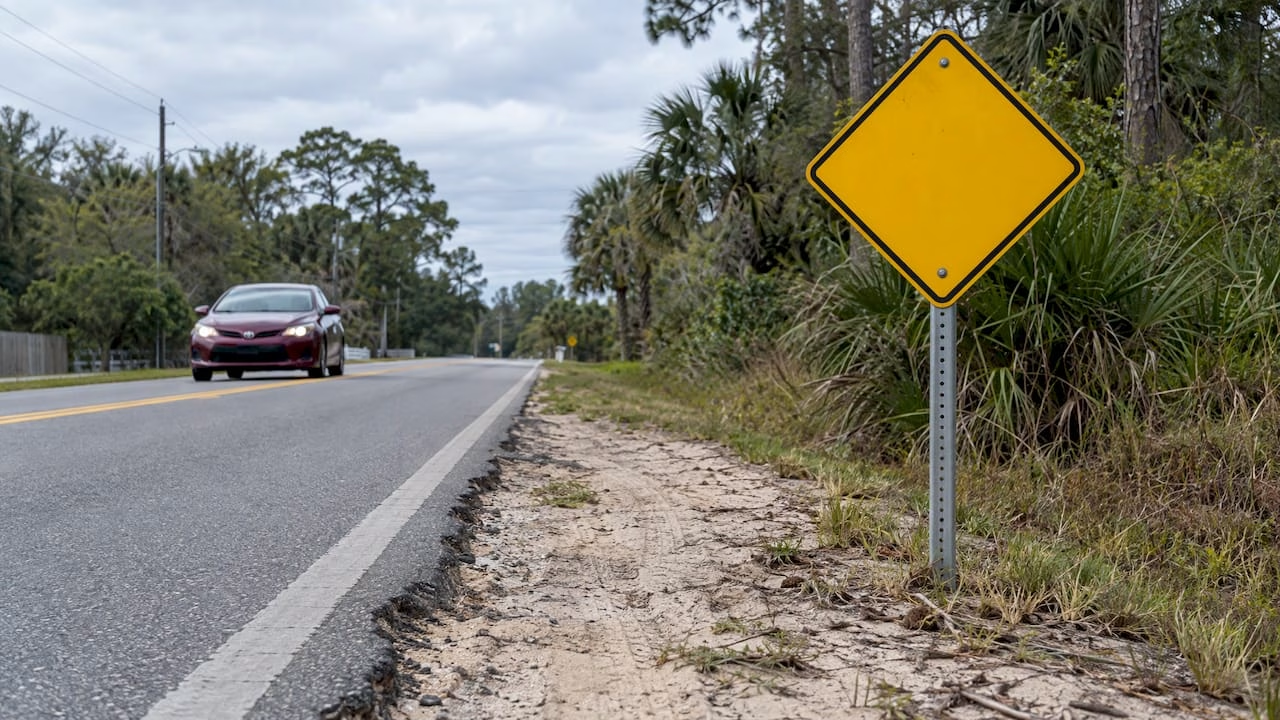
A soft shoulder sign means the ground beside the pavement is loose and may not support your vehicle, so you should stay on the road and use the shoulder only in an emergency. The Georgia Department of Driver Services manual describes it exactly that way. Knowing this sign, and what to do if your tires slip off the edge, is the kind of road-sign knowledge we teach in our state-approved Florida courses, which you can take on any device at your own pace.
Key Takeaways
- A soft shoulder sign warns that the roadside surface is soft or unstable. Keep your vehicle on the pavement unless you have an emergency.
- The federal sign standard, the MUTCD, treats the soft shoulder sign as optional for road agencies, so a soft shoulder can exist without a sign. Treat every unpaved edge with care.
- A soft shoulder is about what the ground is made of. A low shoulder or shoulder drop-off is about a height difference between the pavement and the edge.
- If your wheels leave the pavement, ease off the gas, grip the wheel, do not brake hard or jerk the wheel, slow down, check traffic and steer back gently.
Table of Contents
- What the soft shoulder sign means
- What the sign looks like and who puts it up
- Why a soft shoulder is dangerous
- Soft shoulder, low shoulder and shoulder drop-off: what is the difference?
- How to drive when you see the sign
- If your wheels leave the pavement: step by step
- Why this matters for tests, tickets and insurance
- Take a state-approved course that covers the signs you need
- FAQ
- Sources
What the soft shoulder sign means
The shoulder is the strip beside your travel lane. On many roads it is paved and built to carry a stopped vehicle. On others it is plain dirt, sand, gravel or grass. A soft shoulder sign tells you this edge is the second kind, and that it may give way under the weight of a car or truck.
State driver manuals put it simply. Georgia’s manual says the sign means the shoulder of the road is soft and you should drive on it only in an emergency. That is the working rule for every driver: the sign is not a suggestion to slow down for the next mile, it is a message about where not to put your tires.
So when you see it, you do three things:
- Keep your vehicle fully inside your lane.
- Avoid pulling onto the edge to pass, to let traffic by, or to check your phone.
- Save the shoulder for a true emergency, such as a mechanical failure, and then move slowly and with your hazard lights on.
What the sign looks like and who puts it up
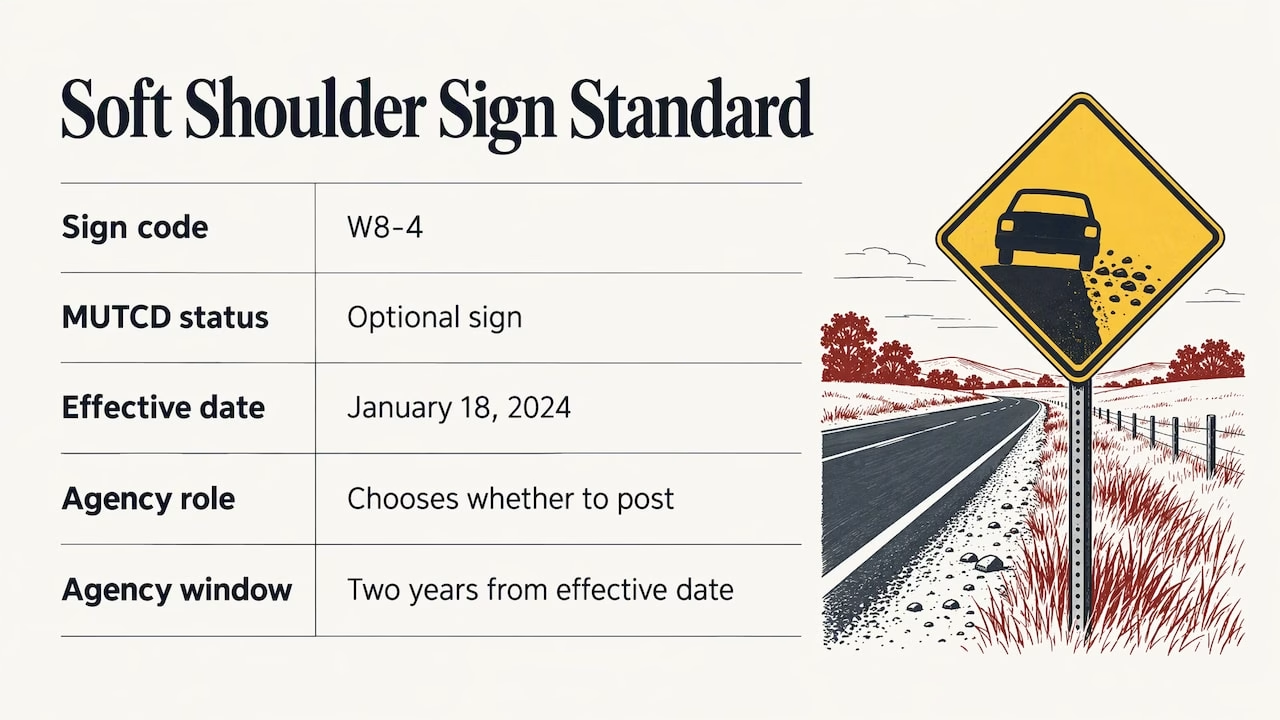
Soft shoulder signs are warning signs, and warning signs in the United States are designed to be noticed before the hazard, so you have time to adjust. The national standard is the Manual on Uniform Traffic Control Devices (MUTCD), published by the Federal Highway Administration. The 11th Edition took effect on January 18, 2024, and it lists the SOFT SHOULDER sign, coded W8-4, as an optional sign that may be used to warn of a soft shoulder condition.
That word “optional” matters to you as a driver. The standard lets road agencies decide when to post it. Agencies had two years from the effective date to adopt the new edition, adopt it with a state supplement, or keep a state-specific manual. In practice, the wording and look of signs can differ a little from state to state, but the message stays the same.
The practical lesson: no sign does not mean a firm shoulder. Rural roads, roads after heavy rain and roads under construction often have soft edges with no warning at all. Read the road itself as well as the signs.
Why a soft shoulder is dangerous
Pavement is engineered to carry traffic. The edge beside it usually is not. Loose dirt, sand, gravel or mud can sink under a tire, and a tire that sinks loses traction. The wheel on the soft side drags more than the wheels on the pavement, and the car pulls toward the edge, and often toward a ditch.
The Pennsylvania driver manual describes what happens next. If you brake hard with two wheels on the pavement and two on a soft shoulder, the vehicle will probably skid out of control. The same chapter warns that a drop-off can quickly become an emergency if you do not know how to recover from it.
The Nebraska Department of Roads and State Patrol make a similar point in a driver safety brochure: thousands of motorists run off the road each year, and what you do after leaving the roadway largely decides the outcome. The drift itself is rarely the crash. The reaction is.
Conditions that make it worse
- Rain and standing water. Dirt turns to mud, and gravel shifts.
- Darkness. You cannot see where the pavement ends and loose material begins.
- Fatigue or distraction. A moment of drifting is enough to drop a tire.
- Heavy vehicles. Trucks, trailers and loaded vans sink faster.
- Narrow lanes. Oncoming traffic pushes you toward the edge.
Soft shoulder, low shoulder and shoulder drop-off: what is the difference?
These three signs sit close together in the MUTCD and are easy to mix up. A road test or traffic school quiz may ask you to tell them apart.
| Sign | What it warns about | Key detail |
|---|---|---|
| Soft Shoulder (W8-4) | The surface of the shoulder is loose or unstable | About the material, not the height |
| Low Shoulder (W8-9) | The shoulder sits lower than the road | An elevation difference of 3 inches or less, per the MUTCD |
| Shoulder Drop Off (W8-17) | A sharper drop at the pavement edge | Used where the drop-off exceeds 3 inches in depth for a significant continuous length |
The Pennsylvania manual’s signs chapter agrees: the low shoulder sign is for shoulders up to 3 inches below the road, and the drop-off sign covers more severe cases.
A useful way to remember it: soft means the ground may not hold you, low means the ground is lower than the road, and drop-off means a real step down. A shoulder can be both soft and low at once, and then both hazards apply.
Older materials may use different codes. The Shoulder Drop Off sign was W8-9a in the 2003 edition and was renumbered W8-17 in the 2009 edition, which the 11th Edition keeps. If you study from an older handbook, expect the number to differ while the meaning stays the same.
How to drive when you see the sign
The sign gives you advance notice. Use it.
- Check your lane position. Center the car in the lane, not hugging the right line.
- Look farther ahead. Scan for curves, oncoming trucks and anything that might push you toward the edge.
- Hold your speed steady. Sudden braking or swerving is how a small drift becomes a loss of control.
- Do not use the shoulder to pass or to yield. If you need to let a vehicle go by, slow in your lane.
- Keep your hands on the wheel and your eyes on the road. Phones and soft shoulders do not mix.
These habits are the core of defensive driving. Our guide to the key elements of defensive driving covers lane position, following distance and space management in more depth.
If your wheels leave the pavement: step by step
Even careful drivers drift. What matters is a calm, practiced response. The Pennsylvania driver manual gives a clear sequence for a vehicle that drifts onto a soft shoulder, and the Nebraska and Montana guidance and the U.S. Army’s wheeled vehicle manual agree on the main points.
- Ease off the gas. Do not slam the brake pedal.
- Grip the steering wheel firmly. The soft edge will tug the car sideways, so hold your line.
- Steer straight along the edge. Pennsylvania’s manual tells you to steer parallel to the roadway, straddling the drop-off edge.
- Slow down. The manual says to get below 25 mph, preferably closer to 10 mph.
- Check for traffic ahead and behind before you move.
- Steer back gently. Once you are slow and the road is clear, turn the wheel to bring the tires back onto the pavement.
The U.S. Army Manual for the Wheeled Vehicle Operator adds a useful detail for the return: when your speed is under control and it is safe, turn the wheel about a quarter turn so the tire can climb the pavement edge and get back on the road. It also advises moving the off-road tires out about one and a half to two feet from the pavement edge first, and avoiding braking if possible.
The mistakes to avoid
- Yanking the wheel back at once. A sharp turn can throw the car across the lane and into oncoming traffic.
- Braking hard. With uneven grip on each side, the car can spin.
- Overcorrecting at speed. Slow first, steer second.
- Panicking about the drop. Most recoveries are uneventful if you stay smooth.
If you want to practice thinking through moments like this before they happen, our article on handling emergency situations on Florida roads walks through them.
Why this matters for tests, tickets and insurance
Warning signs show up on written exams, in driver improvement courses and in the way a driver is judged after a crash. Failing to keep your vehicle in the lane, or reacting badly to a roadside hazard, can end in a traffic violation. Understanding what each sign asks of you is part of keeping your record clean.
That is true whether you are a new driver preparing for the permit test, a ticketed driver who needs a court-approved course, or someone looking for an insurance discount. Our page on Florida signs, signals and roadway markings covers the warning signs you are expected to know, and our guide to defensive driving test questions and answers helps you check yourself.
For fleet managers, shoulder drift is a recurring risk for heavy and loaded vehicles. A short refresher on sign meanings and edge recovery fits well into a driver safety meeting.
We build our courses in-house, with certified educators and safety specialists, because a driver who understands a sign reacts better than one who has only memorized it.
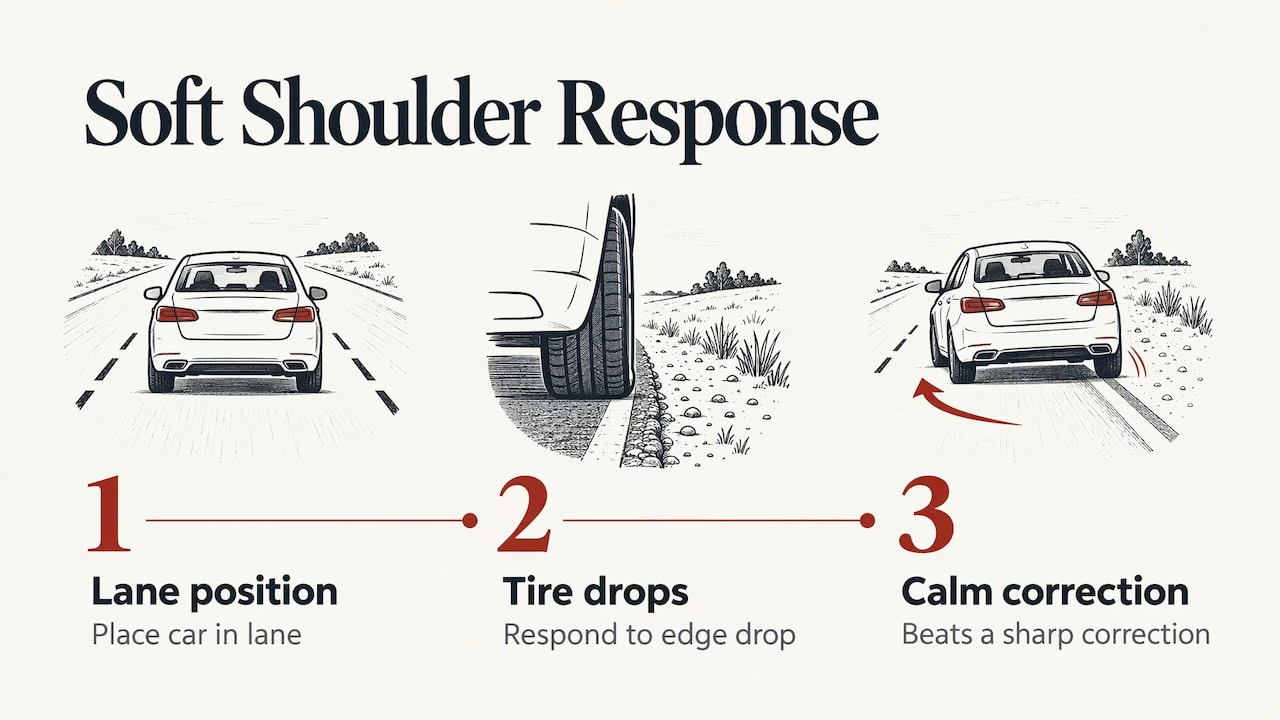
The soft shoulder sign is a good example. It is a few words on a yellow board, but behind it sits a whole chain of decisions: where to place the car in the lane, how to respond when a tire drops off the edge, and why a calm correction beats a sharp one. We teach signs together with the habits that go with them, so you can use them at 55 mph, not only on a quiz.
Our courses are designed to be completed on your phone, tablet or computer at your own pace, with multilingual read-along features that make the material easier to follow. If you learn better by listening while you read, that option is there for you.
the author
Take a state-approved course that covers the signs you need
If a sign question on a test, a ticket or an insurance requirement brought you here, a state-approved course gets you the knowledge and the paperwork in one place. Our Florida courses include the Basic Driver Improvement course for $30, the Driver Education Traffic Safety course (DETS) for $29.90, the Traffic Laws Substance Abuse Education course (TLSAE) for $29.95, the Wireless Devices Distracted Driver course for $24.50 and the Mature Driver Insurance Discount course for $14.50. Pricing is transparent, with no hidden fees and a money-back guarantee.

See every option on our Florida courses page, or read more about the Basic Driver Improvement course if a ticket is what brought you here. Fleet managers can ask about a custom fleet safety course.
FAQ
What does a yellow soft shoulder sign mean?
It means the shoulder beside the road is soft, so you should stay on the pavement and use the shoulder only in an emergency. Yellow is the color used for warning signs, which tell you about a hazard ahead rather than a rule you must obey. Slow smoothly if needed and keep your car centered in the lane.
Is a soft shoulder the same as a low shoulder?
No. A soft shoulder is about loose or unstable ground. A low shoulder is about a height difference of 3 inches or less between the road and the edge, and a shoulder drop-off is a deeper step down than that. Both low and drop-off hazards can also be soft, so the safest answer to any of them is to stay on the pavement.
Do soft shoulder signs always appear where the shoulder is soft?
No. Under the MUTCD the soft shoulder sign is optional, so a road agency may or may not post it. Rain, construction and erosion can also soften an edge that was firm last week. Treat unpaved edges with caution whether or not a sign is there.
What should I do if my tires go off the road?
Ease off the gas, grip the wheel firmly and steer straight along the edge without braking hard. Slow down, ideally below 25 mph and closer to 10 mph if you can, check for traffic and steer back onto the pavement gently. Avoid a sharp turn of the wheel, which can send the car into the next lane.
Can I use the soft shoulder to stop if I feel unwell or my car breaks down?
Yes, an emergency is exactly the case the sign allows. Move slowly, turn on your hazard lights and pull as far off the travel lane as you can. If you feel the ground giving way, stop moving the wheels and call for help rather than trying to drive out.
Sources
- Section 7 Continued: Warning Signs, Georgia Department of Driver Services
- MUTCD 11th Edition, Chapter 2C, Federal Highway Administration
- Chapter 2: Signs, Pennsylvania Driver’s Manual
- Chapter 3: Special Circumstances and Emergencies, Pennsylvania Driver’s Manual
- Manual for the Wheeled Vehicle Operator, U.S. Army
- Nebraska Department of Roads and State Patrol driver brochure
Recommended
- Road Safety Signs: Your Complete Guide
- Traffic Sign Meanings: Understand the Symbols for Safer Driving
- How to Read Road Safety Signs and Symbols
- Yield Sign Meaning: A Complete Driver’s Guide
This article is provided for general information and is not a professional advice.