The citation is still on the counter. You’ve read it twice, checked the traffic school box, and now you’re searching for what the final exam looks like before you hand over a card. That’s the right order.
Here’s the short answer. The BDI course final exam is the assessment that closes Florida’s four-hour Basic Driver Improvement course, and the course doesn’t count as finished until you pass it. The exam itself isn’t the hard part. The hard part is that exam rules change from school to school, and the court’s completion window keeps running while you sort that out.
Two gates stand between you and a clean record: passing the assessment, and getting proof of completion to the clerk before the court’s date. Miss either one and the points land anyway. Most comparison pages explain the first gate and stay quiet about the second, which is exactly where drivers lose the benefit they paid for.
What Your BDI Final Exam Looks Like
Start with the format question, because it’s where students burn the most time.
Florida doesn’t impose one exam template on approved BDI schools. Each provider designs its own final assessment, and public course descriptions prove how wide the gap runs. The Safe2Drive Florida traffic school FAQ lays out the conflict directly: one course describes a 40-question multiple-choice exam with an 80% passing requirement, another says there’s no final exam and relies on chapter quizzes, and a third uses essay questions that staff review by hand. Search “BDI course final exam” and you’ll get an answer that’s accurate for one school and misleading for the next.
The 40-question format you keep seeing belongs to a different course
The number is real. It just may not be yours.
FLHSMV reports that its Driver Education Traffic Safety course final exam contains 40 questions and requires a score of 80% to pass (FLHSMV DETS exam FAQ). That course is a 6-hour program for qualifying applicants under 18 (FLHSMV DETS course page). Adults resolving a moving violation take BDI, not DETS. Ask your school for its own question count instead of borrowing one from a first-time-driver program.
Compare the three designs before you pay
| Exam design | Questions and pass rule | Retake and review | Confirm before enrolling |
|---|---|---|---|
| Multiple-choice final exam | 40 questions, 80% to pass | Retake limit set by the school; a failed attempt is not refunded | Retake limit, identity check, certificate timing |
| Chapter quizzes, no final exam | Quiz scores per chapter | Quiz retakes are school-set; there’s no final to retake | Whether any quiz must be passed to finish |
| Essay questions with manual review | Written answers, staff scored | Manual review | Review turnaround and passing standard |
Read the table one row at a time. A multiple-choice final rewards fast recall, so you can finish the course and test the same evening. The chapter-quiz design spreads the pressure across the course, which means a weak chapter slows you down early instead of at the end. Manual essay review adds a human delay between finishing and having a certificate, and that delay eats into a court deadline you can’t move.
One more check to expect: identity validation. Students must pass validation requirements during the course, which can include biometrics, security questions, or other required methods. Do it early, not on the night you planned to finish.
Before you enroll, get four answers in writing: the question count, the passing threshold, the retake policy, and when the certificate is released.
Public sources still leave real questions open, and you should ask them out loud: does a failed attempt reset the entire course, can you pause safely and come back, do mobile devices and screen readers work with the exam, and are Spanish and Portuguese versions using translated exam questions rather than translated menus? Unlimited retakes calm nerves, but they also tempt students to hunt answers instead of learning the material.
What the Exam Tests on Distraction and Impairment
The exam measures judgment under two conditions Florida tracks closely: a phone within reach and alcohol in the blood.
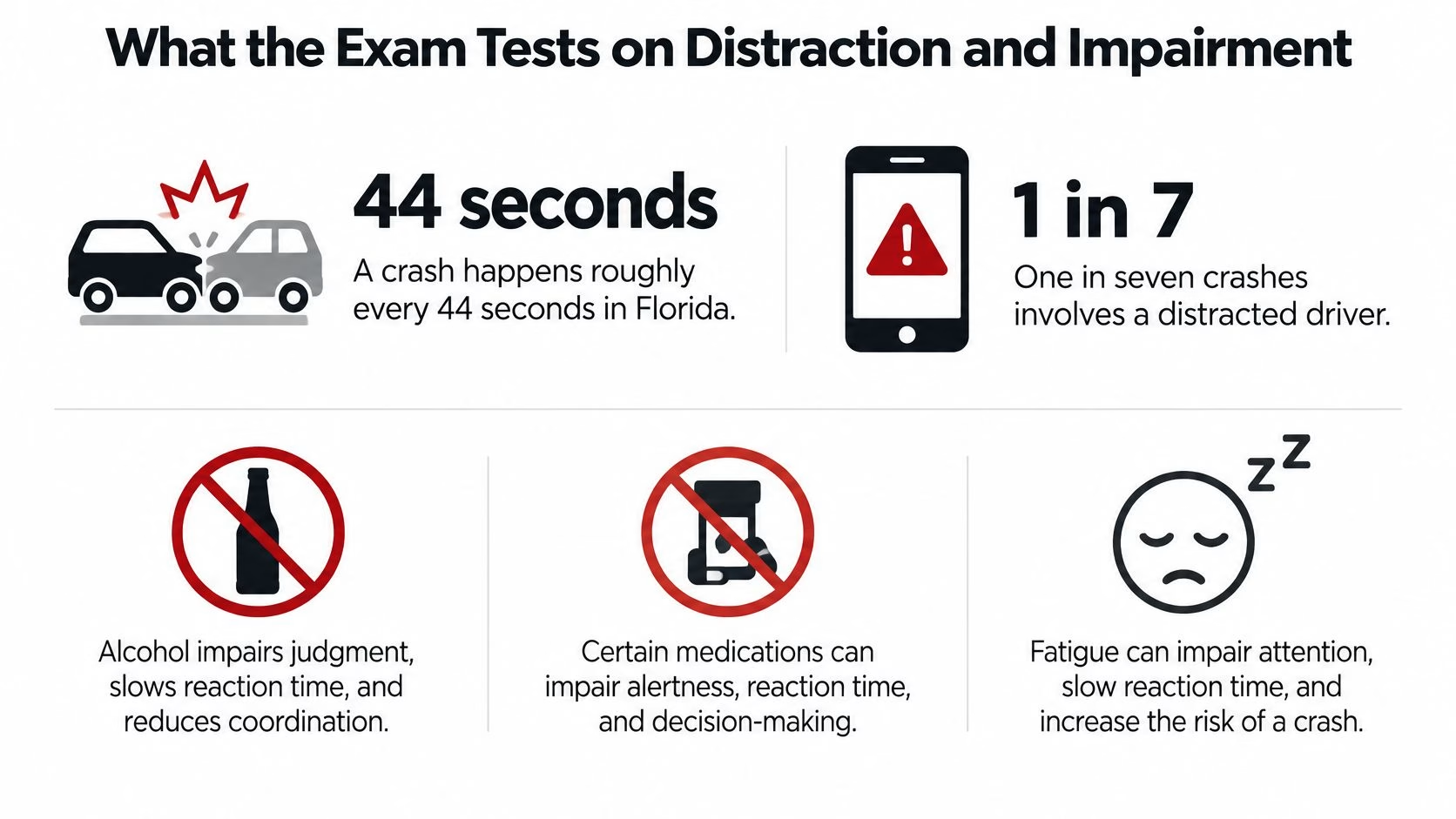
Distraction gets the most exam space because it is the risk students underestimate. The FLHSMV distracted driving campaign release reports that a crash happens roughly every 44 seconds in Florida, and that one in seven crashes involves a distracted driver. Those two figures explain why nearly every BDI module opens with attention management instead of road signs.
Behind those figures sit the injuries and deaths the state counts every year. That weight is why the topic keeps surfacing in questions across the modules rather than appearing once and disappearing.
The scale is easier to hold in your head as a picture.
Age matters here too. The state’s crash records consistently flag younger drivers as the group most likely to be distracted at the moment of impact, and the exam mirrors that by pressing hard on phone habits early in the course.
Impairment questions test the decision, not the limit
Impaired-driving deaths remain a large share of Florida’s traffic fatalities year after year, and the exam treats the topic accordingly. Expect questions on reaction time, judgment, and the decision point where a driver should have handed over the keys.
Turn each topic into an action rather than a rule:
- Attention management: what you do with the phone before the car moves.
- Device restrictions: officers can stop a vehicle solely for prohibited device use while driving, so know what counts as prohibited.
- Sober driving: the plan you make before drinking.
- Hazard recognition: scanning far enough ahead to see the problem developing.
- Decision-making: the choice made three seconds before the collision.
For every topic on the exam, ask what action prevents the crash. The rule tells you what’s illegal. The action tells you what to do at 70 mph.
Weak answers here cost more than a missed point. The course runs four hours and your court completion window keeps shrinking while you study, so every module you have to repeat eats time you cannot get back.
The device questions trip up more students than any other category. If you want the practical version, work through how to avoid distracted driving before you sit the exam. It reframes the rules as habits, which is exactly what the questions reward.
How to Prepare for the Final Exam Step by Step
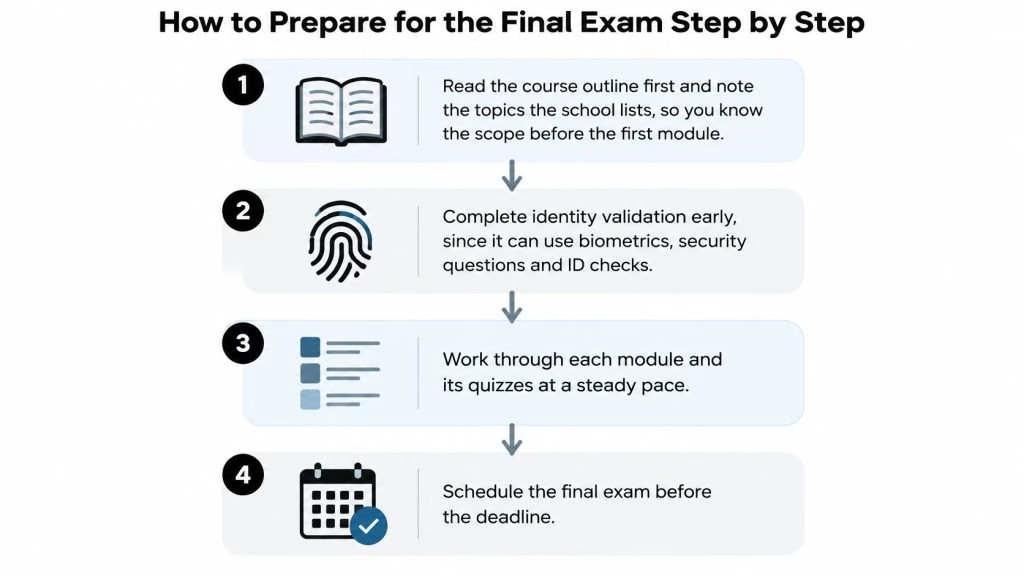
Preparation beats cramming here, because the exam tests judgment and not vocabulary. Work the sequence below and you’ll walk into the assessment already knowing how you’ll answer.
-
Read the course outline before module one. Note every topic the school lists and how many modules cover it. You’re building a map, so nothing on the exam arrives as a surprise.
-
Clear identity validation on day one. Biometrics, security questions, or other required methods can stall a course at the worst moment. Fixing a mismatch on the final night costs you days you may not have.
-
Study the distraction and impairment modules in one sitting. These topics carry the emotional weight of the course and anchor a large share of the questions. Read them together so the risk statistics and the driving behaviors connect.
-
Take notes on right-of-way rules and following distance using a real intersection. Pick the intersection you drive through daily and walk through who yields and why. Concrete examples stick better than definitions you highlighted.
-
Review each chapter quiz and ask why the right answer is right. If your course uses chapter quizzes, treat each one as a preview of the final. The wrong answers teach faster, because they show you the reasoning trap the exam will reuse.
-
Sit the final only when you can explain the attention rules without notes. Say them out loud: phone out of reach, eyes up, scan far, leave space. If you can’t explain it plainly, you’ve memorized the module, not the material.
-
If you fail, read the retake policy before you do anything else. Retake rules and fees come from the school’s own course guidelines, and no refund is issued for failing a final exam or other in-course assessment requirement. Knowing the terms keeps a bad night from becoming a lost election.
Here’s the reasoning behind the order. The exam measures whether you’d make a safer decision in the driver’s seat, not whether you can recite a statute. Studying in sequence builds that judgment, and judgment is what the questions are built to detect.
One habit that keeps the schedule honest: put your exam date on something you see every day. If paper notes disappear on you, visual countdown widgets by Pretty Progress put the remaining time on your screen, so the court’s window stays in view while you work through the modules.
Who Qualifies to Elect a BDI Course
The citation doesn’t make you eligible. Eligibility is a set of conditions you clear before the course can help you, and clearing them in the wrong order wastes the fee.
BDI is a regulated mechanism for handling eligible citations. Florida lets a driver with a qualifying noncriminal moving violation complete an FLHSMV-approved BDI course instead of having points assessed, but only if the driver doesn’t hold a commercial driver license and the violation isn’t excluded by law. The election must be made within 30 days of the citation, with the fine and fees paid in that same period and the appropriate court notified.
The three disqualifiers that end the conversation
- A commercial driver license. FLHSMV’s guidance on questions about driving records confirms a CDL holder cannot use driver improvement school to avoid points on a Florida citation. There is no workaround, so read what Florida’s CDL rules mean for traffic school before you pay for anything.
- Exceeding the limit by 30 mph or more. Under Florida’s driver improvement school rules, a driver cited for going 30 mph or more over the limit generally can’t elect BDI. Read the cited speed on the ticket, not what you think you were doing.
- Criminal violations. BDI handles noncriminal moving violations. Reckless driving and DUI go through a different process entirely.
Frequency matters too. Florida limits the election to once in any 12-month period and caps the total number of elections a driver can use over a lifetime.
Say a driver elects BDI for a speeding ticket in March and picks up a second ticket in November of the same year. That’s eight months later, so the second election is blocked by the 12-month rule no matter how quickly they enroll. Points follow, and the course can’t stop them.
Qualifying only gets you in the door. Keeping the benefit requires passing the course’s final exam and its identity validation checks, which can include biometrics or security questions, and no refund is issued for failing either one. A driver who qualifies on paper but trips an exam rule or a validation check loses the election just as surely as a driver who never qualified.
The cheapest mistake to avoid is enrolling before you’ve checked three things on the ticket: the violation type, your license class, and your last election date.
Answer these four questions before you pay a school:
- Is the violation noncriminal?
- Do I hold a commercial driver license?
- How far over the limit was I cited?
- Have I used an election in the last 12 months?
If any answer rules you out, stop. Other states run their own versions of this bargain, and the Texas ticket dismissal options 2026 show how differently another state structures the same deal for drivers who move or travel.
Deadlines That Decide Whether BDI Protects Your Record
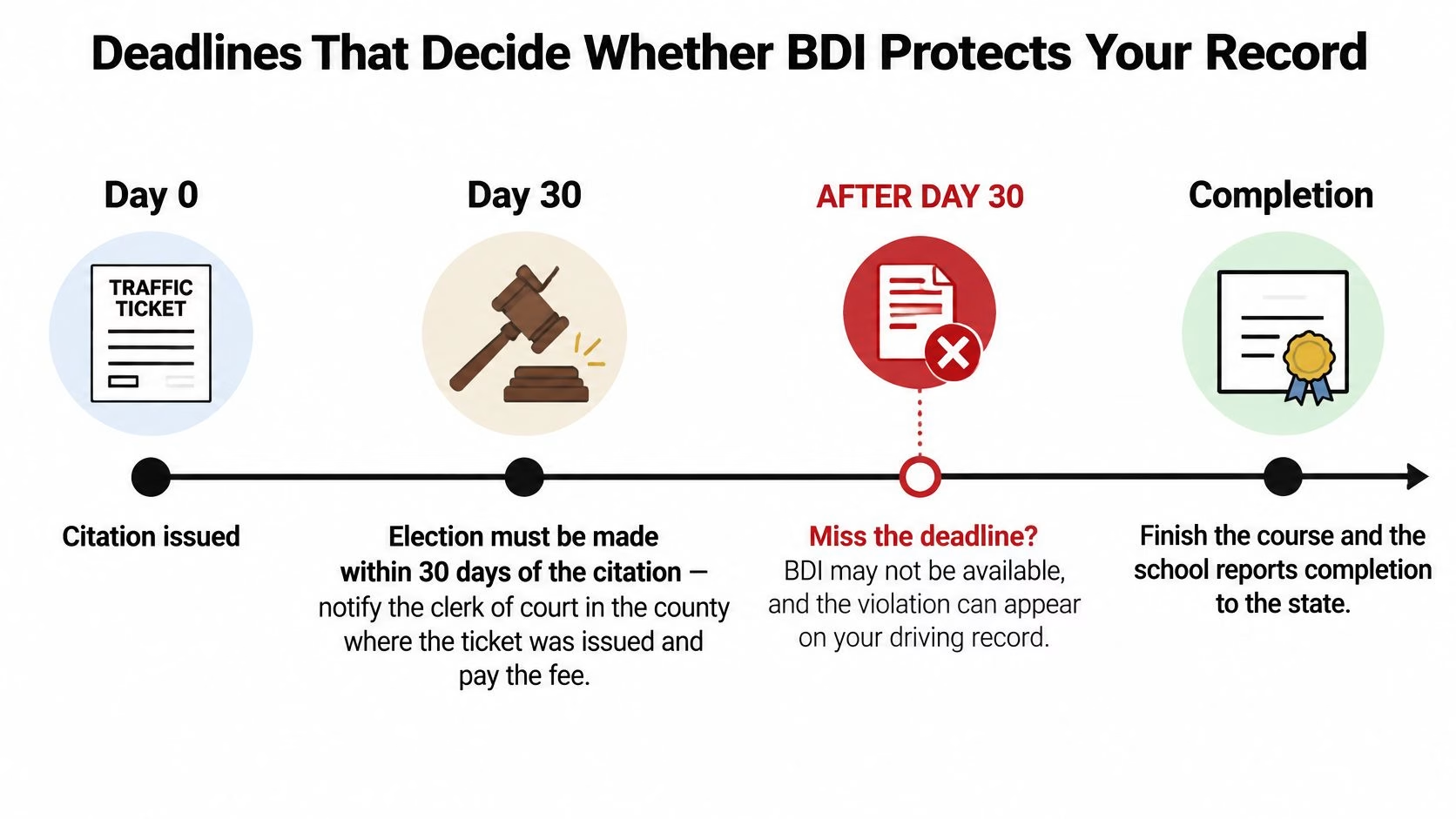
Two dates control everything: the election deadline and the completion window. Confuse them, or let either one slip, and the ticket wins.
The election goes through the clerk of court in the county where the citation was issued (FLHSMV BDI provider listing). You notify the clerk and pay the required election fee within 30 days of the citation date, and you do it before you attend the course, not after. Miss that window and the right to elect BDI is gone, points may be assessed, and an unpaid fine can lead to a license suspension.
| Rule | Limit | What happens if missed |
|---|---|---|
| Election deadline | Within 30 days of the citation date | Election forfeited and points may be assessed |
| Clerk notice and election fee | Filed and paid before attending the course | Right to elect BDI is lost |
| Fine and fees | Paid within the same 30 days | License suspension may follow |
| Course completion window | Generally 60 to 90 days after notifying the clerk | Driver is treated as admitting the infraction and adjudicated guilty |
| Civil penalty reduction | 18% off the civil penalty when BDI is elected | Full civil penalty applies |
The completion window is the deadline students forget. Florida’s driver improvement course FAQ states that after notifying the clerk, drivers generally have 60 to 90 days to finish the course and present proof to the clerk. Pay the civil fine but miss that court-specified period, and you’re treated as having admitted the infraction and adjudicated guilty.
That’s the trap in plain terms. You did the work, you passed the final exam, and the conviction still lands because the certificate showed up late. The exam checks your knowledge; the calendar decides whether that knowledge counts.
Practical rule: treat the court’s completion date as three weeks earlier than it reads. Certificate delivery, name mismatches, and a slow review queue all eat days you budgeted for studying.
A separate rule applies if your situation involves a crash. In 2024, the Florida Legislature specified that drivers required to complete certain department-approved improvement courses after a qualifying crash must do so within 90 days of receiving notice (Florida Statutes, 2024). That’s a court-ordered path, not an elective one, and the clock starts from the notice.
Run your own countdown in three steps. Mark the election deadline on your calendar the day you get the ticket. File with the clerk and pay in the same visit. Then register for a course you can start immediately, because the hours you spend deciding are hours the completion window spends too. If you’re unsure how the four required hours fit around a job, what the course hours actually involve shows how the time divides.
What Happens After You Pass and How It Gets Reported
Passing the exam finishes the course. It doesn’t finish the ticket.
Stage one: you pass the final exam and any other in-course assessment the school requires. That closes your coursework and earns you the certificate.
Stage two: the school reports completion, and your certificate of completion is generated from the details you entered at registration. Name, driver license number, email address. That’s the record the court will match against.
Stage three: you file the certificate with the clerk of court. The election isn’t finished until the court has it, and finishing the online exam alone doesn’t replace those court-reporting obligations.
Stage four: you confirm the clerk received it, before the completion window shuts.
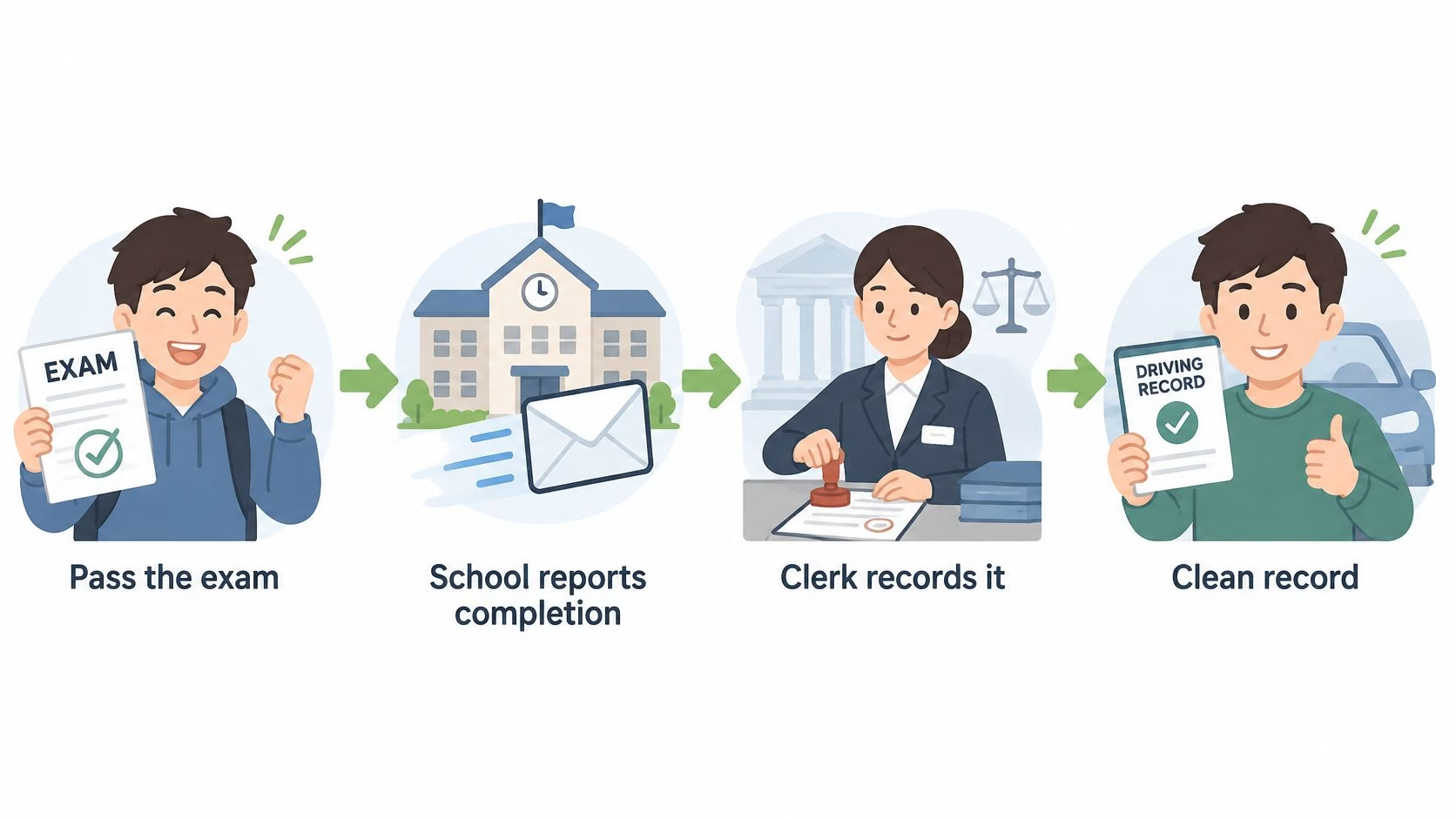
A typical run looks like this. A student finishes the final exam on day 40, the school reports completion, and the certificate is available the same day. They file proof with the clerk on day 42, well inside a 60-day window, and keep a copy of the receipt. No drama, no extension requests.
The failure mode is almost always administrative. A certificate issued to “Mike Alvarez” against a license that reads “Michael R. Alvarez” can stall a filing while someone verifies it. Check the spelling the moment the certificate appears.
- Confirm the name matches your driver license character for character.
- Confirm the email on your account, since that’s where the certificate goes, and a mistyped address is a silent delay.
- Save a copy of the certificate to your phone and your email.
- Confirm the clerk received it, and ask for the case status rather than assuming.
If you want to verify the state side yourself, how to check your Florida traffic school completion walks through what the record should show. Note that once completion has been reported to FL HSMV, no refund is issued, so get the registration details right the first time. We don’t sell or share the information you enter, except as needed to fulfill a request, such as reporting completion to an insurance carrier.
Start Your BDI Course and Finish Before Your Deadline
You know the format, the topics, and the dates. All that’s left is the decision, and it’s a simple one: register with a Florida-approved school now, while the completion window still has room in it.
The four-hour course runs online, so you can work through modules at your own pace instead of rearranging a week around a classroom. That flexibility is the whole reason an online course fits inside a court deadline. Start tonight, finish in one sitting, or split it across evenings.
Choosing a school is the only real decision. Register for Florida’s Basic Driver Improvement course through the BDISchool course list, or compare program options at Driver Educators if you want to see how the courses differ.
What you get at the end is the part that matters. Completing the approved course means points are withheld from your license, provided you submit proof of completion as required. The reduced civil penalty and the withheld points both depend on finishing and filing, and you still owe applicable court costs. Passing the exam online doesn’t replace the certificate you hand to the clerk (FLHSMV traffic citations).
Here’s your sequence, in order:
- Check the citation date and mark your election deadline.
- Notify the clerk and pay the election fee.
- Register for the course on BDISchool’s course page.
- Clear identity validation and pass the final exam.
- Confirm the clerk received your certificate.
Skip step two and nothing else counts. Skip step five and you’ve paid for a course that doesn’t protect your record. Everything in between is four hours of reading and one assessment you now know how to prepare for.
One warning on step four. Identity validation can include biometrics or security questions, and failing it means no refund, same as failing the final exam itself. Answer those checks carefully the first time.
BDISchool’s Florida Basic Driver Improvement course covers the topics the final exam draws on, including attention management, impairment, and right-of-way rules, and it’s approved for all Florida courts and counties. You can register and start today, work at your own pace in English, Spanish, or Portuguese, and finish well inside your court’s window. Visit BDISchool to enroll and get your certificate moving before the deadline does.