A citation sits on the kitchen counter, your renewal notice is already in the mailbox, and the next insurance bill looks higher before you’ve even opened it. That’s when most Florida drivers search for a safe driving insurance discount. They’re not looking for another vague promise. They want a lawful, documented way to reduce the damage and protect the policy they still need.
Florida gives you a practical route through an FLHSMV-approved driver improvement course. The course certificate creates the proof your insurer needs, while Florida Statute 627.06501 provides the framework for applying an eligible premium reduction. The process isn’t magic, and it isn’t automatic, but it is clear when you handle each step correctly.
The Moment Most Florida Drivers Start Searching for a Discount
The search usually begins after a moving violation, an insurance notice, or both. A citation can threaten points, increase your underwriting risk, and create pressure around an SR-22 filing when one is required. Then the renewal quote arrives, and the premium spike turns an already frustrating event into a monthly budget problem.
Drivers often search for “safe driving insurance discount” because they assume the insurer has the final word. The insurer does set the premium under its underwriting rules, but you can give the company documented evidence that supports a reduction. That evidence is usually a certificate from an approved course, not a phone call asking for a favor.
If your concern started with a ticket, review this practical guide on what happens to insurance after a ticket. A course may address a traffic-school obligation, help with point-related consequences where permitted, or support an insurance discount. Those are separate outcomes, so you need to identify which one you’re pursuing before registering.
The Florida mechanism in plain English
Florida Statute 627.06501 authorizes an insurance premium reduction for a driver who completes a DHSMV-approved driver improvement course. The statute says the reduction is presumed appropriate up to 10%, unless credible data supports a different treatment, and the reduced premium may continue for 3 years after completion. Read the statutory framework.
That doesn’t mean every driver receives the same result. Your insurer determines the applicable amount, verifies eligibility, and may require that you have no at-fault crash or moving-violation conviction during the discount period. The finish line is simple: choose the correct approved course, complete it, obtain the certificate, and submit it to the insurer promptly.
Practical rule: Don’t wait for the next renewal notice. Start the documentation process as soon as you know which course and discount pathway apply to you.
What a Safe Driving Insurance Discount Actually Means
A safe driving insurance discount is a premium reduction an insurer applies after you provide acceptable proof of qualifying driver education. It isn’t the same as a traditional safe-driver rating based on a clean claim and violation history. One reflects a course completion. The other reflects how the carrier evaluates your record over time.
Florida Statute 627.06501 connects the course certificate to the pricing decision. The statute establishes a regulated mechanism for a premium reduction and requires the reduction to be handled and disclosed according to the insurer’s policy practices. That makes the certificate more than a school receipt. It becomes a document you can use to request a specific policy adjustment.
Why the certificate matters
The insurer normally needs to match the certificate to the named insured or eligible driver, confirm that the provider and course are approved, and verify the completion information. Once accepted, the discount should appear in the policy’s declarations or discount details, although the exact label varies by carrier.
Ask the representative to confirm three items in writing:
- Effective date: The date the premium reduction begins.
- Expiration date: The date the insurer expects the discount to end.
- Eligibility conditions: Any crash, violation, renewal, or documentation rules that could remove it.
This record matters because a course-based reduction can coexist with other rating factors. A recent ticket, vehicle change, location, mileage, claim history, or driver addition may still affect the total premium. The course discount lowers an eligible part of the premium. It doesn’t erase every underwriting factor.
Your vehicle history can also influence the quote independently of your driving course. Before assuming the course will solve the whole pricing problem, see how VIN history affects premiums and separate vehicle-related factors from driver-related factors.
The right way to view the course
Treat the course as a legal pricing lever, not merely an educational checkbox. You make one documented effort, submit the result, and ask the insurer to apply the reduction under the applicable Florida rules. The protection comes from keeping the certificate, confirming the policy change, and monitoring the discount through the period stated by the carrier.
A certificate won’t guarantee that your entire bill becomes inexpensive. It does give you a concrete basis for requesting a reduction instead of relying on an unsupported appeal to customer service.
How Telematics Discounts Compare to Course-Based Discounts
Telematics programs measure driving behavior through an app, plug-in device, or connected vehicle system. Common inputs include hard braking, speed, acceleration, cornering, nighttime driving, phone use, and mileage. Insurers then use that information to adjust pricing based on monitored behavior. See how telematics and AI affect insurance rates and privacy.
A course-based discount works differently. You complete an approved course and submit proof. The result isn’t recalculated after every commute, late-night trip, or emergency stop. Telematics can reward sustained smooth driving, but it also requires you to accept ongoing monitoring and the possibility that the final discount changes with the data.
| Factor | Course-Based Discount | Telematics Discount |
|---|---|---|
| How you qualify | Complete an approved course and submit the certificate | Enroll in a monitoring program and share driving data |
| What is measured | Course completion and insurer eligibility rules | Braking, speed, mileage, phone use, time of day, and other behaviors |
| Pricing behavior | Generally more predictable after approval | Can change with monitored driving patterns |
| Privacy | Requires course and policy documentation | Requires continuing collection of driving information |
| Best fit | Drivers who want a documented, low-monitoring option | Drivers comfortable with tracking and confident in consistent habits |
The mistake is assuming the advertised maximum is your expected result. Consumer Reports found that the median annual telematics savings among all users was $120, while drivers under 45 saved a median of $145, drivers 45 to 59 saved $102, drivers 60 to 69 saved $115, and drivers 70 and older saved $93. The same reporting said a more typical discount is about 10%, while advertised maximums at major insurers can reach 30% to 40%, depending on the program and carrier. Review the Consumer Reports telematics findings.
My recommendation: Get the course-based discount first. Ask about telematics only after the insurer explains whether the programs can coexist and whether monitored behavior can reduce another discount.
Some carriers may allow both programs, while others may adjust discounts when telematics data shows risky driving. Ask before enabling the app, especially if you drive late, share the vehicle, travel high-mileage routes, or frequently brake hard to manage Florida traffic.
For drivers whose mileage is low, a usage-based option may be worth comparing with a course. Review this explanation of car insurance discounts for driving less before accepting a monitoring program just because its headline offer looks larger.
Florida-Approved Courses That Qualify You for the Discount
Florida drivers need to match the course to the actual problem. A citation, a court order, a second offense, an aggressive-driving requirement, and a mature-driver discount are not interchangeable situations.
The Florida Highway Safety and Motor Vehicles department identifies approved course pathways and explains how mature drivers submit completion information to their insurers. Review FLHSMV driver improvement and mature-driver requirements.
Choose by situation, not by course title
Basic Driver Improvement, or BDI, is the usual starting point for a driver with a moving violation who wants a four-hour course for an eligible court or point-related purpose. It can also be the relevant course pathway when the objective is an insurance reduction, but you should confirm the insurer’s requirements before enrolling.
Intermediate Driver Improvement, or IDI, is an eight-hour program generally associated with a second-offense or court-directed situation. Don’t choose it just because you want a larger discount. The longer course isn’t automatically the correct insurance course.
Aggressive Driver is an eight-hour program for a driver dealing with an aggressive-driving or road-rage-related requirement. It focuses on behavior, judgment, and responsibility. Confirm whether your insurer accepts that course for its premium reduction before treating completion as an insurance solution.
Mature Driver is designed for drivers aged 55 and older. FLHSMV says the driver submits the completion certificate to the insurer, and the insurer sets the discount amount. The program is a state-approved path to an insurance discount, not a guarantee of a fixed rate. Review the FLHSMV mature-driver course pathway.
| Course Type | Typical Driver Situation | Length | Insurance Discount Eligible |
|---|---|---|---|
| Basic Driver Improvement | Moving violation, eligible court election, or insurance inquiry | 4 hours | Often, subject to insurer approval |
| Intermediate Driver Improvement | Second-offense or court-directed requirement | 8 hours | Confirm with the insurer |
| Aggressive Driver | Aggressive-driving or road-rage-related requirement | 8 hours | May qualify, subject to carrier rules |
| Mature Driver | Driver aged 55 or older seeking a mature-driver reduction | 6 hours | Insurer sets the discount and eligibility |
The approval chain matters. The provider must offer a course recognized through Florida’s traffic-school system, the course must satisfy its completion rules, and the certificate must contain information the state and insurer can verify. Review the Florida BDI online course option before registering if your situation involves a standard moving violation or an insurance discount request.
Don’t miss the election deadline
If you elect Basic or Advanced Driver Improvement after a citation, FLHSMV says you must make that decision within 30 days of receiving the citation. Check the FLHSMV education-course timing rule. That deadline addresses the citation process. Your insurance discount request is a separate conversation with the carrier, so handle both instead of assuming one automatically completes the other.
How to Register, Complete, and Submit Your Certificate
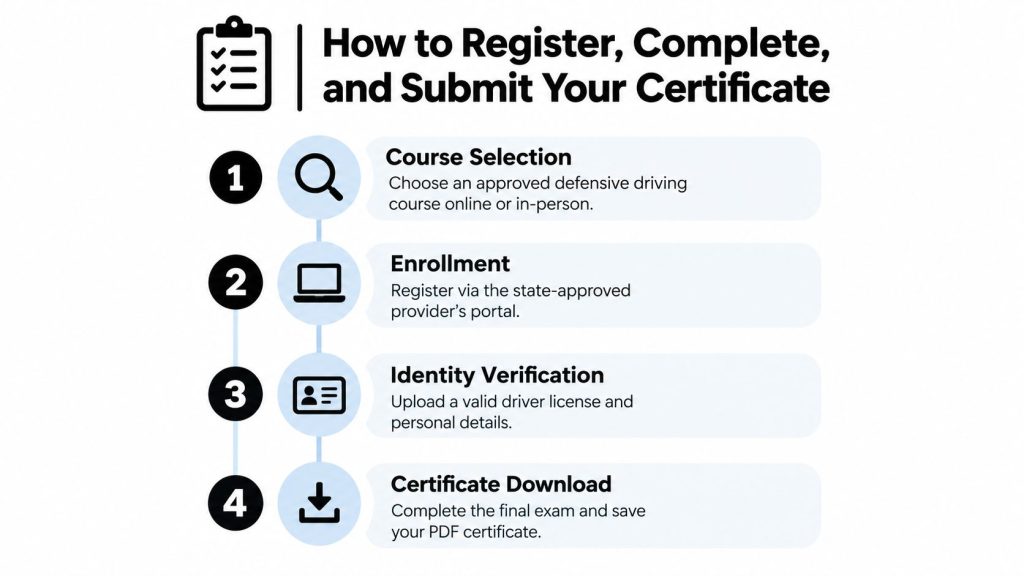
Use this order. It prevents the most common mistake, which is finishing a course without confirming what the insurer needs.
1. Confirm the purpose before payment
Call the insurer or check its discount rules first. Ask whether it accepts a Florida-approved BDI, Aggressive Driver, or Mature Driver course for a premium reduction, whether the discount applies to your policy, and whether the carrier requires a specific provider or certificate format.
If a court or clerk controls your citation option, verify that too. For an election after a citation, the 30-day FLHSMV window is not a suggestion. Use this registration guide for online traffic school and keep your citation details available.
2. Register and complete every identity step
Enter your legal name exactly as it appears on your Florida license and policy records. Complete the provider’s identity verification, use the correct email address, and don’t register under a nickname that could prevent the insurer from matching the certificate.
Online and classroom formats can have different attendance and testing rules. Follow the selected provider’s instructions, complete all required lessons, and pass the final exam or assessment. Partial completion isn’t the same as a reportable course completion.
3. Save the official certificate
Download the electronic certificate as soon as it becomes available. Check your name, license information, course type, completion date, provider details, and the electronic filing or reporting code. That code matters because it helps connect the course record to Florida’s reporting system.
Keep the PDF in two places and save the completion email. If the course is reported directly to FLHSMV, confirm that the report was submitted rather than assuming the upload happened.
4. Send it to the insurer
Use the phone number on your insurance card, the carrier’s secure upload portal, or the email address provided by the insurer. Give the representative your policy number, certificate reference or filing number, completion date, and the exact request: apply the eligible course-based insurance discount.
Ask when the change will appear and request the effective and expiration dates in writing. Carriers commonly apply policy changes within one to two billing cycles, but the insurer should tell you its own processing schedule. If the certificate doesn’t appear in the carrier’s system, send the saved PDF and ask the provider to investigate the state report. If re-issuance is needed, ask promptly because the available correction window may be limited to three months.
Keep the paper trail: certificate, submission confirmation, representative name, reference number, effective date, and expiration date. You shouldn’t have to reconstruct the request after a renewal dispute.
What Can Disqualify You After You Finish the Course
Completing the course doesn’t create permanent savings. It creates eligibility for a discount under the conditions your insurer applies, and Florida’s framework allows the reduced premium to last for 3 years when the applicable requirements continue. See the insurance guidance on defensive-driving savings.
FLHSMV says a mature-driver discount typically lasts three years when the driver has no crash cited to the insured and no moving-violation conviction or no-contest plea. Insurers may also review a course-based discount when a new event changes the driver’s eligibility.
Events that can trigger a review
A new at-fault crash is the clearest threat. Depending on the carrier’s rules, a DUI, license suspension, new points, or a serious moving violation may also cause the insurer to recalculate or remove a discount. Non-moving events are treated differently, but you shouldn’t assume that every incident is harmless without asking the carrier.
Your insurer may pull records on its own schedule or review the policy after a renewal, claim, violation, or underwriting change. The exact process varies by carrier, which is why written confirmation matters more than a verbal promise made when you first submit the certificate.
Protect the discount deliberately
Request the discount’s effective and expiration dates. Check the declarations page after the change posts, and compare the discount details at renewal. If the reduction disappears, contact the insurer with your certificate and prior confirmation before accepting the new premium as final.
Don’t wait until the last day of the eligibility period to ask about renewal or recertification. Mature-driver programs may require recurring course completion, and a carrier may have its own timing rules. Telematics can sometimes provide another savings path, but it brings ongoing monitoring and should be evaluated separately rather than used as a substitute for maintaining your record.
The course protects your pricing position only when you protect the conditions attached to it. Drive defensively, report changes accurately, and keep the documentation that proves what the insurer agreed to apply.
Start Your Course and Lock In Your Savings Today
The practical choice is straightforward. If you have a qualifying Florida situation, select the FLHSMV-approved course that matches it, complete the work, and submit the certificate before the next billing cycle. A course-based reduction is more predictable than relying on daily telematics scores, and Florida law provides the structure for an eligible discount.
Have your valid Florida license, recent citation if one exists, current policy renewal date, and a reliable email address ready. Online completion typically takes 4 to 6 hours, and online certificates arrive the same day after successful completion according to the course pathway. Submit the certificate to your insurer within the same week so the carrier has time to process the request.
For Basic Driver Improvement, Aggressive Driver, and point-reduction courses, register through BDISchool’s Florida course options. Drivers aged 55 and older should review the Florida Mature Driver course available through DriverEducators at drivereducators.com courses.
Don’t keep staring at the renewal increase and hoping it changes. Choose the correct course today, finish it carefully, and put a certificate in your insurer’s hands.
BDISchool offers Florida-approved driver improvement courses that help eligible drivers address citation requirements and request an insurance discount from their carrier. Visit BDISchool to choose the course that fits your situation and start the registration process.