
Read-along driver’s ed is a course where the lesson text is on your screen and a voice reads it aloud, so you hear and see the same material at once. It suits new drivers, people taking a course after a ticket, and anyone who retains more when they listen. The one thing to check before you enroll is that the course is approved for your purpose, whether that is a permit, a ticket, a court order or an insurance discount. Our Florida courses include multilingual read-along features and work on phones, tablets and computers.
Key Takeaways
- A read-along course pairs narration with the written lesson, so you can listen, read, or do both together.
- It is different from an audiobook: the audio is built into a course that has lessons, quizzes and a record of completion.
- Official state audio manuals exist, but they are study aids. They do not replace a state-approved course when a state, court or insurer requires one.
- Before you enroll, confirm which course your state, court or insurance company accepts, and that the provider is approved for it.
- Our Florida courses are state-approved, priced openly with no hidden fees, and backed by a money-back guarantee.
Table of Contents
- What “read-along” actually means
- How audio and text work together
- Who benefits most
- Read-along versus the other ways to study
- Does a read-along course count for a required class?
- How to study with a read-along course
- What our read-along courses offer
- Choose your course
- Our perspective
- FAQ
- Sources
What “read-along” actually means
The phrase gets used for three different things, and mixing them up is how people end up with the wrong product.
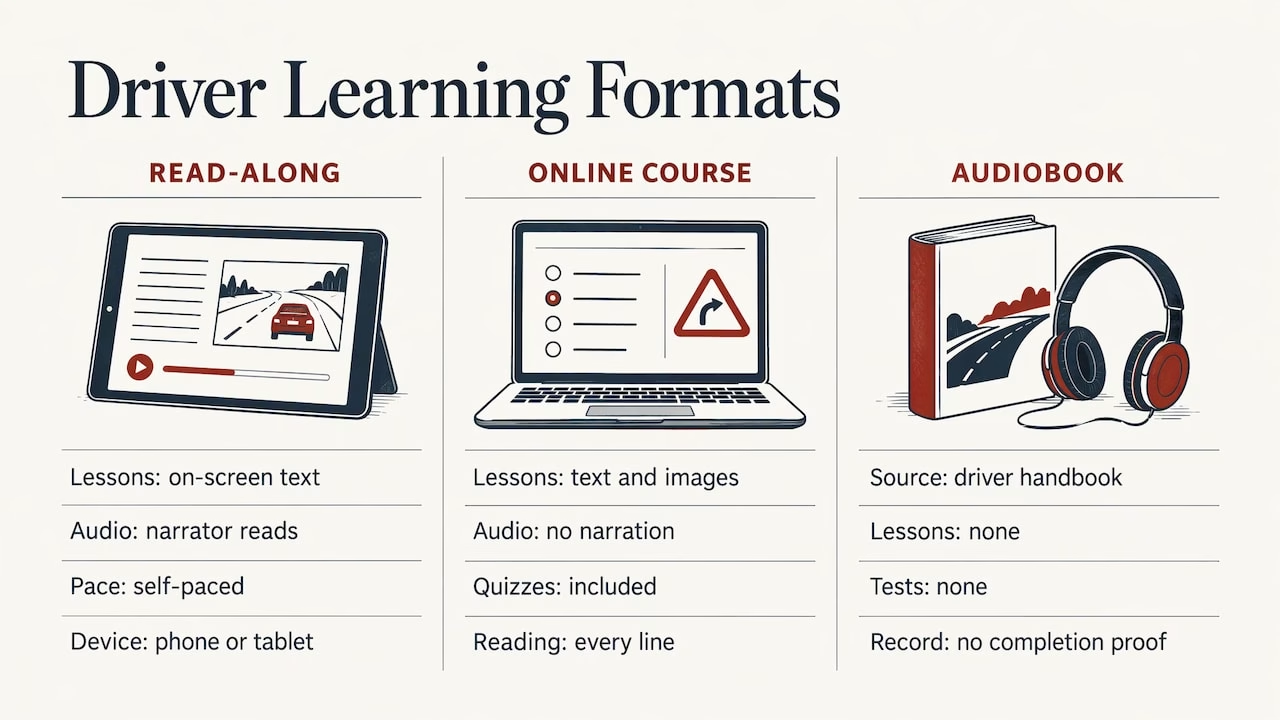
A read-along course. The lessons appear as text on screen and a narrator reads them. You follow the words while you hear them. You can usually work at your own pace, replay a section, and use the course on a phone or tablet. This is what we mean when we say our courses have multilingual read-along features.
A standard online course. Text, images and quizzes, with no narration. It works well for fast readers, but it asks you to read every line.
An audiobook of a driver handbook. A recording of a manual, with no lessons, no tests and no completion record. It helps you study, but it cannot be submitted to a court, a DMV or an insurer as proof of anything.
The difference that matters is the last one. A recording of a handbook teaches. A state-approved course teaches and also produces the completion that an authority or insurer will accept.
How audio and text work together
Pairing the two is not a gimmick. State motor vehicle agencies do it themselves, and their advice shows how to get the most from it.
- Idaho’s DMV publishes its Driver’s Handbook as MP3 files by section. The whole handbook runs 3 hours 00 minutes 12 seconds, and the page tells learners to follow along in the handbook to see diagrams and examples while they listen.
- Oregon’s DMV offers its driver manual as audio by chapter, with chapters such as Lane Travel at 32:17 and Sharing the Road at 27:01. It recommends using a printed or online copy alongside the audio to see the illustrations, and it notes that a Spanish audio manual is also available.
- Colorado’s DMV offers the standard driver handbook as a PDF plus an audiobook, and its driver education page also links an accessibility request for people who need accommodations.
- Vermont’s DMV publishes an audio version of its driver’s manual split into parts that match specific page ranges of the printed manual, so you can find your place in either format.
The pattern is the same in every state: audio carries the explanation, and the text and diagrams carry the details you need to see, such as signs, lane markings and right-of-way situations. A read-along course puts both in one place, so you are not juggling a recording and a PDF.
Who benefits most
New drivers
A first permit means absorbing a lot of rules in a short time. Listening while reading gives you two routes into each idea, which helps when a sentence about right of way or following distance is dense. You can also replay a section until it makes sense, and study on a phone between school, work and practice drives. If you are working out which steps come first, our guides on learner’s permit requirements and permit course requirements for new drivers walk through them.
Drivers who need to clear a ticket
If you took a course because of a citation, you probably want it finished and accepted, not stretched out. Narration lets you move through the material without fighting your way through long paragraphs, and a course you can open on any device fits into a lunch break or a commute. Our Florida Basic Driver Improvement (BDI) course is $30, a one-time price.
People whose court or state requires a course
A court order or a license requirement comes with a specific course name. For first-time Florida drivers, that is often the Traffic Laws Substance Abuse Education course (TLSAE, $29.95) or the Driver Education Traffic Safety course (DETS, $29.90). When an order is involved, hearing the material as well as reading it helps you take in what is being asked of you, and our Florida driver education requirements guide explains which course fits which situation.
Mature drivers
Our Florida Mature Driver Insurance Discount Course costs $14.50. Older learners often prefer a course that lets them listen at a comfortable pace instead of reading small text for hours, and the read-along format supports that. Our mature driver safety refresher guide covers the discount side in more detail.
Learners who read in another language
Spanish is a good example of why this matters. Oregon, for instance, makes a Spanish audio manual available, while Colorado’s Spanish manual is a PDF only. Our courses offer multilingual read-along features, so a learner can follow the lesson in the language they are most comfortable in.
Learners with reading difficulties or disabilities
Audio access is treated as a real accommodation by licensing agencies. Vermont’s license manual says that when a disability limits someone’s ability to read written language, the DMV will lend an audio CD of the manual, and that the exam can be given orally. If you need a specific accommodation for a state exam, ask that state’s DMV directly, since each one sets its own process.
Fleet drivers
Fleet drivers are a mixed group. Some read English fluently, some do not, and many train on a phone between routes. Narrated, mobile-friendly lessons make it easier to train a whole team to the same standard. We build custom fleet safety courses for companies that want training shaped around their drivers.
Read-along versus the other ways to study
| Option | What you get | Counts as a required course? |
|---|---|---|
| Read-along online course | Narration with on-screen lessons, quizzes, completion | Yes, when the course is approved for your purpose |
| Standard online course | Text and images, no narration | Yes, when approved for your purpose |
| DMV audio handbook | Recorded manual, no lessons or tests | No, it is a study aid |
| Printed handbook | Full rules and diagrams | No, it is a study aid |
Use the free official handbook and audio files to build background knowledge for a permit test. Use an approved course when a state, court or insurer asks for one.
Does a read-along course count for a required class?
It counts when the course itself is approved for the requirement. The narration is a delivery feature. It does not change whether the course is accepted. What decides acceptance is the approval behind the course.
Before you enroll, confirm these four things:
- The exact course name your state, court or insurer asked for. A “driver improvement” course and a “drug and alcohol” course are different requirements, even though both are online.
- That the provider is approved by your state for that course.
- Who the course is for. Some courses are for first-time license applicants, some for ticket dismissal, some for court orders, and some for insurance discounts.
- What your court or insurer needs from you, such as a deadline or a proof-of-completion step. Read the paperwork you were given, and if anything is unclear, ask the court clerk, the DMV or your insurance agent.
Requirements differ by state and sometimes by county, so the paperwork you received is the first authority. Some states also allow alternatives to a commercial school. Oklahoma, for example, recognizes parent-taught driver education with 30 hours of classroom and 55 hours of behind-the-wheel training through approved providers. Those details are state-specific and should never be assumed to apply elsewhere.
How to study with a read-along course
These habits make the format work harder for you.
- Listen and read together on your first pass. Let the narrator set the pace while your eyes follow the text. Idaho’s advice to follow along in the handbook while listening is the same idea.
- Pause at diagrams. Signs, intersections and lane layouts are easier to learn when you stop and look at them instead of only listening.
- Replay what you missed. Going back over a short section is faster than rereading a whole chapter.
- Study in short sessions. Twenty to thirty minutes at a time is easier to sustain than a single long sitting, and a course you can open on a phone makes that possible.
- Use the quizzes as a check, not a hurdle. If a question surprises you, return to that lesson and listen again.
- Keep your paperwork nearby. Note the course name, any case or citation number, and your deadline before you start, so you finish the right course on time.
If you are preparing for a permit test, our Driver Education Traffic Safety course guide explains what the course covers and how it fits the process.
What our read-along courses offer
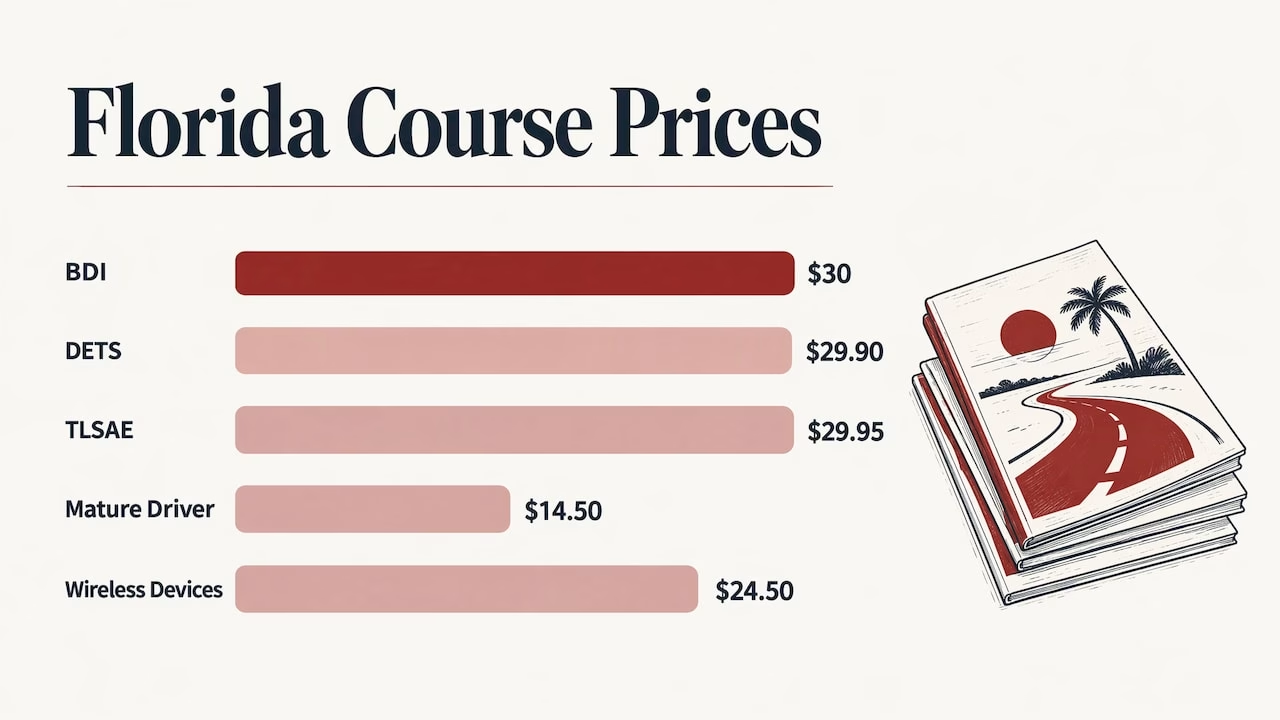 Our courses are developed in-house by certified educators and safety specialists, and the content is kept in line with statutory requirements and real-world safety. Every course is delivered online, works on any device, and includes multilingual read-along features. Pricing is published, there are no hidden fees, and a money-back guarantee backs every course.
Here are the Florida courses with published prices:
| Course | Price |
|---|---|
| Basic Driver Improvement (BDI) | $30 |
| Driver Education Traffic Safety Course (DETS) | $29.90 |
| Traffic Laws Substance Abuse Education (TLSAE) | $29.95 |
| Mature Driver Insurance Discount Course | $14.50 |
| Wireless Devices Distracted Driver Course | $24.50 |
We also offer the Florida Intermediate Driver Improvement Course (8H IDI), the Florida 8-Hour Aggressive Driver Course and custom fleet safety training. You can read about the Florida aggressive driver course or the 8-hour driver improvement course on our site.
Choose your course
If you are not sure which course your situation calls for, start with the list of Florida courses, each with its purpose and price. Pick the one named on your paperwork, start on any device, and work through it at your own pace with narration beside every lesson.
 See every course on our Florida courses page and enroll in the one that matches your requirement.
Our perspective
Reading is not the same as understanding, and a driving course is not worth much if you finish it without absorbing it. That is why we build our courses in-house with certified educators and safety specialists, and why we include read-along features in more than one language.
A driver who hears a rule while reading it has a better chance of remembering it at an intersection. A driver who can open a lesson on a phone is more likely to finish it. A driver who can follow the lesson in a language they know best is more likely to understand it. Those are the reasons we treat read-along as part of the course, not an extra.
We also think the process should be plain. Our prices are published, there are no hidden fees, and our money-back guarantee stands behind each course, because someone dealing with a ticket, a court date or a first permit should not also have to decode the cost.
the author
FAQ
Is read-along driver’s ed the same as an audiobook?
No. An audiobook is a recording of a manual. A read-along course combines narration with written lessons, quizzes and a completion record. That record is what makes a course useful for a ticket, a court order or an insurance discount.
Can I use a read-along course on my phone?
Yes. Our courses are fully mobile compatible, so you can work through them on a phone, tablet or computer and continue at your own pace. Many learners fit the lessons into short breaks across several days.
Will a read-along course satisfy my court or state requirement?
It will when the course is approved for that exact requirement. Check the course name on your court paperwork or with your state’s DMV, then choose the matching course. If your paperwork leaves any doubt, the court clerk or the DMV can confirm what they accept.
Do you offer read-along courses in languages besides English?
Yes. Our courses include multilingual read-along features, so learners can follow the lesson in the language that helps them understand it best. Open the course you need on our courses page to see what is available.
Can read-along help me prepare for a permit test?
Yes. Hearing the rules while reading them helps many learners remember signs, right-of-way rules and safe-driving practices. Pairing a course with your state’s official handbook gives you both a structured lesson and the official wording.
Sources
- Idaho DMV Audio Resource: Driver’s Handbook
- Oregon DMV: Oregon Driver Manual audio version
- Colorado DMV: Driver Education
- Vermont DMV: Driver’s Manual audio
- Vermont License Manual (VN-007)
- Oklahoma Driver Manual
Recommended
- Why Adult Learners Need Specialized Driver Education Programs
- Adult Driver Education Program: A Comprehensive Path to Safer Roads
- How a Self Paced Driver Education Course Helps
- Teen Driver Readiness: Preparing Teens for the Road Ahead
This article is provided for general information and is not a professional advice.