You get a speeding ticket, pay the fine, and assume the problem is over. Then another citation arrives months later, followed by an insurance notice or a letter from FLHSMV. The danger isn’t always one serious violation. Florida drivers license points become a suspension risk when separate convictions accumulate inside rolling time windows.
The good news is that you can act before the record gets worse. This guide gives you the point values, suspension thresholds, practical stacking examples, and the traffic school choices that may keep points from being assessed for an eligible violation. If you need a broader overview of Florida rules, review the Florida state driving laws guide and handle your ticket before the deadline controls your options.
Introduction to Florida Drivers License Points and Why They Matter
A ticket can look manageable until another conviction posts before the first one leaves the relevant review window. Florida assigns points to certain traffic convictions, records them over time, and compares the running total with suspension thresholds. FLHSMV treats separate violations as part of one driving record, not as isolated paperwork.
That creates a rolling risk window. Two or three tickets can push a driver toward suspension faster than the fines alone suggest, especially when a higher-value offense is involved. Use the Florida state driving laws guide to review the broader rules, then check your own record before choosing how to handle a citation.
The risk is cumulative
A single ordinary ticket may not trigger a suspension, but repeated convictions can bring the total to the first threshold within the applicable period. A violation worth 3 points and one worth 6 points do not create the same exposure, so identify the offense and its point value before assuming the ticket is minor. The detailed point math belongs with the offense categories and suspension rules later in this guide.
Do not wait for a warning letter or insurance notice. Your record may already include points from an earlier conviction, and another ticket can narrow your available choices.
Early action protects choices
For an eligible moving violation, an approved Basic Driver Improvement course may prevent points from being added when the driver properly elects the traffic school option through the clerk of court. Course completion does not erase existing points. It addresses the pending eligible violation before it increases the total.
Take these steps immediately:
- Check the citation: Find the county clerk, deadline, and whether traffic school election is available.
- Review your record: Confirm how many points already appear instead of guessing.
- Act before another conviction posts: Delaying can turn a manageable citation into a suspension problem.
- Choose the correct course: A BDI course serves a different purpose from court-ordered improvement programs.
BDI is the immediate option to investigate when the citation qualifies. Confirm eligibility and election requirements with the clerk, then complete the approved course on time. The safest point to manage the problem is after the first ticket, before additional convictions stack inside the same review window.
How the Florida Point System Works Over Time
Florida’s point system uses rolling calendar windows. Points do not disappear merely because a new year begins. The timing of each conviction matters, because an older violation may still count when a new one posts to your record.
Read the rolling windows
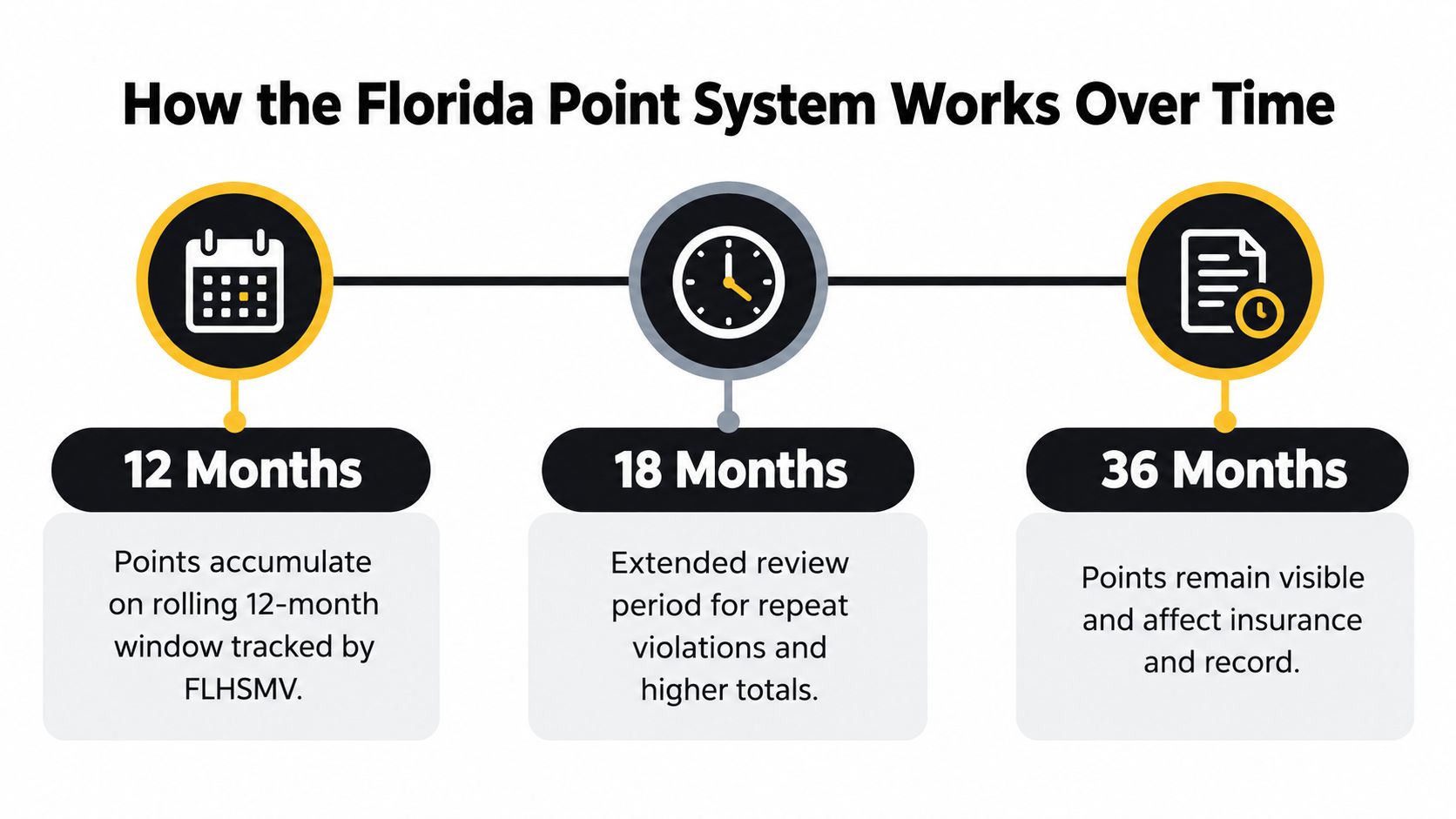
The key review periods are:
- 12 months: 12 points within 12 months can trigger a suspension.
- 18 months: 18 points within 18 months can trigger a longer suspension.
- 36 months: 24 points within 36 months can trigger the most serious point-based suspension in this schedule.
Use the Florida point suspension chart to verify how Florida groups these totals. Drivers who prefer Spanish can review the state’s Spanish-language FLHSMV guidance. The suspension periods themselves belong with the suspension rules, not with this timing explanation.
Two or three tickets can create a problem quickly
Three 3-point convictions total 9 points. Add one more 3-point conviction before the first one falls outside the 12-month window, and the total reaches 12. The calendar turns four ordinary-looking tickets into a suspension risk.
Two 6-point convictions during the same 12-month window also total 12 points. That is why a driver must review both the point value of the new offense and the dates of earlier convictions. Waiting for a warning letter or insurance notice gives the rolling window more time to work against you.
Practical rule: Judge a ticket by the points it can add, the points already on your record, and how long both remain inside the applicable window.
Points can remain relevant across the 36-month period, so checking only your latest citation is not enough. Review the full record and confirm when earlier points stop affecting the calculation. For a focused explanation, read how long points stay on your Florida license.
If a new citation is eligible for traffic school, investigate the BDISchool option immediately and confirm the election requirements with the clerk of court. Completing an approved course does not erase existing points, but it may prevent points from being added for an eligible violation when the driver properly elects the option and finishes on time. Acting after the first ticket preserves more choices than waiting until the next conviction pushes the total higher.
Florida Point Values by Offense Category
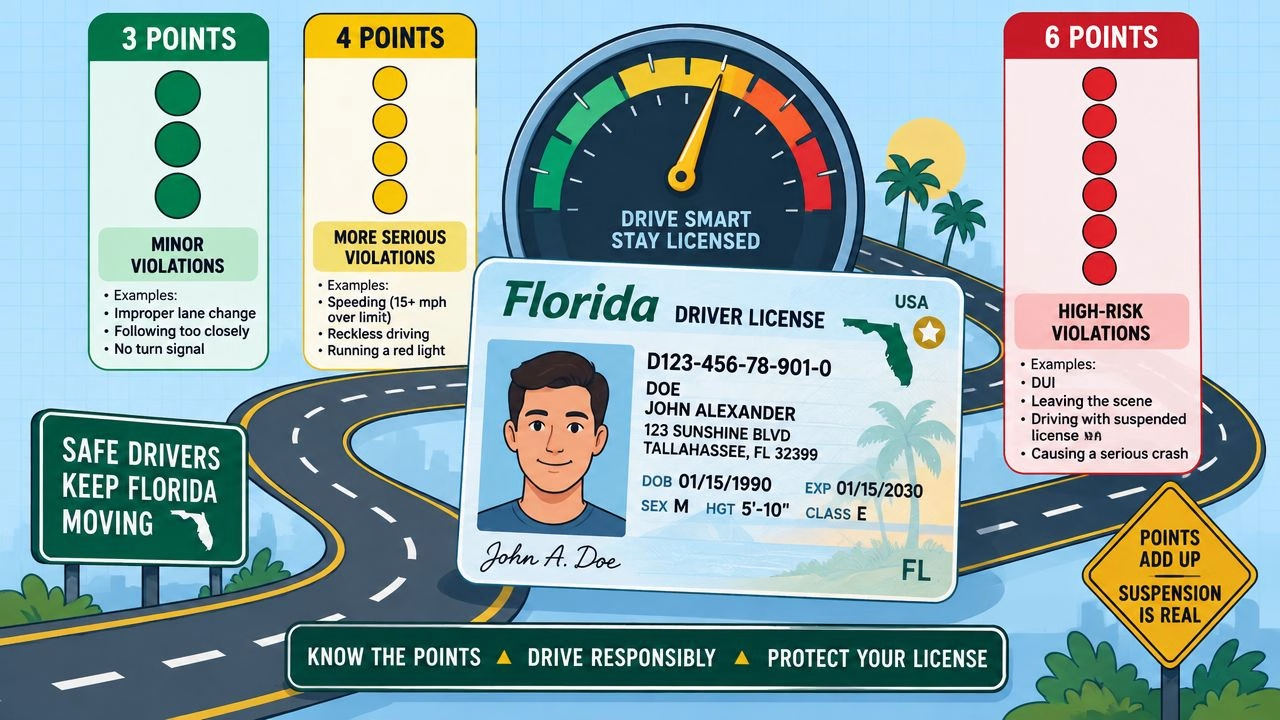
Florida assigns different point values according to the seriousness of the violation. The common categories in the published chart are 3 points, 4 points, and 6 points. That range makes offense classification important because two citations with similar-looking fines can have very different effects on a driver’s record.
| Offense Category | Points Assigned | Example Scenario |
|---|---|---|
| Speeding less than 15 mph over the limit | 3 points | A driver is convicted after traveling below the higher speeding bracket. |
| Speeding 15 mph or more over the limit | 4 points | A driver is convicted after exceeding the limit by at least the higher bracket. |
| Reckless driving | 4 points | A conviction involves driving behavior classified as reckless rather than ordinary careless conduct. |
| Speeding resulting in an accident | 6 points | The speeding conviction is connected to a crash. |
| Leaving the scene of a crash with property damage | 6 points | A driver leaves after a crash that causes property damage. |
Three-point violations
A 3-point offense is the lower value in this common range, but “lower” doesn’t mean harmless. Four separate 3-point convictions within the relevant 12-month period total 12 points, which reaches the first suspension threshold.
A driver who receives a lower-level speeding conviction should still check the calendar. The correct question isn’t “Was this only a speeding ticket?” The correct question is “How many points will this add to my current rolling total?”
Four-point violations
A 4-point conviction moves the total faster. Three 4-point convictions equal 12 points, provided they fall within the first suspension window. Reckless driving also carries 4 points in the listed chart, so the offense classification can create a substantial record impact even when the driver is focused mainly on the court process.
A combination can be even more important than a single category. Two 4-point convictions total 8 points, leaving only 4 additional points before the first threshold. A third 4-point conviction would reach 12.
Six-point violations
The 6-point category demands immediate attention. Two 6-point convictions inside 12 months total 12 points and can trigger the first suspension level. Leaving the scene of a crash involving property damage and speeding resulting in an accident are examples of offenses listed at this value.
The practical lesson is direct: don’t wait to see whether points “really matter.” They matter as soon as a conviction is likely to join other convictions on the record. If the violation is eligible, traffic school may prevent the new points from being assessed, but the driver must make the election correctly and meet the court’s requirements.
Suspension Thresholds and What Triggers Them
A ticket can look minor until it lands inside the wrong rolling window. Florida counts points across set periods, so a driver must track both the new conviction and the points already on the record. Florida Statute 322.27 establishes the point-based structure and authorizes suspension when the applicable threshold is reached.
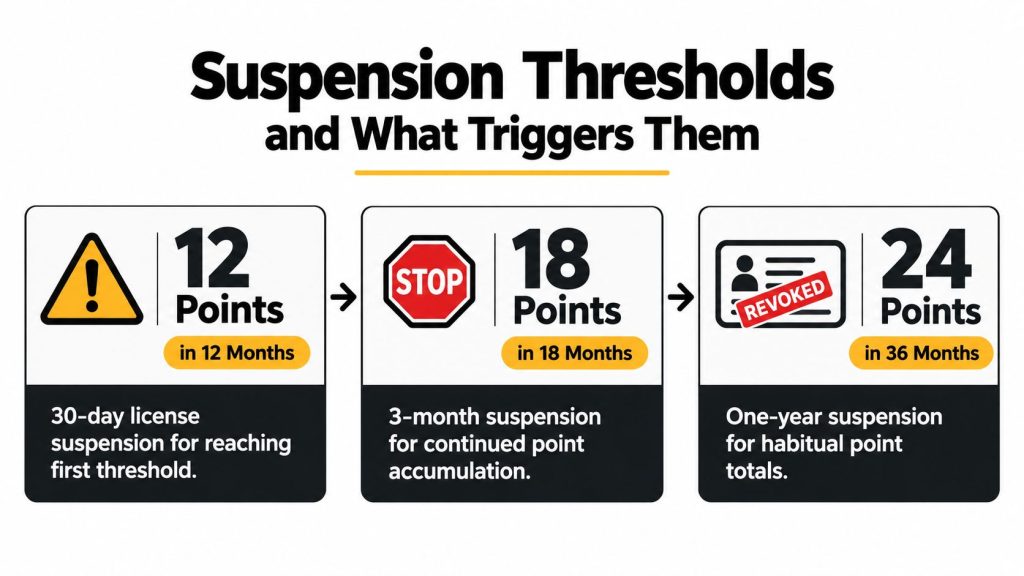
The three suspension levels
| Accumulated points | Review period | Suspension period |
|---|---|---|
| 12 points | 12 months | 30 days |
| 18 points | 18 months | 3 months |
| 24 points | 36 months | 1 year |
The first threshold is only one part of the risk. A mixed record can reach 18 points within 18 months through several violations with different point values. If the record continues building, the total can reach 24 points within 36 months, resulting in a 1-year suspension, while the 18-point level brings a 3-month suspension. Review FLHSMV’s point suspension rules to confirm how the state applies these windows.
Why the statute matters
Florida treats the point system as an enforceable licensing process, not an informal warning. Once the relevant total is reached, a driver cannot count on a service-center employee to overlook the combination or reset the calendar.
The practical move is to act before a pending citation adds another point. Check how many points can suspend a Florida license and contact the clerk before choosing how to resolve an eligible ticket. BDISchool can provide the required course, but the driver must first make the correct election through the court and complete every deadline.
Stop the next preventable point from becoming the one that crosses a threshold. A properly elected traffic school option may keep an eligible violation from increasing the total.
How Traffic School Prevents Points and Protects Your License
Traffic school can be the difference between adding points and keeping an eligible violation from increasing your record total. The key distinction is that you generally must elect the course through the clerk of court, rather than enroll in a course on your own and assume the ticket will be protected.
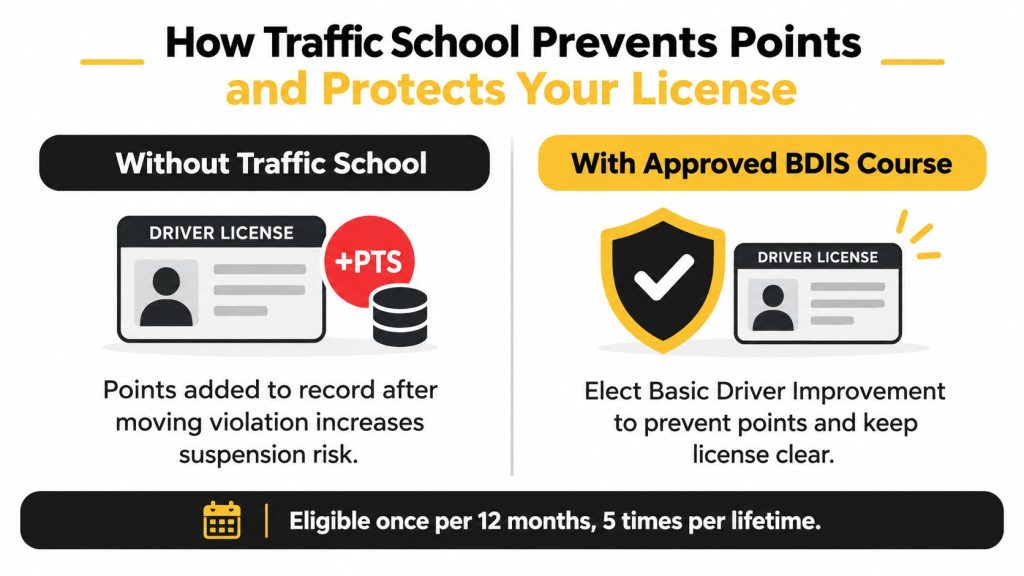
Compare the two outcomes
| Without traffic school | With an approved BDI course |
|---|---|
| The conviction can add the assigned points. | The eligible violation can be handled through the elected course option. |
| The new total may bring the driver closer to suspension. | The driver works to prevent points from being assessed for that violation. |
| Insurance consequences may follow the record and insurer’s rules. | Completing the course may help avoid point-related insurance effects for the eligible violation. |
The course doesn’t erase points already on your license. It also doesn’t replace the clerk’s election process. Treat those as separate responsibilities.
Follow the court process
Start with the citation. Ask the clerk of court whether you can elect Basic Driver Improvement, complete the required payment or election steps, and confirm the course deadline. Then enroll in the approved 4-hour BDI course selected for your situation.
After completion, the certificate must be reported according to the court and provider process. BDISchool courses issue certificates electronically and report completion directly to FLHSMV, based on the publisher’s stated program process. You should still verify that the court requirements were satisfied.
The 8-hour IDI and 8-hour Aggressive Driver Course serve different needs. They may apply when a court orders a specific program or when the driver needs a course addressing more serious behavioral concerns. Don’t choose a longer course because you received a ticket. Choose the program that matches the court order or eligible point-prevention option.
The course only protects you when the election, enrollment, completion, and reporting steps all line up.
This short video offers another explanation of the traffic school process:
Choosing the Right BDISchool Course for Your Situation
The right course depends on the reason you’re enrolling. A driver handling an eligible moving violation needs a different program from someone completing a court order or seeking a mature-driver insurance discount.

Match the course to the need
- Choose Basic Driver Improvement for an eligible ticket: The 4-hour BDI course is designed for drivers who elect traffic school after a moving violation and want to prevent points from being assessed for that violation.
- Choose Intermediate Driver Improvement for a court order: The 8-hour IDI course is intended for drivers directed by a court or those who need more extensive improvement instruction.
- Choose the Aggressive Driver Course for habitual or aggressive conduct: The 8-hour course focuses on responsibility, decision-making, road rage, and behavioral change.
- Choose the Mature Driver Course for an older-driver refresher: The 6-hour course is designed for drivers aged 55+ who want to refresh safe-driving awareness and pursue available insurance discounts.
BDISchool provides these Florida traffic school options through a fully online, self-paced format. The programs are available in English, Spanish, and Portuguese, which gives more drivers access to instruction in a language they understand comfortably.
Why online access helps
You don’t need to rearrange a workday around a classroom schedule. You can study from a compatible device, return to the material as needed, and complete the course within the deadline set by the court or program requirements.
The course content addresses Florida traffic laws, defensive driving, following distance, right-of-way decisions, distracted driving, impaired driving prevention, crash avoidance, and the effect of driver attitude on judgment. Those subjects matter because point prevention is only one part of the goal. A clean record is easier to protect when your driving decisions improve as well.
Review the Florida BDI course online before enrolling. Confirm that the course matches your ticket, election status, and court deadline. If you need to compare available programs, the BDISchool course catalog and DriverEducators course catalog provide the available course paths.
Related Concepts and Cross References You Should Know
Florida driver’s license points create a rolling risk window, so one ticket can matter more than its individual value suggests. For example, a three-point conviction followed by another three-point conviction brings six points into the applicable record period. A later four-point conviction can push the total to ten, leaving little room before a suspension threshold. Check the state’s current points record online before choosing a response, and compare each conviction date with the relevant review window.
Insurance records require documentation
An insurer may request more than your course-completion statement. Keep the citation, election confirmation, enrollment receipt, completion certificate, and any court acceptance notice in one file. Ask your insurer whether it wants the certificate sent directly, uploaded to a customer portal, or retained for your policy records.
A course can prevent eligible points from being recorded for the violation, but it does not guarantee a premium change. Request the insurer’s answer in writing if the course is being used to support a discount or explain the treatment of a citation.
Confirm the court election before enrolling
The clerk of court handles the ticket election and deadline for your case. Call before enrolling, confirm that Basic Driver Improvement is available, and ask what proof the court requires after completion. Save the clerk’s name, the date of the call, and any confirmation number.
The FLHSMV points guidance explains the state’s point-suspension rules. Your citation and clerk remain the sources for case-specific instructions. An online course enrollment by itself does not replace a proper election.
Use the record to prevent the next ticket
After checking your record, review the earlier offense table and match each conviction to its likely point value. Then compare the total with the suspension windows. This process shows whether BDI is an immediate point-prevention option or whether the court has assigned a different course.
BDISchool’s lessons cover following distance, right-of-way decisions, distracted driving, impaired-driving prevention, and aggressive-driving behavior. Use those topics to correct the habits that could add another conviction while older points remain active. Spanish and Portuguese availability also helps drivers study the rules in a language they understand clearly.
Quick Reference Lookup and Next Steps Checklist
A new ticket can change your risk quickly. Two 6-point convictions total 12 points, which can trigger a 30-day suspension within the applicable window. Three lower-value tickets can also push your record toward a suspension threshold, so check the rolling total before choosing how to respond.
Use the point values table above for the exact offense categories. The suspension rules in brief are 12 points in 12 months, 30 days, 18 points in 18 months, 3 months, and 24 points in 36 months, 1 year.
Your action checklist
- Read the citation: Locate the clerk of court, response deadline, and violation description.
- Ask about election: Confirm whether Basic Driver Improvement is available for the violation.
- Check your current risk: Count convictions and points still included in the applicable rolling windows.
- Choose the correct course: Use the 4-hour BDI course for an eligible point-prevention election, or follow the court’s instruction for IDI or another required program.
- Complete on time: Finish every course requirement before the court deadline.
- Confirm reporting: Keep your certificate information and verify that completion was transmitted or accepted.
- Drive defensively: Avoid another moving violation while earlier convictions remain active in the calculation.
BDI is the immediate option when the court allows point prevention. Do not wait for an FLHSMV suspension notice. Verify your record, confirm the election, and handle the ticket before another conviction narrows your choices.
BDISchool offers online Florida traffic school courses for eligible point prevention, court requirements, aggressive-driver education, and mature-driver refreshers. Visit BDISchool, select the course matching your citation or requirement, and begin before points stack up.