You’re standing there with a ticket in your glove box, a calendar that’s already packed, and one simple question: what kind of driving school for adults solves my problem without wasting my time? That’s the right question. Adults don’t need a generic lecture, they need the exact Florida course that matches the reason they enrolled in the first place.
Florida has a lot of adults who come back to driving for different reasons. Some need to handle a moving violation, some want an insurance discount, some are learning later in life, and some are just trying to get comfortable behind the wheel again after years away. A good program respects that reality and gives you a clean path forward, not a pile of confusion.
Why Adults Choose Driving School and What to Expect
A lot of adults wait too long to enroll because they think driving school is only for teenagers. It isn’t. In a fragmented national market with 23,946 businesses and an estimated $2.0 billion industry size in 2026, adult driver education often shows up as a local, flexible service instead of a one-size-fits-all product, and that makes sense for busy people who need practical help fast. IBISWorld’s driving schools overview also estimates that 28% of students are adults aged 20 and older and that there are 4.1 million annual student enrollments, which tells you adult lessons are not some tiny side market.
I see the same pattern over and over. One adult walks in after a citation and wants to keep the problem from getting worse. Another wants to protect their insurance costs. A third hasn’t driven in years and wants structure, not lectures.
Practical rule: If your issue is legal, financial, or confidence-related, don’t guess at the solution. Match the course to the problem.
That’s the smart move. If you need a confidence-focused refresher, start with the Confidence Building Course. If you’re dealing with insurance after a suspended license issue, a separate resource like get car insurance with suspended license can help you think through the insurance side while you handle the driving side.
A quality adult driving school should feel organized, short, and useful. At BDISchool, the courses are built for adults who need flexibility, and the publisher offers instruction in English, Spanish, and Portuguese, which matters when the goal is clear comprehension, not guessing at terminology. Adults do better when the material fits their schedule and their language needs.
Florida-Approved Courses for Every Adult Driver
Florida adults don’t all need the same course, and pretending they do is the fastest way to waste money. The right choice depends on whether you’re managing a ticket, answering to a court order, rebuilding safer habits, or looking for a refresher after age 55.
The state framework is straightforward in practice. Florida’s Basic Driver Improvement (BDI) is tied to a 4-hour course for drivers cited for a moving violation, and the state also allows an 8-hour Intermediate Driver Improvement (IDI) course for court-ordered drivers. That structure is built around purpose, not fluff. Florida BDI and IDI course framework
| Course | Duration | Who It Is For | Primary Benefit |
|---|---|---|---|
| Basic Driver Improvement (BDI) | 4 hours | Drivers cited for a moving violation | Handles ticket-related compliance and point-related concerns |
| Intermediate Driver Improvement (IDI) | 8 hours | Court-ordered drivers or adults wanting deeper instruction | Meets stricter requirements and reinforces safer habits |
| Aggressive Driver Course | 8 hours | Habitual offenders dealing with road rage or repeated behavior problems | Focuses on behavior change and calmer decision-making |
| Mature Driver Course | 6 hours | Drivers aged 55 and older | Refreshes safe driving habits and supports insurance discount goals |
Basic Driver Improvement for moving violations
Choose BDI if you got a ticket and want a practical, approved response. Don’t drag your feet on this one, because the point is to handle the citation correctly and move on. The course is short, focused, and designed for adults who need compliance without giving up a whole weekend.
Intermediate Driver Improvement for court-ordered cases
IDI is the more serious adult track. If a court tells you to complete driver improvement, this is the course you should be looking at, not a generic refresher. The extra time matters because the audience usually needs more than a quick review.
Aggressive Driver Course for behavior correction
This course is for adults whose driving habits have crossed into a pattern problem. Road rage, risky decisions, and habitual impatience don’t get fixed by vague reminders. They get fixed by direct instruction, repetition, and accountability.
Mature Driver Course for older adults
If you’re 55 or older, the Mature Driver Course makes sense when you want a cleaner, calmer refresher. It’s also the right place to look when your goal includes an insurance discount and a safety reset. The Mature Driver Course is built for that exact use case.
Florida adults should stop shopping for “a driving school” and start shopping for the right course. Once you do that, the decision gets much easier.
Real Benefits of Completing an Adult Driving Course
Adults usually enroll for one reason, then discover the course helps in three or four ways at once. That’s why this isn’t just a paperwork exercise. It can protect your record, make your next drive less stressful, and give you language for habits you’ve been doing wrong for years.
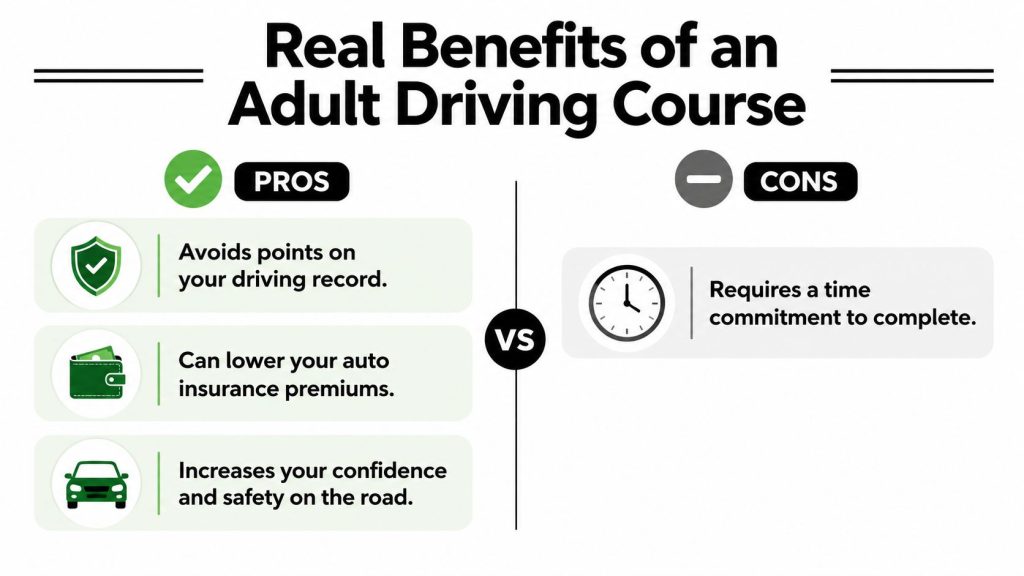
The biggest advantage is simple. If you got cited for a moving violation, taking the right approved course can help you handle the issue instead of letting it snowball into a bigger headache. For older adults, the Mature Driver path is also a practical way to keep habits sharp while staying aligned with discount opportunities tied to that course.
A second benefit is behavior. Florida adults often know the rulebook in a general sense, but they still make bad lane choices, rushed merges, or impatient decisions under stress. A quality course forces you to slow down and think before the mistake becomes a pattern.
Bottom line: A few hours of training is cheaper than years of making the same mistake again.
The third benefit is confidence. That matters more than people admit. Adults who’ve been out of the driver’s seat for years usually don’t need dramatic theory, they need clean repetition, updated rules, and a reminder that they can still build solid habits.
There’s also the less visible value of learning the current Florida-specific expectations around attitude, spacing, and crash avoidance. You don’t need a motivational speech. You need instruction that changes how you drive tomorrow morning.
Online Self-Paced Learning vs In-Person Classes
Most adults don’t fail at driving education because they’re unwilling. They fail because the format doesn’t fit their life. If you work, raise kids, or just hate wasting time in a fixed classroom, online self-paced learning is usually the smarter place to start.
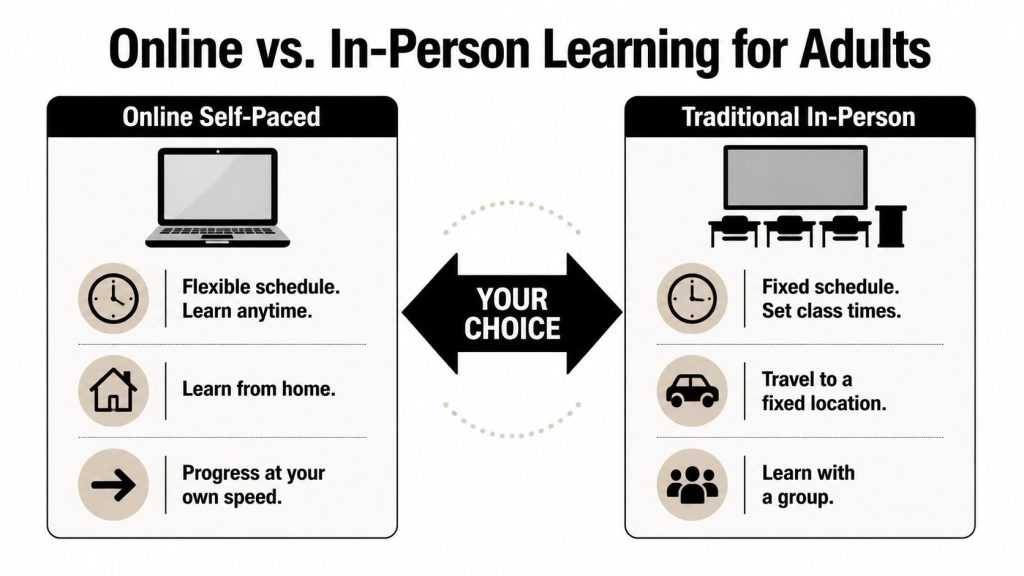
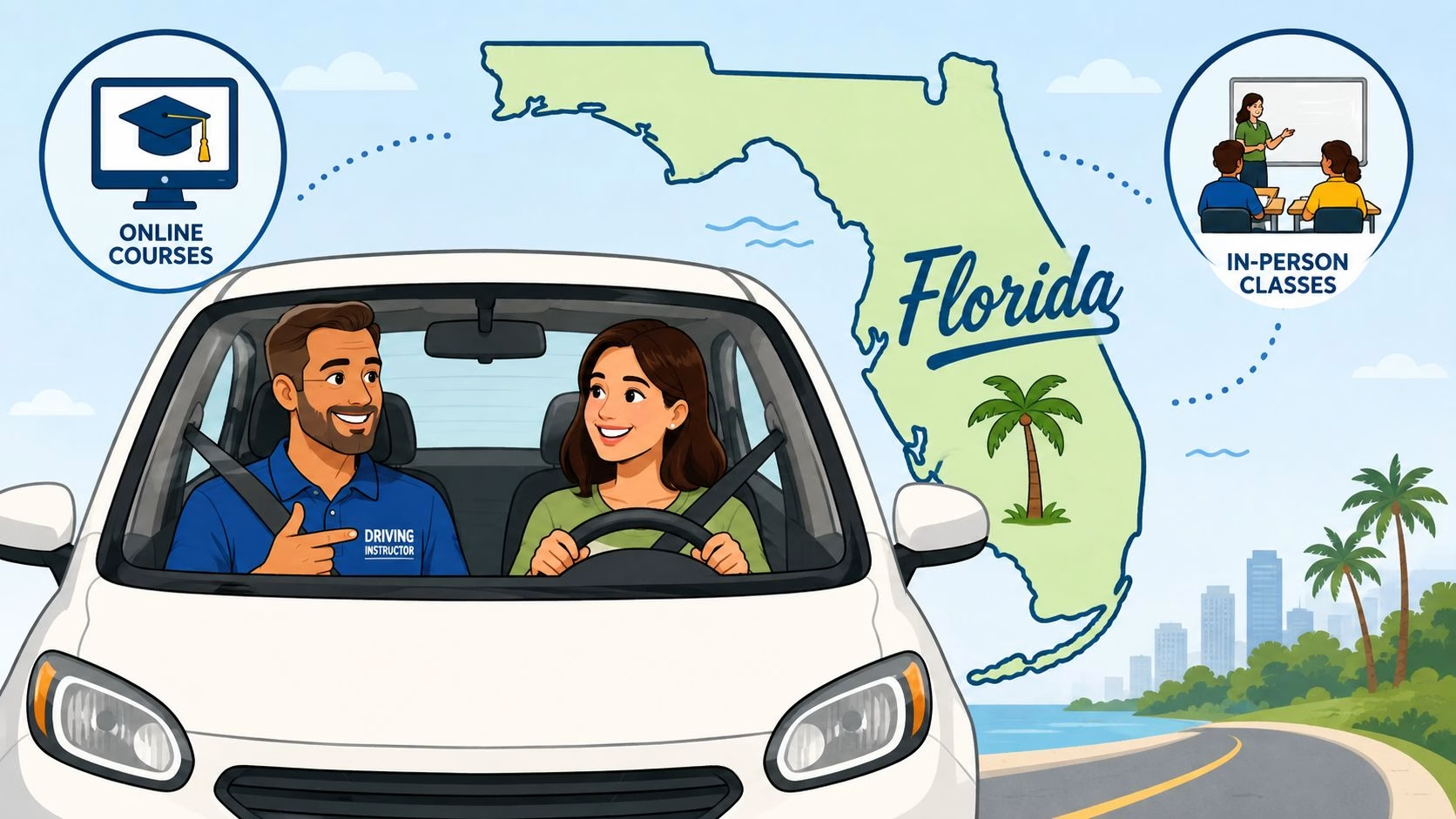
Online self-paced study gives you control. You can work through the material from any device, move at your own pace, and fit lessons around work or family time. BDISchool’s self-paced online courses are built around that reality, and the courses are available in English, Spanish, and Portuguese.
In-person classes still have a place. They make sense when you need live correction, especially for first-time drivers or adults whose anxiety is higher behind the wheel than they expected. The extra presence of an instructor can help some learners stay focused and reduce second-guessing.
The right choice comes down to how you learn. If you want a quiet, controlled environment and don’t need in-car practice in the course itself, online is efficient. If you need real-time feedback and hands-on reassurance, a live setting may be the better fit.
My advice: Don’t choose the format that sounds more serious. Choose the one you’ll actually finish.
Adults get the best results when the format lowers friction. That usually means online for compliance and convenience, then focused behind-the-wheel practice if your situation calls for it.
How to Choose the Right Driving School for Your Needs
Adults should evaluate a driving school differently than teens do. Teens need basic structure. Adults need relevance, approvals, and a process that doesn’t waste their time.
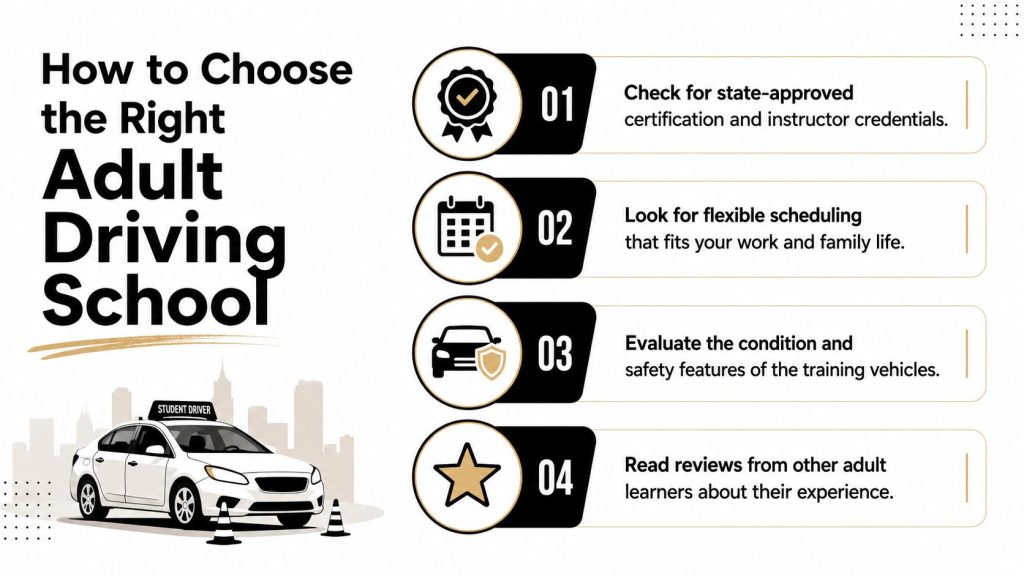
Start with approval. If a school can’t clearly confirm that it’s state-approved for the course you need, move on. Adults don’t have time for guessing games, and a certificate that doesn’t meet the right requirements is worthless.
Next, check certificate handling. Electronic reporting directly to the state is a real convenience because it reduces extra steps and keeps you from chasing paperwork. You also want courses that are easy to access across devices, so you can study on a phone, tablet, or laptop without fighting the platform.
Language matters too. A school that offers multiple languages is doing real service work, not just marketing. That matters for comprehension, confidence, and test-day retention.
Here’s the checklist I’d use if I were shopping as an adult student:
- State approval: Confirm the course matches Florida requirements before you pay.
- Certificate reporting: Make sure completion is sent electronically when that applies.
- Language options: Look for English, Spanish, or Portuguese if that helps you learn faster.
- Current curriculum: The material should reflect current Florida rules and roadway technology.
- Device access: You should be able to start and finish on your own schedule.
BDISchool fits this framework cleanly for adult Florida drivers, especially when the goal is a short, approved course that doesn’t create more hassle. The point isn’t to fall in love with a school. The point is to register with one that solves the problem and gets you back to your life.
Your Enrollment to Certification Journey
Enrollment should be easy, and if it isn’t, that’s a warning sign. Adults need a direct path from choosing the course to getting the certificate, not a maze of calls and delays.
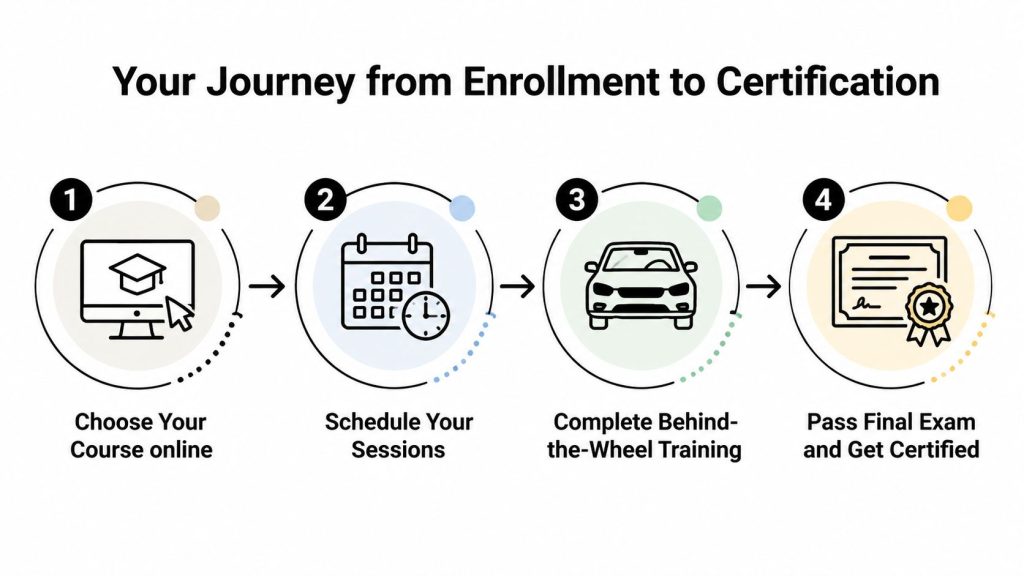
Start by choosing the right course on BDISchool’s online certificate page. From there, register and pay online, then begin the material right away. That immediate access matters because adults usually enroll when they’re trying to solve a time-sensitive problem.
The course length depends on the track you choose. Florida’s adult courses are purpose-built blocks, not endless semesters, which is why they work for busy people. Once you’re inside the course, you can pause and resume as needed, which helps if your day gets interrupted.
Simple rule: If you can’t start quickly and finish without drama, the course is probably not adult-friendly.
The final step is completion and certificate delivery. In these programs, the goal is a clean finish with electronic reporting that supports your next step, whether that’s compliance, insurance, or confidence. You should also expect the platform to work on common devices, because adults don’t sit down to one more course on a single schedule anymore.
That’s the whole journey. Pick the right course, register, complete it at your pace, and move on with the paperwork done correctly.
Frequently Asked Questions About Adult Driving School
Do I need a special lesson plan if I have anxiety or haven’t driven in years? Yes. Adults who are anxious or rusty usually do better with shorter, predictable lessons and clear correction, not a broad, generic class. If the issue feels deeper than basic instruction, a readiness-to-drive evaluation may be more appropriate than ordinary lessons.
How do I restart driving after a long gap? Start with a refresher that rebuilds comfort first, then move into more demanding traffic only after the basics feel stable. Adults usually improve faster when they stop trying to “just get back in the car” and instead rebuild in steps.
Can international drivers use adult driving school to learn Florida rules? Yes, and they should. A local course is useful when you already know how to drive but need to adapt to Florida traffic expectations, signage, and habits.
What if I need to retake a course? Retaking a course is sometimes the practical answer if you missed a deadline or need to meet a different requirement. Don’t treat that as failure, treat it as cleanup and move on.
Will this help with insurance planning? It can, depending on your situation. If you’re also sorting out broader coverage questions, a resource like home and auto insurance Florida can help you think through the insurance side while you handle the course requirement.
Adults do best when they stop overcomplicating the decision. Pick the course that matches your exact situation, finish it, and get back to driving with fewer loose ends.
If you need a Florida course that fits a ticket, a court requirement, an insurance goal, or a confidence reset, BDISchool keeps the process simple and adult-friendly. Visit BDISchool to register, start your course, and handle it the right way today.