
If you are an adult with a job, a family and no free weekday mornings, the fastest way through drivers ed is a state-approved course you can take online, at your own pace, on any device. You stop and restart when your day allows, and you don’t plan your life around a fixed class time. In Florida, our courses are built for exactly that: the Florida DETS course online and the first-time driver course both let you learn from your phone, tablet or computer, with a money-back guarantee and no hidden fees.
This guide covers what adult learners actually need, how to fit the coursework and the practice driving into a full schedule, what it costs, and where the other adult-driver courses (ticket, court, insurance) fit in.
Key Takeaways
- Adult beginners are not too old: the real work is the course plus regular supervised practice, and both can be scheduled around your life.
- Online, self-paced courses remove the biggest scheduling problem, the fixed class day. Our Florida courses run on any device.
- Rules differ by state. Some states require adults to take a course before a first license, and some set time limits for finishing it.
- Our Florida first-time driver courses are priced at $29.90 (DETS) and $29.95 (TLSAE), with no hidden fees.
- Practice hours matter as much as the course. Short, frequent sessions at different times of day work best.
Table of Contents
- Why Adults Need a Different Kind of Drivers Ed
- Does Your State Require a Course for Adults?
- Course Formats for a Packed Schedule
- What It Costs
- Building Driving Hours Without Giving Up Your Week
- When the Reason Is a Ticket, a Court Order or Insurance
- A Realistic Weekly Plan
- Start Your Course Today
- FAQ
- Sources
Why Adults Need a Different Kind of Drivers Ed
Teen drivers ed is built around school calendars and a parent who drives them to class. Adults have none of that. You may be learning because you moved to a city where you can no longer rely on transit, started a job that needs a car, or simply never had the chance before. You are juggling shifts, childcare and commutes, and you probably feel a little self-conscious about being a beginner.
That is common, and it is not a reason to wait. Age is not the barrier. What helps most, according to AARP’s guidance for adults learning to drive, is practicing as much as you can between lessons, varying the times of day you drive, and saying your intended actions out loud while you drive so the skills sink in. The same guidance points to a comfortable, supportive teaching style as a way to keep motivation up, especially if you have delayed learning or carry anxiety from past experiences.
So the plan for a busy adult has two parts: finish the required coursework in the least disruptive way, then build driving hours in small, regular blocks.
Does Your State Require a Course for Adults?
Requirements for adult first-time drivers are set state by state, and they change. Two official examples show how much they differ.
Illinois. The Illinois Secretary of State says adults aged 18 to 20 must complete a six-hour adult driver education course before applying for a first license, but only if they have never completed qualifying driver education. The course can be online or in a classroom, and it is not behind-the-wheel training. The state encourages applicants to log 50 practice hours, 10 of them at night, before licensing. Under the state’s administrative code, the six-hour online course must be finished within 30 days of starting.
Ohio. The Ohio Office of Traffic Safety explains that an applicant aged 21 or older who fails the first maneuverability or road test must take an abbreviated adult course before a second attempt. The options include four hours of class or online theory, plus either four hours of instructor-led driving or 24 hours of supervised practice with a licensed driver aged 21 or older. A rule effective August 1, 2026 says the 24-hour supervised option cannot exceed four hours of driving per day and requires a signed affidavit.
The lesson for a busy adult: read your own state licensing agency’s page first, and note two things, whether a course is mandatory at your age and whether there is a completion deadline. A deadline changes how you schedule the work.
In Florida, where we offer our courses, first-time license applicants complete a state-approved first-time driver course. Our Florida driver education courses page lists the options, and our enrollment guide for the Florida DETS course walks through the requirements and steps.
Course Formats for a Packed Schedule
Adults generally find three formats. Here is how they compare for someone with limited time.
| Format | Schedule | Best for | Time cost beyond the course |
|---|---|---|---|
| Online, self-paced | You choose when to log in and can pause | Shift workers, parents, anyone with an unpredictable week | None: no commute |
| Live online (scheduled video class) | Fixed session times | People who like a set appointment | Must be free at class time |
| In-person classroom | Fixed day and location | Learners who want face-to-face instruction | Travel and a block of the day |
For most busy adults, self-paced online wins because it turns dead time into study time: a lunch break, a quiet 20 minutes after the kids are in bed, a commute you are not driving. Our courses work on mobile devices, so you can pick up on your phone exactly where you left off.
If English is not your first language, our courses include multilingual read-along features, so you can follow the material in a way that is comfortable rather than rushing through unfamiliar terms.
How to fit the coursework in
- Check your deadline. If your state sets a completion window, as Illinois does for its online course, count back from it and set a weekly target.
- Block short sessions. Thirty to forty-five minutes is easier to protect than a four-hour Saturday. Put them on your calendar like appointments.
- Use your phone for review. Short sessions on a mobile device make waiting time useful.
- Finish before you book your permit appointment. Your course completion is a prerequisite, so you do not want it to hold up the next step.
What It Costs
Cost is a common question, and the honest answer is that it depends on the provider and your state. The Illinois Secretary of State notes that adult course costs are set by the provider, so the price on the provider’s own page is the number to use.
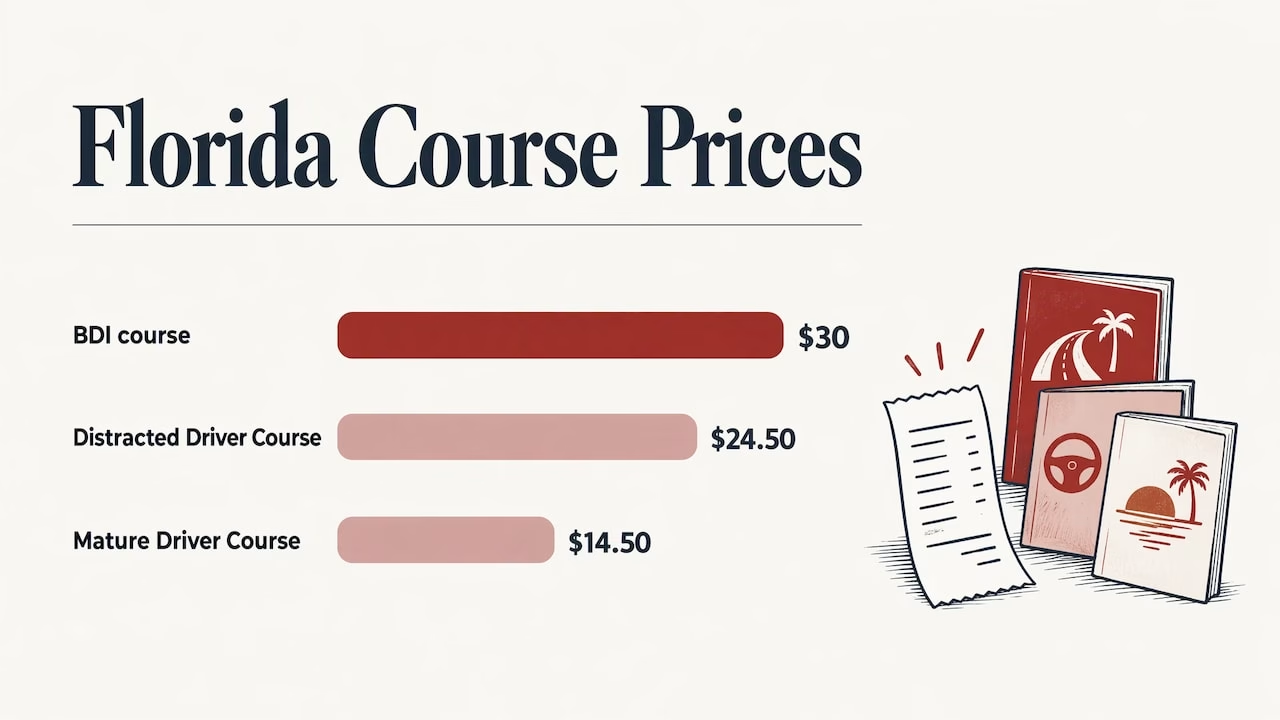
Our published Florida prices, read from our site in October 2026, are:
| Course | Price |
|---|---|
| Florida Driver Education Traffic Safety Course (DETS) | $29.90 |
| Florida Traffic Laws Substance Abuse Education Course (TLSAE) | $29.95 |
| Florida Basic Driver Improvement (BDI) | $30 |
| Florida Wireless Devices Distracted Driver Course | $24.50 |
| Florida Mature Driver Insurance Discount Course | $14.50 |
Each is a one-time payment. We publish prices up front, with no hidden fees, and we back every course with a money-back guarantee. Behind-the-wheel lessons with an instructor are a separate cost and vary by area, so ask any instructor for a written price before you book.
Building Driving Hours Without Giving Up Your Week
The course teaches rules, hazards and safe habits. It does not give you hands-on skill. That comes from practice, and a busy adult can build it in a way that suits a limited schedule.
- Aim for frequency over length. Three 30-minute drives a week teach more than one exhausting two-hour drive, and they are easier to fit around work.
- Vary conditions. AARP’s advice is to practice at different times of day. Include a dusk or night drive, a rush-hour drive with an experienced driver beside you, and a quiet weekend morning for new skills like parking.
- Narrate your driving. Saying aloud what you are about to do (checking the mirror, braking for the light ahead) reinforces skills and helps your supervisor understand your thinking.
- Use the Illinois benchmark as a guide. Fifty hours with ten at night is a useful target even outside Illinois, and checking your own state’s minimum is simple.
- Plan lessons around your goals. If you wonder how many driving lessons you might need, the answer depends on your starting confidence, so keep a short list of the skills you want help with and bring it to each lesson.
Who can supervise your practice?
AARP’s guidance says friends or family can teach an adult if professional instruction is unaffordable or unwanted, and that finding an instructor whose style makes you comfortable matters. Supervising-driver rules are set by your state. Ohio’s 24-hour option, for example, requires a licensed driver aged 21 or older. Check your state’s rule before your first practice drive.
If nerves are the thing holding you back, our article on gentle, patient driving lessons for anxious learners speaks to that directly.
When the Reason Is a Ticket, a Court Order or Insurance
Not every busy adult is a beginner. Many are licensed drivers who need a course because of a violation or to lower an insurance bill. The same time-saving logic applies.
Tickets and points. An approved course can help keep points off your record. Ohio’s Office of Traffic Safety describes its adult remedial program as an eight-hour classroom or online course used for court orders, point credit and some suspensions, with a two-point credit for qualifying drivers with two to 11 points. In Florida, our Basic Driver Improvement (BDI) course is $30 and our Wireless Devices Distracted Driver Course is $24.50. Always confirm with the clerk of court or your citation what is required for your case.
Court requirements. If a judge or the DMV ordered a course, the approval of the course matters most. Our courses are state-approved, and we offer court-ordered compliance courses so you can complete the requirement from home.
Insurance savings. Ohio’s guidance notes that mature-driver training may qualify drivers aged 60 or older for an insurance discount, with the amount decided by the insurer. In Florida, our Mature Driver Insurance Discount Course is $14.50. Our guide to how to claim the Florida mature driver insurance discount explains the next step after you finish.
Fleet drivers. If you manage employees who drive for work, we build a custom fleet safety course so training fits around shifts rather than pulling people off the road for a full day.
A Realistic Weekly Plan
Here is an example of how a working adult could approach the first month. Adjust it to your state’s rules.
- Week 1: Confirm your state’s requirements and any deadline. Enroll in your course and complete the first short sessions.
- Week 2: Keep up three to four short study sessions. Find your supervising driver or book an instructor.
- Week 3: Finish the course and keep your completion record. Begin short, quiet practice drives.
- Week 4: Add variety: a night drive, a busier road, parking practice. Log your hours in a notebook or phone note.
The point is momentum. Small steps on a calendar beat waiting for a free weekend that never comes.
Our Perspective
We build our courses in-house with certified educators and safety specialists, and we keep the content current with statutory requirements. For an adult with a full schedule, that matters in a practical way: you should be able to open a course on your phone at 9 p.m., learn at your own speed, and know the material is state-approved and up to date.
We believe the best course for a busy adult is one that removes friction. That is why we publish our prices, avoid hidden fees, offer a money-back guarantee, and include multilingual read-along features. You should spend your energy on becoming a safe, confident driver, not on working out whether a course fits your life.
Learning to drive as an adult is an accomplishment. Our job is to make the classroom part as simple as it can be.
the author
Start Your Course Today
If you are in Florida, you can enroll in a state-approved course now and finish it around your own schedule. Our DETS course is $29.90 and our TLSAE first-time driver course is $29.95, both one-time payments with a money-back guarantee. Browse every option on our courses page and choose the one that matches your state, court or insurance requirement.
 If you are not sure which course applies to you, our TLSAE quick guide explains what the first-time driver requirement covers.
FAQ
Is 40 too old to learn to drive?
No. Adults learn to drive at every age. AARP’s guidance for adult learners suggests practicing often, varying the time of day, and choosing a supportive instructor, which helps especially if you have delayed learning or feel anxious. The same approach works at 25, 40 or 65.
Do I have to take a classroom course as an adult?
It depends on your state. Illinois, for example, allows its six-hour adult course to be online or in a classroom, and Ohio’s adult remedial program is available in class or online. Check your state licensing agency, then choose the format that fits your schedule. In Florida, our courses are online and self-paced.
How much should I expect to pay?
Prices are set by each provider, so use the price on the course page. Our Florida DETS course is $29.90, TLSAE is $29.95 and BDI is $30, each a one-time payment with no hidden fees. Behind-the-wheel lessons are priced separately.
Can a friend or family member teach me to drive?
Often yes. AARP’s guidance says friends or family can teach an adult if professional instruction is unaffordable or unwanted. Your state sets the rules for the supervising driver, such as minimum age and license status, so confirm them first.
Sources
- Find Out How You Can Learn to Drive After 50, AARP
- Adult Driver Education FAQs, Illinois Secretary of State
- Administrative Code, Illinois JCAR
- Adult Drivers, Ohio Office of Traffic Safety
- Rule 4501-8-09, Ohio Administrative Code
Recommended
- Drivers Ed Online: Your Florida Guide to Fast, Affordable Courses
- Easy Online Traffic School: Flexible Learning for Busy Florida Drivers
- Can Courses Be Paused? A Guide for Busy Drivers
- Adult Driver Education Program: A Comprehensive Path to Safer Roads
This article is provided for general information and is not a professional advice.