A California cell phone ticket starts with a $20 base fine for a first offense, but the amount on your court notice is usually several times higher once penalty assessments and fees are added. A first offense adds no DMV point. A second one within 36 months does, and that point is what can push your insurance up. The best move is to learn what your ticket is, what it really costs and whether you are eligible to keep it off your record, before the due date passes. We build state-approved online courses for drivers in this exact spot, so we walk through the process the way we would for a friend.
Key Takeaways
- The base fine is $20 for a first offense and $50 for each later one, but court assessments and fees can more than triple it.
- A first conviction carries no violation point. A repeat conviction inside 36 months can add one.
- Holding your phone at a red light still counts as driving under California’s rules.
- Eligible drivers who finish court-approved traffic school can keep the point hidden from insurance companies.
- Ignoring the ticket is the costly mistake: the court can add up to $100 and a failure-to-appear charge.
Table of Contents
- What California Actually Bans
- What a California Cell Phone Ticket Costs
- Does It Add a Point to Your Record?
- How to Check What You Owe and When
- Traffic School: Keeping the Ticket Off Your Insurance Record
- Fighting the Ticket Instead
- Our Perspective
- Where Drivereducators Fits In
- How to Avoid the Next Ticket
- FAQ
- Sources
What California Actually Bans
California’s rule is stricter than most drivers think. Under Vehicle Code §23123.5, you may not drive while holding and operating a phone or other electronic communications device. The device must be set up for voice-operated, hands-free use, and you must use it that way. If the phone sits in a mount, you may touch it only with a single swipe or tap. Systems installed by the vehicle manufacturer are exempt.
In plain terms:
- Talking is legal on speaker, Bluetooth or a hands-free system.
- Texting is legal only by voice command.
- A mounted phone can take one tap or swipe, such as accepting a call or starting navigation.
- Scrolling, typing, or holding the phone in your hand is a violation.
Red lights and stop signs
A stopped car is still being operated. The Sacramento Bee reported in September 2025 that the rules apply at red lights and stop signs, and that in June 2025 the Sixth District Court of Appeal ruled that simply holding a phone while driving is a violation, even when the driver was only looking at a map app without touching the screen. If you need to check something, put the phone in the mount before you pull out.
Exceptions
The law has narrow exceptions. Section 23123 lists emergency calls to law enforcement, health care, fire or other emergency services, authorized emergency vehicles, and driving on private property. Drivers under 18 face a tougher rule: VC §23124 bars any wireless phone use, hands-free included, except for emergency calls.
Enforcement is active. The California Highway Patrol reported in April 2026 that it issued more than 111,700 distracted-driving citations in 2025, nearly 20% more than in 2024.
What a California Cell Phone Ticket Costs
The statute sets the base fine: $20 for a first offense, $50 for each subsequent offense. That is not what you pay. The court adds state and county penalty assessments, court operations and conviction assessments, a surcharge and fees. Marin County’s 2026 fixed penalty schedule lists each of these components, which shows how a $20 base fine becomes a much larger bail amount. A city police FAQ notes that with assessments the fine can be more than triple the base.
Because each county sets its own add-ons, two drivers cited for the same offense can owe different totals. The only number that matters for you is the one printed on your citation or the court’s notice.
| Offense | Base fine | Typical effect on total |
|---|---|---|
| First conviction | $20 | Multiplied by assessments and fees, set by county |
| Second or later conviction | $50 | Multiplied the same way, so noticeably higher |
| Driver under 18, any device | $20 first, $50 after | Same structure, per the Santa Clara County court guide |
The fine is only part of the cost. A second conviction can bring a DMV point, and with it a possible insurance increase. That is why the next section matters more than the ticket price.
Does It Add a Point to Your Record?
It depends on whether this is your first offense. The Santa Clara County Superior Court’s infraction guide lists the handheld-device violations at $20 and $50 and states that no violation point attaches to the conviction under Vehicle Code §12810.3. For violations on or after July 1, 2021, a point is assessed only when the new conviction falls within 36 months of a prior conviction for the same offense.
So the practical picture is:
- First offense: no point, though the conviction can still be reported to the DMV.
- Second offense within 36 months: one negligent-operator point, which stays on your record for three years.
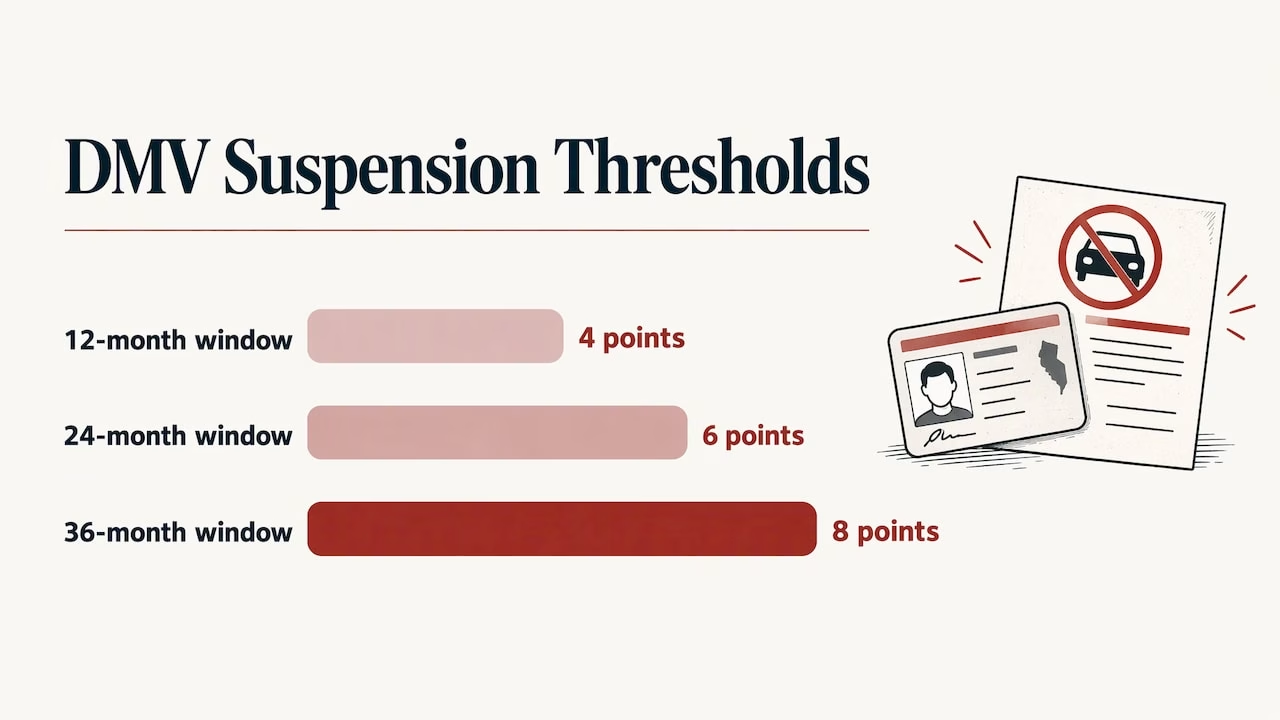
- Enough points: the DMV Driver’s Handbook says an adult license can be suspended at 4 points in 12 months, 6 in 24 months or 8 in 36 months.
One more point to understand: paying the ticket is treated as a conviction. The California Courts self-help guide explains that paying means forfeiting bail, and it counts as a conviction. Pleading guilty or no contest gives the same record result. The difference matters only if someone later sues you, because a guilty plea can be used as proof in that case.
What about insurance?
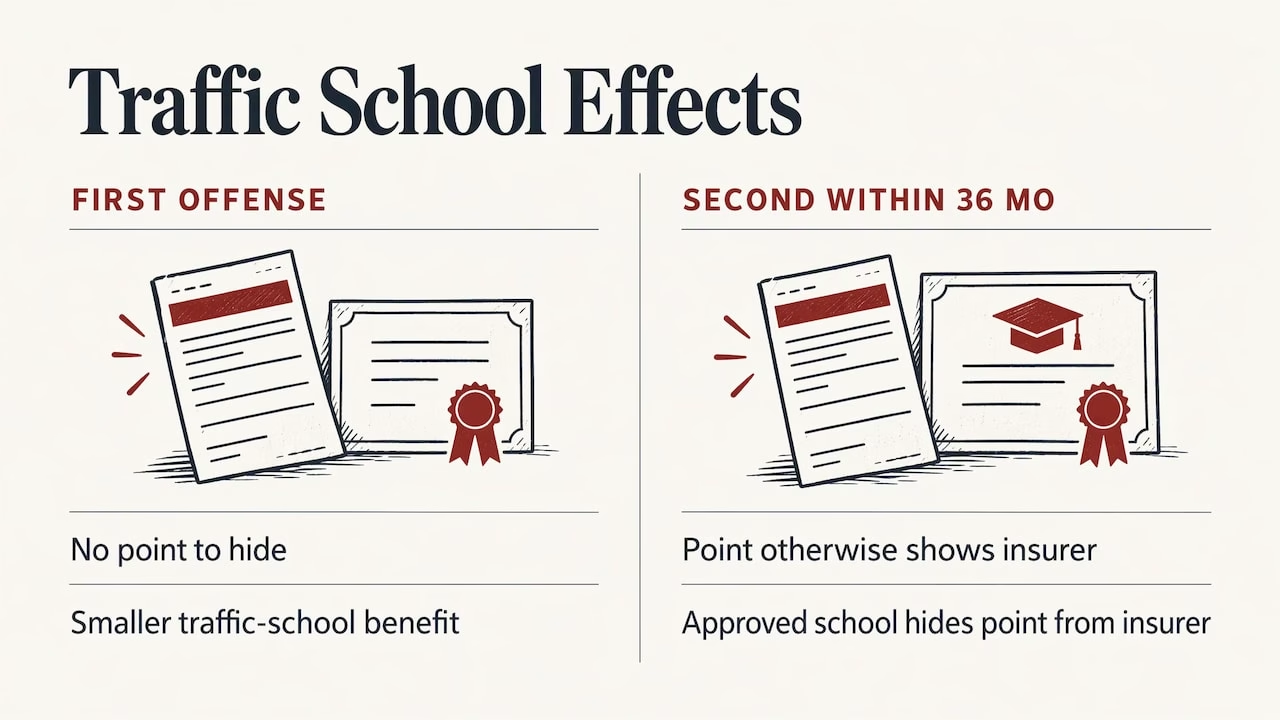
Convictions that carry points go on your DMV record and can raise your rates. A first cell phone conviction has no point, so the insurance risk is mostly about a second offense. If you are eligible for traffic school and finish it on time, the court explains the point stays on your record but is hidden from insurance companies, so it usually will not affect your rates.
How to Check What You Owe and When
You do not need to wait for the mail to know where you stand. Here is the routine:
- Find your citation number. It is on the ticket the officer handed you.
- Allow time for entry. After an officer files a ticket, the Santa Cruz County court says it can take up to 30 days to review, enter and mail a courtesy notice. The California Courts guide says the notice can take 30 days or longer.
- Search the court’s case portal. Many courts let you look up a citation by name and date of birth or by the ticket number. Use the court for the county where you were cited.
- Read the notice. It states the amount you owe, your due date and your options, including whether you qualify for traffic school.
- Act by the due date. Not receiving the notice does not relieve you of the responsibility to resolve the ticket on time.
The cost of delay is real. If you ignore a ticket, the court may add up to $100 as a civil assessment, charge you with failure to appear and add the violation to your DMV record. A $20 base fine should never turn into that.
If you need a step-by-step view of what follows a citation in general, our guides to what happens after a traffic citation is issued and traffic citation steps explain the usual path from ticket to resolution.
Traffic School: Keeping the Ticket Off Your Insurance Record
For most drivers with a cell phone ticket, the real choice is between paying and taking the conviction, or completing traffic school so the point is masked. Traffic school does not erase the ticket. You still pay the fine and the court’s fee. What changes is what the DMV and insurers can see.
Who is eligible
The San Francisco Superior Court lists the criteria under Vehicle Code §42005 and Rule 4.104. You need:
- A valid California driver’s license
- An eligible infraction carrying no more than one DMV point
- No traffic school in the past 18 months
- No alcohol or drug connection
- No speed more than 25 mph over the limit, and no tank-vehicle citation
The court warns that if you enroll when you are not eligible, the $52 administrative traffic school fee is not refunded and the conviction is still reported to the DMV. Check your eligibility on your court notice first.
The 18-month rule is also written into California Rule of Court 4.104: a violation within 18 months of a previous one is ineligible if you attended or elected traffic school for that earlier violation. Sutter County’s court adds that Vehicle Code §1808.7 allows only one citation in an 18-month period to be masked, counted from the violation date. Drivers with a commercial license who were not driving a commercial vehicle may attend, but the conviction is not held confidential, though no point is added.
Why it matters most for a second offense
On a first cell phone ticket there is no point to hide, so the benefit is smaller. On a second ticket within 36 months, completing a court-approved program is what prevents the point from showing to your insurer. That is the situation where traffic school pays for itself.
Choosing a course
The court must accept the provider. Before you pay for any course, confirm on your court notice or the court’s traffic page that the school is approved for your county. A course that the court does not recognize will not mask your ticket, and you will have paid for nothing.
Fighting the Ticket Instead
Some drivers contest the citation, for example because they were using a mounted phone with a single tap or were using a built-in system. The self-help guide from the California Courts explains your options and deadlines in one place. If you plan to contest, keep any facts that show how the phone was set up, and do not let the due date pass while you decide. Contesting is a legal decision, so for a complicated case a licensed California attorney is the right person to ask.
Our Perspective
Most drivers who contact us about a ticket are not worried about the fine itself. They are worried about what the ticket does to their record and their insurance premium. Our view is simple: a ticket is a moment to learn the rule, not just to pay it.
We build our courses in-house with certified educators and safety specialists, so the content follows statutory requirements and reflects real-world safety. Our courses are state-approved, they run on any device so you can learn at your own pace, and we publish our prices with no hidden fees and a money-back guarantee. We also offer read-along features in multiple languages, because understanding the rules should not depend on the language you grew up with.
The phone-related habits behind a ticket are usually small ones: a glance at a map at a stoplight, a quick reply at a crosswalk. A course that explains why those habits are risky, and how to set up a car so they are unnecessary, does more than a fine ever will.
the author
Where Drivereducators Fits In
Our courses are state-specific. We offer state-approved online courses in Florida, Michigan, Delaware and Colorado, so if your ticket was issued in California, the court that handles it decides which traffic school counts, and you should confirm that on your notice. If you are a Florida driver, or you drive in Florida, our Florida Wireless Devices Distracted Driver Course is $24.50, with no hidden fees and a money-back guarantee. You can see every Florida option, including the Basic Driver Improvement course at $30, on our courses page.

If you manage drivers who use phones for work, our custom fleet safety course is built around your company’s needs. A written phone policy plus training is the most practical way to keep a team out of the citation numbers California reported.
To understand how points work more broadly, read our guide to ways to reduce points on your driving record. We have also written about how California’s texting rules have shifted.
How to Avoid the Next Ticket
The California Office of Traffic Safety has noted that even hands-free use can be distracting and that the safest choice is to avoid phone use entirely while driving, pulling over and parking safely if you need the phone. The CHP gives the same advice: if you cannot use hands-free features, ask a passenger or park before using the device, with 9-1-1 as the exception.
A setup that works:
- Mount the phone before the car moves, within reach and in a legal position.
- Enter your destination before you start.
- Use voice commands for calls, texts and music.
- Put the phone on Do Not Disturb while driving.
- Hand the phone to a passenger when you need something done.
FAQ
Is a California cell phone ticket a moving violation?
Yes. California treats a handheld phone violation as a moving violation, and the court reports convictions to the DMV. A first conviction carries no point, but the conviction can still appear on the record. A second conviction within 36 months can add one point.
Can I use my phone at a red light in California?
No, not in your hand. The vehicle is still considered in operation at a red light or stop sign. You may use a phone only in a hands-free mode or, if it is mounted, with a single tap or swipe.
How much will my ticket cost in total?
The base fine is $20 for a first offense and $50 for later ones, plus penalty assessments and court fees that vary by county. Your citation or the court’s courtesy notice shows the exact amount you owe, and that figure is the one to rely on.
What happens if I do not respond to the ticket?
The court can add up to $100 as a civil assessment, charge you with failure to appear and add the violation to your DMV record. Not receiving the notice does not remove your responsibility, so check the court’s case search if you have not heard anything within about 30 days.
Does traffic school remove a cell phone ticket?
No, it does not dismiss it. You still pay the fine, but if you are eligible and finish a court-approved course on time, the point stays on your record and is hidden from insurers. Eligibility generally requires a valid license, a noncommercial vehicle and no traffic school in the last 18 months.
Sources
- California Vehicle Code §23123.5
- California Vehicle Code §23123
- CHP hands-free law and distracted driving citations
- City of San Ramon cellular phone law FAQ
- Sacramento Bee on phone use at red lights
- Marin County 2026 traffic infraction penalty schedule
- Santa Clara County court infraction guide
- California Courts guide to traffic tickets
- California DMV Driver’s Handbook
- TicketFight guide to cell phone tickets
- Santa Cruz County court citation search
- San Francisco Superior Court traffic school page
- California Rule of Court 4.104
- Sutter County court traffic school page
Recommended
- An Online Driving Course for a Speeding Ticket Can Help
- 7 Ways to Reduce Points on Your Driving Record
- What Is a Moving Violation and How Does It Work?
This article is provided for general information and is not a professional advice.