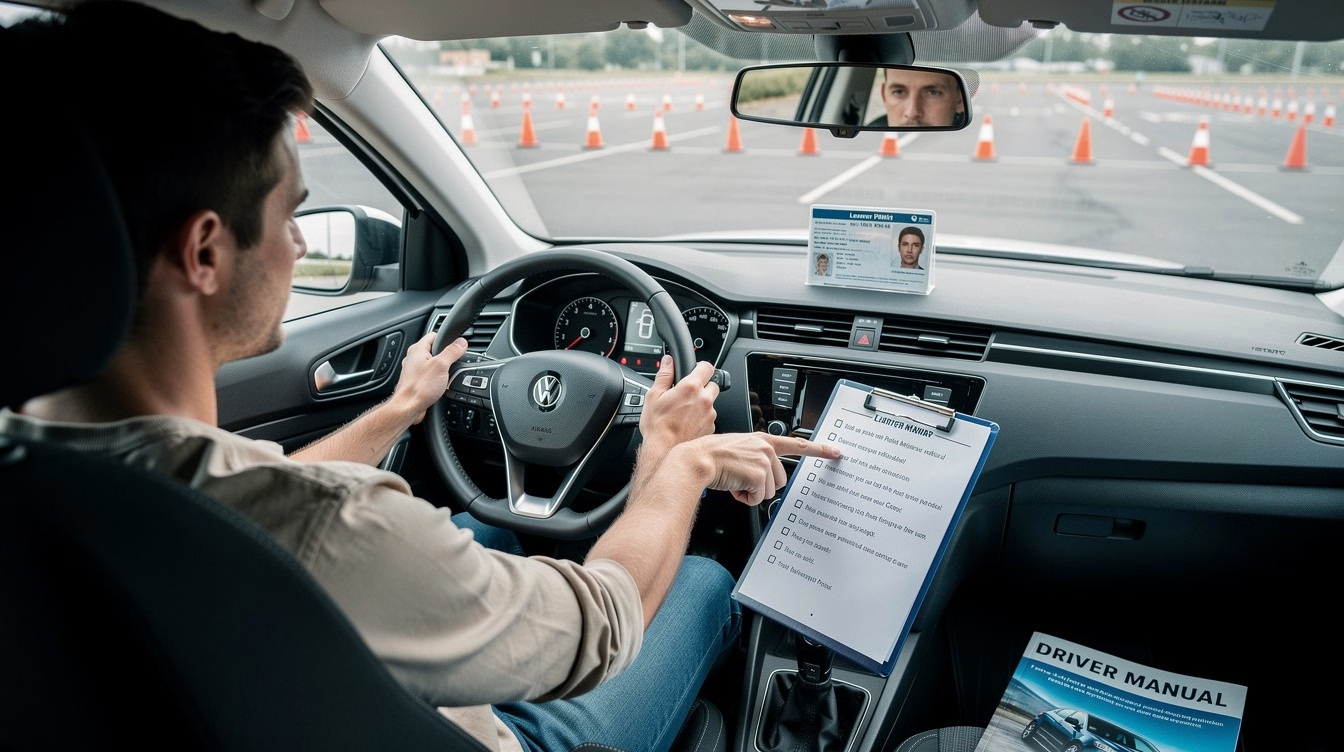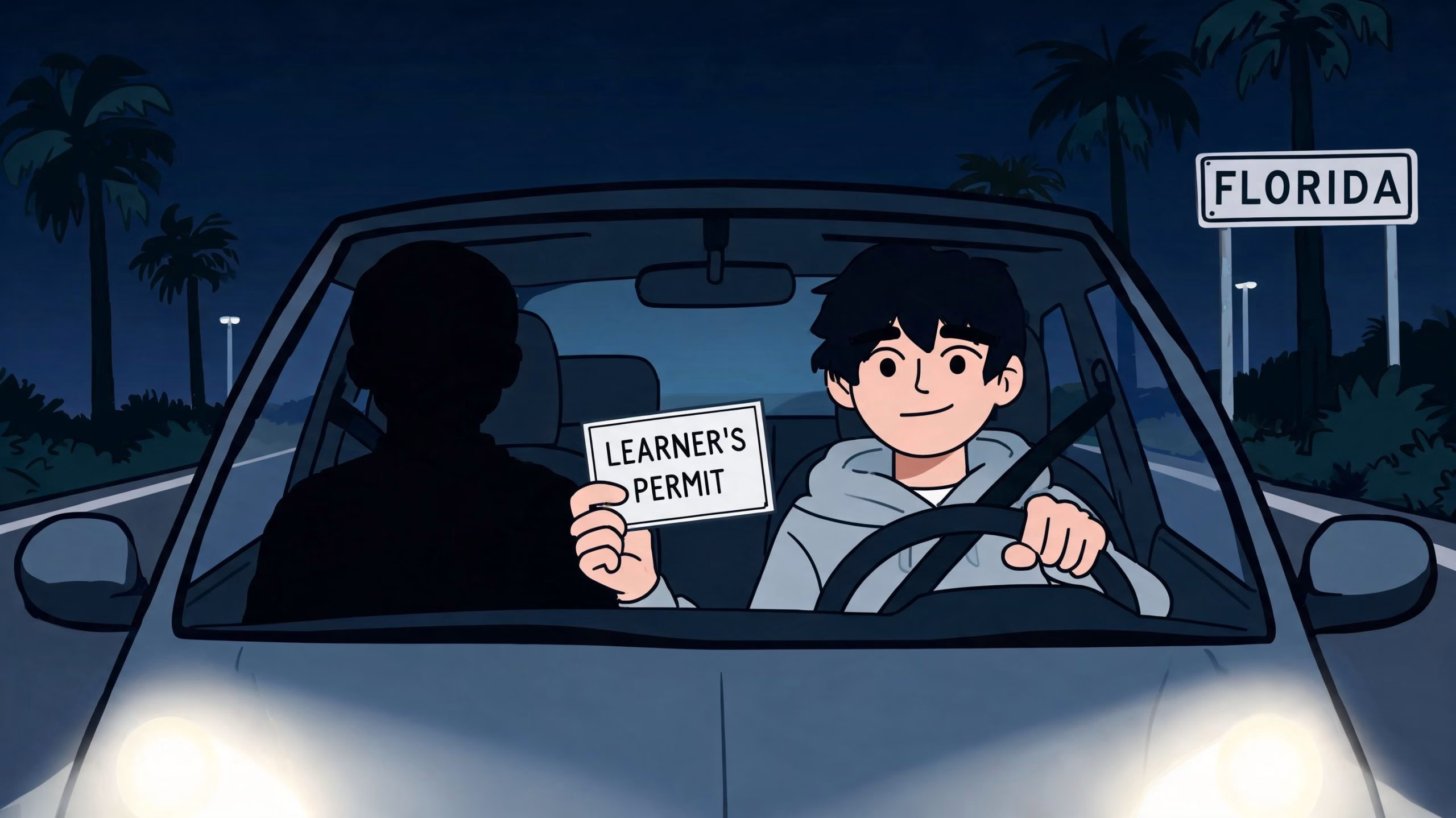
Yes, you can drive at night with a permit in Florida, but the rules depend on your age. For teens ages 15 to 17, Florida’s Graduated Driver Licensing law allows supervised driving only during daylight hours at first, then until 10 p.m. after the first three months, while adult permit holders can drive at night only if a licensed driver age 21 or older is in the front passenger seat.
If you’re asking because a new driver in your house just got a permit, this question usually comes up fast. A teen gets invited to a late movie. An adult learner gets off work after dark and wants to practice. A parent wonders whether “with me in the car” changes the rule. Those are normal questions, and Florida’s answer is simple once you separate teen permit rules from adult permit rules.
The confusion usually starts because people hear “permit” and assume one rule applies to everyone. It doesn’t. Florida treats a 15 to 17-year-old learner very differently from an 18+ adult learner. The reason is safety, not punishment. Night driving is harder, and the law tries to add difficulty in stages instead of all at once.
Introduction Can I Drive at Night With My Permit
A common Florida scene goes like this. A 15-year-old has a fresh learner’s permit, some confidence from a few daytime practice drives, and a text from friends about going out later. The obvious question pops up: can you drive at night with a permit?
For a teen, the answer is usually yes, but only within Florida’s learner restrictions and only with supervision. For an adult with a permit, the answer is also yes, but only with a qualified supervising driver in the front seat. That second part matters more than many drivers realize.
Florida’s permit rules work like training wheels on a bike. Training wheels aren’t there because the rider is doing something wrong. They’re there because balance comes first, then speed, then sharper turns. Driving laws for beginners follow the same logic.
Practical rule: If you have a permit, don’t ask only “Can I drive?” Ask “What time is it, how old am I, and who is in the front passenger seat?”
Parents often worry that these rules are too strict. New drivers often think they’re too limiting. In reality, they’re guardrails. They slow things down during the hours when new drivers tend to face the toughest conditions, especially after dark.
That’s why it helps to think about night driving as a separate skill, not just “day driving but darker.” The law does.
Why Night Driving Rules Exist for New Drivers
Night driving asks more from a beginner than daytime driving does. The road looks different. Distances feel less clear. Headlights flatten depth perception. Fatigue shows up faster. Even a familiar street can feel unfamiliar after sunset.
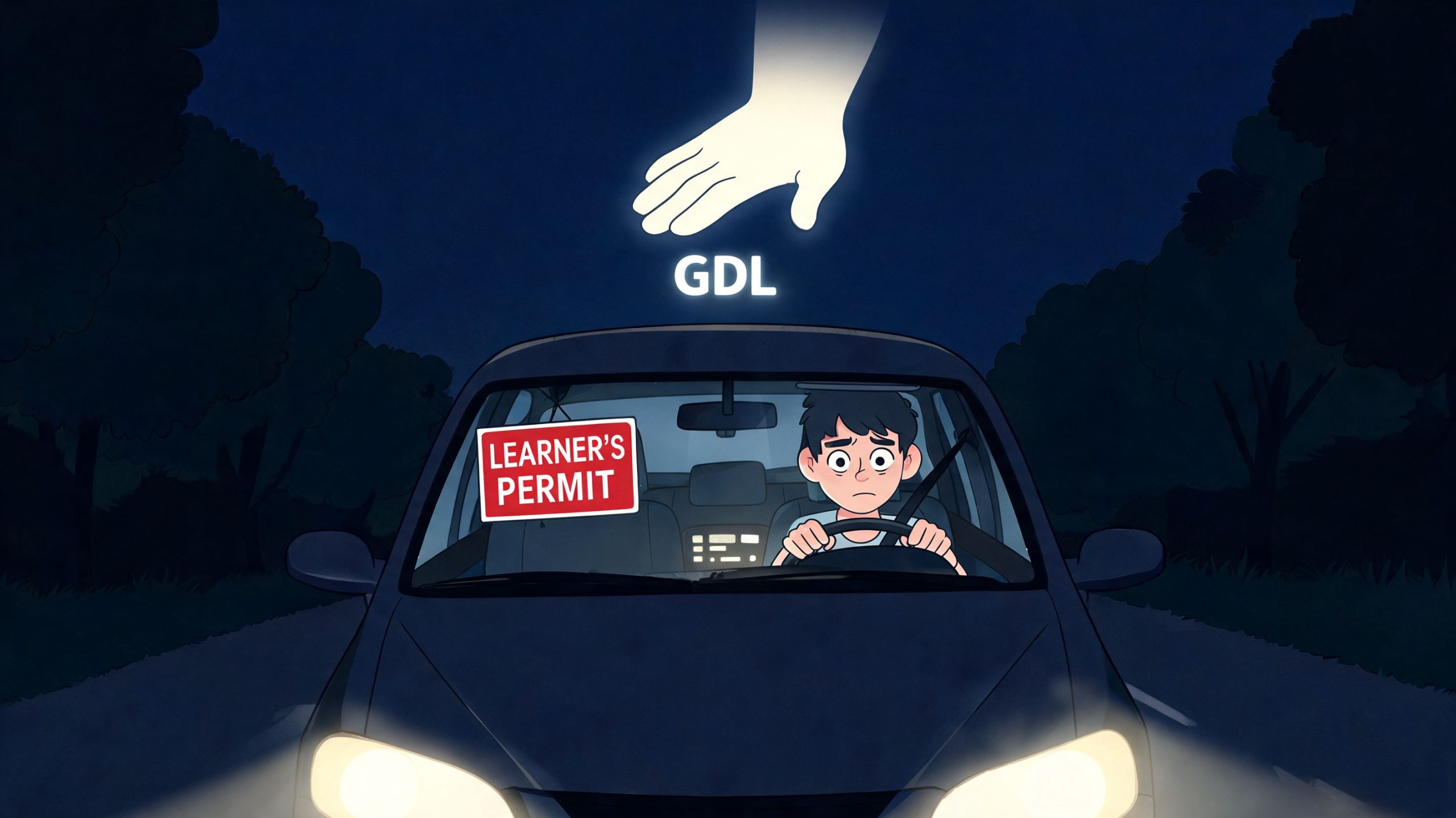
Florida’s rules for young drivers fit into a larger system called Graduated Driver Licensing, or GDL. A good way to think about GDL is “beginner mode” in a game. You don’t start on the hardest level with the fewest visual cues. You progress to greater complexity as your skill improves.
The risk changes after dark
The clearest reason these rules exist is crash risk. According to NHTSA’s summary of GDL safety findings, the rate of driver fatalities was 5 times higher among 16- and 17-year-olds from 10 p.m. to 5:59 a.m. than during daytime hours. The same source notes that 31% of U.S. drivers aged 16 or 17 involved in fatal crashes were in night hours, even though those hours accounted for only 11% of trips by that age group.
That gap tells you something important. Nighttime isn’t just a little harder. For a novice, it changes the whole difficulty level.
What makes night driving harder
Three problems show up at once:
- Visibility shrinks: You see less of the road, less of the shoulder, and less of what’s developing ahead.
- Glare gets worse: Bright headlights can briefly wash out what your eyes need to track.
- Judgment gets tested: New drivers have less experience deciding whether something is far away, slowing down, or turning across their path.
When a beginner says, “I can see the road fine,” they usually mean they can see what’s directly in front of the hood. Safe driving requires seeing what’s developing farther ahead and to the sides.
Restrictions are meant to reduce exposure
The point of nighttime permit rules isn’t to make a teen miserable or keep an adult learner dependent. It’s to reduce exposure during the hours when mistakes cost more. A learner who first builds steering, scanning, lane position, and braking in daylight has a stronger base when nighttime practice begins.
That’s also why supervised night driving matters. A calm adult in the passenger seat can catch early signs of trouble long before a beginner notices them.
Florida’s Night Driving Rules for Teen Permit Holders
Florida uses a step-by-step system for drivers under 18. The rules change based on license stage and age, so it helps to separate them.
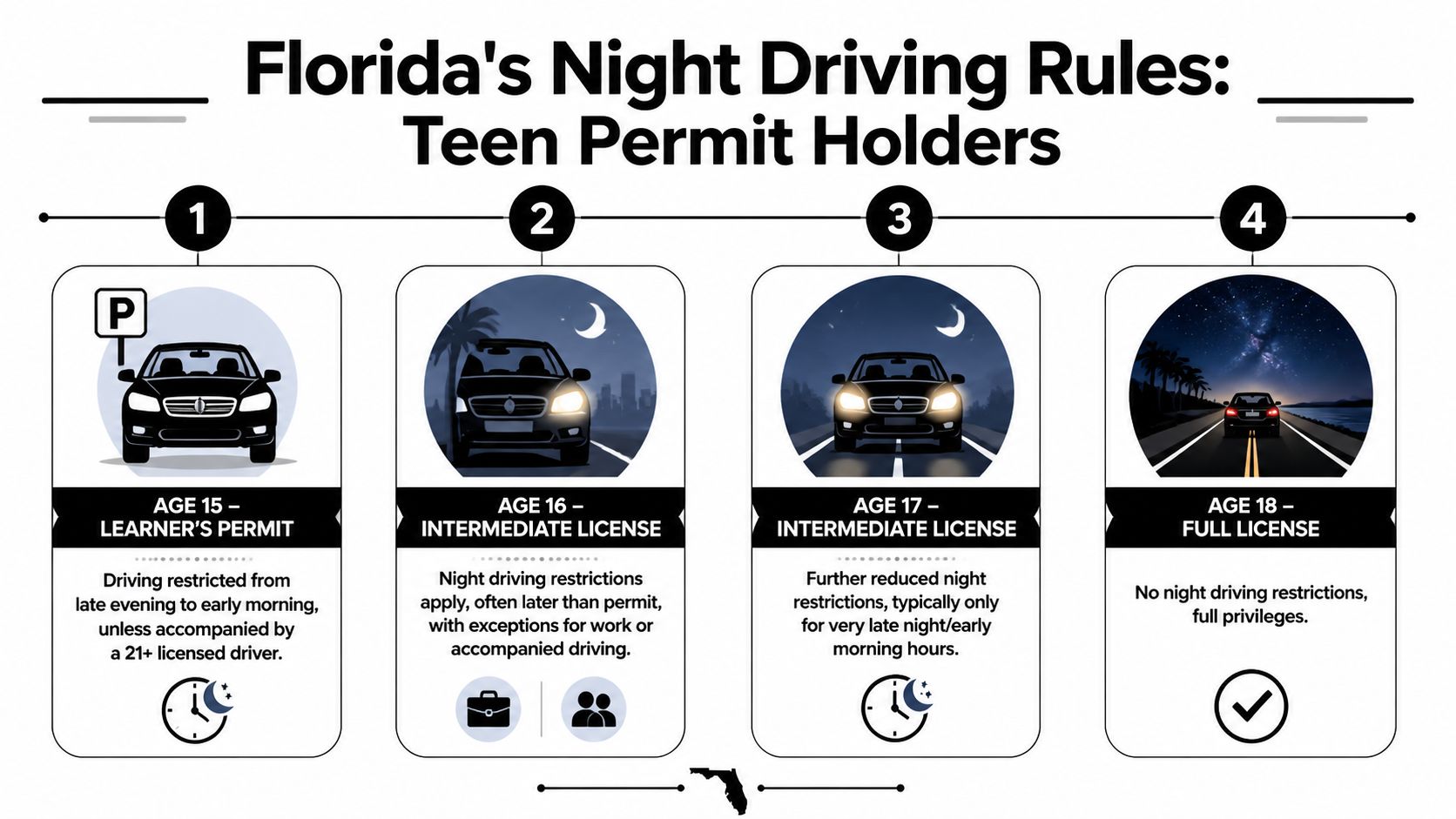
Learner’s permit rules for ages 15 to 17
If you have a Florida learner’s license, your first rule is simple. You cannot drive alone. You must have a licensed driver age 21 or older in the front passenger seat.
Florida also limits the hours for teen learners. According to the CDC overview of teen nighttime restriction patterns, including Florida’s GDL structure, Level 1 permit holders in Florida are initially limited to supervised driving during daylight hours. After three months, they may drive until 10 p.m., still with a licensed driver 21 or older.
That means a teen learner in Florida can think about the rule this way:
| Permit stage | When you can drive | Who must be with you |
|---|---|---|
| First 3 months | Daylight hours only | Licensed driver age 21+ in front seat |
| After 3 months | Until 10 p.m. | Licensed driver age 21+ in front seat |
If a teen asks, “Can I drive to a 9:30 movie?” the answer depends on whether the drive home would go past the allowed time. If the trip pushes you outside the allowed permit hours, it’s not legal.
For a fuller overview of how these stages work, BDISchool’s guide to Florida graduated driver licensing rules lays out the progression in plain language.
Intermediate license rules after the permit stage
Once a teen moves beyond the learner stage and gets an intermediate license, the restrictions change again.
Here’s the practical breakdown Florida families should remember:
- Age 16: Driving is restricted from 11 p.m. to 6 a.m., unless driving to or from work or accompanied by a licensed driver age 21 or older.
- Age 17: Driving is restricted from 1 a.m. to 5 a.m., unless driving to or from work or accompanied by a licensed driver age 21 or older.
- Age 18: These age-based nighttime restrictions end with a full adult license.
Many families frequently misunderstand this. They remember “my teen can drive later now” but forget that a later curfew is still a curfew.
The easiest way to avoid mistakes
Use a three-question check before every nighttime trip:
- What license stage is the driver in?
- What time will the trip end, not just start?
- Is the required supervising driver in the front seat if supervision is required?
A lot of permit violations happen on the return trip. The driver leaves legally at dusk, stays out longer than planned, and comes home outside the allowed hours.
Parents can make this easier by setting a house rule: no nighttime trip starts unless everyone agrees on the latest legal return time before the keys leave the counter.
What About Adult Permit Holders in Florida
Adult learners often get left out of this conversation. Most online advice is aimed at teens, their parents, and school-age drivers. But plenty of Florida permit holders are adults. Some are first-time drivers. Some are new residents. Some are returning to driving after years away.
For adult permit holders, the key difference is this: Florida does not apply the same teen curfew structure to adults with permits. The important rule is supervision.
According to the guidance gap identified in this discussion of adult learner permit confusion and supervision rules, Florida’s adult permit framework is understood as requiring a licensed driver age 21 or older in the front passenger seat at all times, without a separate time-of-day curfew like the teen GDL system.
What that means in real life
If you’re 18 or older and have a learner’s permit in Florida:
- You can practice during the day.
- You can practice after dark.
- You cannot practice alone.
- The supervising driver needs to be 21 or older and seated in the front passenger seat.
That last point matters. A parent, spouse, friend, or roommate in the back seat doesn’t satisfy the supervision requirement. The supervising driver needs to be in the position where they can watch traffic, coach you, and step in verbally right away.
If you’re studying for the process itself, BDISchool’s page on getting a driver’s permit in Florida is a useful starting point for adult learners as well as teens.
Why adults still need a night plan
Adults sometimes assume that because there’s no teen-style curfew, night practice is automatically fine anytime. Legally, the supervision rule is what controls. Practically, you should still build up in stages.
Start in a quiet parking lot or low-traffic neighborhood after sunset. Then move to familiar roads with light traffic. Save busy multilane roads, rain, and glare-heavy commercial corridors until you’re more comfortable.
Adult learners often feel pressure to “catch up fast.” That pressure causes mistakes. Slow, repeated practice works better than trying to cram every difficult condition into one week.
Consequences for Breaking Nighttime Driving Rules
Breaking permit rules can feel minor in the moment. A teen thinks, “It’s only a short drive.” An adult learner thinks, “I know the route.” But license restrictions are legal conditions, not suggestions.
The immediate consequence can be a traffic stop and a citation. The longer consequence is often more frustrating. A violation can interrupt your progress toward the next license stage and create headaches with insurance, school, work, or family transportation.
Why the state takes these rules seriously
One useful comparison comes from New York. Violating nighttime permit rules can lead to permit suspension, fines up to $250, and a delay in road test eligibility by 6 months. Florida’s exact penalties can differ, but the reason behind enforcement is the same: reduce high-risk driving by beginners during nighttime hours.
If you want a broader picture of how violations can affect your status, it helps to spend a few minutes understanding Florida driving license laws, especially when supervision or licensing status is part of the issue.
The practical costs are often bigger than the ticket
A nighttime permit violation can create problems that spread outward:
- License delays: A teen may have to wait longer to move forward.
- Record concerns: A violation can become part of the story insurers and courts see.
- Family trust issues: Parents usually tighten driving privileges after one preventable mistake.
- More stress at every drive: Once a learner gets cited, every future trip feels higher stakes.
For drivers worried about citations and record impact, it’s also smart to understand how Florida driver license points can affect the bigger picture.
If a trip isn’t legal, the safest backup plan is boring but effective. Reschedule, get a ride, or have the supervising driver take over.
Essential Safety Tips for Driving After Dark
The legal rule answers whether you may drive. Safe technique answers whether you’re ready to drive well.
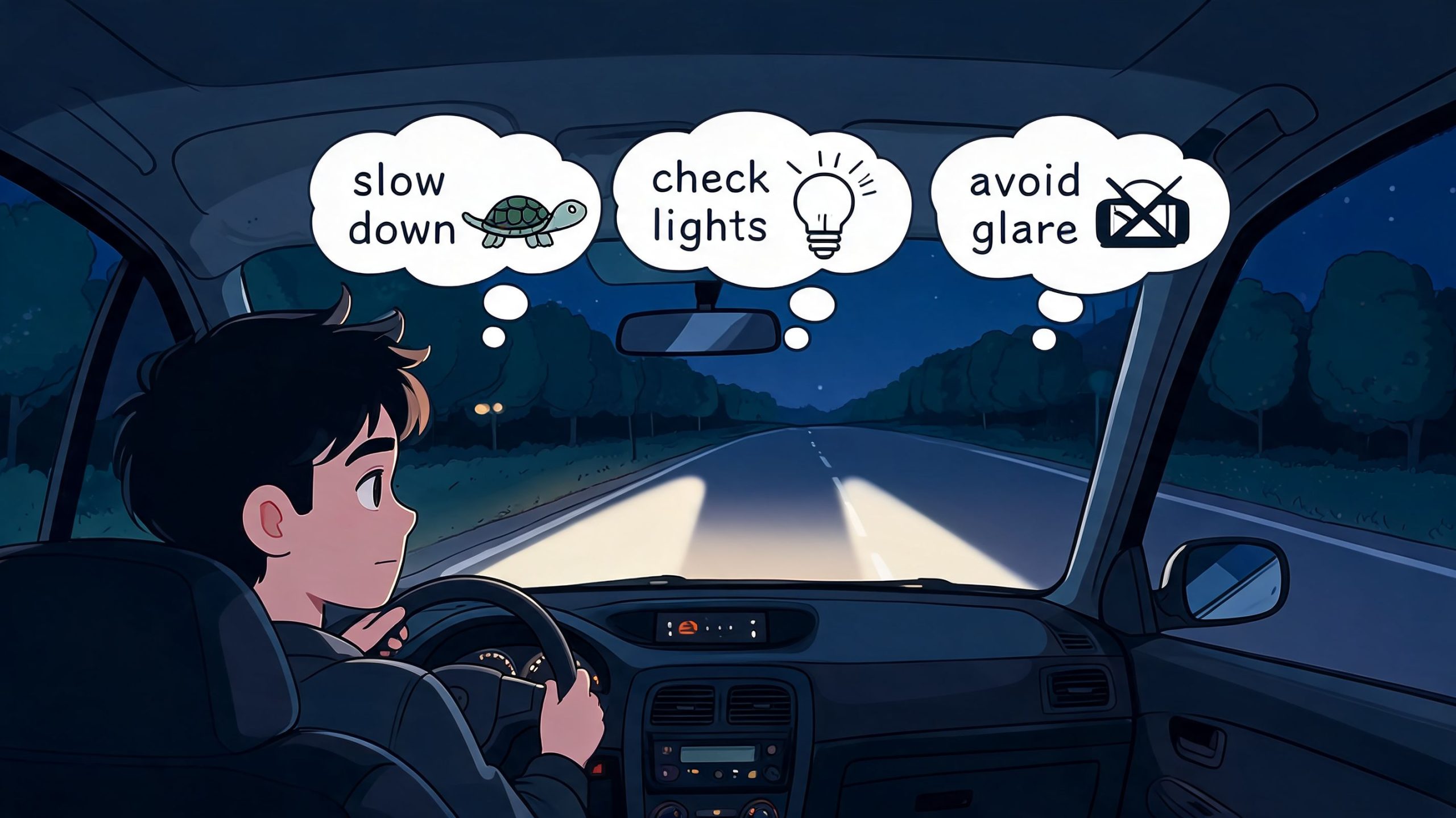
One of the hardest parts for beginners is glare. According to this discussion of novice night-driving challenges, recovery from oncoming headlights can take 5 to 7 seconds for a new driver, compared with 1 to 2 seconds for an experienced one. That’s why night driving can feel overwhelming even when traffic is light.
Five habits that make night driving safer
- Increase your following distance. At night, give yourself extra space behind the car ahead. More space buys you more time to react when visibility shrinks or glare hits.
- Look slightly right of oncoming headlights. Don’t stare into bright lights. Use the right edge of your lane as a reference point until the glare passes.
- Slow down to match what you can see. If your headlights show only a short stretch of road, your speed should fit that shorter visible area.
- Clean the glass before driving. Dirty windshields, mirrors, and headlights turn ordinary light into smeared glare.
- Drive familiar routes first. Night practice goes better when the road layout is already known and the only new variable is darkness.
A more complete list of beginner-friendly night driving tips can help you turn these into a repeatable routine before every evening practice drive.
How parents can supervise better
Parents often focus on correcting every little mistake. At night, that can overload a new driver. Keep your coaching simple and timed well.
Try this approach:
- Before the drive: agree on route, turns, and parking plan.
- During the drive: give short instructions early, not at the last second.
- After the drive: discuss only two or three improvements, not ten.
“Scan farther ahead, ease off the gas, and keep your hands steady” is easier for a learner to use than a running stream of corrections.
Video walkthroughs can also help a learner preview what nighttime hazards look like before getting behind the wheel:
Small details matter more at night
Night driving rewards clean habits. Adjust mirrors before moving. Keep dashboard brightness low enough that it doesn’t compete with the road. If a learner struggles with glare or cabin visibility, it’s worth reading about options like ceramic tint for general visibility considerations, while always following Florida tint laws.
For permit holders, the best night practice session is usually short, calm, and repeatable. Twenty careful minutes on a familiar route teaches more than a long, stressful drive in heavy traffic.
How BDISchool Prepares You for Night Driving Success
A permit rule on paper is one thing. Using that rule calmly on a dark road is something else.
That gap is where training helps. New drivers often know they need supervised practice, but they are less sure how to turn that requirement into real skill. Florida’s rules make more sense when you connect each one to a driving habit. Limited visibility means scanning farther ahead. Extra glare means choosing speed more carefully. Supervision means getting feedback before a mistake becomes a pattern.
BDISchool offers Florida-approved driver education and traffic school courses in English, Spanish, and Portuguese. Its instruction helps learners connect the legal rule, the reason for it, and the action to take behind the wheel. For a teen permit holder, that can mean understanding how staged licensing rules shape practice time. For an adult permit holder, it can mean getting clear guidance without lessons that assume every beginner is 15 or 16.
That distinction matters in Florida.
Teens usually need a roadmap for building toward required supervised experience, including night practice that feels controlled and legal. Adults with permits often need the same road skills, but with different concerns, such as fitting practice into work hours, rebuilding confidence, or learning the rules later in life. A good course speaks to both groups instead of treating one as an afterthought.
BDISchool’s value is practical. The material covers Florida traffic laws, defensive driving habits, crash avoidance, and the choices that shape safe decision-making. For night driving, that foundation works like learning the controls of an airplane before a night flight. You do not want your first lesson in glare recovery, lane tracking, or hazard recognition to happen in a stressful moment on the road.
For families, that means practice sessions can follow a clearer plan. For adult learners, it means less guesswork and more confidence about what to practice, when to practice, and how to build those night hours safely under Florida’s supervision rules.
Frequently Asked Questions About Permit Driving at Night
Does a teen permit holder in Florida ever drive alone at night
No. A teen with a learner’s permit must have a licensed driver age 21 or older in the front passenger seat. The allowed hours also depend on how long the teen has held the permit.
If I am 18 or older, can I drive at night with a permit
Yes, but not alone. Adult permit holders can practice at night if a licensed driver age 21 or older is in the front passenger seat.
Does it count if the supervising driver is in the back seat
No. The supervising driver needs to be in the front passenger seat. That placement is part of the supervision requirement.
How should I log my night driving hours
Keep a simple written or digital log with the date, start time, end time, route, and supervising driver’s name. Families should decide in advance what counts as “night” for their records and keep the log consistent.
What if a legal trip starts before the cutoff time but ends after it
That can still create a problem. Always plan around the end time of the trip, not just the departure time.
What counts as driving to or from work for a teen exception
Keep it narrow and honest. It should be a direct trip connected to an actual work schedule, not a social stop along the way.
If you want help turning permit rules into real driving confidence, BDISchool offers Florida-approved courses that support teen drivers, adult beginners, and drivers who need to protect their record or refresh their skills.