You’re driving home in Florida after work. Traffic is heavy, your mind is already on dinner, and then you see flashing lights in the mirror. A few minutes later, you’re holding a ticket and wondering what happens next. Do you just pay it? Will points hit your record? Will your insurance go up? Do you need traffic school, and if so, can you do it online without turning your week upside down?
That moment feels stressful, but it doesn’t have to stay that way. For many Florida drivers, online driver education is the simplest path forward. You can handle the requirement from home, on your own schedule, and with a clearer understanding of what the state expects from you.
Online learning has become a normal part of driver training. The global driver education market reached $0.66 billion in 2024 and is projected to reach $1.44 billion by 2033, while 35% of learners prefer digital options, according to driver training market statistics. That shift makes sense. People want flexibility, but they also want something official, practical, and easy to follow.
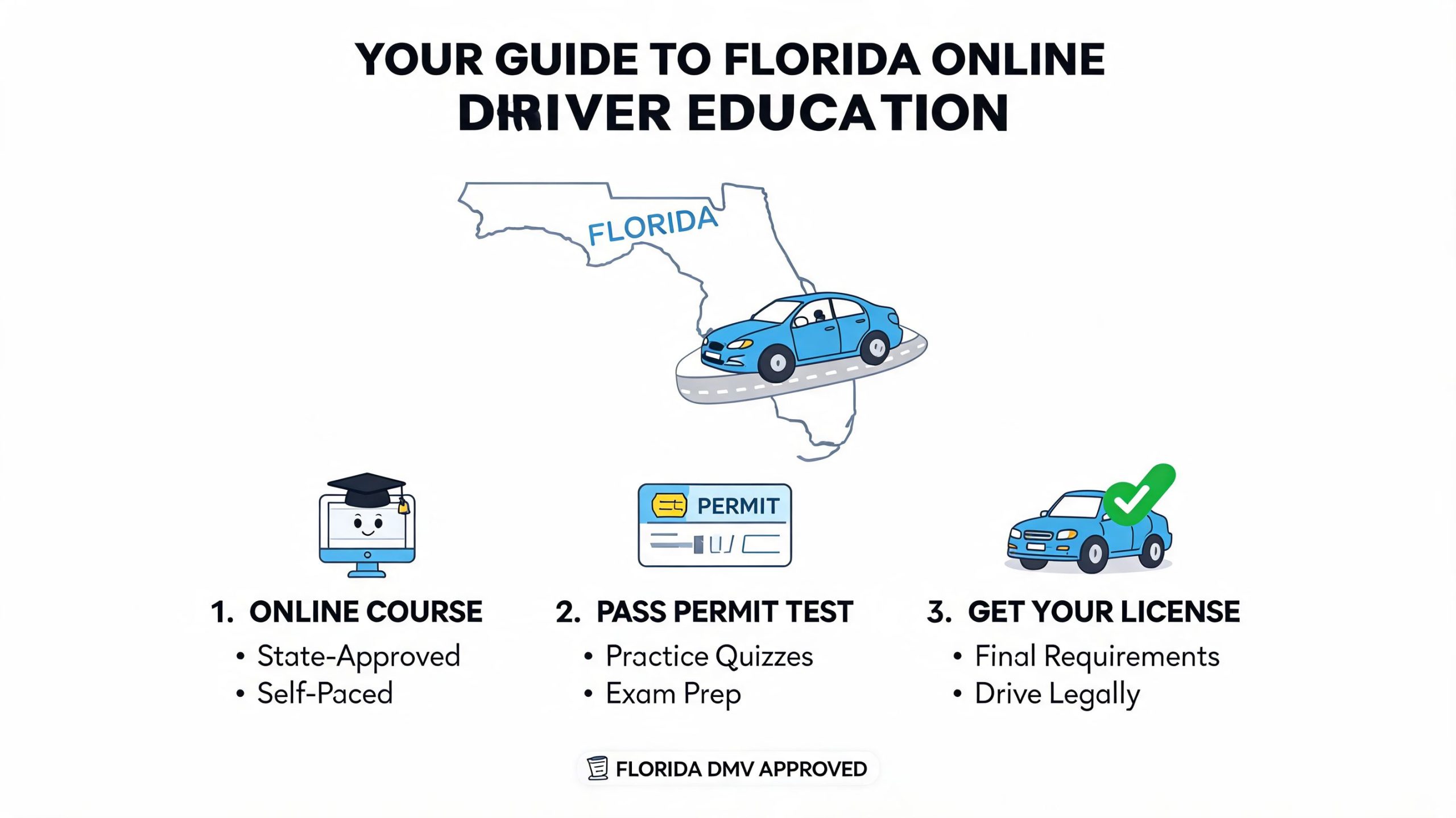
Your Guide to Florida Online Driver Education
Most drivers who start looking for online traffic school aren’t doing it for fun. They’re doing it because something happened. A ticket. A court notice. A call from an insurer. Or sometimes just a quiet realization that they haven’t reviewed Florida road rules in years.
That’s why online driver education works so well for real life. It meets you where you are. If you’re a busy parent in Orlando, a shift worker in Tampa, a retiree in Naples, or a new resident in Miami trying to understand Florida traffic laws, the format removes a lot of friction. You don’t have to drive to a classroom, sit through a fixed schedule, or rearrange your week around a course.
Why this matters right now
In plain terms, online driver education can help Florida drivers handle official requirements while also sharpening habits that matter on the road. Some people take a course to deal with a moving violation. Others want an insurance discount. Others aim for a safer, calmer way to drive in crowded traffic.
A lot of confusion starts because traffic laws and point systems differ from place to place. If you’ve moved recently or you like comparing how other jurisdictions handle similar issues, this explanation of Badesha Law on careless driving demerits is a useful example of how one ticket can carry broader consequences beyond the fine itself.
Practical rule: Don’t guess about your options after a ticket. Find out whether a state-approved course can protect your record before you simply pay and move on.
What Florida drivers usually want to know
Many individuals asking about online driver education are trying to solve one of these problems:
- Points concern: They want to know whether a course can help keep points off their record.
- Insurance worry: They’re trying to avoid a rate increase after a citation.
- Scheduling pressure: They need something self-paced because work and family leave little room for classroom attendance.
- Language access: They need clear instruction in a language they fully understand.
Florida gives drivers several paths, but the details matter. The course has to be state-approved, the reason you’re taking it matters, and deadlines can affect the outcome. Once you understand those pieces, the process feels much less intimidating.
Understanding State-Approved Online Traffic School
“Online driver education” can mean different things in different states. In Florida, when most adults use that phrase after a ticket, they usually mean a state-approved online traffic school course that satisfies a legal, court, or insurance-related purpose.
That approval matters. A course isn’t useful just because it’s online. It has to fit Florida’s rules and reporting requirements. If it doesn’t, you can finish every lesson and still end up with a result the court or state won’t accept.
What state-approved means in Florida
A state-approved course follows standards recognized by the Florida Department of Highway Safety and Motor Vehicles, often shortened to FLHSMV. For drivers, that means the course is built for an official purpose, not just general education.
People usually enroll for one of these reasons:
- They received a non-criminal moving violation and want to elect traffic school if eligible.
- A court ordered the course as part of resolving a case.
- They want an insurance-related benefit, such as a discount tied to a qualifying course.
If you’re trying to sort out the first category, a state-approved Florida DMV online driving course is the kind of option drivers typically look for when they need a course that matches Florida requirements.
How online traffic school differs from the old classroom model
Traditional traffic school usually means showing up at a set time, sitting in a physical room, and staying for the full session whether the pace works for you or not. That setup can be difficult if you work irregular hours, care for family, travel often, or need more control over your study time.
Online driver education changes the experience in a few important ways:
- You control the schedule: You can study early in the morning, late at night, or in shorter sessions.
- You avoid travel: No commute, parking, or waiting room.
- You can review difficult topics: If a section on right-of-way or aggressive driving feels confusing, you can slow down and go over it carefully.
- You can learn more comfortably: Many drivers absorb information better in a familiar setting than in a crowded classroom.
State approval is the line between a course that feels convenient and a course that actually counts.
Why language support matters in Florida
Florida’s roads are shared by people from many backgrounds, and driver education only works when learners clearly understand the rules. That’s one reason multilingual access matters so much.
Florida’s population is over 26% Spanish-speaking, yet many driver education resources are still English-only, according to a review of multilingual access gaps in driver education. That leaves many drivers trying to meet legal obligations in a language that may not be their strongest.
A multilingual course helps with more than comfort. It helps with comprehension. If a driver fully understands topics like lane changes, following distance, DUI risks, and court compliance, they’re better positioned to complete the course correctly and apply what they learn on the road.
If you’re comparing how other states handle court-related education requirements, this Texas DWI classes guide is a helpful example of how course requirements can vary depending on the offense and the jurisdiction.
What often confuses drivers
A lot of people mix together three separate ideas:
| Term | What it usually means |
|---|---|
| Traffic school | A course taken after a ticket, court order, or for an insurance purpose |
| Driver education | Broader instruction about traffic laws, safe habits, and responsible driving |
| State-approved course | A course recognized for a specific official use |
Those ideas overlap, but they aren’t identical. In Florida, the safest approach is to confirm your exact reason for enrolling, then choose the course that matches it.
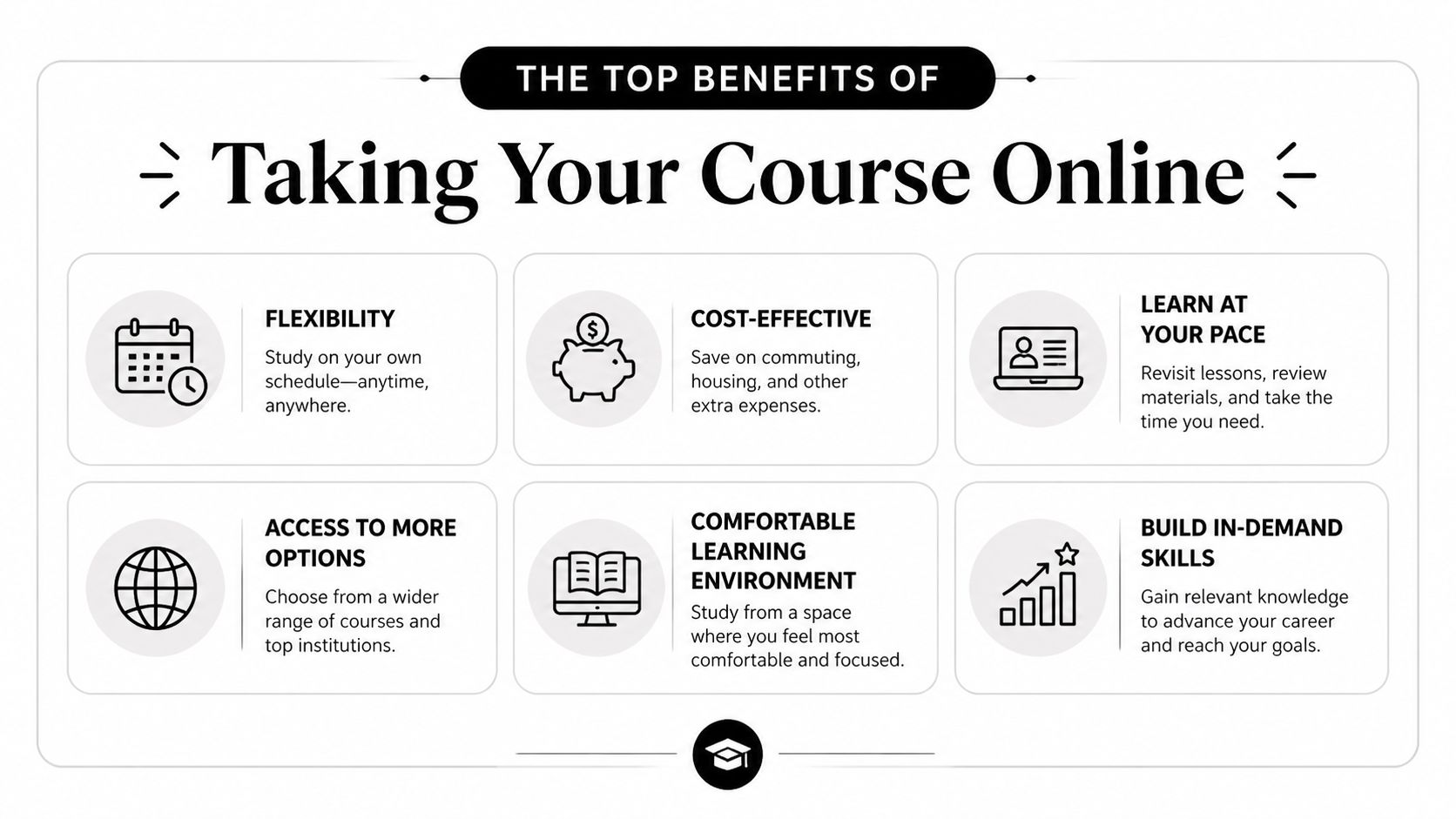
The Top Benefits of Taking Your Course Online
Drivers usually care about one thing first. Results. They want to know whether online driver education helps with the problems sitting in front of them.
It can. Formal driver education programs, including online formats, have been linked with 4.3% fewer crashes and nearly 40% fewer convictions, and structured online theory combined with behind-the-wheel practice has been associated with 5% to 15% crash reductions, according to driver education outcome research. Those numbers matter because they point to a simple truth: good instruction changes behavior.
Protecting your driving record
For many Florida drivers, the first benefit is keeping a ticket from creating a bigger problem. A qualifying course can be part of the path that helps a driver avoid the full ripple effect of a citation on their record.
That matters because one small mistake on the road can follow you longer than you expect. A clean record gives you more breathing room. It can affect how insurers view you, how employers view you in driving-related roles, and how much stress you carry every time you renew something or respond to another traffic issue.
Helping limit insurance trouble
Insurance companies pay attention to driving history. That’s why many drivers start searching for online traffic school almost as soon as they receive a citation. They’re not just thinking about the ticket itself. They’re thinking about what comes after.
A qualifying Florida defensive driving course online can make sense for drivers who want a practical way to address that concern while also reviewing habits that reduce future risk.
Making learning fit real life
The convenience benefit isn’t just about comfort. It’s about completion. People are more likely to finish a course when it fits around work, school pickups, travel, and ordinary household responsibilities.
Here’s what online driver education makes easier:
- Studying in short blocks: You can complete part of the course during lunch, then return later.
- Using familiar devices: Many drivers prefer learning on a laptop, tablet, or phone they already use every day.
- Avoiding wasted time: You don’t spend extra hours commuting to and from a classroom.
- Reducing stress: A self-paced format often feels more manageable than keeping up with a room full of strangers.
The best course is often the one you can actually complete correctly and on time.
Building safer habits, not just checking a box
A good online course does more than satisfy a requirement. It can help drivers slow down mentally, notice patterns in their own behavior, and make better decisions under pressure.
For example, a driver who got a ticket for speeding may realize the issue wasn’t just speed. It may have been rushing between appointments, following too closely, or failing to adjust to traffic flow. Another driver may discover that “I’m just being assertive” is edging into aggressive behavior.
Those insights matter because they’re practical. They show up the next morning in traffic.
Insurance discounts for the right driver
Not every course is about a ticket. Some drivers, especially older adults, take online driver education to refresh their knowledge and ask their insurer about discounts.
That’s a smart use of the format. You can review updated laws, revisit defensive habits, and complete the material at a comfortable pace without the pressure of an in-person classroom.
A better option for hesitant learners
Some drivers don’t love asking questions in a group. Others feel embarrassed returning to traffic school after years of driving. Online learning lowers that emotional barrier.
You can pause. Re-read. Reflect. Then continue when you’re ready.
That quiet flexibility is one reason online driver education works so well for adults.
Choosing the Right BDISchool Course for Your Needs
Florida drivers don’t all need the same course. The right fit depends on why you’re enrolling, what the court or clerk told you, and whether you’re trying to handle a ticket, meet an order, or seek an insurance-related benefit.
Choosing carefully is important. A driver who needs a standard improvement course shouldn’t accidentally sign up for something intended for a different situation. The names can sound similar, but the purpose is not.
If you’re comparing options, a Florida BDI course online is one example of the kind of course drivers choose when they need a basic improvement program for a common moving violation.
The main course types Florida drivers ask about
Some drivers know exactly what they need because the court paperwork tells them. Others only know they got a ticket and need “traffic school.” These are not always the same thing.
The common categories include:
-
Basic Driver Improvement
This is the course many drivers look for after a standard moving violation. It focuses on traffic laws, defensive driving, and the choices that lead to avoidable citations.
-
Intermediate Driver Improvement
This is generally associated with more serious or court-directed situations. If your order specifically says you must complete an eight-hour course, pay attention to that wording.
-
Aggressive Driver Course
This course is aimed at behavior-related concerns such as road rage or aggressive driving patterns. That’s important because these cases are not just about rule knowledge. They’re about judgment, attitude, and self-control behind the wheel.
-
Mature Driver Course
This option is typically for older drivers who want a refresher and may be seeking an insurance discount.
BDISchool Florida Course Comparison
| Course Name | Duration | Primary Purpose | Ideal For |
|---|---|---|---|
| Basic Driver Improvement BDI | 4 Hour | Addressing a standard moving violation and reviewing core safe-driving principles | Drivers handling an eligible ticket |
| Intermediate Driver Improvement IDI | 8 Hour | Meeting a court-ordered driver improvement requirement | Drivers instructed to take a longer course |
| Aggressive Driver Course | 8 Hour | Addressing aggressive driving behavior and responsibility on the road | Drivers cited in aggression-related situations |
| Mature Driver Course | 6 Hour | Refreshing driving knowledge and supporting insurance discount discussions | Drivers age 55 and older |
How to tell which course fits your situation
The easiest way to narrow it down is to ask what triggered the need for the course.
If the answer is “I got one ordinary moving violation,” Basic Driver Improvement is often the category drivers investigate first.
If the answer is “The court told me I must complete an eight-hour program,” then you should follow that direction exactly. The same goes if the paperwork mentions aggressive driving specifically. The course title matters because the requirement is tied to the nature of the violation or order.
A short course and a long course are not interchangeable just because both are online.
A note on aggressive driving cases
Aggressive driving cases raise a common question. Is an online course enough?
The answer depends on the legal requirement and the broader goal. For high-risk groups, online-only formats can be convenient, but some data suggests lower long-term adherence than hybrid models, as discussed in this overview of aggressive-driver course effectiveness. Even so, a structured online curriculum centered on behavioral change and responsibility remains a required and important tool when the state directs a driver to complete it.
That distinction matters. A course may not solve every underlying behavior issue by itself, but it still plays a real role in helping drivers confront risky patterns, understand consequences, and meet formal requirements.
Why course language can be the deciding factor
If English isn’t the language you use most comfortably, course content can become harder than it needs to be. Traffic law is already technical. Add stress from a ticket or deadline, and confusion grows fast.
That’s why many Florida drivers look specifically for online driver education offered in English, Spanish, and Portuguese. Clear language reduces mistakes during enrollment, improves understanding during the lessons, and makes it easier to finish with confidence.
One practical way to decide
Before you enroll, check these three things in your paperwork or with the clerk:
- What is the exact course name or course length required
- What is your deadline
- Whether the course is for ticket election, court compliance, or insurance purposes
Those three answers usually point you to the correct category very quickly.
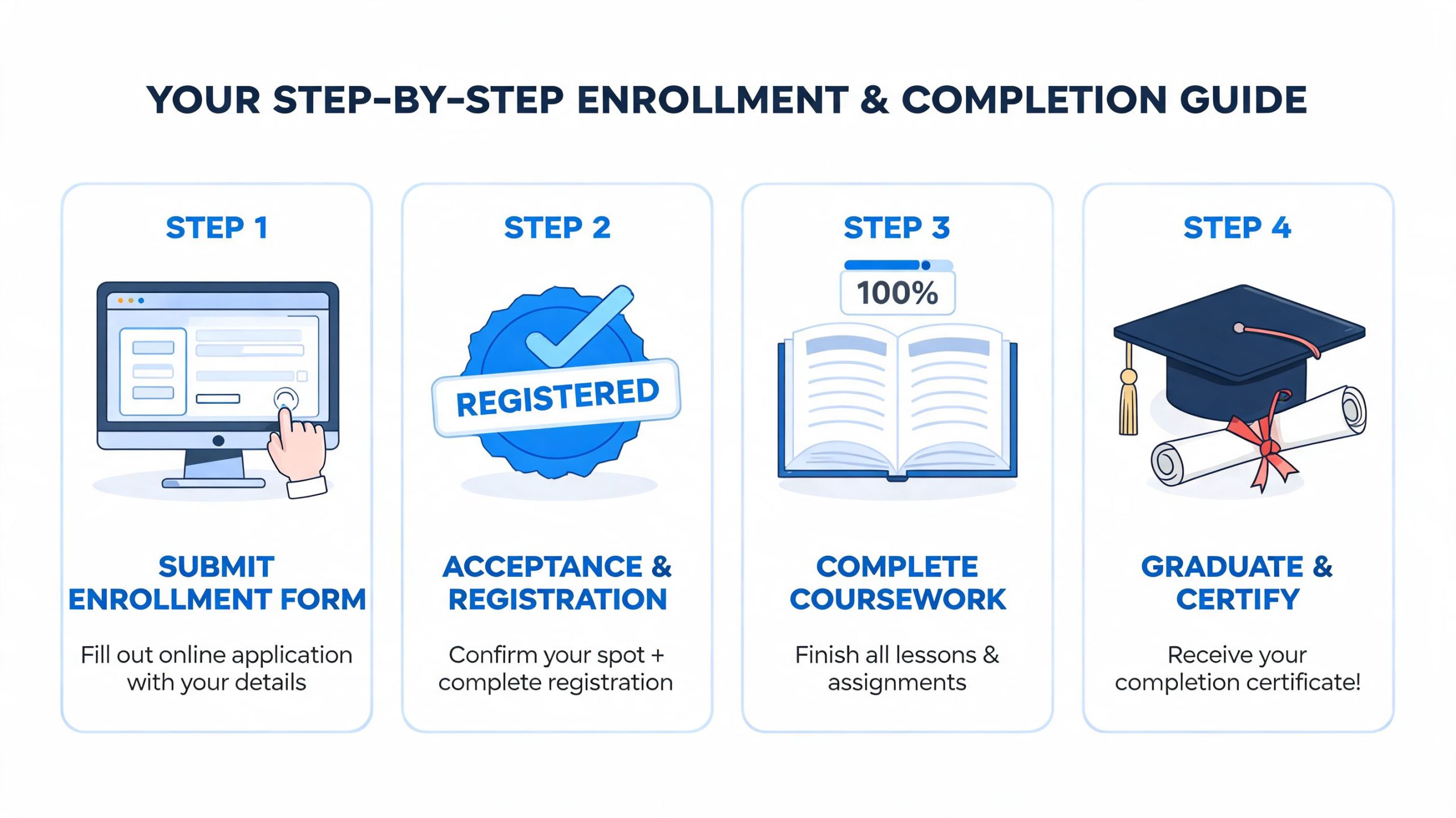
Your Step-by-Step Guide to Enrollment and Completion
A lot of drivers delay enrolling because they think the process will be confusing. In practice, it’s usually straightforward once you break it into a few simple actions.
The biggest mistake is waiting too long to confirm the requirement. Start there, not with the checkout page.
Step 1 Confirm eligibility and deadline
If you received a ticket, contact the clerk or review your citation instructions carefully. You need to confirm whether you’re eligible to take a course and what deadline applies to your situation.
If a court ordered the class, the order should tell you what kind of course you must complete. Read it slowly. One word can make a difference.
Don’t enroll based on memory of what a friend did. Enroll based on what your paperwork or clerk says you need.
Step 2 Enroll online
Once you know the correct course type, registration is usually quick. You’ll enter your identifying information, choose the course, and create access so you can begin.
For drivers who want to understand what proof of completion looks like at the end, an online driving certificate page can help clarify what you’ll typically receive after finishing a qualifying program.
Step 3 Complete the lessons at your own pace
Online driver education becomes much easier than a traditional classroom for many adults. You can log in, work through a section, stop when needed, and come back later.
That flexibility doesn’t mean the course is loose or casual. State-approved online programs use tracking features such as time-stamped logs and assessments that prevent students from skipping ahead, reflecting standards discussed in Ohio’s online driver training requirements. The point is simple: the state wants actual participation, not just a fast click-through.
Step 4 Finish the assessment
Most drivers worry about the final exam more than they need to. If you pay attention during the course and take your time, the assessment usually feels like a review of what you’ve already learned.
A good approach is to treat the lessons seriously from the start. Don’t rush. If a section on right-of-way, following distance, or impaired driving is unclear, go back and read it again before moving on.
Step 5 Make sure reporting is handled
After you finish, the next concern is proof. Drivers often ask, “Do I need to mail anything?” or “How will the state know I completed it?”
That depends on the provider and the type of course, but many approved online programs issue the certificate electronically and handle reporting in line with state procedures. Always verify what happens after completion so you’re not left guessing near a deadline.
A simple checklist before you begin
- Check your paperwork: Make sure you know the right course and due date.
- Use accurate personal details: Your name, citation information, and other records should match official documents.
- Save confirmations: Keep your registration email and any completion record.
- Finish early if possible: Give yourself room in case you need support or clarification.
That’s the entire path. Confirm, enroll, learn, complete, verify.
Frequently Asked Questions About Florida Traffic School
Drivers usually feel better once they understand the basics, but a few specific questions come up again and again. These are the ones that tend to hold people back right before enrollment.
Can I take a course for a ticket I received outside of Florida
Usually, you should start with the state or court that issued the ticket. Traffic school rules are tied to the jurisdiction handling the citation, not just to where you live now.
If you live in Florida but got the ticket elsewhere, don’t assume a Florida online course will satisfy that requirement. Contact the court clerk or agency on the ticket and ask what kind of course they accept.
How do I know if my insurance company will give me a discount for the Mature Driver course
Ask before you enroll. Call your insurer and use direct language. Tell them your age, ask whether they recognize a qualifying mature driver course, and ask what documentation they need after completion.
Some companies are very clear about this. Others want to review the certificate first. The important part is getting the answer from your insurer, not from an ad or a general assumption.
Ask your insurer two questions: “Do you offer a discount for this course?” and “What proof do you need from me?”
What happens if I don’t pass the final exam on my first try
Policies vary by provider, so you should read the course terms before starting. In many online education settings, there’s a process that lets students review material and try again rather than ending the matter with one failed attempt.
If this worries you, slow down during the course itself. Most final assessments are built from the same core lessons you just completed. Drivers who rush through the reading usually feel more stress at the end than drivers who take the lessons one section at a time.
Are online courses really as good as learning in a classroom
For many adult learners, yes. A well-designed online course can be very effective because it allows self-paced review, structured checkpoints, and fewer distractions than a room full of strangers.
The quality depends on the course design. If the program is approved, clearly organized, and built to keep you engaged, online learning can work very well for reviewing laws, defensive techniques, and decision-making. For some driving goals, especially those involving physical vehicle control, behind-the-wheel instruction still matters. But for traffic school and many driver improvement purposes, online instruction is a practical fit.
Will the course automatically remove all consequences from my ticket
No course should be treated as a magic reset. The effect depends on your eligibility, your election, the court or clerk’s rules, and whether you complete the right course on time.
That’s why the first step is always to verify your exact situation. Online driver education can be a strong solution, but only when it’s matched to the requirement properly.
Is online traffic school a good option for nervous or returning drivers
Often, yes. Many adults returning to driver education after years away feel more comfortable online than in a classroom. They can pause, think through the examples, and review unfamiliar topics without feeling rushed.
That matters for nervous drivers, mature drivers, and new Florida residents alike. Learning works better when the setting lowers pressure.
What if I’m more comfortable in Spanish or Portuguese
Then you should look for a course that offers that language clearly throughout the learning experience, not just in a few translated buttons. When traffic law is involved, full comprehension matters.
If you understand the material better, you’re more likely to finish the course correctly and apply the lessons when you’re back on the road.
Take Control of Your Driving Record Today
A Florida traffic ticket can feel like the start of a long headache. It doesn’t have to be. In many cases, online driver education gives you a manageable way to respond, meet the requirement, and move forward without adding a classroom commute to an already busy life.
The key is choosing carefully. Confirm what you need. Pay attention to deadlines. Pick the course that matches your situation, whether that means a basic improvement class, a court-ordered program, an aggressive driver course, or a mature driver refresher. If language access matters, make sure the course supports that from the beginning.
Online learning works best when it removes confusion, not when it adds to it. A clear course, accurate reporting, and a format you can complete from home can make the whole process feel much more doable.
If you’ve been putting this off, today is a good day to stop wondering and start resolving it. The sooner you verify your requirement and enroll in the right online driver education course, the sooner you can protect your record, address the ticket properly, and get back to driving with more confidence.
If you’re ready to handle a Florida ticket or refresh your skills with a state-approved online course, visit BDISchool to review your options and choose the course that fits your situation.