- California fully allows DMV-approved online traffic school to mask one eligible ticket every 18 months, and online courses can cost as little as $27.99. If your ticket qualifies and the court approves it, this is one of the clearest ways to protect your driving record from insurance companies without sitting in a classroom.
You’re probably here because a normal day turned annoying fast. Maybe you saw flashing lights in your mirror on the freeway. Maybe you opened a citation notice and felt that familiar knot in your stomach. Then the questions started piling up. Can I take traffic school online in California? Will it keep the point off my record? Do I deal with the DMV, the court, or both?
That confusion is normal. California’s system works, but it doesn’t feel simple when you’re in the middle of it.
The part most drivers miss is this: there are statewide DMV rules, and there are county court procedures. Those are related, but they are not the same thing. It’s similar to flying with a valid passport; the passport gets you recognized broadly, but the airline still controls boarding for your specific flight. In California traffic school, the DMV sets the broad framework, but your local court controls many of the practical details that make or break your outcome.
That’s why the smartest move isn’t just finding any course that says “DMV-approved.” It’s confirming what your court wants before you enroll, finish, and assume everything is handled.
That Sinking Feeling Your Guide to Fixing a California Ticket
A lot of drivers go through the same sequence.
First comes the stop. Then the ticket. Then a few hours later, when the adrenaline wears off, the practical worries show up. How much is this going to cost? Will my insurance go up? Am I about to lose half a workday sitting in some stale classroom?
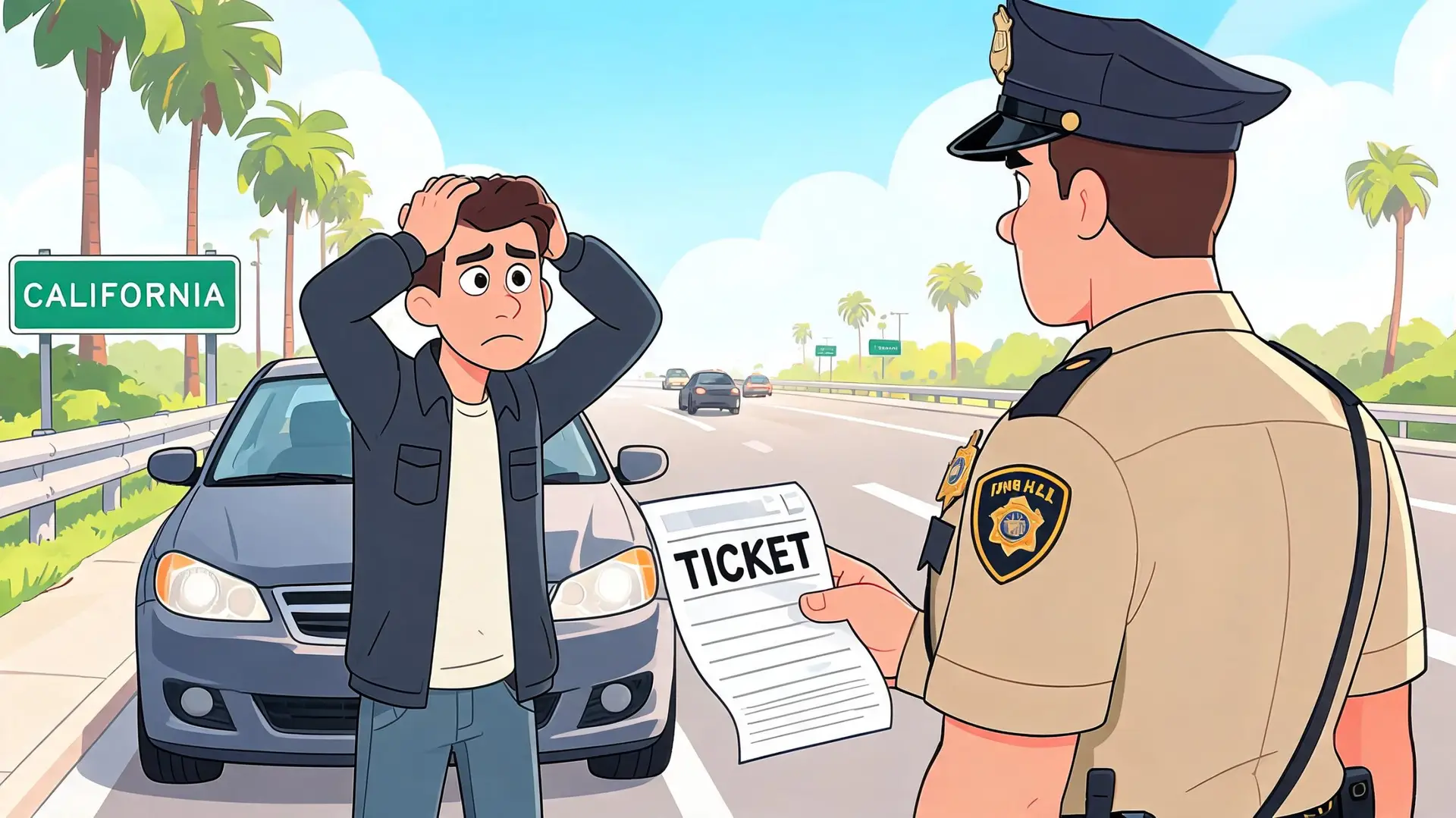
For many California drivers, online traffic school is the pressure valve. It gives you a structured way to deal with a qualifying ticket from home, on your own schedule, with a real chance to keep the violation from affecting what insurance companies see.
Why this feels harder than it should
The stress usually doesn’t come from the course itself. It comes from not knowing the order of operations.
Some people sign up too early. Others pay the fine but forget to request traffic school. Some finish the course and assume the court has already processed everything. That’s where mistakes happen.
Practical rule: In California, the course is only one part of the process. The court’s permission is the gate you have to walk through first.
A calmer way to handle it
A simple mental model helps. Think of your ticket as a three-desk process:
- The court desk: Decides whether you can use traffic school for that citation.
- The school desk: Provides the required course and reports completion.
- The DMV desk: Maintains the record according to California rules.
If you’re deciding whether to fight the ticket instead, some drivers also look for AI-powered attorney matching to compare whether legal help makes sense for their situation. That can be useful when the violation may not be a good traffic school candidate.
For everyone else, the goal is straightforward. Confirm eligibility, get court approval, complete the course correctly, and then verify that your county court accepted the completion.
Is Traffic School Online in California Legitimate
Yes. Traffic school online california is a real, regulated option under California’s system.
What makes people uneasy is not whether online traffic school is legal. It is. The confusing part is that two different authorities are involved, and they do different jobs. The state approves schools. Your county court decides whether your ticket can use one and how you must handle the paperwork. If you mix up those roles, the process starts to feel far more mysterious than it is.
What makes an online school legitimate
The phrase to look for is DMV-approved.
A legitimate online traffic school is part of California’s licensing framework. It is not just a website with reading material and a quiz. The course has to be approved in a way that allows the completion to be reported properly for an eligible case. That is what gives the course legal effect.
A simple comparison helps:
| Format | Legitimate if | Main benefit |
|---|---|---|
| In-person class | It’s approved by the state | Traditional classroom setting |
| Online course | It’s DMV-approved and accepted for your case | Flexible schedule, home access |
The format is not the issue. Approval is.
Why online traffic school is widely accepted
Online traffic school works like filing taxes online instead of mailing paper forms. The method is newer and more convenient, but it still has to fit the same official rules. California allows that digital format as long as the school is properly approved and the course is used in the right kind of case.
That matters for drivers with real scheduling constraints. An online course lets you log in from home, pause when needed, and finish on your own time. The convenience is practical, but the legal part still depends on meeting the state and court requirements correctly.
What DMV approval does and does not mean
This is the point many drivers miss.
DMV approval answers one question: Is the school itself recognized by the state?
It does not answer a different question: Will your local court accept traffic school for your specific ticket, under its deadlines and procedures?
That separation is the key to understanding the whole process. The DMV sets statewide rules for approved providers and record handling. County courts manage the case in front of them. A school can be fully legitimate at the state level, and a driver can still run into problems by missing a county deadline, failing to request traffic school from the court, or assuming completion alone closes the loop.
So yes, online traffic school in California is legitimate. The safer way to read that statement is: legitimate school, plus court permission, plus correct timing. Those pieces have to line up.
Checking Your Eligibility for California Traffic School
Eligibility is where drivers either save themselves time or create expensive frustration.
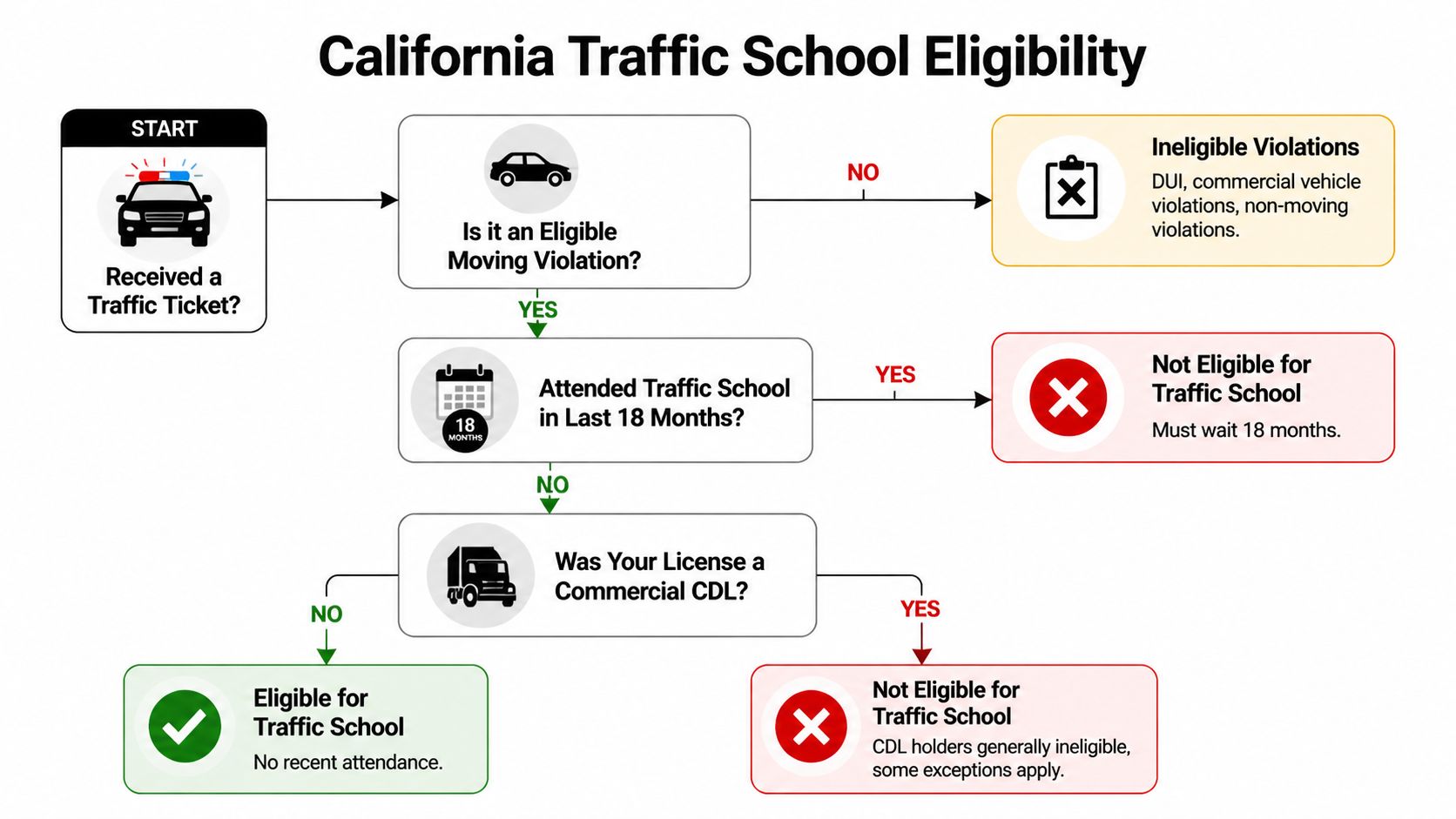
California uses a rule set that works a bit like a lock with several pins. One correct detail isn’t enough. The violation type, the timing, and the license context all have to line up. According to California traffic school eligibility rules, traffic school is limited to 1-point moving violations and excludes citations involving alcohol, drugs, commercial vehicles, or speeding more than 25 mph over the limit, with a strict 18-month cooldown between traffic school elections.
Start with the violation itself
The first question is not “Do I want traffic school?”
It’s “Is this the kind of ticket traffic school can even apply to?”
A common example is a routine moving violation. Those are the tickets commonly associated with traffic school. But some citations are outside the system from the start. If the case involves alcohol, drugs, a commercial vehicle, or speed beyond the allowed threshold above the limit, the usual traffic school path can be closed.
That’s why broad promises on provider websites can mislead people. A school can be licensed and still not be the right fit for your specific citation.
The 18-month rule matters more than people think
This rule is easy to misunderstand because drivers often remember the course date, not the underlying violation date.
If you already used traffic school within the last 18 months, you generally can’t use it again during that period. It functions as a coupon that resets on a fixed cycle. It’s not a loyalty perk you can stack whenever another ticket appears.
If you’re unsure whether the clock has run out, don’t guess. Check with the court before paying for a course.
Commercial and special-case problems
Commercial driving issues create confusion because some people focus on the type of ticket and forget the context in which it happened.
The system can treat a violation differently when a commercial vehicle is involved. That means two drivers with similar conduct might not have the same result if one was operating under commercial conditions.
A practical checklist before you do anything else
Use this as a first-pass filter:
- Violation type fits: It appears to be a 1-point moving violation rather than an excluded offense.
- No recent use: You have not elected traffic school during the last 18 months.
- No excluded factors: The citation does not involve alcohol, drugs, a commercial vehicle, or speed more than 25 mph over the limit.
- Court approval still needed: Even if everything looks good, the local court gets the final say for your case.
Why the court still has the last word
State rules create the framework. The court applies that framework to your exact ticket.
That difference matters because your court sees the citation details, the filing status, and the local process requirements. An online school can screen for likely eligibility, but it can’t replace the court’s decision. Think of the school as the training provider, not the referee.
A good way to stay out of trouble is to treat online enrollment as step three, not step one.
The Step-by-Step Court and DMV Process
You get the ticket, look up online traffic school, and see plenty of course websites ready to take your payment. That feels like the next step. In California, it usually is not.
The cleaner way to handle this is to split the process into two tracks. The court controls your case. The DMV licenses schools and sets the rules those schools must follow. If you keep those roles separate, the process becomes much easier to follow.
Step one starts with the court notice
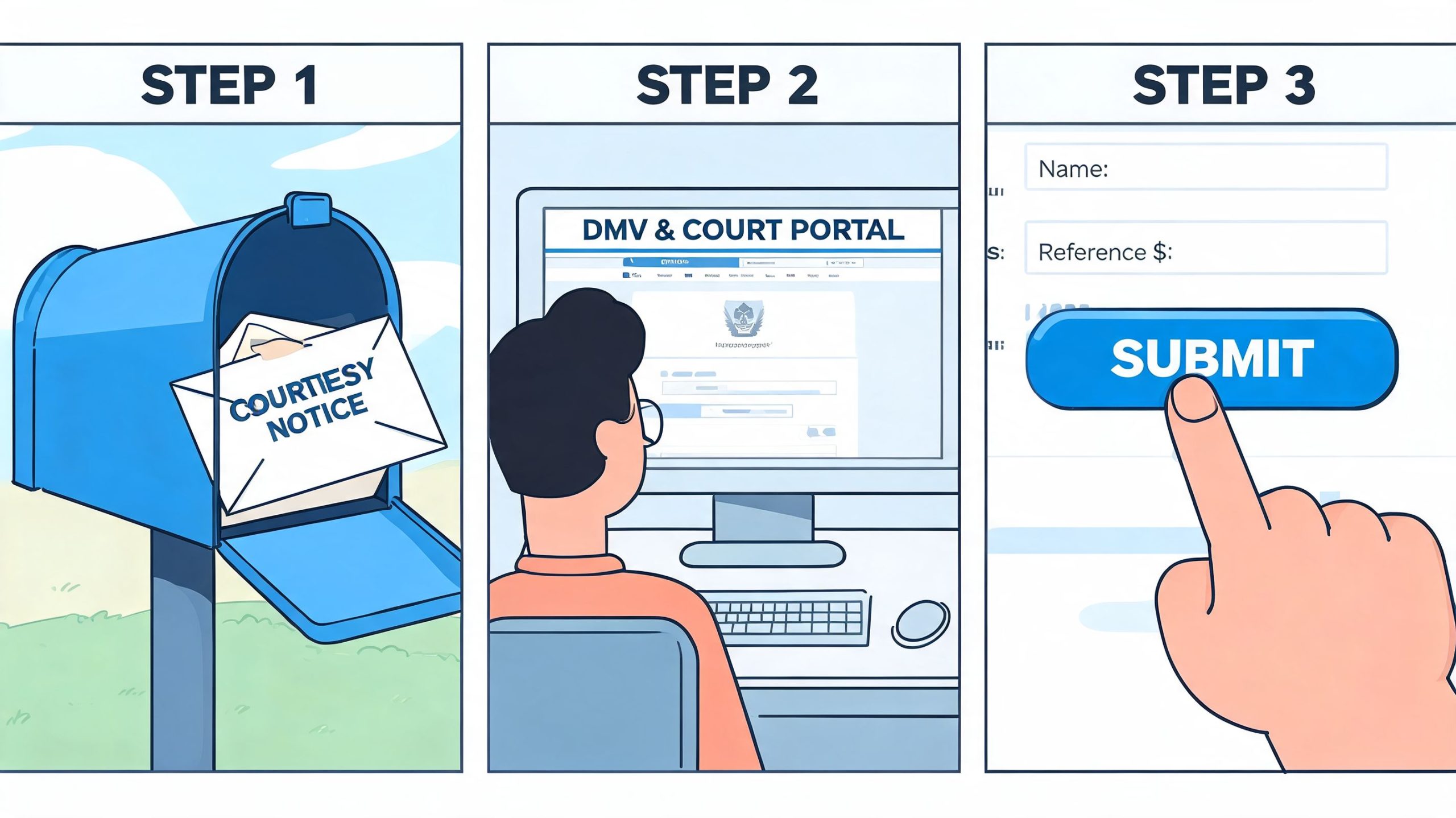
Your first useful document is usually the courtesy notice or the case information in the court portal. Treat it like the cover sheet on a file. It tells you which court has your case, what deadline applies, and whether traffic school may be available.
If you are not sure which number the court wants, this guide on what a citation number on a ticket means can help you identify the right reference before you call, search the portal, or enroll anywhere.
A small mistake here can slow everything down.
Pay the court first
Many drivers assume the school is the main event. It is not. The school is more like the class provider after the court opens the door.
In practice, the court usually wants you to respond to the ticket first, follow its instructions, and pay the required amounts before you enroll. That often includes the base fine and a separate administrative fee for traffic school. The exact workflow can vary by county, which is why the local court matters more than any course website at this stage.
A practical order looks like this:
- Read the court notice or check the court portal. Confirm that traffic school is available for your case.
- Follow the court’s instructions to resolve the citation. That may include entering a plea and paying the amounts the court requires.
- Wait until the court accepts the traffic school election or request. Approval is the trigger.
- Then enroll in an approved school. At that point, you are following the case process, not guessing.
That sequence prevents a common problem. A driver pays for a course first, then learns the court needed a different step or had not approved traffic school yet.
What the school has to do behind the scenes
Once the court side is handled, the school side is more technical than many people expect.
California courts explain that approved traffic schools use systems that track course participation, enforce timing rules, and report completion electronically through the proper channels, as outlined in California courts traffic school guidance. The course is not just a slideshow with a finish button. It has to create a record the court can trust.
That is why the course may pause if you leave your device idle too long. The system is documenting attendance and course time, much like a classroom taking roll.
Keep this in mind: A completion screen is not the same thing as court acceptance. The school reports completion. The court updates the case.
County procedure is where people get tripped up
State rules create the framework, but counties run the case process.
That difference is easy to miss. The DMV can approve schools statewide, yet your local court still controls deadlines, payment timing, and how your case is marked for traffic school. One county may make the process clear in an online portal. Another may require a specific request or have slower posting times. Same state. Different local workflow.
This is the overlooked step that saves people the most stress. Verify the details with the court handling your ticket, even if the school website looks clear and even if your friend handled a similar citation differently in another county.
If your case involves some other court-ordered class, readers sometimes compare the reporting process to attending an online victim panel. The subject matter is different, but the lesson is similar. Finishing the program matters, and matching the court’s procedure matters just as much.
How to Choose the Right Online Traffic School
Once the court has cleared you to proceed, choosing a provider becomes a consumer decision.
That doesn’t mean picking the first search result. It means checking whether the school is properly licensed, understanding the total price, and making sure the course format fits how you learn and how you use your devices.
Start with verification, not marketing
A polished website doesn’t prove a school is acceptable for your case.
You want a provider that appears in the official DMV licensing ecosystem and clearly explains how it handles reporting. That matters because California has a large field of providers, and the market includes both established operators and sites that can feel outdated or unclear about court-specific handling.
Cost matters, but total cost matters more
Online traffic school can cost as low as $27.99, while attorney fees for fighting tickets can reach hundreds of dollars, according to a California online traffic school cost comparison. That’s one reason traffic school is often the practical choice when the court has already approved it. The same source notes that only about 25% of eligible drivers use the option, which means many people leave a straightforward remedy on the table.
Still, don’t stop at the headline price. Look for the full checkout picture.
California Online Traffic School Comparison Checklist
| Feature | What to Look For | Why It Matters |
|---|---|---|
| License status | Clear DMV-approved status and verifiable provider details | Reduces the risk of paying for a course that creates reporting problems |
| Total checkout cost | Upfront pricing, with no surprise certificate or processing add-ons | A low advertised price can become less attractive if hidden fees appear later |
| Course format | Text, audio read-along, or other accessible presentation styles | Some drivers finish faster when they can listen instead of reading everything |
| Device support | Works on your phone, tablet, and laptop | Busy drivers often need to switch devices during the course |
| Language options | Clear support for the language you need | Better comprehension lowers frustration and mistakes |
| Reporting process | Explains whether completion is submitted electronically | You want clarity about what happens after you finish |
| Customer support | Easy-to-find help channels | Useful if your case number, name, or court information needs correction |
Matching the school to your situation
Different drivers need different things.
- If you’re budget-focused: Compare the final checkout cost, not just the first number you see.
- If you study on your phone: Make sure the login, lesson pages, and quizzes work cleanly on mobile.
- If English isn’t your preferred language: Look for language support and audio features before enrolling.
- If you want a familiar example to review: You can also look at a DMV-approved online traffic school overview to understand how providers typically present course options and approvals.
The right school is not always the flashiest one. It’s the one that is licensed, clear about reporting, easy for you to complete, and compatible with your court’s process.
This is the only place where I’ll name a provider example directly. BDISchool is one option readers may encounter while researching online traffic education. As with any provider, the important question isn’t branding. It’s whether the offering is appropriate for your situation and aligned with the California approval and court requirements you’ve already confirmed.
What to Expect During Your Online Course
Many drivers build up the course in their minds as something harder than it usually is.
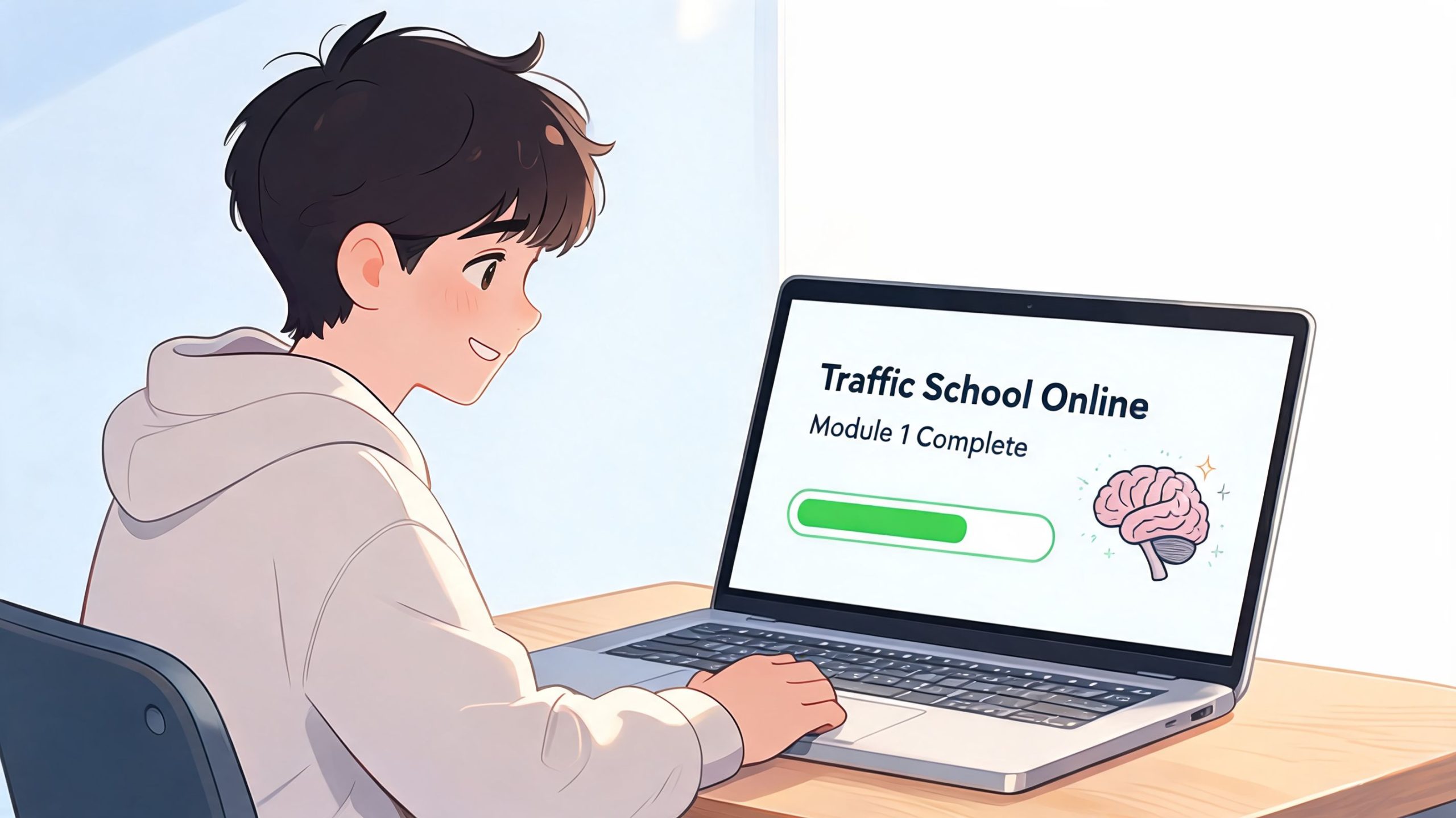
The process is quite straightforward. You log in, move through a series of lessons on traffic laws and safer driving habits, answer short quizzes, and complete a final exam. The experience is closer to a guided online tutorial than a high-pressure academic test.
The time requirement versus the real user experience
California requires an 8-hour course. That’s the legal requirement.
But the online format changes how that time feels. Because the course is self-paced, many people work through it in shorter sessions instead of blocking out an entire day. Some providers also design the material so it feels less like a lecture and more like short reading segments with simple knowledge checks.
The important thing is to respect the system’s pacing rules. If the course pauses after inactivity, that’s normal.
What the lessons usually look like
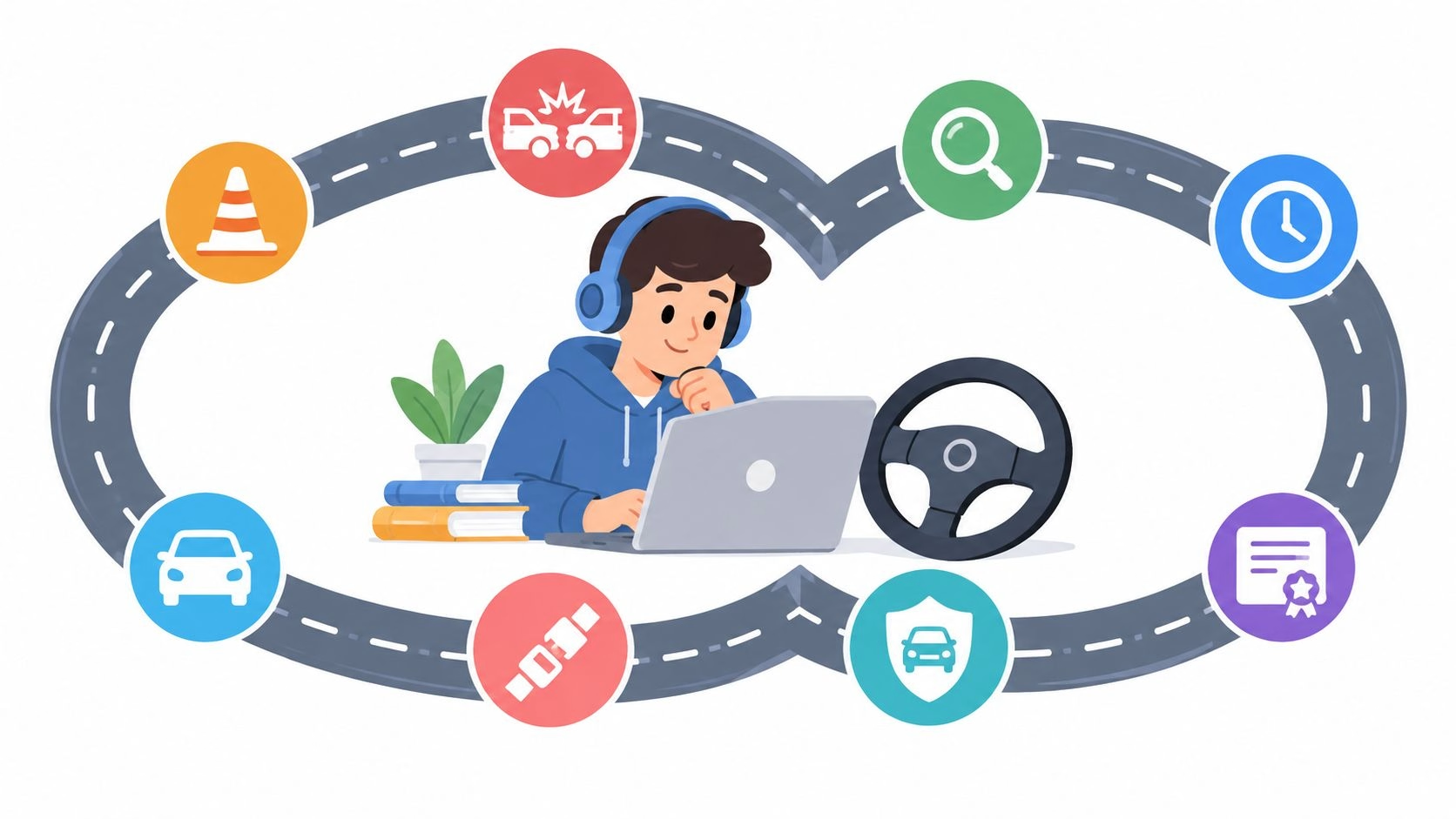
A typical course includes topics such as:
- Traffic laws: Right-of-way, signs, signals, and common violation patterns
- Defensive driving: Space management, hazard awareness, and decision-making
- Risk factors: Speed, distraction, fatigue, and poor judgment behind the wheel
Most quizzes are there to make sure you’re following along, not to trick you. If you’ve ever read the driver handbook, a lot of the material will feel familiar.
The final exam is usually less scary than the word “exam” suggests
Drivers often worry most about the last screen.
In practice, many online traffic school finals are open-book in feel, and some providers offer unlimited retake opportunities. That changes the mood completely. You’re not taking a one-shot licensing board exam. You’re demonstrating that you absorbed the course.
“Treat the final like a review, not a trap.”
The best way to get through it smoothly is boring but effective. Read carefully, don’t rush simple wording, and use the course material when you need it. The process often concludes without complications.
After You Finish What Happens to Your Ticket
Finishing the course feels like the end, but administratively it’s more like the handoff point.
Once you complete the program, the school submits the completion information through the proper channel. Then the court processes that completion for your case, and the DMV record reflects the result according to California’s masking rules.
What “masked” actually means
This term causes a lot of confusion because it sounds like the ticket vanishes.
It doesn’t vanish. Instead, once the process is completed and accepted, the point associated with the eligible violation is masked from insurance companies and third parties, while the conviction is kept confidential for statistical purposes by the DMV. That distinction matters. Masked is not the same as erased.
A simple analogy helps. Imagine it as a file placed in a sealed inner folder. The system still knows it exists, but the outside audience that would normally react to it, especially insurers, doesn’t get the same visibility.
Why you still need to verify with the court
This is the most overlooked step in the whole journey.
A school may send the completion quickly, but courts do not all process at the same speed. Some counties move faster. Some, especially rural courts, may take longer or use procedures that generic provider FAQs don’t explain clearly. That’s why California’s DMV traffic school lookup guidance makes driver verification so important after completion.
Use a simple follow-up routine:
- Check the submission timing: Give the reporting system a reasonable window to send your completion.
- Contact the court: Use the court’s case lookup, phone line, or clerk contact method to confirm receipt.
- Keep your records: Save your completion confirmation until the case is fully reflected.
If you want to understand the bigger dismissal picture
Some drivers want a broader view of how traffic school fits into ticket resolution generally. A practical companion resource is this guide on how to dismiss a traffic ticket, which helps place traffic school in the larger menu of options drivers sometimes consider.
Don’t assume silence means success. Confirm that the court accepted the completion and closed the loop on your case.
That final check is what turns “I finished the course” into “the process worked.”
Frequently Asked Questions About California Traffic School
Can I sign up for a course before the court approves traffic school
You can enroll at any time, but enrolling early can backfire.
Traffic school works a bit like buying a train ticket before you confirm the train stops in your town. You may have a valid ticket, but it does not help if your case was never approved for traffic school in the first place. Wait for the court’s approval, then choose your course.
If I paid the ticket already, can I still do traffic school
Sometimes. The answer depends on how your county court recorded that payment.
In some courts, payment and traffic school election happen together. In others, paying first can close off that option unless the court reopens it or notes traffic school separately. Statewide rules set the general framework, but your local court controls how your case was entered and what can still be changed. A quick call or case message to the court is the safest next step.
Does online traffic school remove the ticket completely
Usually, no.
A better way to picture it is a file that stays in the cabinet but is handled differently. For an eligible violation, completing traffic school can keep the point from being visible to insurance companies and other third parties once the court accepts it. That benefit matters a lot, but it is different from making the ticket disappear.
What if my provider says they submit instantly, but the court still doesn’t show it
That is a common point of confusion.
The school’s job is to send the completion. The court’s job is to post it to your case. Those are two separate steps, and they do not always happen on the same timeline. If your record has not updated after a reasonable wait, contact the court and keep your completion confirmation handy.
How do I know whether my violation is the right type for traffic school
Start with the broad category. Many routine moving violations may qualify, while some violations do not.
Then let the court make the final call. The court sees the official violation code attached to your case, which is like the label on a package. That label, not your guess or a provider’s general FAQ, determines whether traffic school fits your citation.
Is the online course hard
For most drivers, it is manageable.
The material is written for everyday drivers, and the course is usually more about steady attention than difficult testing. Many people struggle more with setting aside uninterrupted time than with understanding the lessons.
What if I miss my deadline
Deadlines matter because the court ties the traffic school benefit to dates on your case.
If you finish late, the court may decide the completion does not count, even if the course provider sent it over. Contact the court as soon as you see a deadline problem. Some courts explain next steps clearly. Others require a clerk request or a judge’s review. That county-by-county difference is why local confirmation matters so much.
Can traffic school lower my insurance in other ways too
The main benefit in a California ticket case is keeping an eligible point from showing up the way drivers fear.
Some people also ask whether driver education can lead to separate insurance discounts outside the ticket process. If you want to sort out those two ideas, this guide on whether a defensive driving class lowers insurance explains the difference between ticket masking and discount questions.
What is the smartest final step after I finish
Check with the court yourself.
That last check closes the loop. It also fits the core principle of traffic school online california. The DMV creates the statewide rules, but your county court decides whether your case was received, posted, and completed correctly.
If you’re sorting through ticket options and want a clear, education-first starting point, BDISchool offers resources that help drivers understand traffic school, citations, and dismissal paths in plain language. The safest approach stays the same from start to finish. Confirm your local court’s requirements first, then choose the next step that matches your case.