Most violations cannot be erased on request. They come off in one of four ways: you stop the conviction from happening, a court dismisses or clears it, the state corrects a mistake, or enough time passes. Which one applies depends on your state and on where your ticket is in the process. The best moment to act is before the conviction is entered.
Key Takeaways
- A conviction that is accurate generally stays on your record until your state’s retention period ends. Only an error, a dismissal or a court order changes that sooner.
- Acting before conviction is the strongest move: contest the ticket, ask for a deferral, or elect traffic school where your state allows it.
- In Florida, an eligible driver who elects and completes an approved Basic Driver Improvement (BDI) course can have adjudication withheld and the points for that citation not assessed.
- Expungement and insurance are separate questions. A cleared state record may not change what your insurer sees or decides.
- Always confirm eligibility with your county court clerk or state motor vehicle agency before you enroll in anything.
Table of Contents
- What “removing a violation” actually means
- Before conviction: the best time to act
- How traffic school works in Florida
- When your record is wrong: correcting an error
- Waiting it out: how long violations stay
- Does expungement clear a violation?
- What this means for your insurance
- Our perspective: act early, and be skeptical of shortcuts
- Take the course online, at your own pace
- A practical checklist
- FAQ
- Sources
What “removing a violation” actually means
People use the phrase for three different goals, and each has a different path.
- Keeping it off in the first place. The ticket is dismissed, reduced, deferred or resolved through traffic school before a conviction posts.
- Correcting a mistake. The record shows a violation you did not commit, or one a court already dismissed.
- Waiting it out. The violation is accurate, and you want to know when it drops from your record.
Sites that promise to “wipe” an accurate conviction from a state driving record are overselling. Your record is an official document, and states do not edit it on request. What you can do is influence what goes onto it, fix what is wrong, and know your timeline.
Before conviction: the best time to act
Paying a ticket is usually treated as pleading guilty. In California, for example, the courts’ self-help guide says paying traffic ticket bail without appearing in court is a conviction, so the violation appears on the DMV record and a point may be charged. Most states work in a similar way. Paying quickly feels like the easy route, but it can be the most expensive one.
Before you pay, look at these options:
- Contest the ticket. You can ask for a hearing or trial. If the case is dismissed or you are found not responsible, no conviction is recorded.
- Ask the clerk or prosecutor about alternatives. Some courts offer a reduced charge, a deferral or a diversion program. Policies vary by county.
- Request traffic school or a defensive driving course. Some states let a judge or clerk approve a course in exchange for dismissal, masking or a no-points outcome. Others do not.
- Fix-it tickets. In California, correctable violations can be dismissed by the court after you show proof of correction and pay a transaction fee.
If the ticket involves a serious charge such as reckless driving, DUI or driving on a suspended license, talk to a licensed attorney in your state. Those cases can carry criminal penalties, and the traffic school route usually does not apply.
How traffic school works in Florida
Traffic school is not a national rule, so here is how it works in the state where we are based. In Florida, “traffic school” means a Basic Driver Improvement (BDI) course. For an eligible noncriminal citation, you elect the course through the county court. If you complete it as required, adjudication is withheld and the points for that citation are not assessed.
That is not the same as erasing points you already have. It prevents them from being added. Our guide on whether traffic school can dismiss tickets goes through the difference in detail, and how to dismiss a speeding ticket covers the speeding case.
Florida limits you should know
The Florida Department of Highway Safety and Motor Vehicles (FLHSMV) states that you may elect traffic school no more than eight times in your lifetime and once in any 12-month period. The election applies to Florida violations and is made through the county court. If you used it within the past year, you cannot use it again for a new ticket.
Florida also makes the stakes clear. Points stay on a driver record for at least five years from the date of conviction, and too many in a short window lead to suspension:
| Points accumulated | Suspension |
|---|---|
| 12 points within 12 months | 30 days |
| 18 points within 18 months | 3 months |
| 24 points within 36 months | 1 year |
Those numbers are why keeping points from being assessed is worth the effort. If you are already carrying points, read how to remove points from your Florida driving record and the overview of point dismissal options to see what applies.
The usual steps in Florida
- Read your citation and note the deadline to respond. Missing it can turn a simple ticket into a suspension.
- Check that your violation is eligible. Criminal offenses and some serious infractions are not.
- Contact the county clerk and elect traffic school, paying any court fees the clerk requires.
- Complete a state-approved BDI course within the time the court gives you.
- Confirm the school reports your completion, and keep your certificate and receipt.
Our Florida driving class for ticket page covers this sequence step by step, and how to complete a driver improvement course online shows what the course itself looks like.
When your record is wrong: correcting an error
Sometimes the violation should not be there at all. A court may have dismissed the case and the report never updated, or the entry may belong to someone else. Correction is a paperwork process, and it usually runs through the court that reported the conviction.
- California: you submit form DL 207 with court documentation, such as a court abstract or a signed or certified court letter.
- Texas: to fix an incorrectly listed drug or DWI conviction, contact the court that filed the original report and request a correction.
Start by ordering a copy of your record from your state agency. Washington’s licensing department notes that driving records are confidential and released only to people authorized by law, so expect to verify your identity. Check each entry against your own court paperwork before you contact anyone.
Waiting it out: how long violations stay
Every state sets its own retention rules, and they differ by offense. Three examples show the range:
- Washington: most convictions and violations stay for 5 years, while alcohol-related convictions, vehicular assault and vehicular homicide stay for life.
- Missouri: ticket convictions may be removed three years after the conviction, with conditions that vary by conviction and license class. If a conviction led to a point suspension or revocation, the ticket can be purged five years from the reinstatement date.
- Florida: points remain for at least five years from the conviction date, as the FLHSMV table above notes.
Missouri adds a useful detail. A ticket is not eligible for removal if it supports an existing suspension, revocation or denial action. Eligibility rules like this are common, so read your own state’s rules rather than assuming a general timeline.
Does expungement clear a violation?
Expungement can help, but only in certain situations. Maryland’s Motor Vehicle Administration explains that when a court dismisses or clears a traffic charge or conviction, it may be removed from your driver record through expungement. The key words are “eligible” and “court order.” The same page warns that it may not erase records held by other agencies.
That last point matters for insurance. Maryland’s agency notes that even when an offense is expunged from the MVA record, private insurers may still consider your full history under their own risk policies. Do not assume an expungement lowers your premium. Ask your insurer directly.
What this means for your insurance
Insurers look at your motor vehicle record (MVR) when you apply, when a driver is added, and again at renewal. A proposed California regulation, for instance, describes insurers verifying a driver’s safety record at application, when a new driver is added, and at least every 36 months. That is one reason a clean record pays off over time.
Traffic school should never be sold as a guaranteed way to lower a premium. Whether an insurer gives a discount, and for which course, is up to the insurer and your state’s rules. What the course can do is keep points from being assessed for an eligible Florida ticket, which gives your insurer less to react to. For drivers who want a course tied to a discount, see our guide to a driver safety course for insurance discount, and check eligibility with your carrier first.
Our perspective: act early, and be skeptical of shortcuts
We build state-approved courses, and we talk with drivers every day who found out about their options too late. Here is what we have learned.
The ticket is the cheapest place to fix a problem. After a conviction posts, you are mostly limited to correcting errors and waiting. Before it posts, you often have choices. In Florida, a driver who is eligible and takes a BDI course on time can keep points from being assessed at all, and that costs far less than the extra insurance and the risk of a point suspension.
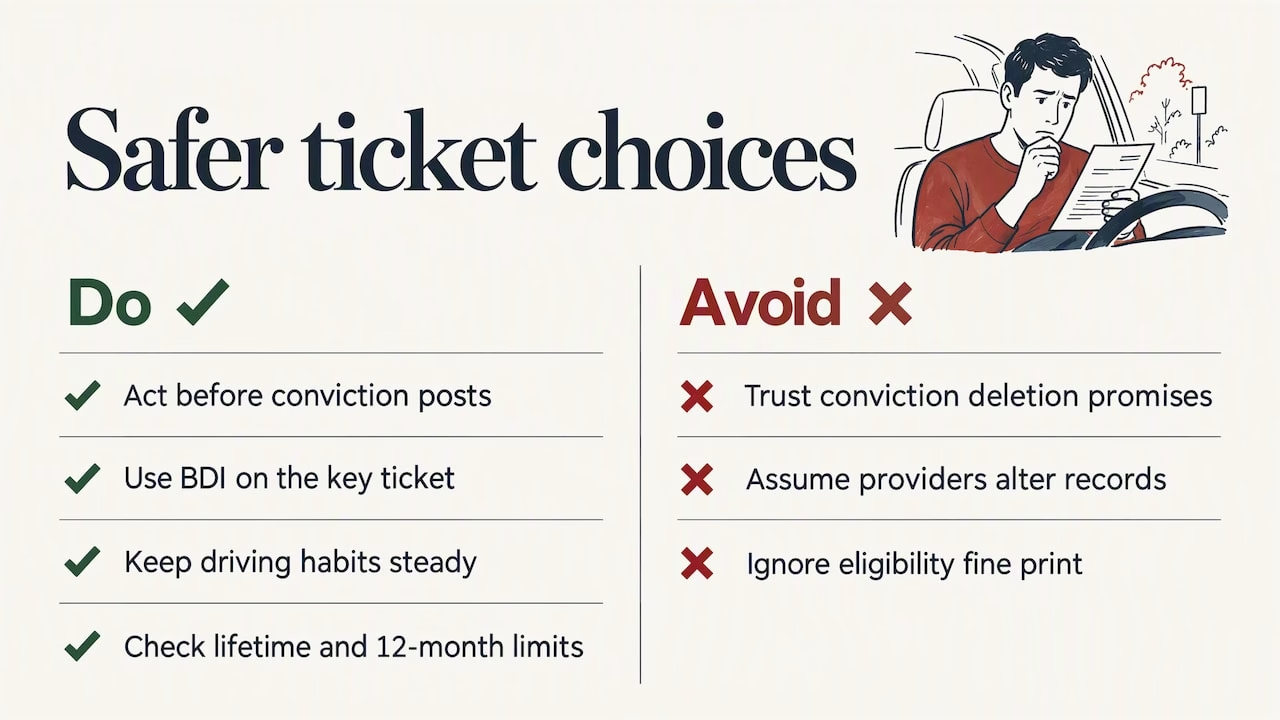
We also tell drivers to be cautious about anyone promising to “delete” a conviction. Official records change through courts and state agencies. A course provider cannot alter them, and we do not claim to. What we do is give you a state-approved course, reported properly, so you meet the requirement the court or state set for you.
Finally, read the fine print about eligibility. The lifetime and 12-month limits on Florida traffic school are real. If you can use the election, use it on the ticket that matters most, and keep your driving habits steady so you are not back in the same spot next year.
— the author
Take the course online, at your own pace
If your Florida citation is eligible for traffic school and your court has told you to complete a course, we make that part simple. Our Florida Basic Driver Improvement (BDI) course is $30, with no hidden fees and a money-back guarantee. You can study on any device, and our multilingual read-along features help if English is not your first language.

Other Florida courses are listed on our courses page, including the Driver Education Traffic Safety Course (DETS) at $29.90, the Traffic Laws Substance Abuse Education Course (TLSAE) at $29.95, the Mature Driver Insurance Discount Course at $14.50 and the Wireless Devices Distracted Driver Course at $24.50. You can also read more about the Florida Basic Driver Improvement course before you enroll. Confirm with your county clerk which course your citation requires.
A practical checklist
Use this list whether you are in Florida or elsewhere.
- Get your record. Order it from your state agency and read every entry.
- Note every deadline. Your citation lists the date to respond or pay. Do not let it pass.
- Do not pay first. Paying can be treated as a conviction. Ask the clerk about options before you do.
- Ask about traffic school. Learn whether your state allows it, how often, and which providers are approved.
- Keep proof. Save course certificates, court letters and receipts for at least as long as the violation could matter.
- Match the fix to the goal. Errors need correction paperwork, accurate convictions need prevention or time, and insurance questions go to your insurer.
For a wider look at tactics, our guide to the best ways to avoid driving points lays out more options, and the Florida guide to keeping points off goes deeper on dismissals.
FAQ
Can I remove something off my driving record?
Only in certain cases. You can have a violation corrected if it is an error, cleared if a court dismisses it or issues an expungement order where your state allows it, or purged when your state’s retention period ends. An accurate conviction usually cannot be removed on request.
Can traffic school remove points or keep a ticket off my record?
It depends on the state. In Florida, electing and completing an approved BDI course for an eligible citation means adjudication is withheld and the points for that citation are not assessed. It does not remove points you already have, and the election is limited to once per 12 months and eight times in a lifetime.
How long does a traffic violation stay on a driving record?
It varies by state and offense. Washington keeps most convictions for 5 years and alcohol-related ones for life. Missouri may remove ticket convictions after three years. Florida points stay for at least five years from conviction. Check your own state’s motor vehicle agency.
Does expunging a court case remove the violation from my driving record?
Sometimes. In Maryland, an eligible offense may be removed from the MVA record after a court order. That may not erase records held by other agencies, and insurers may still consider your full history.
Will clearing a violation lower my car insurance?
Not automatically. Insurers check your motor vehicle record at application and periodically afterward, and they apply their own risk rules. Keeping points off an eligible ticket gives them less to rate, but ask your insurer what it will actually do.
Sources
- California Courts: Guide to traffic tickets
- California Judicial Branch: Traffic Program FAQ
- Florida FLHSMV: Questions About Driving Records
- Florida FLHSMV: Points & Point Suspensions
- California DMV: Form DL 207
- Texas DPS: Issuing a Driver Record
- Washington DOL: Guide to driving records
- Missouri Department of Revenue: Tickets and Points FAQ
- Maryland MVA: Driving Record Expungement
- California Department of Insurance: Proposed regulation text
Recommended
- Point Dismissal Options: Ways to Clean Your Driving Record
- How to Remove Points from Your Florida Driving Record
- Course to Remove Points from License: Your Florida Guide
- Florida Basic Driver Improvement Course
This article is provided for general information and is not a professional advice.