

A Delaware defensive driving course does not erase a ticket by itself. What it does is earn you a 3-point credit with the DMV and, for most drivers, a car insurance discount. Whether the ticket itself is dismissed is decided by the court, not by the course. Knowing which of those three things you are after, the ticket, the points or the premium, tells you whether a course is the right move and when to take it.
This guide explains how the court process works, how the 3-point credit is applied, what the course involves and how to make sure your completion is recorded. It is written for Delaware drivers with a ticket, a points concern or an insurance bill they want to bring down.
Key Takeaways
- The course earns a 3-point credit with the Delaware DMV and may lower your insurance premium. A judge, not the course, decides whether a ticket is dismissed or reduced.
- The credit applies to future violations in certain circumstances. It is not automatically subtracted from points you already have.
- Insurers must offer a discount to drivers who finish a DMV-approved course. The Department of Insurance says it is 10% off the PIP and liability portions for three years, or 15% with a timely refresher.
- Completion is loaded to your driving record electronically within 48 hours, so keep your certificate and take the course before a problem forces your hand.
- The basic course runs at least 6 hours and the refresher at least 3 hours, and you choose a provider that is approved by the DMV.
Table of Contents
- What a Delaware course can and cannot do for a ticket
- How the court side works
- How the 3-point credit works
- What the course involves
- What it can do for your insurance bill
- Step by step: taking a course and filing it
- Our Delaware course in brief
- Who should take a course and when
- Our perspective
- FAQ
- Sources
What a Delaware course can and cannot do for a ticket
People search for “traffic school for ticket dismissal” because in some states a course wipes out the citation. Delaware works differently, and it helps to know that before you spend an evening on a course.
In Delaware the ticket and the points are two separate matters:
- The ticket (the charge and fine) is handled by the court. You either pay it or contest it.
- The points are handled by the Division of Motor Vehicles (DMV). The court does not assess points itself.
- The insurance cost is handled by your insurer, within a discount the state requires insurers to offer.
A defensive driving course speaks to the second and third of these. That is still valuable: points drive license actions and a clean record keeps your costs down for years.
How the court side works
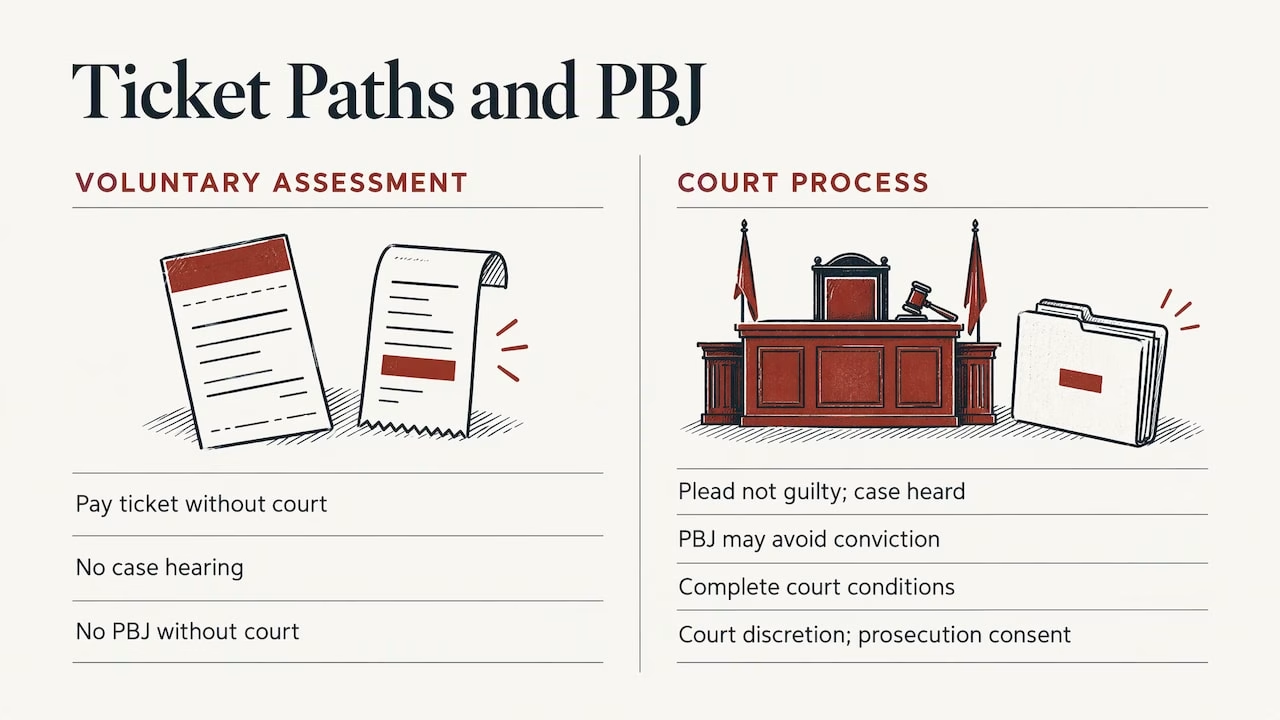
The Delaware Courts’ traffic FAQ for the Justice of the Peace Court describes two basic paths for most tickets. You can pay by voluntary assessment, which means paying the ticket without going to court, or you can plead not guilty and have your case heard.
If you go to court, some drivers may be considered for probation before judgment (PBJ). That is a result in which a case can be resolved without a conviction when the driver completes the court’s conditions. According to the same FAQ, PBJ is at the court’s discretion and needs the prosecution’s consent. You are not eligible if you have prior convictions for the same offense, if you received PBJ within the previous five years or if you hold a commercial driver’s license (CDL).
That is the only route in which a ticket can end without a conviction, and it is a courtroom decision. If a judge or prosecutor asks you to complete a course as part of your case, take that instruction seriously and get the details in writing from the court so you choose a course that satisfies it. If you are unsure whether you qualify, a Delaware attorney or the court clerk is the right person to ask.
A note on paying quickly
If you choose voluntary assessment, the Delaware Courts FAQ points you to the Voluntary Assessment Center. Paying does not remove the DMV’s role: the court does not assess points, and the DMV applies its own policy afterward. That is why a course matters even when you simply pay the fine.
Speeding tickets can carry no points
Under DMV Policy #45, as the Courts FAQ states it, no points are assessed on a voluntary-assessment speeding ticket for 1 to 14 mph over the limit if you have had no speeding conviction in the previous three years. If that describes you, your concern may be the fine and your insurer rather than your point total. If you have had a speeding conviction within three years, points are assessed under DMV policy, and a course credit becomes more useful.
How the 3-point credit works
The Delaware DMV may consider satisfactory completion of an approved defensive driving course as a 3-point credit when it calculates penalties. Three details decide how useful it is:
- It is a credit for future violations. The DMV says it applies to future violations in certain circumstances. It is not automatically deducted from points already on your record.
- It only affects DMV penalties. The credit does not lower the overall point values used for employment and insurance review.
- It lasts three years. The course remains valid for three years from completion.
The state regulation behind this, 2 DE Admin. Code 2208, adds that the credit is entered on your driving record effective on the completion date, that the driver pays all fees and that it is not applied retroactively once an action item is already in effect. In plain terms: take the course before you are close to a threshold, not after the DMV has already sent a notice.
A printable good luck driving test card is a small gift for a teen who is about to take a road test, but the credit above is the kind of safeguard that matters once they are licensed and driving on their own.
Why timing matters: the point thresholds
The same regulation sets the actions the DMV takes based on points calculated over a rolling 24-month period:
| Points in 24 months | DMV action |
|---|---|
| 8 | Advisory letter (defensive driving credit does not affect the letter) |
| 12 | Behavior modification (attitudinal driving) course within 90 days, or a 2-month suspension |
| 14, 16, 18, 20, 22 | Mandatory suspension of 4, 6, 8, 10 or 12 months |
For the higher suspensions, reinstatement requires completing the course within the prior two years. So a course is useful in two ways: as a credit that can offset points from a later violation, and as a requirement if a suspension ever occurs. Taking it early keeps you covered for both.
What the course involves
The DMV’s defensive driving FAQ cites the state regulation on course length: a basic course requires at least six hours of instructional time and a refresher course at least three hours. The provider decides how to allocate that time across lessons.
What a typical course covers:
- Collision-avoidance habits such as following distance, scanning ahead and managing blind spots
- How speed, distraction, fatigue and impairment raise risk
- Delaware traffic laws and the reasons behind common violations
- Review questions at the end of lessons or modules
Online, you work at your own pace on a phone, tablet or computer, and the timers you see are part of the state’s instructional-time requirement.
Basic and refresher courses
Your first course is the basic one. A refresher is shorter and is meant for drivers who have already taken the basic course. The DMV FAQ says a refresher may be taken no sooner than two years and six months after the initial course and no later than five years after it. Plan the refresher date when you finish the basic course.
What it can do for your insurance bill
For many drivers the insurance discount is worth more than the point credit. Delaware regulation requires insurers to offer a discount to drivers who complete a course from a DMV-approved provider, as the DMV FAQ notes.
The Delaware Department of Insurance states the terms: if all drivers on a vehicle complete an approved course, they receive 10% off the personal injury protection (PIP) and liability portions of auto insurance for three years, or 15% if they take a refresher within 90 days of the end of the three-year period. The Department also lists approved providers on its website.
How to claim it:
- Finish your course with an approved provider.
- Send your certificate to your insurer or agent and ask for the discount by name.
- Ask what date the discount starts, and note the date it ends so you can plan the refresher.
- If you have a question about how the discount is applied, the Department of Insurance takes calls at 1-800-282-8611.
Because the discount applies only to the PIP and liability portions and only when all drivers on the vehicle qualify, get everyone in the household who drives that vehicle through the course.
For how this works with the savings in another state where we offer courses, see our guide to the defensive driving insurance discount.
Step by step: taking a course and filing it
- Check the situation. If you have a court date, find out whether the court wants a course, whether it will consider PBJ, and what proof it needs. If you only want the credit and the discount, you can enroll any time.
- Pick a DMV-approved provider. Approval is what makes your completion count for the DMV credit and the insurance discount. Confirm it on the Department of Insurance’s approved list.
- Finish the required hours. Six hours is the minimum for the basic course. Spread it over a few sessions if that helps you retain it.
- Confirm the record update. Completion is electronically loaded to your driving record within 48 hours, according to the DMV. For questions, Driver Improvement is reached at 302-744-2509.
- Keep your certificate. If you lose it, you request a replacement from the provider, and there may be a cost.
- Send it to your insurer and ask for the discount.
- Calendar the refresher inside the window for a bigger discount.
One point to remember: the credit is not automatically deducted. It is held for a future violation in certain circumstances, so the record update does not lower your point total today.
Our Delaware course in brief
We build our driver education courses in-house with certified educators and safety specialists, and they run on any device, with multilingual read-along features. Pricing is transparent with no hidden fees, and a money-back guarantee backs every course. Our Delaware online defensive driving course guide walks through the requirements and steps in more detail, and you can see everything we offer on our home page.

If you want to start with a clear plan, begin there, check that the course you choose is approved in Delaware and finish it before your next point-counting event, not after.
Who should take a course and when
Drivers with a recent ticket. If the ticket will bring points, a course gives you the 3-point credit for a future violation. It does not change the outcome of this ticket, so settle the court question first.
Drivers close to eight points. The advisory letter at 8 points is not affected by the credit, but a course on file can matter if you reach 12 points or more and your record is reviewed.
Drivers who want lower premiums. Course completion is the direct route to the 10% or 15% discount, and a refresher at the right time keeps it going.
New drivers and parents. A young driver with a clean record is the easiest person to protect. A course taken early gives them habits, and the three-year clock starts running while they have nothing on their record to repair.
Fleet managers. If you manage employees who drive for work, our custom fleet safety training is built for companies that need to train several drivers.
Our perspective
We hear the same question from drivers all the time: will this course make my ticket go away? The honest answer in Delaware is that the court decides the ticket, and the course protects what comes after it. Points, suspensions and premiums are where a course does its work.
That is why we design our courses to be straightforward to finish. Our curriculum is developed in-house by certified educators and safety specialists, and we keep it current with statutory requirements. You can take it on a phone or a laptop, at your own pace, with multilingual read-along support, and you pay one clear price with a money-back guarantee behind it.
Our advice is simple: decide what you want the course to do, get it done early and keep your certificate where you can find it. A clean record is easier to keep than to repair.
the author
FAQ
Does a defensive driving course dismiss a ticket in Delaware?
No. The court decides the ticket, and the options are paying by voluntary assessment or pleading not guilty and going to court. Some eligible drivers may be considered for probation before judgment at the court’s discretion. The course earns a DMV point credit and an insurance discount.
How many points does the course take off?
The DMV may consider a completed course as a 3-point credit. It is used to calculate DMV penalties for future violations in certain circumstances, and it is not deducted automatically from your current points. It stays valid for three years.
How long is the course?
The basic course requires at least six hours of instructional time, and the refresher requires at least three hours. The provider decides how that time is divided among lessons. A refresher can be taken between two years and six months and five years after the basic course.
How do I prove I finished?
Completion is loaded to your driving record electronically within 48 hours. For insurance, send your certificate to your insurer and ask for the discount. If you lose the certificate, request a copy from the provider, which may cost a fee.
Sources
- Traffic FAQs in the Justice of the Peace Court, Delaware Courts
- Driver violations and the defensive driving credit, Delaware DMV
- Delaware Administrative Code, Title 2, 2208
- Defensive driving FAQ, Delaware DMV
- Consumer alerts, Delaware Department of Insurance
- Good luck driving test card
Recommended
This article is provided for general information and is not a professional advice.