
The moment usually starts the same way. You see flashing lights in the mirror, pull onto the shoulder, and replay the last few minutes in your head. Maybe it was a speeding ticket on I-65. Maybe it was a lane change that looked harmless until blue lights appeared behind you. Then the questions come fast. Will this put points on my record? Can I take a class instead? Does Alabama even allow an online option?
If you’re searching for an alabama defensive driving course, you’re probably trying to solve a very practical problem. You want to protect your license, avoid extra costs if possible, and make sure you don’t waste time on a course your court won’t accept. That’s smart. Defensive driving isn’t just about checking a legal box. It’s also about learning habits that make daily driving calmer, safer, and more predictable.
Why You Might Need an Alabama Defensive Driving Course
A lot of drivers look into a course right after a traffic stop. Others come to it later, after reading the ticket more carefully, calling the court, or speaking with their insurance company. Either way, the feeling is the same. You want a path forward that gives you some control.
In Alabama, that concern isn’t overblown. Alabama has the second highest rate of teen driver fatalities in the nation, and residents have a greater than two-in-five chance of being involved in an injury or fatal crash in their lifetime, according to ALDOT 2024 Crash Facts. That makes driver education more than a paperwork exercise. It matters on the road.
Two common reasons drivers enroll
Drivers typically take a defensive driving course for one of these reasons:
- Ticket-related help: You may be trying to keep a moving violation from causing bigger problems for your driving record.
- Insurance savings: You may hope the course will qualify you for a premium discount.
- Skill refresh: Some drivers take the class because they know they’ve picked up bad habits and want a structured reset.
Think of the course like a driving tune-up. Your car gets one before a small issue becomes a major repair. Your driving habits deserve the same attention.
A traffic ticket feels like a dead end when you first get it. In many cases, it’s really a fork in the road. One path is passive. The other is corrective.
Who usually benefits most
An alabama defensive driving course often helps drivers who are busy, stressed, or uncertain about procedure. That includes:
- Parents of young drivers who want stronger hazard awareness at home
- Commuters who spend long hours on highways and urban roads
- Drivers with a recent citation who need to know whether a course is accepted
- Anyone shopping for insurance relief after a rate increase or renewal surprise
The key is knowing why you’re taking the course before you sign up. That one decision shapes everything else, including the format you choose, the provider you use, and who needs your completion certificate.
Understanding the Purpose of a Defensive Driving Course
A defensive driving course teaches a different skill from basic driver training. The focus is not steering, braking, and parking. The focus is reading the road early enough to avoid trouble before it turns into a close call, a ticket, or a crash.
That difference matters in Alabama because drivers often sign up for the course with a practical goal in mind. You may be trying to satisfy a court, reduce the effect of a citation, or ask your insurer for a discount. Those goals all depend on the same core idea. The course is designed to improve how you notice risk, judge your options, and respond with enough time to stay in control.
The course functions more like correction than punishment
Drivers often hear “traffic school” and assume they are being sent back to class as a penalty. In practice, the better way to understand it is as corrective training. It works on the habits that lead to common violations, such as following too closely, missing developing hazards, or reacting late in heavy traffic.
That is why courts sometimes approve it. The goal is not to embarrass you. The goal is to lower the chance that the same mistake happens again. If your situation involves a judge, clerk, or citation paperwork, the rules for a court ordered driving school requirement can shape which course counts and how you must submit proof of completion.
Some Alabama providers offer programs through established safety organizations and local arrangements, but the name of the school matters less than whether the right decision-maker will accept it. That question becomes especially important with online courses, which is where many drivers get tripped up.
What the course is trying to retrain
A good defensive driving course usually works on three driving habits at the same time:
-
Awareness
You practice scanning farther ahead and noticing patterns sooner, not just staring at the bumper in front of you. -
Judgment
You learn how to choose the safer response when another driver crowds your lane, brakes suddenly, or acts unpredictably. -
Timing
You build the habit of acting earlier. A gentle speed adjustment or lane decision made five seconds sooner is often what prevents a chain reaction.
Here is a simple way to picture it. New drivers learn the controls of the vehicle. Defensive drivers learn the timing of risk. It is the difference between seeing a problem and seeing it soon enough to do something calm and useful about it.
Why this matters to courts and insurance companies
Courts care because education can reduce repeat violations. Insurance companies care because safer habits can mean fewer claims. You care because one course may help protect your record, your budget, or both.
The savings question also needs a realistic expectation. A course does not erase a bad record, and it does not guarantee every insurer will lower your premium. If you have a spotty record, the course may still help, but the result often depends on your carrier’s rules, your recent violations, and whether the discount applies only to certain coverages. That is why the primary value of the course starts with safer driving and only then extends to possible financial benefits.
Practical rule: Do not treat the class as something to click through. Treat it as practice for buying yourself a few extra seconds on the road. Those extra seconds are where better outcomes usually begin.
Some drivers take the course after a ticket. Some take it because the court gave them that option. Others enroll voluntarily because their rates went up and they want every legitimate way to improve their situation. The purpose changes slightly from one driver to another, but the course always aims at the same target. Better decisions before the danger fully develops.
Confirming Your Eligibility and Court Requirements
This is the step that trips up more Alabama drivers than the course itself. They find a provider, pay for the class, complete it, and only then learn that their court wanted a different format or a different course length. That’s like buying a plane ticket before checking which airport your flight uses.
Start with one basic question
Ask yourself this first: Are you taking the course because the court requires it, or because you want to take it voluntarily?
Those are not the same situation.
If the court ordered the class, your judge, clerk, or paperwork controls the rules. If you’re hoping to use a course to help with a recent ticket, you need to find out whether the court will allow that option and what format it accepts. If you’re taking the class only for insurance purposes, the court may have no role at all.
Why online approval is the biggest point of confusion
Alabama presents complexities. Court acceptance of online courses varies significantly in Alabama; a 2023 Judicial System report indicated that only 62% of district courts in rural counties fully accept 4-hour online programs due to a preference for in-person training, according to Alabama Safe Driver guidance. That one fact explains why so many drivers get mixed answers when they search online.
An online course can be perfectly legitimate and still not satisfy your specific court. The problem isn’t always the course. The problem is fit.
Think court approval like prescription filling
A defensive driving course is a little like medication. The pharmacy may stock an approved product, but your doctor still has to prescribe the right one for your condition. In the same way, a provider may offer a state-approved class, yet your court may still require a particular length, delivery format, or filing method.
What to ask before you enroll
Call the court listed on your ticket. If it’s a municipal court, call that court. If it’s a district or county-level matter, contact the correct clerk’s office tied to your citation.
Use questions like these:
- Do you accept an online defensive driving course for my citation?
- Is a 4-hour course enough, or do you require a longer class?
- Do I need prior permission before enrolling?
- What provider types do you accept?
- Who receives the certificate, and how should it be submitted?
- What is my deadline for completion?
Write down the answers, including the date and the name of the person you spoke with. If the court communicates by email, save that message.
If the clerk says, “You need to confirm with the judge,” stop there and get that answer before paying any provider.
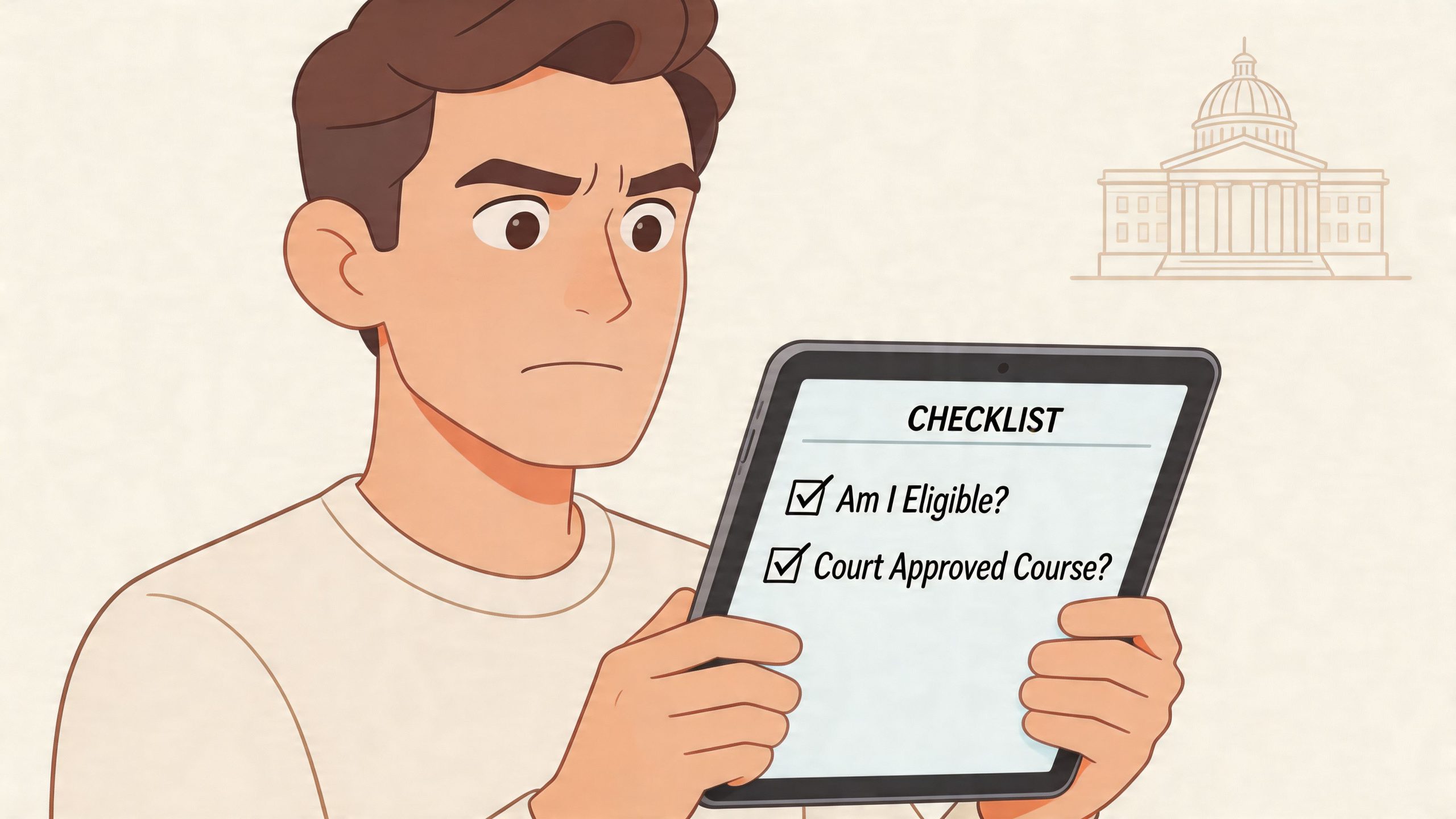
A simple eligibility checklist
Before you enroll, make sure all five boxes are checked:
- Your court allows the course
- The format is approved
Online and classroom are not always interchangeable. - The timing works
Some drivers miss the benefit because they finish after the deadline. - The provider is acceptable to the court
- You know where the certificate must go
Drivers handling a mandatory case often benefit from reading a broader overview of court-ordered driving school requirements so they can compare court language with provider claims.
The biggest takeaway is simple. In Alabama, “approved” is not the same as “accepted by your court in your case.” That’s why confirmation comes first and enrollment comes second.
Online vs Classroom Courses Which Format Is Right For You
You have court permission, or you have decided to take the course for insurance reasons. Now you have a practical choice to make. Do you want the flexibility of online study, or the structure of a classroom?
A defensive driving course works a lot like a workout plan. The best one is not the one that sounds nicest on paper. It is the one you will finish, correctly, before your deadline.
Online courses work well for drivers who need flexibility
Online study fits drivers whose schedules do not stay neat and predictable. If you work shifts, care for family members, commute long distances, or learn best in shorter sessions, an online course often removes the biggest obstacle, finding a block of uninterrupted time.
It also gives you more control over pace. You can pause, reread a section, and come back later without losing your place. That matters if you want time to absorb the material instead of rushing through it in one sitting.
Cost is another reason many drivers start by looking online. Prices are often modest, though the exact amount depends on the provider and what your court will accept. Before you choose based on price alone, remember the bigger question. Will your court accept that format for your case? A low-cost course is no bargain if you finish it and the clerk says it does not count.
If you want a clearer picture of how a digital class usually works, this guide to online driving school formats gives a useful overview.
Classroom courses work well for drivers who want more structure
A classroom can be the better fit if you focus best when someone else sets the pace. You show up at a scheduled time, stay in the lesson, ask questions as they come up, and leave with the course completed or nearly completed.
That live interaction helps more than some drivers expect. If a rule, example, or traffic-law term feels confusing, an instructor can explain it in plain language right away. For a driver who has already had a ticket or two and wants to avoid another mistake, that direct feedback can be reassuring.
Classroom courses may also be the safer choice when local court practice is conservative about online options. Alabama courts do not all handle this the same way. Some accept online completion without much trouble. Others are more comfortable with an in-person course, especially if the judge or clerk wants a provider they already recognize.
That is one of the two biggest questions drivers usually have, and generic articles often skip it. Online may be accepted in one Alabama court and rejected in another. The format itself is not the whole issue. Local court practice is.
A side-by-side comparison
| Feature | Online Course | In-Person Classroom |
|---|---|---|
| Schedule | Flexible, easier for many busy adults | Fixed date and time |
| Pacing | Often self-paced | Instructor-led |
| Travel | No commute | Travel to the class site |
| Technology | Requires a device and internet access | Little to no tech needed |
| Interaction | Limited live feedback | Real-time questions and answers |
| Cost | Often competitively priced | Varies by provider and location |
| Court acceptance | Must be verified carefully | Sometimes viewed more favorably by local courts |
How to choose without second-guessing yourself
Start with your biggest source of friction.
Choose online if your problem is time, transportation, childcare, or an unpredictable work schedule. Choose classroom if your problem is focus, confidence, or uncertainty about whether online approval will hold up with your court.
If your record is already a little messy, be more cautious, not less. Drivers in that position often care about avoiding another mark that causes bigger consequences later. The logic behind that concern is similar to what you see in David G. Moore on Michigan points. Different state, same lesson. Small traffic issues can stack up and become more expensive than they first appear.
One final rule helps many Alabama drivers make the right call. If the court sounded fully comfortable with online courses, online may save time and hassle. If the court sounded uncertain, classroom is often the safer lane.
The Real Benefits Point Dismissal and Insurance Savings
Realistic expectations are necessary. A defensive driving course can offer real value, but not every promised benefit applies to every driver in the same way. Some people save money. Some mainly protect their record. Some discover that the biggest benefit is avoiding a larger future headache.
Benefit one protects your driving record
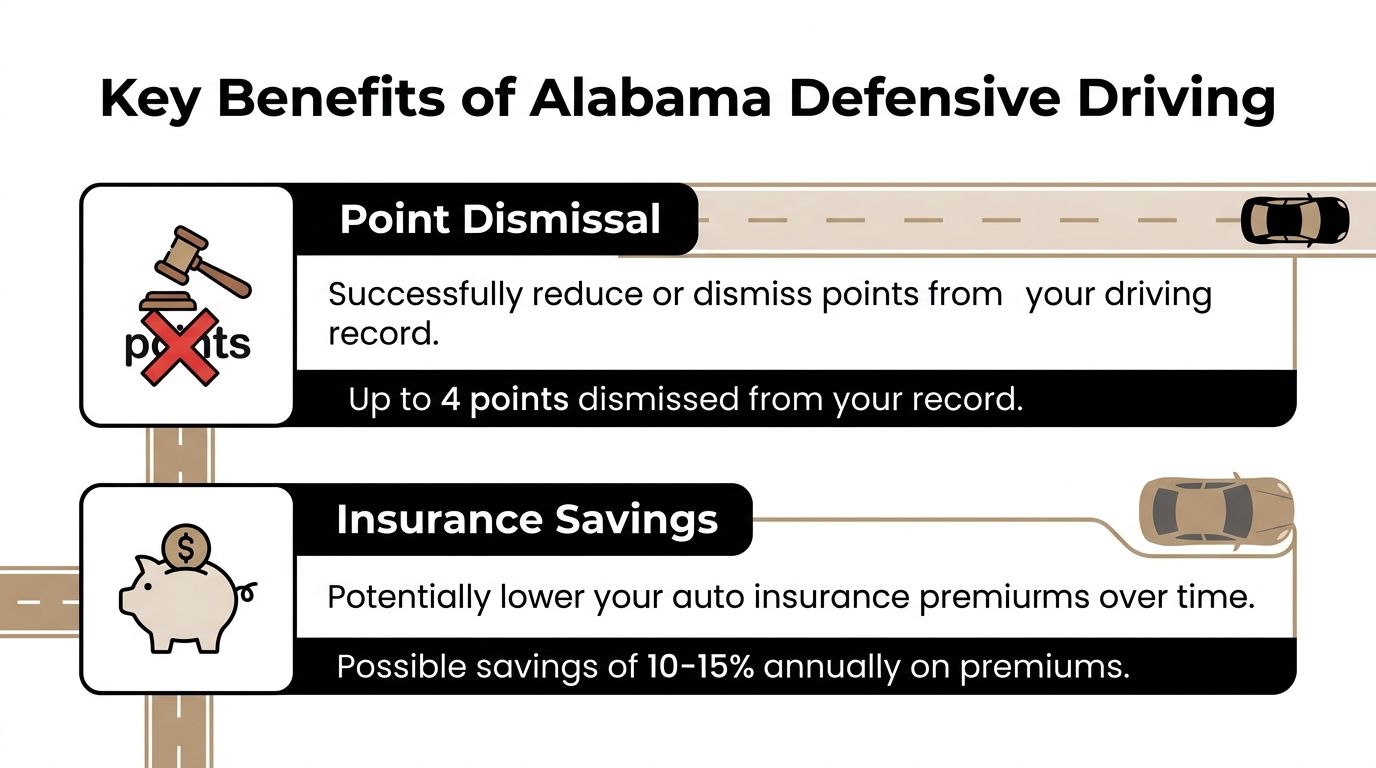
For many drivers, the strongest reason to take an alabama defensive driving course is record protection. If your court allows course completion in connection with a citation, the course may help keep one violation from causing extra damage to your license history.
That matters because points systems can snowball. One ticket may feel manageable. A second or third issue often changes how courts, insurers, and employers view your risk. If you want a plain-language example of how point accumulation affects drivers in another state, David G. Moore on Michigan points offers a useful comparison of why even “small” traffic mistakes can have lasting consequences.
The Alabama-specific lesson is straightforward. A course can be a shield, but only when the court accepts it for your case and you submit proof correctly.
Benefit two can lower insurance, but not evenly
Insurance savings are real for some drivers, but advertising often presents a tidier picture than reality. Alabama drivers who completed a course saw average annual premium drops of $120, but only 41% of drivers with multiple violations reported savings, because some carriers exclude them from discounts.
That means the headline claim and your personal result may not match.
What this means in plain English
If you have a relatively clean record, your odds of seeing a discount may be better. If you have multiple violations, your insurer may treat the course as educational but not discount-worthy. The course still may help you in other ways, but you shouldn’t assume that every provider’s marketing applies to your exact policy.
Reality check: Insurance savings are possible. They are not automatic, and they are not distributed evenly across all driver histories.
How to judge the value honestly
Instead of asking, “Will this definitely save me money?” ask three better questions:
-
Will it help with my court issue?
If yes, that may be the main financial win right there. -
Will my insurer recognize this course?
Ask before enrollment, not after completion. -
What matters more in my case, record protection or premium reduction?
For many drivers with a spotty record, the first answer is more important than the second.
Some carriers look more favorably on first-time course completers than on drivers with repeat violations. That’s why a driver with one recent ticket may feel thrilled with the outcome, while another driver with several issues sees little change in premium even after finishing the same class.
Questions to ask your insurance company
Call your insurer and keep it simple:
- Do you offer a defensive driving discount in Alabama?
- Does my driving history affect eligibility?
- Does the course need to be from a specific provider type?
- How should I send the certificate?
- When would any change appear on my policy?
If you want a broader consumer-oriented explanation of whether defensive driving class can lower insurance, that guide can help you frame the conversation before you call your agent.
Your benefit depends on your goal. A clean record, fewer downstream costs, and stronger driving habits often matter as much as any discount line on a renewal notice.
Navigating the Course Curriculum and Completion Process
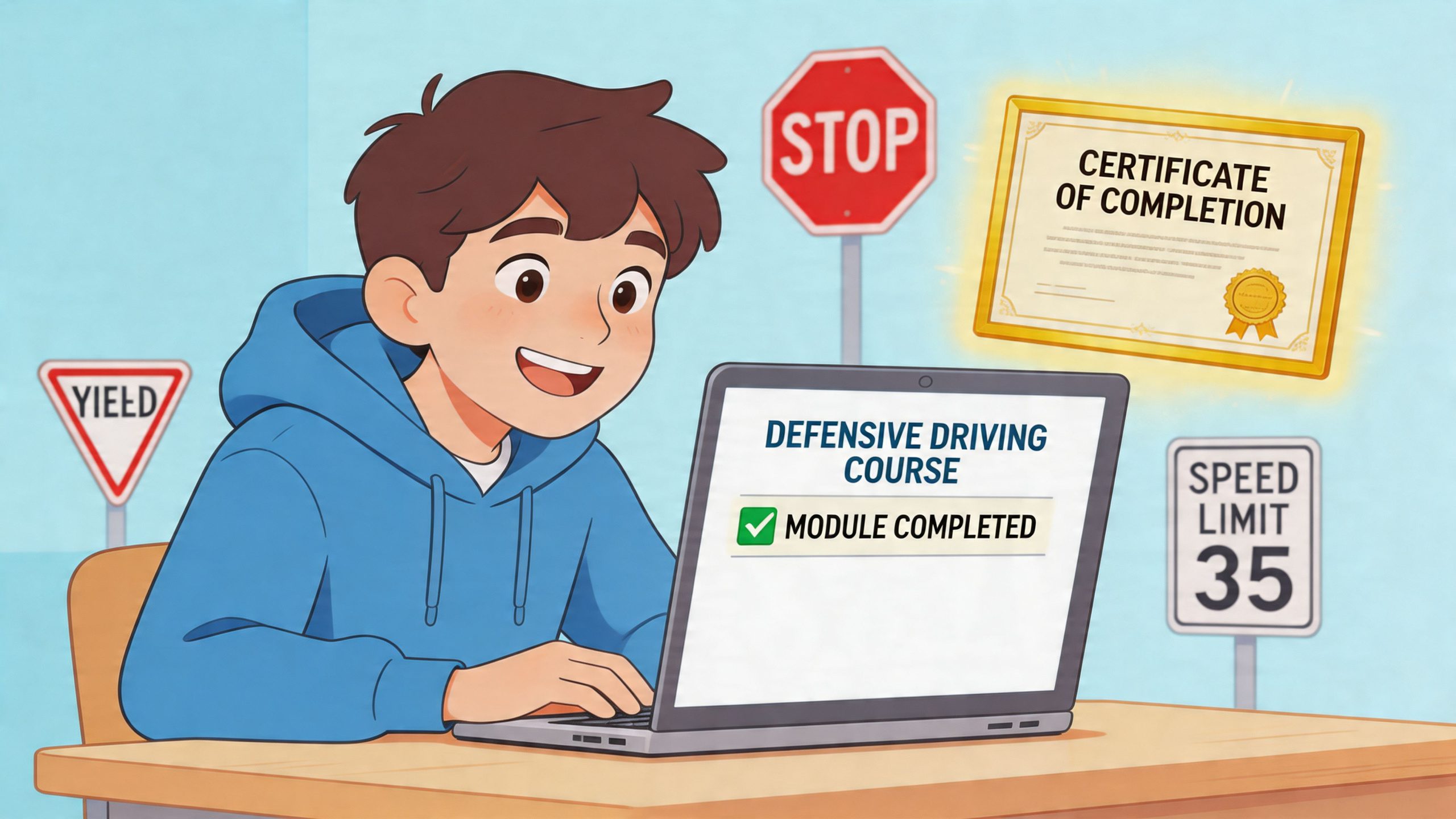
Once you’re enrolled, most of the anxiety fades. The course itself is usually more practical than people expect. You won’t spend hours memorizing obscure legal terms. You’ll spend time working through everyday road situations and learning how to reduce the chance that a bad moment turns into a crash or another citation.
What you’ll typically learn
Alabama defensive driving content often centers on hazard recognition and safe response. Two concepts commonly discussed are the SIPDE process and the Smith System.
SIPDE in plain language
SIPDE stands for:
- Search for hazards ahead and around you
- Identify what could become a problem
- Predict how that problem might develop
- Decide on your safest option
- Execute the action smoothly and early
If that sounds abstract, here’s a normal example. You’re approaching an intersection. A car at the side street is creeping forward. Using SIPDE, you search ahead, identify that driver as a possible risk, predict they may pull out, decide to ease off the gas and cover the brake, then execute that plan before the situation becomes urgent.
Other topics that usually appear
Courses often include a mix of:
-
Distracted driving prevention
How to reduce phone use, mental drift, and split attention. -
Speed management
Not just obeying the sign, but matching conditions, traffic flow, and stopping distance. -
Following distance
Giving yourself room so you don’t inherit the mistakes of the driver ahead. -
Aggressive driving awareness
How to avoid escalating a conflict with another driver. -
Decision-making under stress
Staying deliberate when traffic gets crowded, noisy, or frustrating.
Good defensive driving is less about fast reflexes and more about early choices.
What happens when you finish
The end of the course is where details matter again. Completion only helps you if the right person receives proof by the right deadline.
A clean finishing routine looks like this:
-
Complete every required module
Don’t assume you’re done because you reached the last lesson. Some systems require every section to be marked complete. -
Pass any required quiz or final assessment
Read questions carefully. Most missed answers come from rushing. -
Get your certificate of completion
Save the digital copy immediately, and print one if the court or insurer prefers paper. -
Submit it to the correct place
This may be the court clerk, probation office, attorney, employer, or insurance agent. Follow the instructions you confirmed earlier. -
Keep proof of delivery
Save the confirmation email, fax receipt, upload confirmation, or stamped copy.
Avoid the three most common completion mistakes
- Finishing the course but not submitting the certificate
- Sending the certificate to the provider instead of the court or insurer
- Missing the deadline because you assumed someone else would file it
That last mistake is especially common. Never assume automatic reporting unless the court or provider explicitly says that applies to your case. Your safest approach is to verify receipt yourself.
How to Find a Reputable State-Approved Provider
By the time you reach this step, you already know your purpose, your format, and your court requirements. Now you need a school that is legitimate, clear, and easy to work with. This matters more than people think, because the biggest problems usually come from sloppy administration, hidden fees, and vague claims about approval.
State-approved should be your starting line
If a provider doesn’t clearly explain its approval status, move on. You are not looking for a “good enough” course. You are looking for one that fits Alabama requirements and presents information in a way that matches what your court or insurer asked for.
Approval alone isn’t enough, though. A reputable provider should also explain what kind of course it offers, how completion works, and how quickly you’ll receive your certificate.
A practical checklist for choosing a provider
Use this list before you pay:
-
Clear pricing
The website should show the full course price clearly, not hide mandatory fees until checkout. -
Accessible support
If you have a deadline, you need a real way to contact customer service when something goes wrong. -
Straight answers about approval
The provider should explain what approvals it holds without implying that every Alabama court accepts every course. -
Certificate details upfront
You should know whether the certificate is emailed, downloadable, mailed, or handled another way. -
Reasonable website clarity
If the site feels confusing, outdated, or evasive, trust that signal.
Warning signs that deserve caution
Some providers make broad promises that sound comforting but don’t answer your real question.
Watch for language like:
- “Accepted everywhere” when your court has not confirmed that
- “Guaranteed savings” when insurance discounts vary by carrier and record
- “Instant completion” without explaining timing, verification, or requirements
A reputable school doesn’t rush you past your questions. It helps you answer them before checkout.
Reviews matter, but specifics matter more
General praise is fine, but the most useful reviews mention concrete details. Did students receive certificates promptly? Was customer support responsive? Did the provider explain submission steps clearly? Those are the signals that affect your outcome.
Drivers comparing options may also want to review what approved online traffic school programs usually have in common. It’s a helpful way to separate a polished sales page from a provider that supports students through completion.
A good provider should reduce uncertainty. If the website creates more uncertainty, keep looking.
Frequently Asked Questions for Alabama Drivers
Can I take an online course for any Alabama ticket
Not automatically. Some courts accept online courses, while others prefer or require classroom instruction. The answer depends on the court handling your case, the type of citation, and whether you received permission in advance.
Will a defensive driving course help after a DUI
You should never assume that a standard defensive driving class will satisfy a DUI-related requirement. Major violations often involve separate legal and educational rules. Ask the court, your attorney, or the supervising authority exactly what program is required.
How do I know where to send my certificate
Send it only where your instructions tell you to send it. That may be the court clerk, your insurance company, or another office tied to your case. If you’re not sure, stop and confirm before uploading, emailing, or mailing anything.
Can I take the course just for insurance
Yes, in many cases drivers do that voluntarily. But you should confirm with your insurer that the course qualifies for a discount and ask whether your driving record affects eligibility.
What if my court says “approved provider” but gives no list
Call back and ask more direct questions. Ask whether they accept online courses, whether a specific course length is required, and whether they recognize the provider you’re considering. Vague language on a ticket often becomes clearer when you speak with a clerk.
What if I already paid for a course and then learn my court won’t accept it
Contact the provider immediately and ask about refund or transfer options. Then get the court’s exact requirements in writing or by detailed note before enrolling anywhere else. It’s frustrating, but it’s still fixable if you act quickly.
If you want a straightforward online option backed by a driving-school-first approach, BDISchool is worth a look. Their focus is driver education that’s practical, flexible, and built to help students handle traffic school requirements with less confusion and more confidence.