You opened the ticket, saw the deadline, and immediately had three questions. Can I keep points off my record? Will my insurance jump? What course am I supposed to take in Florida?
That confusion is normal. Florida traffic school isn’t hard, but it is easy to do wrong if you pick the wrong course or wait too long.
A defensive driver course online fixes that problem when you choose the course that matches your reason for taking it. Some drivers need a 4-hour Basic Driver Improvement course for a moving violation. Others need an 8-hour court-ordered class. Some are looking for an insurance-related refresher. The smart move is to stop guessing and match the course to the requirement first.
Turn a Traffic Ticket into a Learning Opportunity
The worst time to make a rushed decision is right after getting a ticket. You’re frustrated, you’re searching fast, and every website sounds like it offers the same thing.
Most of them don’t.
Stop thinking only about the ticket
A Florida ticket isn’t just a fine. It can affect your driving record, your insurance situation, and your time.
That’s why a defensive driver course online is useful. It gives you a practical way to respond instead of just paying the citation and moving on.
Practical rule: Check the exact requirement first, because approval is state- and purpose-specific.
The idea behind defensive driving isn’t new or trendy. The first Defensive Driving Course was launched in 1964. That matters because you’re not signing up for some random internet class. You’re using a long-established safety model in a more convenient format.
What Florida drivers usually want
Most drivers who land on this page want one of these outcomes:
- Protect the record: They want to avoid unnecessary points from a qualifying ticket.
- Control insurance fallout: They want to reduce the chance of a violation turning into a bigger long-term expense.
- Satisfy a requirement: They need to complete the right course for a court, clerk, or state instruction.
- Finish fast without making mistakes: They want a clear path, not another hour of comparing vague course pages.
If that sounds like you, start by reviewing your Florida traffic ticket options before enrolling. That one step prevents the most common mistake, which is taking a course that doesn’t fit the actual reason you need it.
A better way to look at the situation
Getting cited doesn’t feel like an opportunity, but it can be a reset. You review Florida rules, sharpen hazard awareness, and handle the administrative side in one move.
That’s the right mindset. Don’t treat traffic school as punishment. Treat it as damage control plus a refresher that can make your next drive better than your last one.
Understanding Your Florida-Approved Online Course
A Florida-approved online course should do two things well. It should satisfy the official requirement you’re dealing with, and it should teach material that helps you drive smarter.
If it only does one of those, it’s not enough.
What the course actually teaches
A real defensive driver course online isn’t just a slideshow with a final quiz. The core curriculum centers on crash avoidance and decision-making.
Courses are built around recognizing traffic hazards, identifying impairment cues in other drivers, and applying state traffic laws so you make better choices behind the wheel. In plain English, that means learning to spot trouble earlier and react before a bad situation becomes a collision.
Expect topics like:
- Florida traffic laws: Right-of-way, lane use, following distance, and rules that drivers often forget.
- Hazard perception: Reading traffic patterns instead of staring only at the car directly ahead.
- Impaired and distracted driving awareness: Not just your own behavior, but signs that another driver is about to do something reckless.
- Crash-avoidance habits: Space management, speed adjustment, and safer responses in stressful moments.
Why the online format works
Online learning fits real life better than a classroom for most adults. You can log in when you have time, stop when you need to, and continue without rearranging your whole week.
That flexibility matters if you’re working full time, handling family obligations, or trying to finish before a ticket deadline. A self-paced course removes the usual friction.
A good online course should feel simple to complete, but still serious enough to be worth your time.
Florida drivers also need clarity on approval. That’s why it makes sense to choose a Florida-approved online traffic school rather than a generic defensive driving site that doesn’t clearly align with Florida requirements.
What you should expect as a student
You shouldn’t expect mystery. You should expect a clean login process, straightforward lessons, and clear instructions about completion.
You should also expect the course to feel relevant. The point isn’t to memorize trivia. The point is to drive with better timing, better awareness, and fewer preventable mistakes.
Which Florida Defensive Driving Course Is Right for You?
Many drivers encounter difficulty. They search for a defensive driver course online, but what they really need is the correct Florida course for their exact situation.
The hour requirement tells you a lot. Defensive driving programs are commonly packaged as 4-, 6-, or 8-hour courses, which shows these are regulated programs tied to specific requirements, not random time blocks.
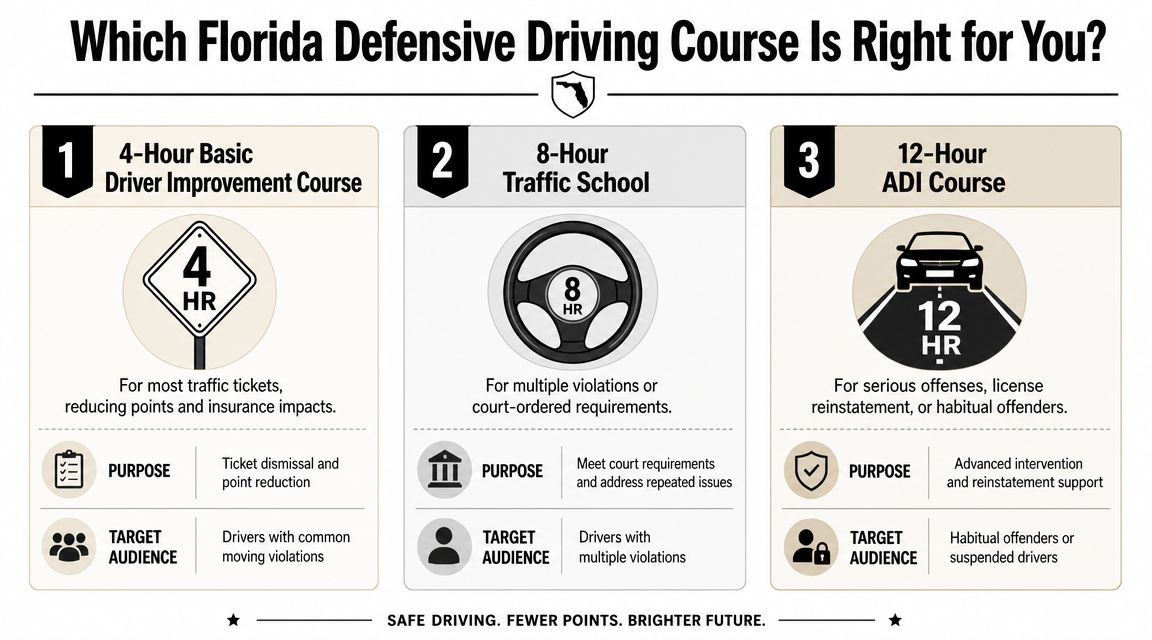
Use this quick comparison first
| Course | Typical Florida use | Who it fits |
|---|---|---|
| 4-Hour BDI | Moving violation election | Drivers handling a common ticket and trying to protect their record |
| 8-Hour IDI | Court-ordered requirement | Drivers told by the court to complete a longer improvement course |
| 8-Hour Aggressive Driver | Behavior-focused requirement | Drivers assigned a course tied to aggressive driving concerns |
| 6-Hour Mature Driver | Insurance-related refresher | Drivers age 55+ seeking a qualifying refresher for insurance purposes |
The 4-hour course most ticketed drivers need
If you got a standard moving violation and chose traffic school, the 4-Hour Basic Driver Improvement course is usually the first course to check.
This is the one many Florida drivers mean when they say they need traffic school online. It’s built for the driver who wants to handle the citation correctly without creating a bigger problem later.
When the 8-hour options apply
The 8-Hour Intermediate Driver Improvement course is different. This is generally tied to a court requirement, not a casual choice you make because the shorter option sounds easier.
The 8-Hour Aggressive Driver course is even more specific. If your paperwork or court instruction points to aggressive driving, take that seriously and enroll in the exact course named.
If a court, clerk, or notice names a course type, don’t substitute a different one because the title sounds similar.
The mature driver option
The 6-Hour Mature Driver course serves a different purpose. It isn’t primarily about a fresh ticket. It’s a refresher for older drivers who want to stay current and pursue an insurance-related benefit where applicable.
That distinction matters. A mature driver course isn’t a replacement for a BDI or IDI requirement.
My advice on choosing fast
Use this decision path:
- Read the ticket, court notice, or clerk instruction carefully.
- Identify the purpose first. Ticket election, court order, aggressive-driver requirement, or insurance refresher.
- Match the exact course type.
- Choose a provider that offers the course in a format and language you can finish.
If English isn’t your easiest language, don’t force it. Courses offered in English, Spanish, and Portuguese are the practical choice because comprehension matters more than speed.
The Real Benefits of Completing Your Course Online
The value of traffic school isn’t abstract. It shows up in your record, your compliance status, and your peace of mind.
But only if the course is accepted.
Approval is not optional
This is the part too many drivers overlook. Florida uses specific course categories, and the provider has to fit the requirement.
A good rule comes from state-regulated driver improvement programs more broadly. Georgia, for example, warns that classes taken at uncertified schools won’t be accepted, which is a useful reminder that state approval determines whether your certificate counts at all. The same basic lesson applies in Florida. If the provider isn’t properly aligned with the requirement, your time and money are wasted.
Why online is the smarter route for most drivers
The online format solves the problems drivers have:
- Scheduling conflicts: You can work around your job and family calendar.
- Deadline pressure: You can start quickly instead of waiting for an in-person class date.
- Less friction: No commute, no classroom seat, no unnecessary delay.
- Focused completion: You can move through the material in a controlled way rather than losing a whole day.
That’s not just convenience. It improves follow-through.
The outcomes drivers care about most
For Florida drivers, the main benefits are practical:
- Record protection: The right course can help you deal with a qualifying violation the correct way.
- Requirement fulfillment: If a court ordered a course, finishing the approved program checks that box.
- Insurance value: Some drivers take a qualifying course because they want an insurance-related benefit or refresher.
If insurance is part of your goal, review the details on defensive driving insurance discount options before enrolling. Don’t assume every course serves the same purpose.
The course only helps if it matches the reason you’re taking it.
That one sentence saves drivers from the most expensive traffic-school mistake.
How to Enroll and Complete Your Course in 4 Steps
Most drivers delay enrollment because they think the process will be annoying. It usually isn’t.
The right process is simple, and it stays simple if you choose your course before you pay for anything.
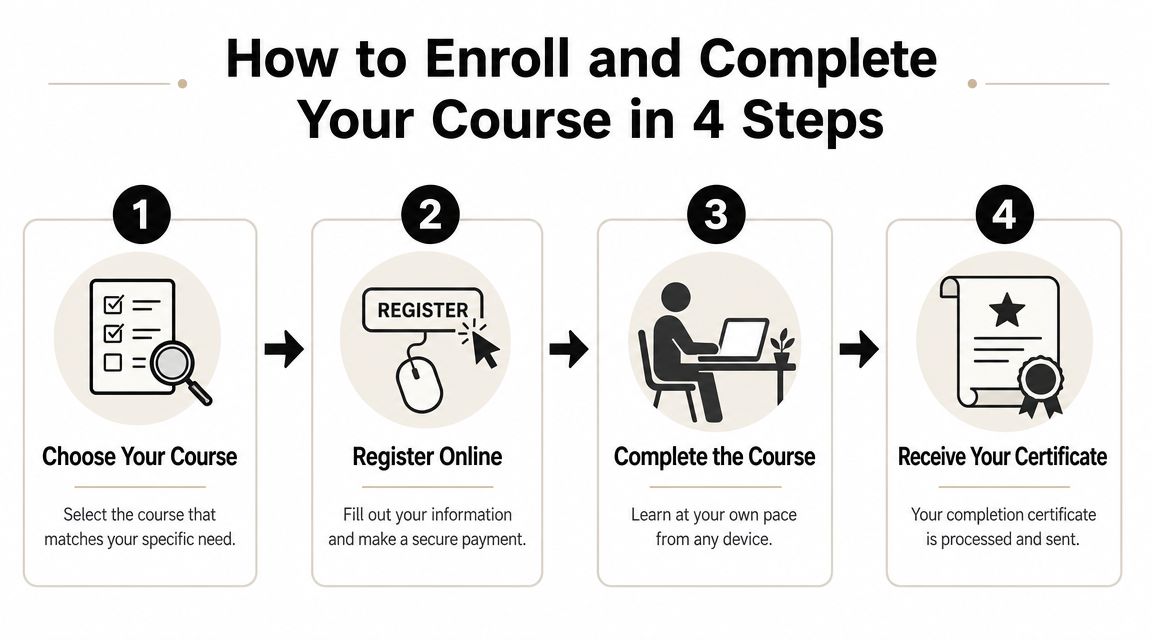
Step 1 Pick the course that matches your reason
Start with the requirement, not the course title. Ticket election, court order, aggressive-driver instruction, and mature-driver insurance refresher each point to a different path.
If you’re comparing providers, BDISchool offers Florida traffic school courses in formats tied to these needs, along with electronic certificate handling through its online driving certificate process.
Step 2 Register online and get access
Registration should be quick. You enter your details, choose the course, and create your account.
Keep your ticket or court paperwork nearby when you sign up. That reduces errors with your personal information and helps you confirm you’re enrolling in the right class.
Step 3 Complete the lessons at your own pace
Online learning earns its value, letting you complete the material from your phone, laptop, or desktop without building your week around a classroom.
Some modern online courses may use adaptive curriculum tailored to learner variables such as age, driving behaviors, vehicle type, and geography. That’s a smarter approach than a one-size-fits-all lesson because it keeps the material closer to the situations drivers encounter.
Step 4 Finish the exam and handle the certificate
Most students worry about the reporting and certificate side more than the course itself. That’s fair. Administrative mistakes are what create last-minute panic.
Use this checklist:
- Confirm completion requirements: Finish every required lesson before attempting the final exam.
- Review your personal details: Your name and identifying information should match your records.
- Check reporting expectations: Know whether the provider reports electronically, issues a downloadable certificate, or both.
- Save your confirmation: Keep the completion email or receipt until the requirement is fully satisfied.
The point is to finish cleanly, not just quickly.
Get Your Questions Answered and Get Started
Florida drivers usually ask the same last-minute questions.
Quick answers before you enroll
How do I know which course I need?
Check the exact requirement first. Your ticket, court notice, or insurance goal tells you whether you need BDI, IDI, an aggressive-driver course, or a mature-driver refresher.
Will any online course work?
No. It has to fit the purpose and approval standard tied to your situation.
Can I do the course on my own schedule?
Usually yes. That’s one of the main reasons drivers choose an online option.
What if I’m worried about understanding the material?
Choose a course offered in the language you read most comfortably. Finishing fast doesn’t help if you misunderstand the content or the instructions.
What matters most before I pay?
Course type first, approval second, reporting process third.
That’s the cleanest way to handle a ticket or driving requirement in Florida. Don’t overcomplicate it. Match the course to the reason, complete it carefully, and keep your paperwork straight.
A defensive driver course online is a useful tool when you use it correctly. It’s not just about getting through a requirement. It’s about protecting your record, avoiding preventable mistakes, and closing out the issue without creating another one.
If you’re ready to handle the requirement and move on, review the available Florida courses at BDISchool and enroll in the one that matches your ticket, court order, or insurance goal.