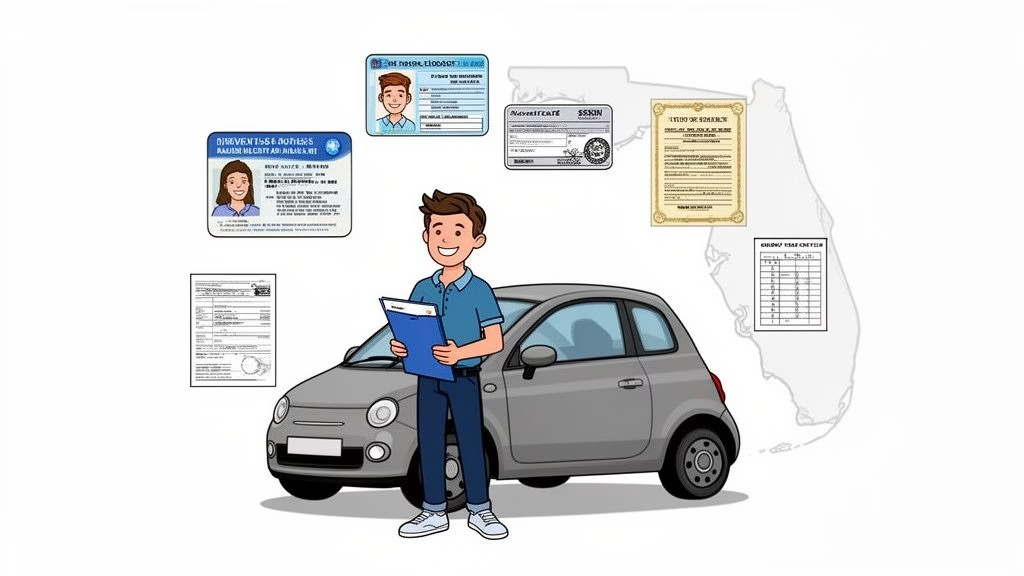
Getting your learner's permit in Florida boils down to a few key things: you need to be at least 15 years old, have finished a 4-hour drug and alcohol course, and be ready to pass the official vision and knowledge tests. Of course, you’ll also need to get all your documents in order, like proof of identity and where you live, before you make the trip to the FLHSMV.
Your Florida Permit Application Blueprint
Earning that first learner's permit is a massive milestone. It’s your first real taste of driving freedom. But let’s be honest, navigating the Florida Highway Safety and Motor Vehicles (FLHSMV) process can feel like a maze if you go in blind. This guide is your step-by-step roadmap, designed to break the whole thing down into three manageable parts: checking your eligibility, knocking out the required courses, and gathering all the right paperwork.
This visual gives you a quick, at-a-glance look at the main stages you'll go through. It's all about eligibility, courses, and paperwork.
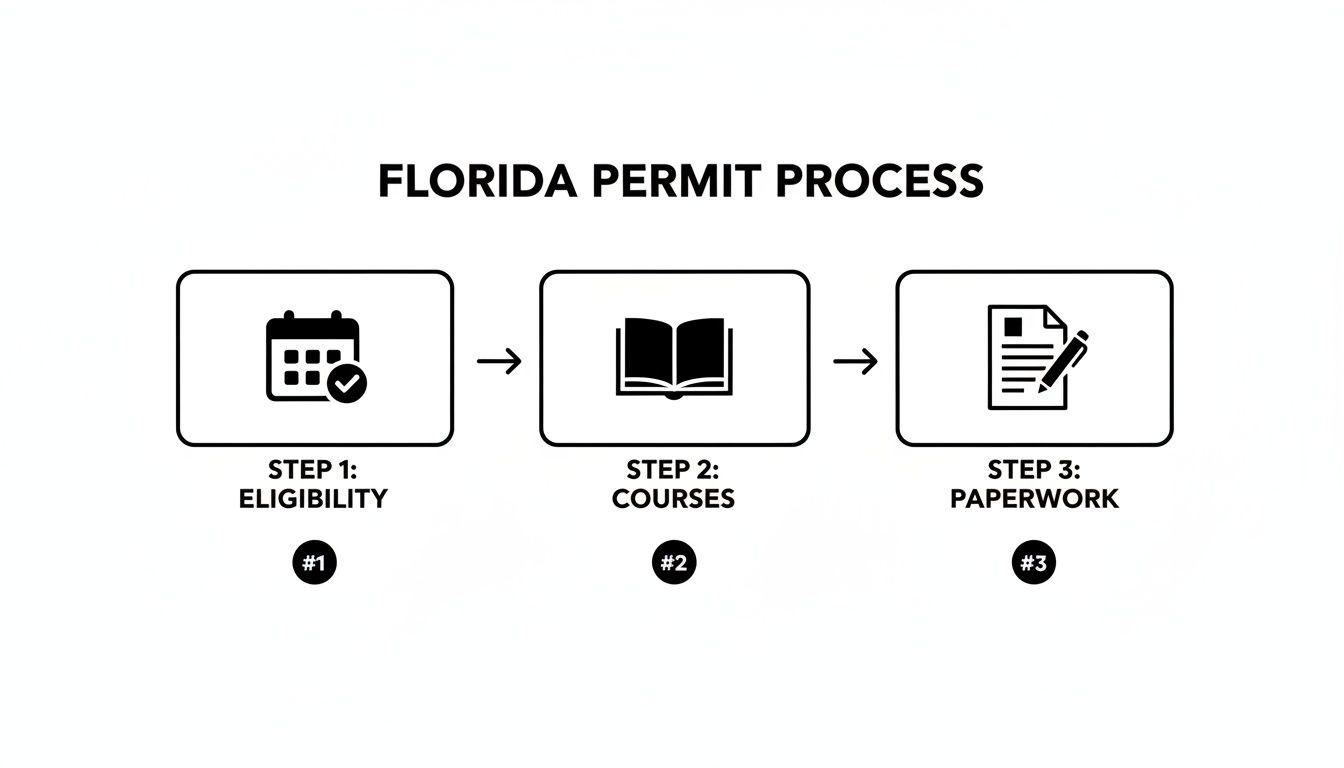
Think of it this way: tackle these milestones one by one, and you’ll find the process is a lot less intimidating than it seems.
To give you a clear starting point, here's a quick summary of what you'll need.
| Requirement Category | Details for Applicants |
|---|---|
| Age Requirement | Must be between 15 and 17 years old. |
| Required Course | Complete the 4-hour Traffic Law and Substance Abuse Education (TLSAE) course. |
| Parental Consent | If under 18, a parent/guardian must sign the consent form. |
| Official Tests | Pass both the vision screening and the 50-question Class E Knowledge Exam. |
| Required Documents | Provide proof of identity, Social Security number, and two proofs of residential address. |
This table lays out the core components, but let's dig into what this all means in practice.
Understanding the Core Requirements
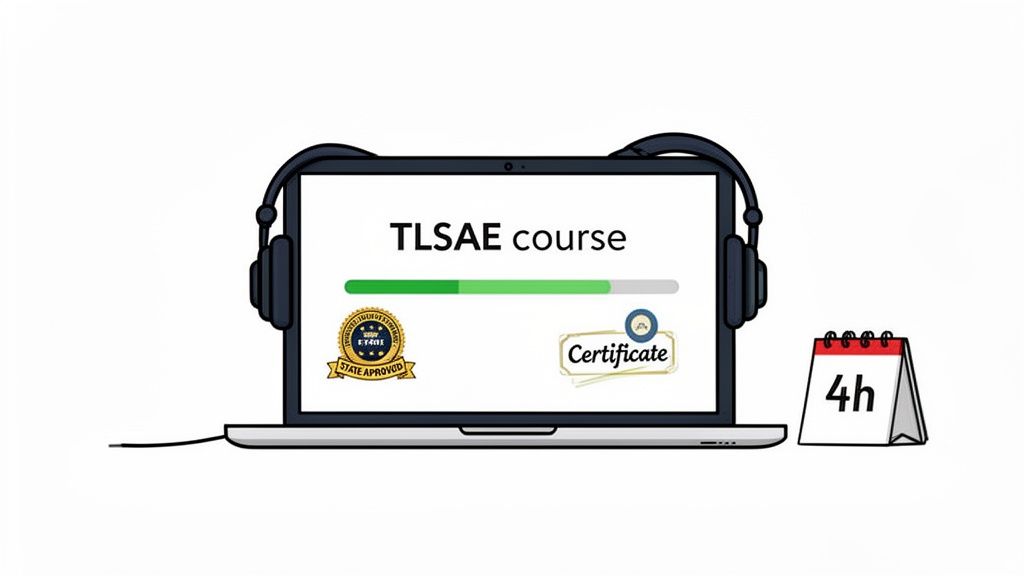
For any teen driver, the first real step is completing the mandatory Traffic Law and Substance Abuse Education (TLSAE) course. This isn't just about ticking a box. This four-hour course is the bedrock of your driver's ed, covering the stuff that actually keeps you—and everyone else—safe out there on the road.
My best advice? Take it one step at a time. Finish your course before you start hunting for your birth certificate or trying to book a test. Focusing on one thing at a time—course, then documents, then test—is the secret to keeping the stress down.
Florida's graduated licensing system is there for a reason: it builds safe, responsible drivers from day one. You're not alone in this, either. In 2024, more than 250,000 teens went through this exact process to get their first permit. The good news? For those who came prepared, the pass rate on the knowledge test was an impressive 92% on the first try. You can dig deeper into these numbers with Florida's permit success rates and driver statistics.
Knowing what's expected before you walk into the FLHSMV office is half the battle. Use this guide as your personal checklist to make sure you have everything buttoned up, so you can start your driving journey with confidence.
Gathering Your Essential Documents
Showing up to the driver's license office only to be turned away for missing paperwork is a classic, frustrating rite of passage—but it's one you can completely avoid. Let's walk through exactly what you need to bring, so you can get in, get it done, and walk out with your learner's permit on the first try.
The Florida DHSMV is serious about verifying your identity. They have a strict system, and a student ID or a library card just won't cut it. You'll need specific, official documents to prove who you are, where you live, and your legal presence.
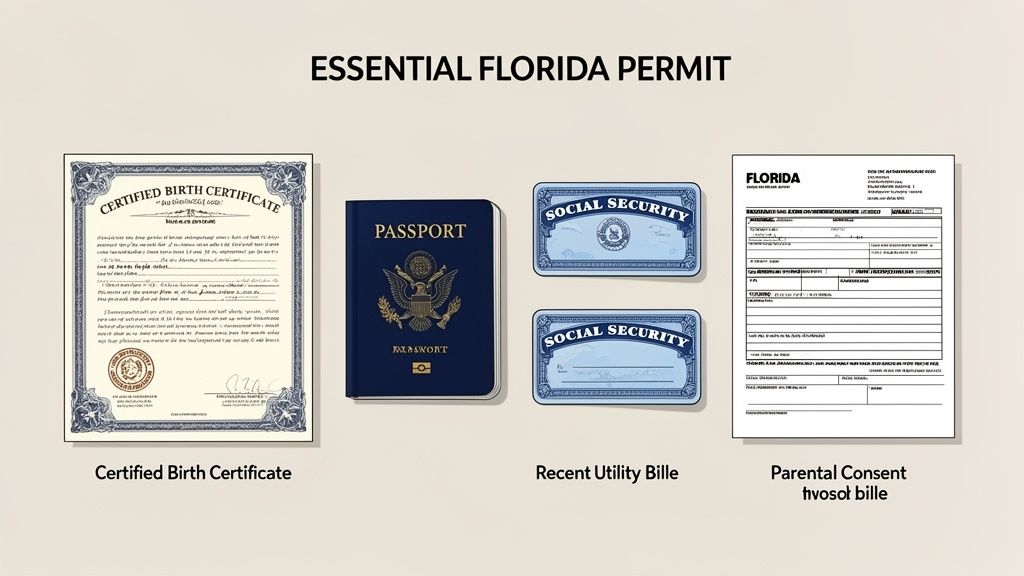
Proving Your Identity and Social Security Number
First things first, you need to prove you are who you say you are. This requires one primary document, and it absolutely must be the original or a certified copy. No photocopies allowed.
Your best bets for primary identification are:
- A certified U.S. birth certificate (make sure it's the official government version, not the one from the hospital).
- A valid, unexpired U.S. passport or passport card.
- A Certificate of Naturalization or Citizenship.
Next up is your Social Security number. This is a simple but common stumbling block. The easiest way to handle this is to bring your original Social Security card. If you can't track it down, don't panic. A recent W-2 form or a pay stub that clearly shows your full name and SSN will also work.
Expert Tip: When they say "original or certified," they mean it. The DHSMV employee has zero wiggle room on this rule. A perfect scan on your phone or a crystal-clear photocopy will still get you sent home to find the real thing.
Verifying Your Florida Residential Address
This is where a lot of people get tripped up. Florida requires two separate documents proving you live where you say you live. Both documents need to have your full name and current residential address printed on them.
Think of it this way: what mail could you grab right now to prove you live at your address?
Some of the most common documents people use are:
- A utility bill (like power, water, or cable) or a cell phone bill from the last two months.
- Mail from a bank, like a checking or savings account statement.
- Your vehicle registration or title certificate.
- For teens still in school, a report card or official transcript for the current school year works perfectly.
Here's the catch: your two proofs of address must come from different sources. You can't use a water bill and a power bill from the same utility company, for example. Your best bet is to bring one utility bill and one bank statement. It's also smart to know what other kinds of paperwork might be needed for different situations. For example, while not for a permit, understanding the requirements for a Florida Sports Physical Form gives you a good idea of how specific documentation can be.
Special Requirements for Minors
If you're under 18, you have one more critical piece of paper: the Parental Consent Form. A parent or legal guardian has to sign this form, officially taking financial responsibility for your driving.
This has to be done either right in front of the driver's license examiner at the DHSMV or in front of a notary public ahead of time. Getting it notarized beforehand is a huge time-saver. You can download the form right from the FLHSMV website to get it ready. And once you're on the road, it's always a good idea to know how to check the status of your driving record to stay on top of things.
Tackling Your Required Safety Courses
Before you can even set foot in the DMV for your permit test, Florida requires you to complete a specific safety course. Think of it as your first official step into the world of responsible driving—it's a non-negotiable prerequisite.
This mandatory course is the Traffic Law and Substance Abuse Education (TLSAE) program. You'll often hear it called the "drug and alcohol course." It's a four-hour program that every single new driver in Florida must pass before they can even apply for their learner's permit. This isn't just about checking a box; it's designed to build a strong foundation for safe driving habits right from the start.
What to Expect from the TLSAE Course
The TLSAE course is much more than a dry lecture on traffic rules. It gets real about the serious consequences of driving under the influence, breaking down exactly how alcohol and drugs impair your judgment, slow your reaction time, and affect your vision. The curriculum is designed to hit home, showing you the stark legal and personal consequences of a DUI.
But it's not all about substance abuse. The course also hammers home the key traffic laws that can be tricky for new drivers. You’ll get a solid review of topics like:
- Navigating right-of-way at confusing intersections.
- The real dangers of distracted driving (yes, that includes texting and fiddling with the radio).
- Safely sharing the road with pedestrians and cyclists.
- The basic physics behind driving, like stopping distances and why speed management is so critical.
The easiest way to get this done? Take it online. A state-approved online TLSAE course lets you work through the material at your own pace, fitting the four hours around your school or work schedule. Once you pass, the provider sends your completion record directly to the Florida Department of Highway Safety and Motor Vehicles (FLHSMV) for you. That’s one less piece of paper you have to track down for your appointment. You can learn more about state-approved options for driver's education in Florida and see how convenient it is.
Passing the Vision and Hearing Screenings
Once your TLSAE is in the system, the last hurdles before your written test happen right there at the service center: the vision and hearing tests. Don't sweat these—they're just simple screenings to make sure you meet the basic physical standards for driving safely.
The vision test isn’t meant to be difficult. It’s a practical check to ensure you can see road signs, potential hazards, and other cars clearly. If you wear glasses or contacts for distance, remember to wear them for the test.
For the vision screening, you'll look into a machine and be asked to read a few lines of letters. Florida’s standard is 20/40 vision or better in at least one eye, with or without corrective lenses. If you need your glasses or contacts to pass, a restriction will be added to your permit, meaning you're legally required to wear them anytime you're behind the wheel.
The hearing test is even more straightforward, simply ensuring you can hear sounds at a level necessary for safe driving awareness.
Nailing the Florida Knowledge Test
For many people, the Class E Knowledge Exam feels like the biggest hurdle standing between them and a learner's permit. Facing a 50-question test can seem daunting, but with the right game plan, you can walk into the testing center—or log on at home—feeling ready to pass on the first go.
The test is pretty straightforward. You'll face 50 multiple-choice questions that cover Florida's traffic laws, road rules, and road signs. To get a passing grade, you need to score at least 80%, which means answering a minimum of 40 questions correctly. Trust me, just skimming the Florida Driver's Handbook the night before isn't going to cut it. You need a real study strategy.
Study Smarter, Not Harder
Forget about last-minute cram sessions. The best way to prepare is to actually simulate the test-taking experience. This is where practice tests become your secret weapon. They get you used to the question format and, more importantly, highlight the specific areas where you still need some work.
From my experience, I've seen new drivers consistently get tripped up by a few key topics. Make sure you really focus your study time on these:
- Tricky Right-of-Way Situations: Who has the right-of-way when two cars pull up to a four-way stop at the same time? What are you supposed to do if a traffic light is completely out?
- Parking Rules: You need to know the specific rules for parking on hills, how many feet to leave for a fire hydrant, and what all the different curb colors mean.
- Speed Limits: It's not enough to just drive with the flow of traffic. You must know the default speed limits for residential zones, business districts, and rural highways by heart.
- Lesser-Known Traffic Signs: Everyone knows a stop sign. But can you identify warning, regulatory, and guide signs just by their shape and color? You'll need to.
A great way to see where you stand is by taking an online practice exam. Give our free Florida permit practice test a try to get a feel for the real thing.
Florida Knowledge Test At a Glance
Here’s a quick breakdown of the key facts about the Class E Knowledge Exam to help you focus your preparation.
| Test Feature | Details |
|---|---|
| Total Questions | 50 multiple-choice questions |
| Passing Score | 80% (at least 40 questions correct) |
| Test Topics | Road rules, traffic laws, and road signs |
| Key Reference | Official Florida Driver License Handbook |
| Online Option | Available for applicants under 18 |
Knowing these numbers helps you set a clear target for your study sessions and practice tests.
Taking the Test: What to Expect on the Day
If you're under 18, Florida gives you a huge advantage: you can take the Class E Knowledge Exam online through a state-approved provider. This is a fantastic option that helps cut down on test-day anxiety. Taking the exam in the comfort of your own home, where you're relaxed and focused, can make a world of difference.
Quick heads-up: Even if you pass the test online, you'll still need to visit an FLHSMV or tax collector's office. They have to conduct your vision and hearing screenings, process your paperwork, and take your photo for the permit.
So, what if you don't pass the first time? Don't sweat it—it happens. You can take the test again, although there will be a fee for each new attempt. The best thing to do is use that first try as a diagnostic tool. It will show you exactly which topics you struggled with, so you can go back and study with a much clearer focus.
Understanding the Rules of the Road with Your New Permit
Passing the knowledge test is a huge first step—congratulations! But the real learning happens on the road, and your new learner's permit comes with some very specific rules you need to follow. These aren't just suggestions; they are part of Florida's Graduated Driver Licensing (GDL) laws, created to keep new drivers safe while they build experience.
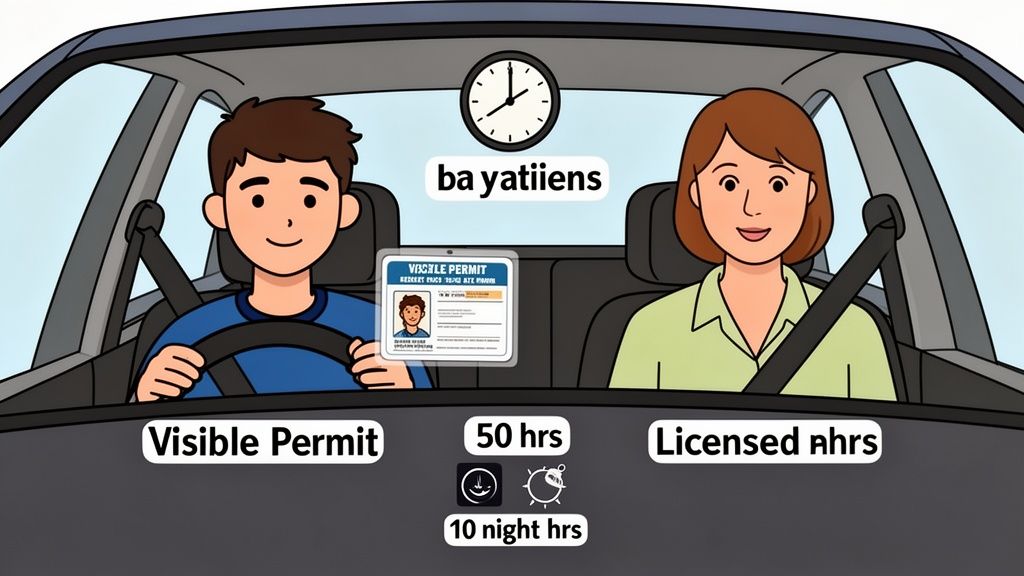
The most critical rule is simple: you can never drive alone. A licensed driver who is at least 21 years old must be in the front passenger seat at all times. No exceptions. Whether you're making a quick trip to the grocery store or driving across town, you need that supervisor right next to you.
Navigating Time Restrictions
Florida's GDL laws also have strict curfews to help you avoid the riskiest driving times. These restrictions ease up slightly after you've had your permit for a little while.
- For the first three months, you can only drive during daylight hours.
- After those first three months, you're permitted to drive until 10:00 PM.
These time limits are there for a good reason. Night driving introduces a whole new set of challenges, from headlight glare to reduced visibility, and it's best to master the basics in broad daylight first.
My best advice is to treat these rules as a training plan, not a limitation. Use the daylight-only period to get completely comfortable behind the wheel. When the time comes, you'll be much more confident about easing into evening driving with your supervising driver.
Your Supervised Driving Log
Before you can even think about getting your driver's license, Florida wants to see proof that you've put in the practice. You'll need to log a total of 50 hours of supervised driving. This is about more than just hitting a number; it's about gaining real skills in all sorts of traffic and road conditions.
A critical piece of this is that 10 of those 50 hours must be at night. This ensures you get hands-on experience in tougher, low-light situations before you're driving solo. Keep a detailed log of every practice session—note the date, the duration, and what you worked on.
As you get more comfortable on the road, it's also smart to stay sharp on all the traffic laws, even the obscure ones. Things can get confusing, like whether you can you drink non-alcoholic beer while driving. Knowing the rules inside and out is part of becoming a responsible driver.
And of course, keep the official handbook handy. The Florida driver's manual is your best source for official rules and will be an invaluable resource on your journey.
Got Questions About the Florida Permit Process? We’ve Got Answers.
Going through the permit process for the first time always brings up a bunch of questions. It's totally normal. From figuring out the costs to understanding what happens if you miss a deadline, navigating the details can feel a little overwhelming.
Let's walk through some of the most common questions we get from new drivers and their families. My goal here is to clear up any confusion so you can walk into the driver license office with total confidence.
How Much Does It Cost to Get a Permit in Florida?
It's smart to know the costs upfront. The good news is that Florida keeps the fees pretty reasonable. The standard fee for your initial learner's license is $48.00.
Think of this as your main cost, but keep in mind there could be small add-ons. For instance, if you don't pass the knowledge test on your first try, there's usually a small fee to retake it. It's always a good idea to double-check the latest fees on the official FLHSMV website before you go, just in case anything has changed.
Can I Take the Permit Test Online in Florida?
Yes, you can—but there's a catch. This convenient option is generally reserved for new drivers under the age of 18. For teens, taking the Class E Knowledge Exam online through a state-approved provider is a fantastic way to handle the test in a comfortable setting, like your own home.
Just remember, passing the test online is only half the battle. You still have to make a trip to an FLHSMV or tax collector's office. That's where they'll check all your documents, give you the vision and hearing tests, and snap your photo for the permit itself.
This two-part approach really helps break things up, letting you focus on the test first and the paperwork later.
What Happens if My Learners Permit Expires?
It happens more often than you think. If your Florida learner's permit expires before you get your driver's license, you'll need to head back to a service center and apply for a new one.
The process isn't as bad as it sounds, though. You typically won't have to retake the TLSAE course or the written knowledge test. You will, however, have to pay the $48.00 issuance fee again and pass another vision test.
Are the Permit Requirements Different for Adults Over 18?
The core rules are the same for everyone—you still need to pass the knowledge and vision tests and bring the right ID. But if you're 18 or older, the process gets a bit simpler.
Here’s what you don't have to worry about as an adult applicant:
- No Parental Consent: You won't need a parent or guardian to sign any consent forms. You’re on your own for this one!
- TLSAE Course (Maybe): The drug and alcohol course is only required for adults who have never held a driver's license in any other state or country. If you're licensed elsewhere and just moving to Florida, you can skip it.
Even if you're technically exempt, I still recommend taking the TLSAE course. It's a great refresher on Florida's specific traffic laws and the dangers of impaired driving. It really helps build a solid foundation for staying safe out there.
Ready to check that state-required safety course off your list and get one step closer to driving? BDISchool offers a fully online, FLHSMV-approved TLSAE course that you can complete on your own schedule. Find out more and enroll today at https://bdischool.com.