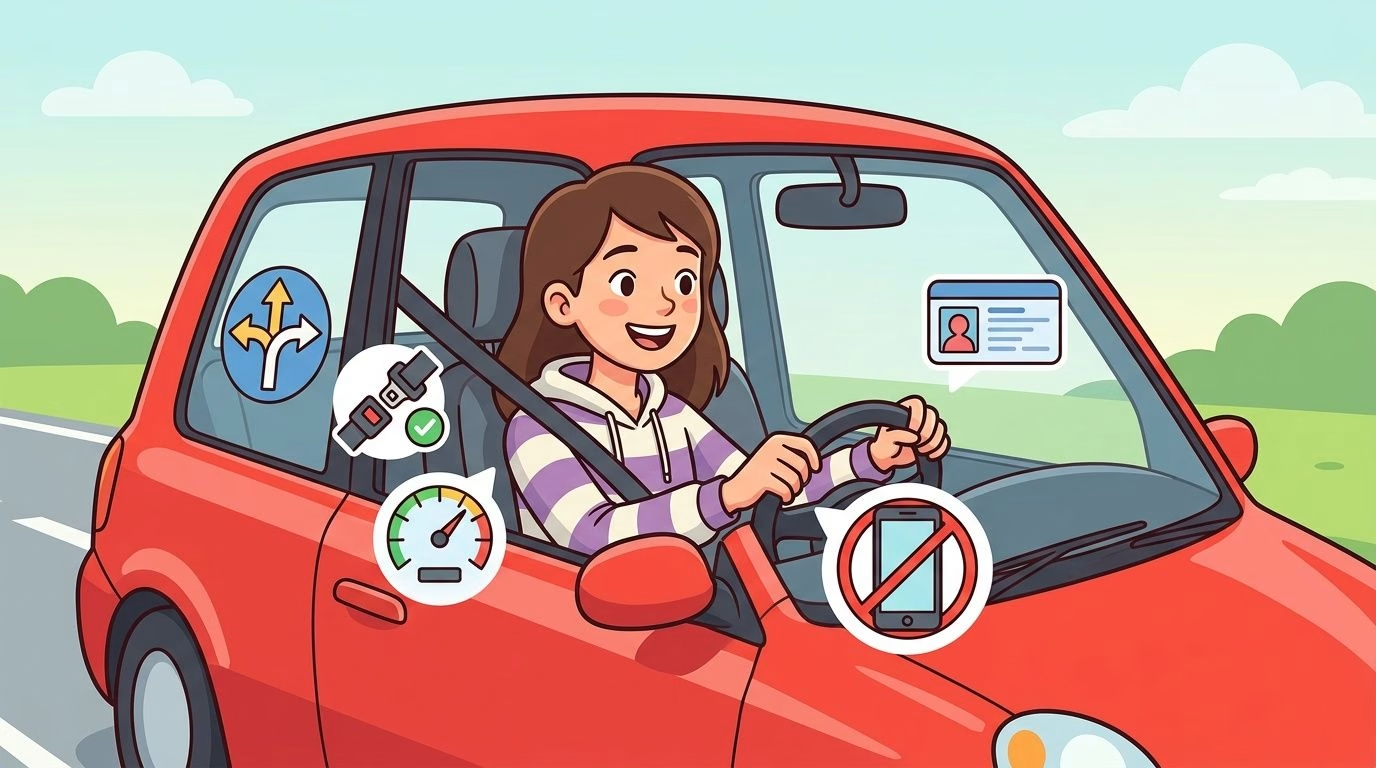
A new license feels like freedom. It also comes with a hard truth.
Young drivers ages 16 to 19 face a fatal crash rate almost three times higher than drivers 20 and older per mile driven, and the risk is highest in the first months after they start driving on their own, according to the CDC’s teen driver risk overview. That’s why the best rules for new drivers aren’t random hoops. They’re guardrails for the exact period when judgment is still forming.
Most families feel this tension. A teen wants independence. A parent wants proof that independence won’t turn into a bad night, a ticket, or something worse. Both are reasonable.
The good news is that safe driving can be learned step by step. New drivers don’t need magic confidence. They need repetition, structure, and clear explanations of why each rule exists.
The Responsibility and Reward of Driving
A student often starts the same way. They know how to steer, brake, and use a turn signal. Then they pull up to a busy intersection, see cars approaching from different directions, and freeze for a second.
That second matters.
The risk isn’t high because teens can’t memorize signs. It’s high because driving asks them to make fast decisions in changing conditions before they’ve built enough experience to do it calmly. The first months alone in a car are demanding, even for smart, careful kids.
What makes the early months so risky
A new driver may know the speed limit and still enter a curve too fast for the weather. They may know seat belts matter and still let a short trip tempt them into skipping one. They may know not to use a phone and still glance down at the worst possible moment.
The legal side matters too. Insurance, registration, and financial responsibility become part of everyday driving, not just parent paperwork. If your family is sorting that side out, this guide to Understanding Florida auto insurance laws is a useful starting point.
Practical rule: Treat a license as permission to keep learning, not proof that learning is finished.
Why this should still feel encouraging
Driving gives people access to school, work, family, and ordinary adult life. It teaches planning, patience, and accountability in a way few other milestones do.
That’s why I tell students to think of driving as a craft. You build it one habit at a time. Smooth braking. Early scanning. Waiting instead of rushing. Checking mirrors before every lane change.
Parents help most when they stay calm, stay consistent, and insist on standards. New drivers improve fastest when expectations are clear and practice is regular.
Your Path from Permit to Full License
Getting licensed feels simpler when you see it as a sequence instead of a maze. Most states use some form of Graduated Driver Licensing, or GDL, because it gives new drivers time to gain experience before full independence.
GDL laws reduced teenage crash deaths by 48% between 1996, when the first three-stage program was implemented in the United States, and 2023, according to the Insurance Institute for Highway Safety. That’s the “why” behind the process.
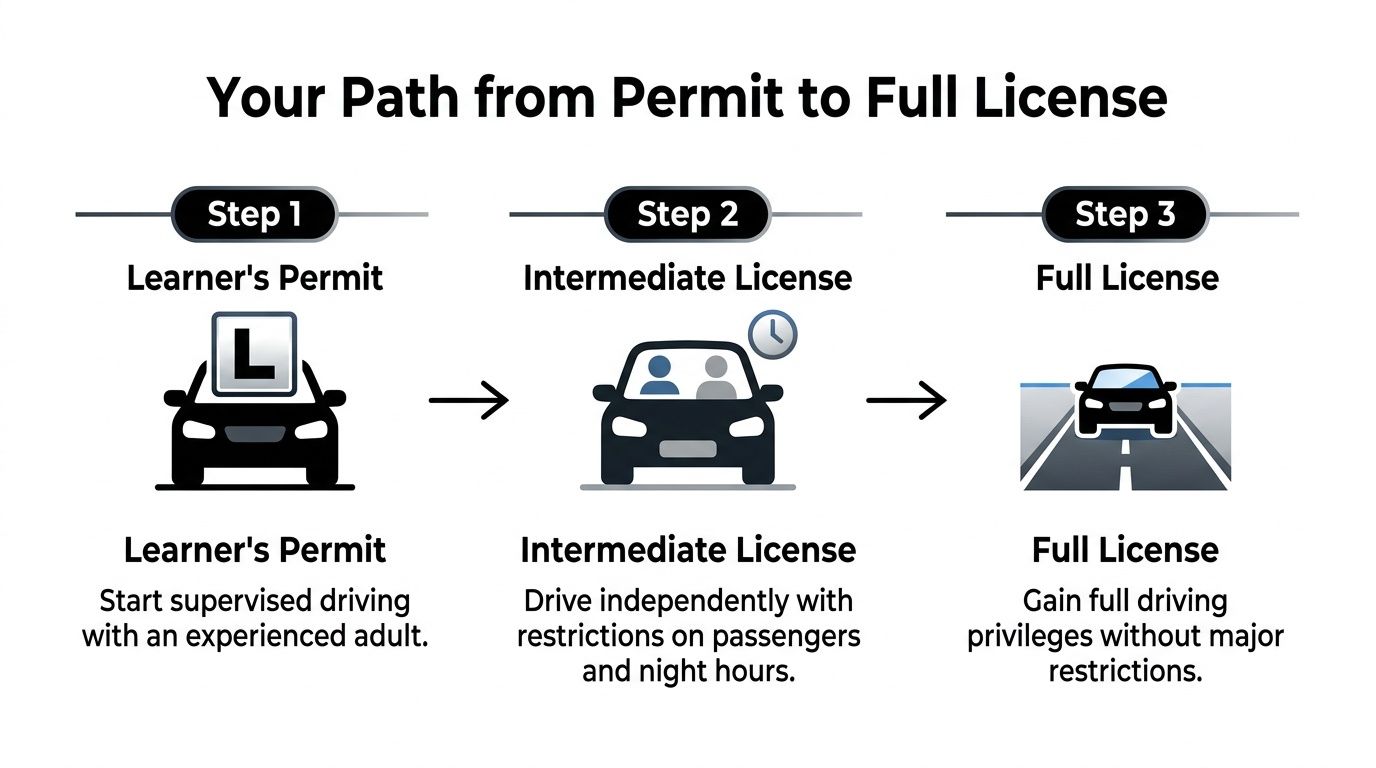
Stage one begins with a learner’s permit
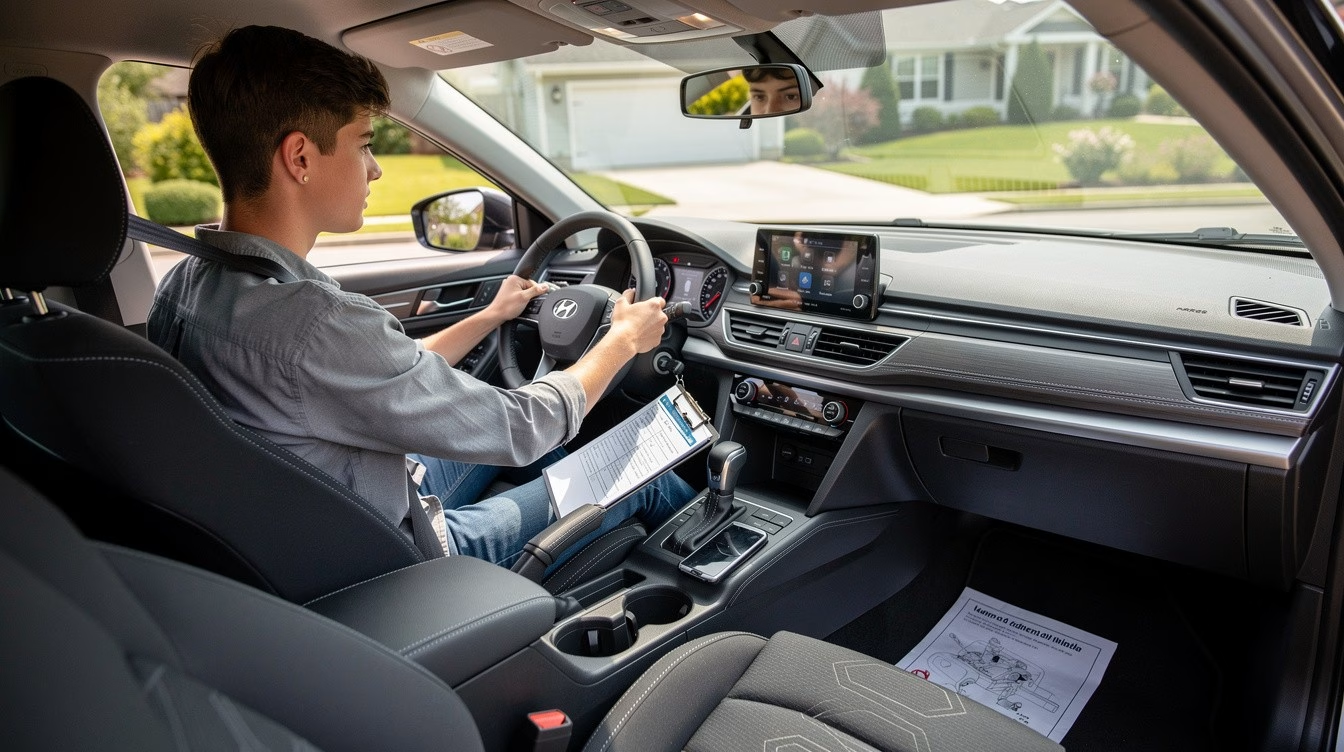
This is the supervised phase. The point isn’t just to let a teen touch the wheel. The point is to make basic tasks automatic while an experienced adult is still in the car.
A strong permit period usually includes:
- Consistent short drives: parking lots, neighborhood turns, simple lane changes, then busier roads.
- Deliberate repetition: left turns, school zones, stop signs, backing, and scanning for hazards.
- Structured study: a course helps students connect handbook rules to real road situations. Families who want a clean starting point can review learner’s permit requirements.
The middle stage matters more than most families expect
The intermediate stage is where many new drivers first begin driving without constant adult coaching. They’ve passed initial tests, but they still need limits on when and how they drive.
Many parents often get confused at this point. “If my teen has a license, why are there still restrictions?” Because passing a test shows baseline ability. It doesn’t create mature judgment overnight.
New drivers benefit from restrictions because restrictions remove the highest-risk situations before habits are ready for them.
Full driving privileges come last
A full license means the driver has moved through the supervised and restricted phases without major problems. By then, common actions should feel routine:
| Stage | Main purpose | What the driver is learning |
|---|---|---|
| Learner’s permit | Build basic control | steering, braking, mirrors, scanning |
| Intermediate license | Build judgment under limits | independent decision-making with guardrails |
| Full license | Expand freedom after practice | consistent safe habits without special restrictions |
Parents sometimes want to speed this up. Teens definitely want to speed this up. That’s understandable, but rushed progress usually creates shaky drivers.
A smoother path is better than a faster one. Practice until the student can explain what they’re seeing, predict what might happen next, and make decisions without panic.
Navigating Critical Driving Restrictions
Once a driver reaches the restricted phase, frustration usually starts with two questions. Why can’t I drive late? Why can’t I load the car with friends?
Because those two conditions create some of the hardest situations for a brand-new driver.
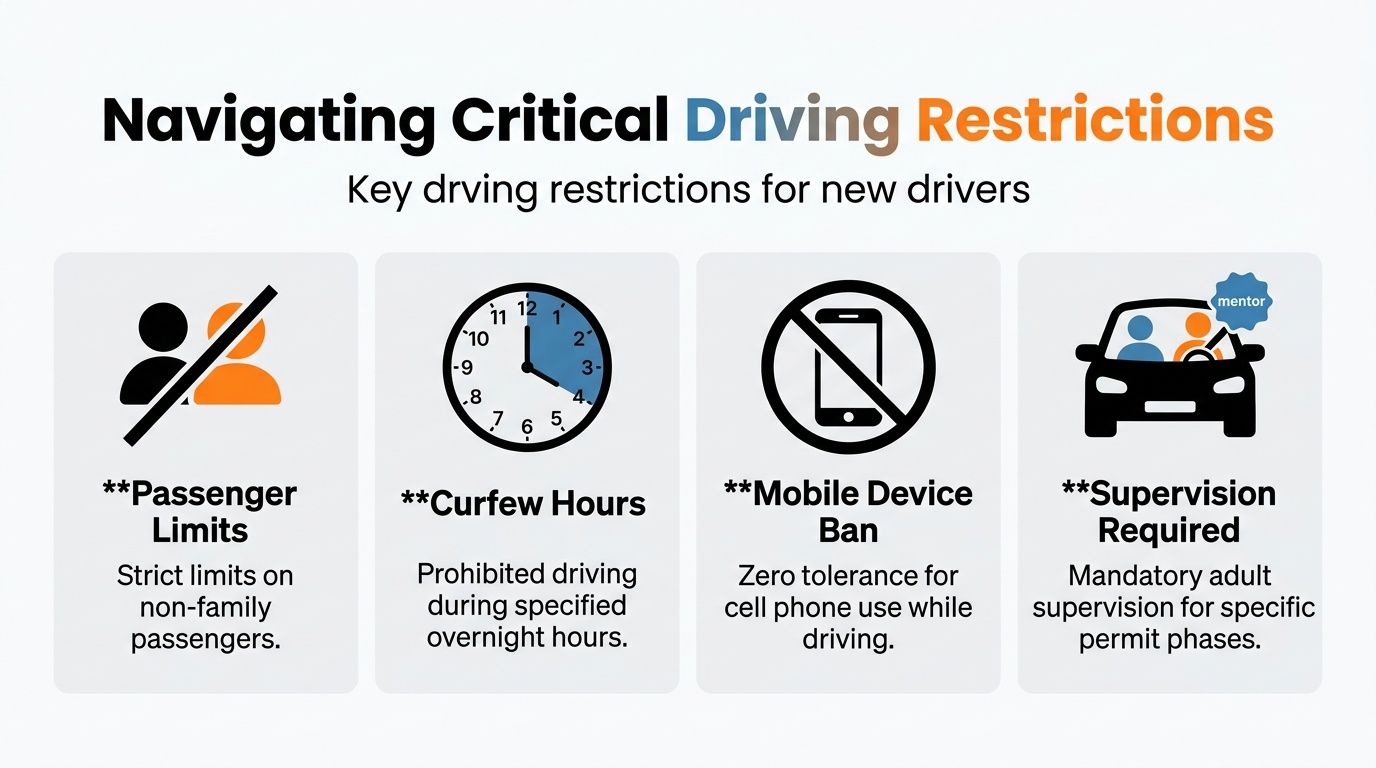
Night restrictions are about visibility and judgment
Darkness reduces what a driver can see and how quickly they can read the road. Road signs appear later. Pedestrians are harder to spot. Fatigue shows up faster.
Texas gives a clear example of how states respond to that risk. It enforces a curfew from midnight to 5 a.m. and limits passengers under 21 to one non-family member, directly targeting night driving and peer distraction, which together increase crash probability by 60%, according to the Texas teen driver education guide.
If you want a simple explanation of how these phases work, this guide to graduated driver licensing breaks down the logic well.
Passenger limits protect attention
A car full of friends changes the whole task of driving. The noise level rises. The urge to perform rises. The number of distractions rises.
A teen may believe they can “handle it” because the route is familiar. Familiar roads can create false confidence. Many mistakes happen not because a driver forgot a rule, but because they divided attention at the wrong time.
Here’s how to explain passenger limits to a new driver:
- One passenger still changes the environment: conversation competes with scanning and planning.
- Non-family passengers add social pressure: the driver may rush, joke, or take chances.
- Restrictions are temporary: they exist while the driver builds calm, repeatable habits.
A restricted license is still a license. It gives independence, but in a safer order.
Phone bans are simpler than students make them
This rule shouldn’t be negotiated. If the car is moving, the phone shouldn’t be part of the driver’s task.
That includes more than texting. Music changes, map fiddling, notifications, and quick glances all break concentration. New drivers need their eyes moving between the road, mirrors, speed, and possible hazards. They don’t have spare attention yet.
Mastering Essential Rules of the Road
Most new drivers can pass a quiz on signs and lane markings. The bigger challenge is applying rules in real time when several things happen at once.
That’s where the experience gap shows up. A student knows the rule in theory, but not how to judge timing, distance, and risk under pressure.
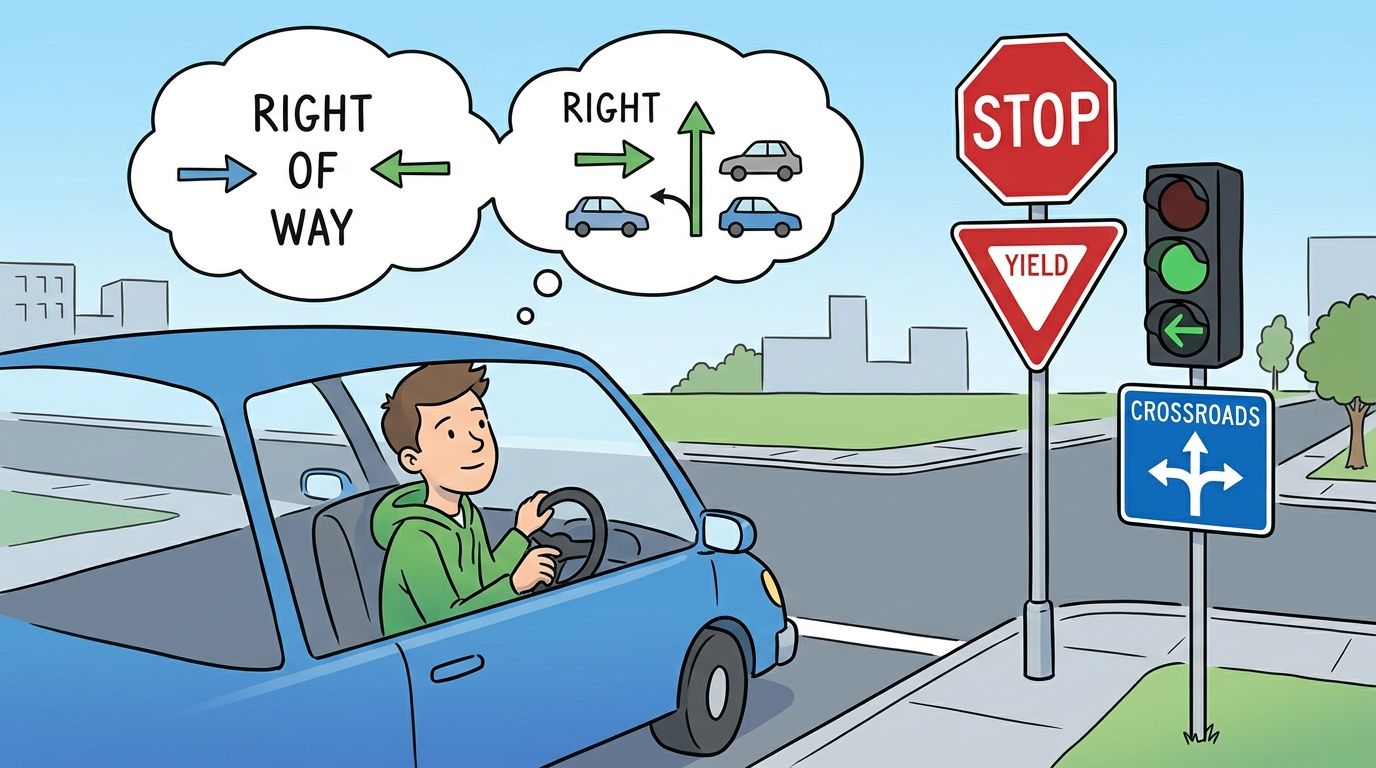
Intersections are where judgment gets tested
A four-way stop is manageable if everyone follows the pattern. The first vehicle to stop goes first. If two arrive together, the driver on the left yields to the driver on the right. A left-turning driver also yields to oncoming traffic that’s going straight.
Uncontrolled intersections are tougher because they don’t give much guidance in the moment. New drivers often understand who has the right-of-way but still misjudge whether the gap is safe.
Pennsylvania’s driver manual notes that drivers turning from minor roads to major roads should allow 8 to 9 seconds between themselves and approaching traffic, a concrete benchmark that many manuals leave too vague, as shown in this intersection guidance. That’s a useful example of why students need coached practice, not just memorized wording.
For a practical refresher on this topic, review these right-of-way rules at intersections.
Build a decision routine, not just a memory bank
When students get nervous, they need a sequence they can trust.
Try this at every complex intersection:
- Slow early: give your brain time before you need the answer.
- Scan left, front, right, then mirrors: don’t stare in one direction.
- Identify conflicts: who could cross your path, and how fast are they closing?
- Choose only when the gap is clearly safe: if you’re debating it, wait.
Waiting an extra moment is almost never the mistake. Rushing is.
Following distance, speed choice, and parking all work the same way
Each skill sounds separate, but they all depend on anticipation.
- Following distance: leave enough room so the car ahead doesn’t control your braking.
- Speed choice: drive for rain, glare, traffic, and visibility, not just the posted limit.
- Parking: set up early, move slowly, and correct without embarrassment.
Students often think good drivers make fast decisions. Good drivers usually make early decisions. That’s why they look smooth.
A visual walkthrough can help when a student is trying to connect these ideas to real road movement.
Avoiding Common New Driver Mistakes
Most beginner mistakes aren’t dramatic. They’re small habits repeated often enough to become dangerous.
Tailgating is a common example. A new driver may not feel aggressive. They may just be following the pace of traffic without realizing they’ve removed their margin for error.
The mistakes that lead to trouble fastest
These patterns deserve early correction:
- Driving too close: it shortens reaction time and turns a minor surprise into a hard brake.
- Letting distractions pile up: food, playlists, passengers, and notifications all take pieces of attention.
- Driving emotionally: irritation makes drivers rush yellow lights, block merges, or refuse to yield.
- Ignoring conditions: rain, glare, and heavy traffic demand a slower, more deliberate style.
Families can reinforce safer habits by using a simple pre-drive question: “What could go wrong on this trip?” That keeps the driver in a defensive mindset before the car even moves.
New drivers also need a plan for the unexpected
A nervous driver often gets into trouble after the first surprise, not during it. They tense up, overcorrect, or stare at the hazard.
Use calm scripts for unusual moments:
| Situation | Best first response |
|---|---|
| Emergency vehicle appears | stay calm, check surroundings, yield safely |
| Tire issue or blowout feeling | hold the wheel firmly and slow gradually |
| Missed turn | keep driving and reroute safely |
| Sudden weather change | reduce speed and increase following space |
The strongest defense is habit. A student who constantly scans ahead, checks mirrors, and leaves room around the car has more options when something unexpected happens.
For more practical help, these tips for first-time drivers are worth reviewing with both teens and parents.
Smooth, boring driving is good driving. The goal isn’t to look skilled. The goal is to stay in control.
Turn Your Knowledge Into Lifelong Safety
A driver doesn’t become safe by passing one test. Safety comes from repeating the right decisions until they become automatic.
That matters for first-time drivers, but it also matters for adults who already have a license. Some drivers need to satisfy a court requirement after a citation. Others want a refresher because their habits have slipped. Some are helping a teen and realize they need a clearer grasp of current rules themselves.
Formal instruction solves problems that self-study misses
Reading a handbook helps with terminology. It doesn’t always fix confusion under pressure.
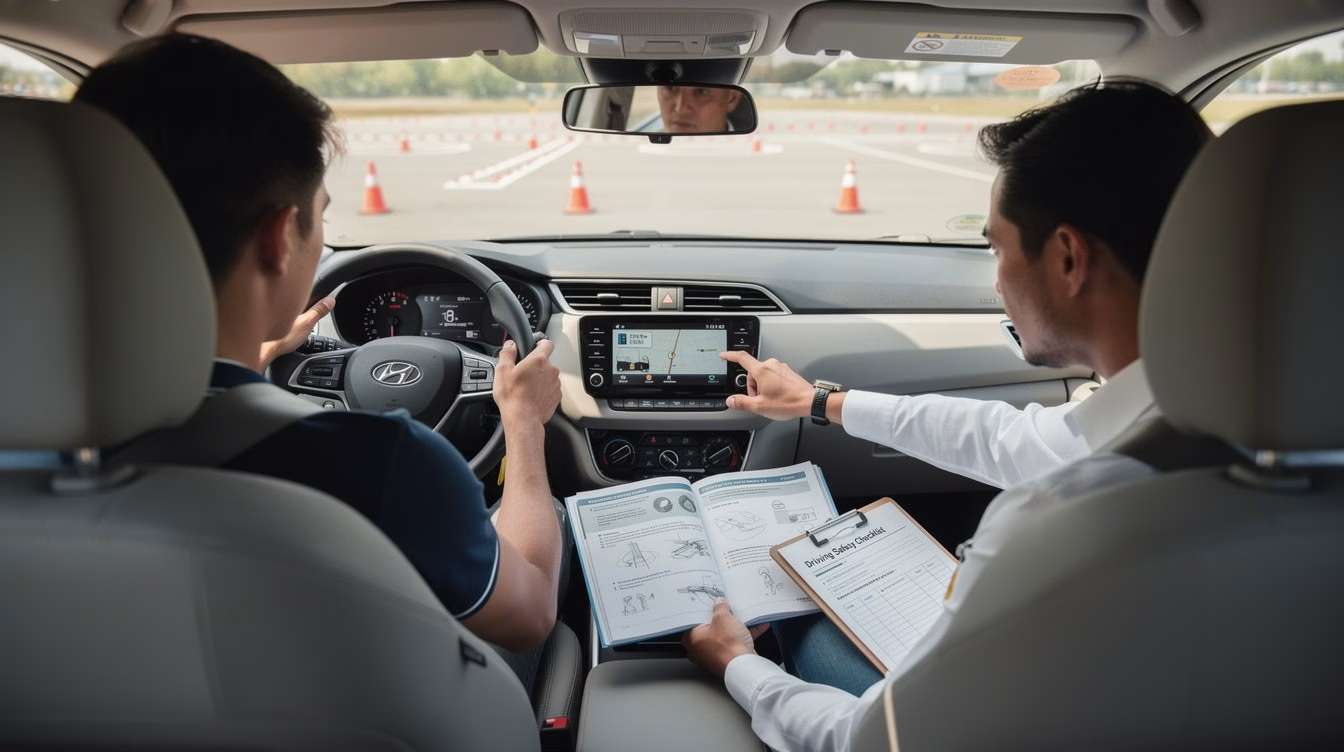
A structured course is useful because it organizes the material in the order drivers need it. Instead of random facts, students get a sequence: laws, hazard recognition, judgment, and defensive habits. That kind of structure is especially valuable when a family wants consistency between what a parent says and what the law requires.
Different drivers need different course types
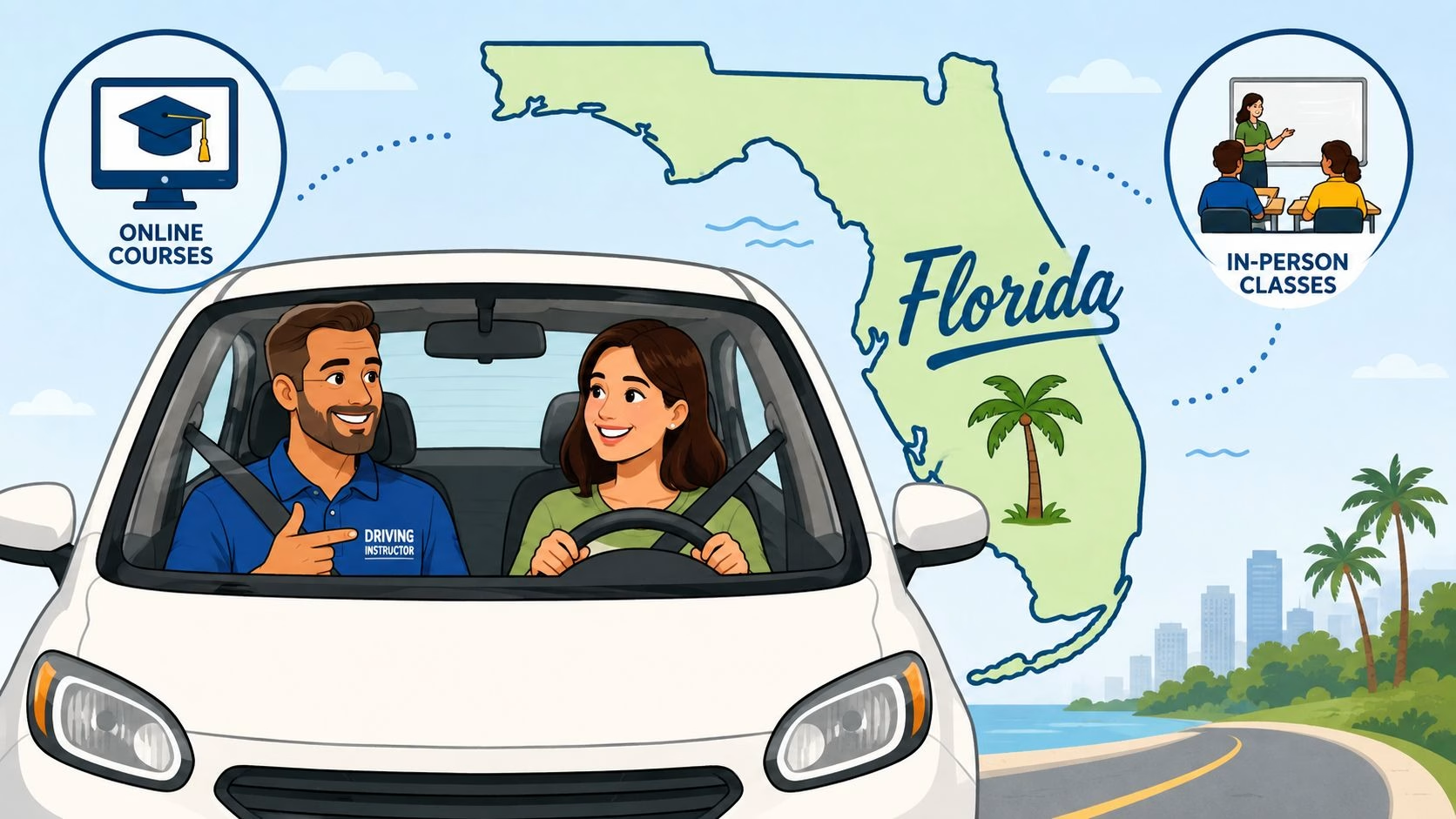
For drivers with a moving violation in Florida, the course category matters. The state-approved Basic Driver Improvement course is a 4-hour program designed for drivers who received a moving violation and need to meet court-ordered traffic school requirements to avoid points on their record.
That’s very different from beginner education for teens. New drivers need foundational instruction and guided repetition. Citation holders need corrective education focused on law, risk, and behavior.
Driver education also works best when it fits real life. Flexible online learning, multilingual access, and clear reporting make it easier for busy adults and families to complete what they need without delays.
Your Questions About New Driver Rules Answered
Can a new driver break the law even if they have a permit
Yes. A permit gives limited driving privileges, not full freedom.
If a permit holder drives outside the allowed conditions, they can face consequences just like any other driver. Parents should treat permit rules as strict operating conditions, not suggestions.
Why do states place so many restrictions on teens after they pass a test
Because passing a test doesn’t eliminate inexperience.
A new driver may have basic vehicle control but still need help with risk recognition, timing, and self-control in distracting situations. Restricted phases give them room to improve without facing every high-risk condition at once.
Is nighttime driving really that different from daytime driving
Yes. Night driving changes visibility, fatigue, and hazard detection.
A student who looks confident during the day may struggle more at night with glare, dark clothing, poorly lit roads, and late decisions. That’s why families should practice after sunset with calm coaching before independence expands.
Are passenger limits really necessary if the teen is responsible
Yes, because responsibility and attention aren’t the same thing.
Even a careful teen can become overloaded by conversation, noise, and social pressure in the car. Passenger limits reduce mental clutter during the period when focus is still fragile.
Should parents keep supervising after a teen gets a restricted license
Yes. Supervision should continue, just less constantly.
Ride along sometimes. Ask the driver to explain what they’re seeing and why they’re making each choice. That turns silent driving into active judgment practice.
What’s the best way to help a nervous new driver
Keep instructions short and specific.
Say “slow earlier,” “check left again,” or “wait for a better gap.” Don’t lecture in the middle of a turn. Correction works best when it’s calm, timely, and focused on one issue at a time.
Do adult first-time drivers need the same kind of training as teens
They need many of the same core skills, but usually with different emphasis.
Adults often learn faster on rules and slower on comfort, especially if they’re anxious. They benefit from the same fundamentals: scanning, gap judgment, parking, lane changes, and defensive habits.
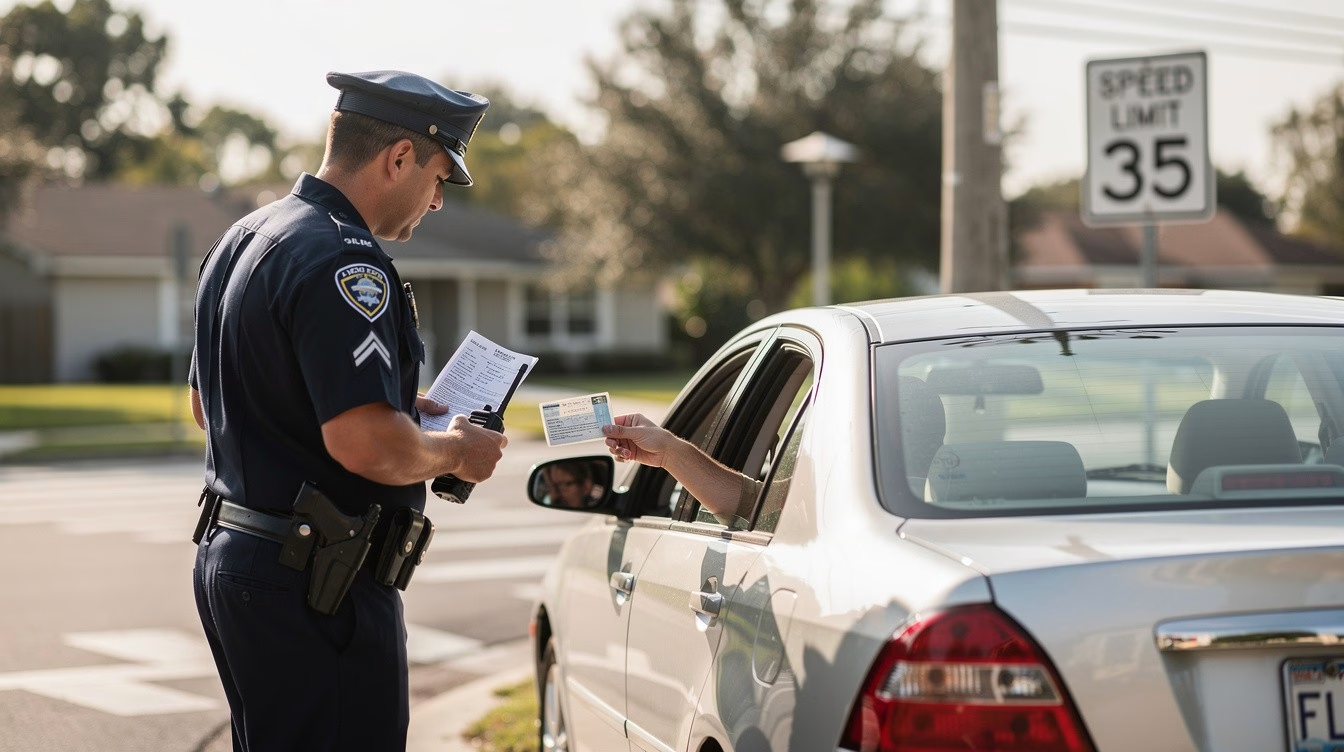
What should a driver do right after getting a ticket in Florida
First, read the citation carefully and confirm what response options apply.
If traffic school is allowed, many drivers choose it to protect their record. In Florida, a driver improvement course can also reduce the civil fine on a citation by up to 18 percent.
Are there new education requirements for some Florida teens
Yes. Starting August 1, 2025, first-time driver’s license applicants in Florida who are under 18 must complete a 6-hour Driver Education Traffic Safety course before they’re eligible for a license.
Families should check current requirements early so there’s no surprise late in the process. Waiting until the road test stage is too late.
What if a driver has repeated collisions
Florida may require a longer improvement course in some cases.
Drivers convicted of three collisions within a three-year period must complete a specific 8-hour Driver Improvement course to satisfy DMV requirements for license reinstatement or to avoid further penalties.
If you’re ready to turn these rules into confident habits, BDISchool is a smart next step. Its state-approved online courses help new drivers, citation holders, and families get clear instruction, flexible access, and practical training that supports safer decisions on the road.