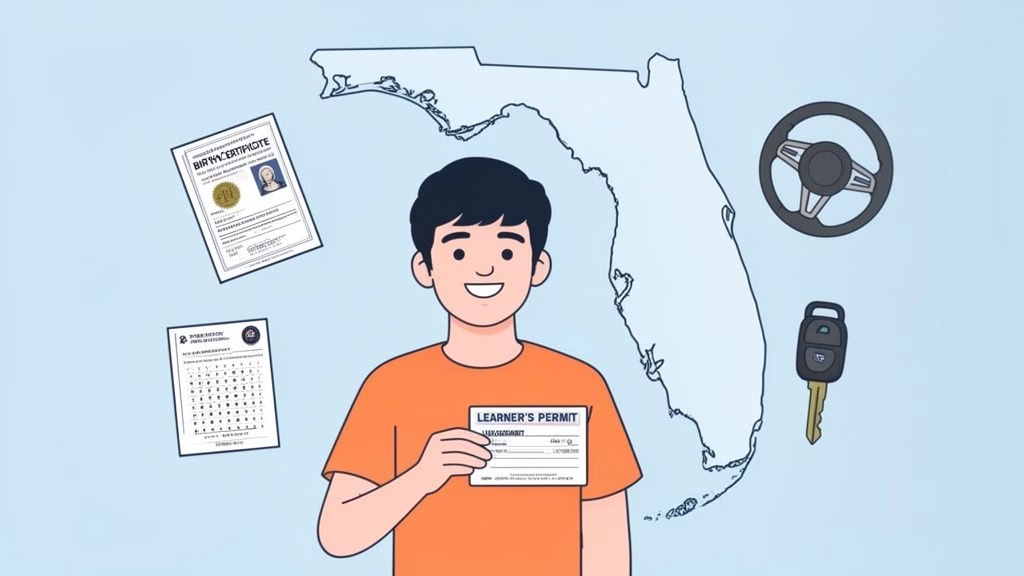
Getting your driver's permit is a huge first step toward independence. It's an exciting time, but the process can feel a bit overwhelming at first. You'll need to make sure you're eligible, gather the right paperwork, take a required course, and pass a couple of tests.
Think of it as your personal roadmap for navigating the Florida Highway Safety and Motor Vehicles (FLHSMV) system and getting on the road.
Starting Your Journey to Driving Freedom
Earning that first permit is a major milestone. It’s the moment the dream of driving starts to feel real. But between state regulations, paperwork, and tests, it's easy to get confused. This guide is here to clear things up and give you the confidence you need. We'll walk you through the entire journey, from figuring out Florida's eligibility rules to acing the written exam.
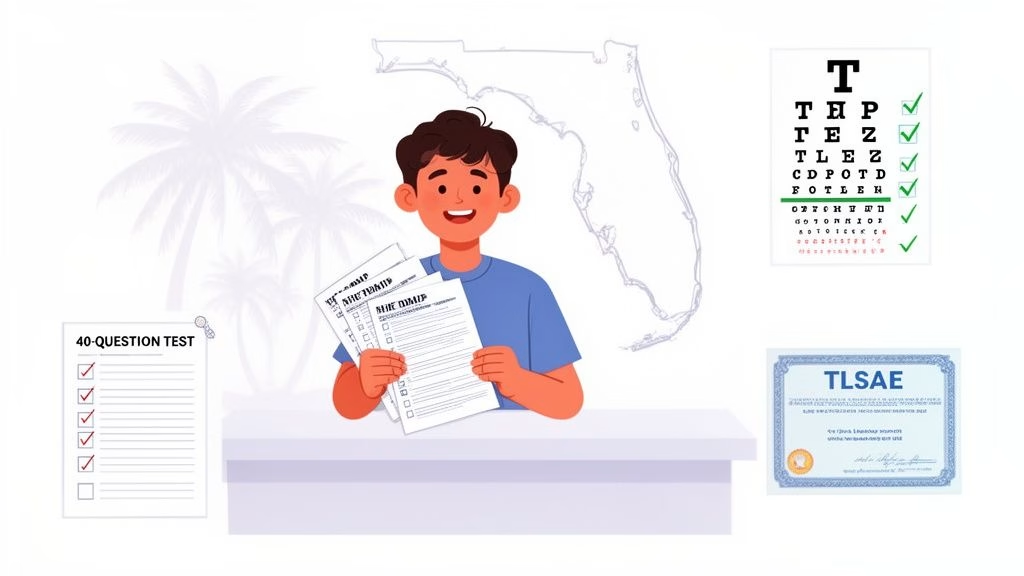
This visual breaks down the core process into three simple stages: Learn, Pass, and Drive.
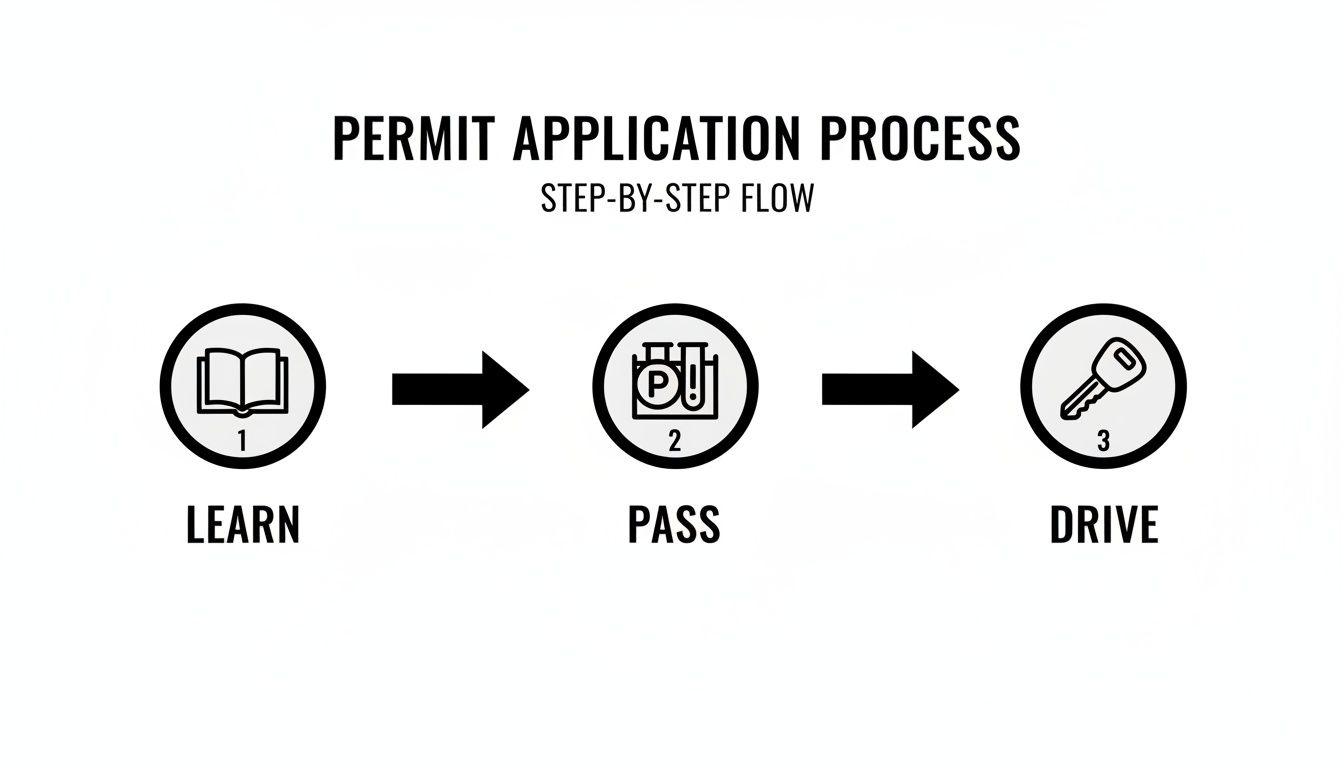
As you can see, success comes from following a logical path: get the knowledge, pass the tests, and then start practicing.
What to Expect on Your Path to the Permit
Getting your permit is more than just a quick trip to the DMV. It takes some preparation, and you have to meet some very specific state requirements.
For instance, all Florida teens must complete a state-approved Traffic Law and Substance Abuse Education (TLSAE) course before they can even take the permit test. The good news is that modern online options make this super convenient, letting you learn at your own pace from home.
Getting a learner's permit is the essential first step for millions of teens. In fact, the number of licensed drivers in the U.S. is projected to hit 242,293,175 by 2025, which shows just how vital this rite of passage is. In Florida, the rules are clear: you have to be at least 15 years old, complete the TLSAE course, and pass your knowledge exam. Once you have that permit, you'll need to log at least 50 hours of supervised driving before you can even think about getting your intermediate license.
Your permit isn't just a piece of plastic; it's a commitment to learning the rules of the road and developing safe habits that will last a lifetime. Mastering the information in the official handbook is your first, most important step.
Before you start cramming with practice tests, it's a smart move to really get to know the source material. A great place to start is our guide on the Florida driver's manual.
Are You Ready? Confirming Your Eligibility for a Florida Permit
Before you even think about digging through drawers for your birth certificate, the very first step is making sure you actually qualify for a learner's permit in Florida. Getting this right from the jump saves you a ton of headaches and prevents a wasted trip to the driver's license office. It's all about being prepared.
Let's start with the most basic requirement: your age.
In Florida, you absolutely must be at least 15 years old to apply. There's no wiggle room here—if you're 14 and counting down the days, you'll have to be patient. This rule is in place to ensure you have a certain level of maturity before you start getting behind the wheel.
To make it even easier, here's a quick checklist you can use to see where you stand.
Florida Learner's Permit Eligibility Checklist
Use this checklist to quickly confirm you meet all state requirements before you start your application.
| Requirement | Details and Key Information |
|---|---|
| Minimum Age | You must be at least 15 years old. No exceptions. |
| Parental Consent | If you're under 18, a parent or legal guardian must sign the consent form. This is usually done in person at the FLHSMV office. |
| TLSAE Course | All first-time drivers must pass the Traffic Law and Substance Abuse Education (TLSAE) course. This is a 4-hour course covering drugs, alcohol, and traffic laws. |
| Vision Screening | You must pass a vision test at the FLHSMV with at least 20/40 vision in one or both eyes (with or without corrective lenses). |
| Hearing Screening | You must pass a basic hearing test to ensure you can hear important sounds like sirens and horns on the road. |
This table gives you a bird's-eye view, but let's dive into a few of these requirements that often trip people up.
The Course and Consent Requirements
If you're under 18, two things are non-negotiable: you need a parent's permission, and you need to complete a specific course.
A parent or legal guardian has to sign a consent form, which officially puts them on the hook financially for your driving. It’s a serious step that really highlights the responsibility you're both taking on.
More importantly, every single first-time driver in Florida—no matter their age—has to complete the Traffic Law and Substance Abuse Education (TLSAE) course. You can think of this as Driver's Ed 101. It’s designed to drill in the essentials before you ever turn the key. The course covers critical topics like:
- How alcohol and drugs seriously impair your ability to drive safely.
- The specific traffic laws and road signs you'll see every day in Florida.
- The real-world consequences of taking risks behind the wheel.
Key Takeaway: Finishing the TLSAE course isn't just about checking a box on a form. It's a mandatory prerequisite that builds a critical foundation of safety awareness before you even start practicing.
The good news? You don't have to sit in a stuffy classroom anymore. These days, plenty of state-approved online courses let you knock out the TLSAE requirement from home, on your own schedule. If you're looking for a flexible program, you can learn more about driver's education in Florida and find one that fits your life.
Meeting the Health Standards
Finally, you’ll have to pass a couple of quick but crucial health screenings when you get to the FLHSMV office: a vision test and a hearing test.
For the vision part, you’ll need to prove you have 20/40 vision or better in at least one eye. If you wear glasses or contacts, don't forget to bring them! This is a common mistake that can send you home without a permit.
The hearing test is simple—it’s just to make sure you can hear important roadway sounds like another car’s horn or an approaching ambulance. These checks are just a final confirmation that every new driver can safely perceive their surroundings, keeping themselves and everyone else on the road safe.
Getting Your Paperwork in Order
Let's be honest—dealing with paperwork is probably the least exciting part of getting your driver's permit. But trust me, showing up at the Florida Highway Safety and Motor Vehicles (FLHSMV) office without the right documents is a surefire way to get sent home empty-handed. I've seen it happen countless times.
To make sure that doesn't happen to you, let's break down exactly what you need. Think of it less like a chore and more like a scavenger hunt for your ticket to the open road.
Florida is a REAL ID state, which is a federal standard for identification. This means the state has strict rules about the documents you need to present to prove who you are and where you live. Getting this right from the start is crucial.
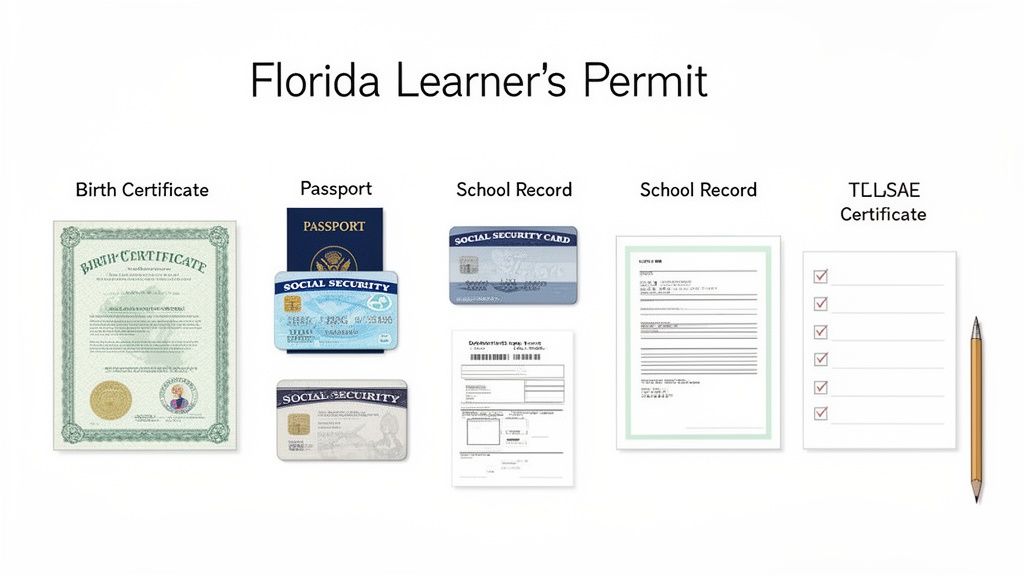
Proof of Identity and Your Social Security Number
First things first, you have to prove your legal identity. This isn't the time for photocopies or digital versions; you'll need the real deal—an original or certified copy of one of these primary documents.
- U.S. Birth Certificate: It has to be an original or a certified copy issued by a vital statistics office. Hospital birth certificates won't work.
- Valid U.S. Passport or Passport Card: Make sure it's not expired!
- Certificate of Naturalization or Citizenship: If you became a citizen, this is your golden ticket.
Next up is your Social Security Number (SSN). The easiest path is to bring your original Social Security card. If you've misplaced it (which happens to the best of us), a W-2 form, a pay stub showing your full SSN, or a 1099 form will also work.
Here’s a critical piece of advice: the name on your SSN document must perfectly match the name on your birth certificate or passport. A missing middle initial or a slight misspelling can bring the whole process to a screeching halt.
Pro Tip: If your name has changed for any reason (marriage, divorce, etc.), you absolutely must bring the official documents that show the link between your birth name and your current legal name. This means bringing the original marriage certificate or court order.
Proving You're a Florida Resident
Finally, you need to prove you actually live in Florida. This requires two separate documents that show your current residential address. This is often a snag for teens since most don't have utility bills or bank statements in their own names.
Thankfully, the FLHSMV has options specifically for minors. Here's what you can use:
- School Records: A recent transcript or report card from your current school year usually does the trick.
- Official Mail: Any mail you've received from a government agency (federal, state, county, or city) works.
- A Parent's Proof: Your parent or guardian can use their own proof of address (like a utility bill or lease) and simply sign a form at the FLHSMV office certifying that you live with them.
It's interesting how much things have changed. Back in 1983, over 80% of 18-year-olds had their driver's license. Fast forward to 2018, and that figure has dropped to just 61%. With the rise of ridesharing and stricter licensing requirements, getting a license isn't the automatic rite of passage it once was.
This shift means more 15-year-olds in Florida are getting a smart start by enrolling in approved programs like BDISchool to knock out their requirements early. Plus, with REAL ID permits becoming mandatory for domestic flights after May 7, 2025, getting your documents right the first time is more important than ever. If you're curious, you can find more data on driver licensing trends and see just how much the numbers have evolved over time.
Passing the Knowledge and Vision Tests
Alright, you've gathered all your paperwork. Now it's time for the main event at the FLHSMV office: the tests. You’ll face two hurdles: the Class E Knowledge Exam and a quick vision screening. They might sound a little nerve-wracking, but with the right preparation, you'll walk in confident and walk out with your permit.
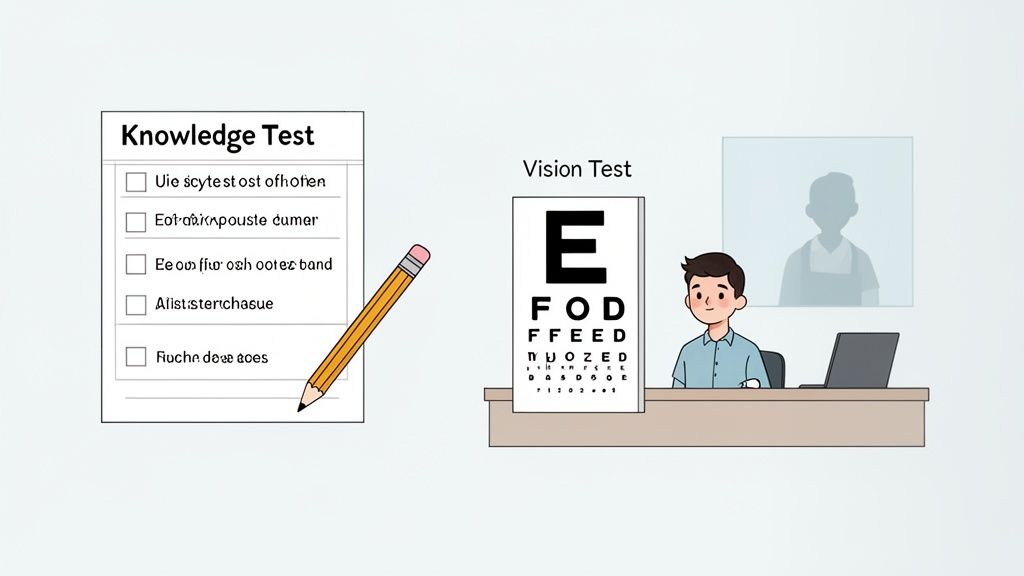
The knowledge exam is where you prove you know the rules of the road. In Florida, it’s a 50 multiple-choice question test covering everything from traffic laws to road signs. To pass, you need to get at least 40 questions right, which comes out to an 80% score.
Trust me, just flipping through the driver's handbook once isn't the best way to prepare. The most effective strategy is to actively test yourself and figure out what you don't know before the real exam does it for you.
Strategies for Acing the Knowledge Exam
Think of your study sessions as training, not just reading. The goal is to truly understand the why behind the rules, not just memorize a bunch of facts. This is where a good study plan can make all the difference.
Taking an online Florida driver's license practice test is one of the smartest things you can do. It’s like a dress rehearsal for the real thing. You get a feel for the question format and, more importantly, you can pinpoint your weak spots immediately.
For instance, you might fly through the road sign questions but get tripped up by the ones on following distances or what to do when an emergency vehicle approaches. That’s valuable intel! It tells you exactly where to focus your study time.
The real objective here isn't just to score an 80%. It's to build a strong foundation of knowledge that will help you make safe, split-second decisions when you're actually behind the wheel.
Find the most effective study method for your learning style to ensure you're ready for the knowledge exam.
Comparing Permit Test Study Methods
| Study Method | Effectiveness | Pros | Cons |
|---|---|---|---|
| Reading the Handbook | Low to Moderate | Free, comprehensive information. | Passive, can be dry, hard to retain. |
| Flashcards | Moderate | Good for memorizing signs and specific rules. | Lacks context for real-world scenarios. |
| Practice Tests | High | Simulates the real exam, identifies weak areas. | May not provide in-depth explanations. |
| Online Courses | Very High | Structured, interactive, combines lessons with quizzes. | Typically has a cost associated with it. |
Ultimately, a mix of methods is often best. Use an online course or the handbook to learn the material, then hammer it home with practice tests until you're consistently scoring well above the passing mark.
Understanding the Vision Screening
Alongside the written test, you'll do a simple vision screening. Don't worry, it's not a full-blown eye exam. It’s just a quick check to make sure you can see well enough to drive safely.
Florida requires you to have at least 20/40 vision in either one or both eyes. This can be with or without your glasses or contact lenses.
Speaking of which, if you wear corrective lenses, please remember to bring them. It's such a common and frustrating mistake. Showing up without your glasses or contacts is an automatic fail, and you'll have to make another trip to the DMV. The test itself is straightforward—you’ll look into a machine and read a few lines of letters.
It can be helpful to know the basics of sight standards, like what 20/20 vision means, just so you feel more prepared. Once you clear both the knowledge and vision tests, you've done it! You’ll officially be a permit holder, ready to start practicing on the road.
Your FLHSMV Appointment and What Comes Next
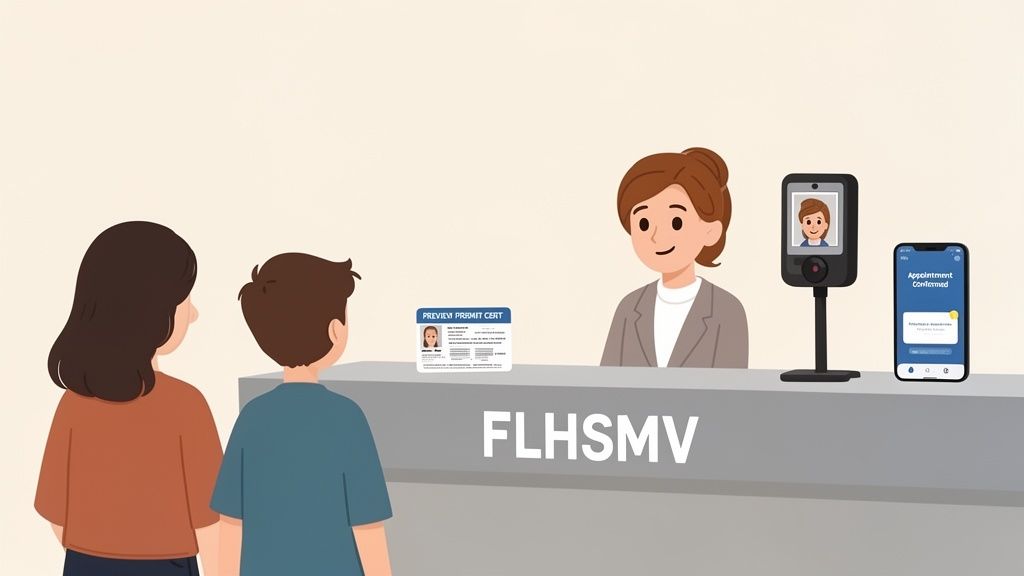
You've gathered your documents and passed the knowledge test—fantastic! The final hurdle is your in-person visit to a Florida Highway Safety and Motor Vehicles (FLHSMV) office. My advice? Book this appointment online, well in advance. Trying to walk in can mean hours of waiting, and you've got better things to do. This is the moment it all becomes real.
When appointment day arrives, you’ll hand over that neat stack of paperwork you collected. A DMV agent will go through everything, take your photo for the permit itself, and collect the fees. This is also when your parent or guardian signs the consent form right there in front of the agent, making it all official.
You Passed! (Now What?)
Once the agent gives you the nod and hands over your learner's permit, take a second to soak it in. This is a huge step toward independence, and you've earned it! But keep in mind, this new freedom comes with some very serious responsibilities and rules you have to follow to the letter.
A learner's permit isn't a free pass to drive wherever you want. It’s a specific learning period with restrictions in place to keep you—and everyone else on the road—safe while you build experience. Think of these rules less as limitations and more as guardrails for your behind-the-wheel training.
Key Takeaway: Your learner's permit is your license to practice driving under strict supervision. The whole point is to build real-world skills in a controlled, low-risk environment before you even think about driving solo.
The Rules of the Road for Permit Holders
Knowing these rules is just as critical as learning how to merge onto a highway. If you ignore them, you could delay getting your actual license or even have your permit suspended.
Here’s the breakdown of what you absolutely need to know:
- Always Have a Licensed Supervisor: This is non-negotiable. You must always have a licensed driver who is at least 21 years old sitting in the front passenger seat.
- Daylight Driving First: For the first three months you have your permit, you can only drive during daylight hours.
- Nighttime Curfew: After those initial three months, you can extend your driving time until 10:00 PM. That supervisor still needs to be right there next to you.
- No Phones, Period: Florida has a zero-tolerance policy for this. Drivers with a learner's permit are strictly prohibited from using any handheld wireless device while behind the wheel.
These laws are part of Florida’s graduated licensing system, a safety-focused approach used worldwide. While specifics can vary, the core idea is the same. International standards, like the 1949 Geneva Convention, help align driving credentials across borders, with many of the 102 signatory countries having similar phased-in driving privileges. To get ready for what comes next, check out our guide on how to prepare for your driving test.
Following these rules is the foundation for logging your required 50 hours of supervised driving practice, with 10 of those hours at night. Hitting that goal is your next major milestone on the road to getting your intermediate driver's license.
Got Questions About the Florida Driver's Permit?
Even with the clearest instructions, getting a permit can feel a little confusing. A lot of parents and teens run into the same little uncertainties along the way, so we’ve gathered some of the most common questions we hear.
Think of this as your go-to spot for those "what if?" moments. Getting these details straight will make the whole process feel much smoother.
Can I Take the Florida Permit Test Online?
Yes, you can—and it’s a game-changer for many teens! If you're under 18, Florida lets you take the official Class E Knowledge Exam online through a state-approved provider. This is a fantastic option because you can take the test from the comfort of your own home, where you’re likely to feel more relaxed and focused.
Just keep in mind, taking the test online doesn't mean you get to skip the trip to the driver's license office. You'll still have to make an appointment at an FLHSMV location to turn in your paperwork, pass the vision test, get your picture taken, and be issued your physical learner's permit.
Heads Up: This online option is only for first-timers under 18. If you've already taken the test in person and didn't pass, you'll have to retake it at an FLHSMV office.
What Happens If I Fail the Permit Test?
First things first: don't sweat it. It's more common than you think, and it's definitely not the end of the road. If you don't pass the knowledge test on your first attempt, you can absolutely take it again. There’s a small fee for the re-test, but you can usually give it another shot as soon as the next day.
My advice? Don't rush right back in. Take a breath and use it as a chance to zero in on what you need to study. Your test results usually give you a clue about which areas gave you trouble. Go back to those specific sections in the Florida Driver's Handbook and hit the books. Firing up a few online practice tests is also a great way to drill the material until it sticks.
How Long Is a Florida Learner's Permit Valid?
Your Florida learner’s permit is good for exactly one year from the day it's issued. This isn't just a random timeframe; it’s a key part of Florida's Graduated Driver Licensing (GDL) program, designed to give you plenty of supervised practice.
To move on and get your intermediate driver's license, you have to hold that permit for the full 12 months without getting any traffic tickets. If your permit expires before you've upgraded, you'll unfortunately have to go back to square one—that means retaking the tests and paying the fees all over again.
What Do My Parents Need to Sign My Application?
When you head to the FLHSMV office, your parent or legal guardian isn't just your ride. They have an official job to do: signing the parental consent form right there in front of the clerk.
To do this, they’ll need to prove who they are. This usually means presenting their own valid Florida driver's license or ID card. To avoid any hiccups, it’s smart to double-check the official FLHSMV website for the latest list of acceptable IDs before you go. A little prep can save you a big headache.
Ready to get started with a trusted, state-approved provider? At BDISchool, we offer the online TLSAE course and permit test prep you need to succeed. Enroll today and get one step closer to driving freedom!

![Teen Driver Licensing Requirements in Florida [2026]](https://drivereducators.com/wp-content/uploads/emplibot/florida-license-requirements-hero-1773544196.avif)