Let's be honest, staring down the Florida DMV exam can be a little intimidating. But here's the good news: the single best tool you can have in your corner is a good drivers license practice test. Think of it less like a quiz and more like a full-on dress rehearsal for the real thing. It shifts your prep from just passively reading to actively solving the kinds of problems you'll actually face.
Why a Practice Test Is Your Secret Weapon for the DMV Exam
You wouldn't run a marathon without ever having run a few practice miles, right? You might know the general route, but you'd have no idea about the tough hills or how to pace yourself. A practice test does the exact same thing for your DMV exam. It simulates the real experience, building your mental muscle and showing you exactly where you might stumble before it actually matters.
This isn't just about the questions, either. It’s about getting comfortable with the format, the specific way questions are worded, and the time pressure. Each time you take a practice run, the real exam feels a little less daunting.
The table below breaks down the key advantages you'll gain from making practice tests a central part of your study plan.
How a Practice Test Sets You Up for Success
| Advantage | How It Helps You Pass |
|---|---|
| Realistic Simulation | You get used to the question format, wording, and time limits of the actual Florida DMV test. No surprises on exam day! |
| Confidence Booster | Familiarity breeds confidence. Knowing what to expect eliminates test-day jitters and helps you think clearly under pressure. |
| Identifies Weak Spots | Instantly reveals which topics (like road signs or right-of-way rules) you need to review, saving you time. |
| Active Recall | Instead of just reading the handbook, you're forced to actively remember and apply the information, which makes it stick. |
Essentially, a practice test closes the gap between simply knowing the rules and being able to apply them correctly when it counts.
Build Confidence and Reduce Test-Day Anxiety
Believe it or not, one of the biggest reasons people fail the written exam isn't a lack of knowledge—it's anxiety. The pressure of the official testing environment can make you second-guess answers you absolutely know. A drivers license practice test completely demystifies the whole process.
When you repeatedly tackle the material in a setting that mirrors the real test, you're replacing that fear of the unknown with a feeling of familiarity. That confidence is everything. It lets you walk into the DMV, stay focused, and show them what you know.
A practice test is the bridge between reading the driver's handbook and successfully applying that knowledge under pressure. It turns passive learning into active, confident recall.
Pinpoint and Strengthen Your Weak Areas
Trying to memorize the entire Florida driver's handbook is a huge task. A practice test works like a diagnostic tool, showing you precisely which sections need a little more of your attention.
The best part is the instant feedback. Did you get tripped up by the questions on road signs? Were the rules about right-of-way a bit fuzzy? This targeted insight helps you study smarter, not harder. You can zero in on what you don't know instead of rereading chapters you've already got down cold.
- Identify Knowledge Gaps: Instantly see which traffic laws, signals, or parking rules you haven't quite mastered.
- Reinforce Learning: Going over your wrong answers is one of the best ways to lock the correct information into your memory.
- Track Your Progress: Seeing your scores go up over time is a huge motivator and a clear sign that you're getting ready for the real deal.
And it’s a big deal. The number of drivers on the road is always climbing. In the U.S. alone, the number of licensed drivers is expected to hit 242,293,000 in 2025, a massive increase from 210 million back in 2010. With so many drivers, effective preparation is key to keeping everyone safe.
By taking a practice-first approach, you're setting yourself up for success just like countless others have. You can also round out your studies by checking out our free drivers training online resources.
Cracking the Code of the Florida DMV Written Exam
Walking into the DMV for your written exam can be intimidating, but it doesn't have to be. The key to feeling confident is knowing exactly what you’re up against. Think of it like a coach handing you the other team's playbook before a big game. When you know the format, the rules, and the most common questions, you gain a massive advantage.
Understanding the exam’s structure gets rid of the element of surprise—a huge source of test-day jitters. This inside knowledge lets you focus your study time on what really matters. A good driver's license practice test is built around this exact blueprint, making it one of the most powerful tools in your arsenal.
The Exam Structure in a Nutshell
The Florida DMV written test isn't designed to trip you up, but it is comprehensive. It’s a multiple-choice exam that pulls its questions straight from the Official Florida Driver License Handbook. Your job is to show that you have the essential knowledge to be a safe, responsible driver.
Here’s the breakdown you need to burn into your memory:
- Total Questions: You’ll face 50 multiple-choice questions.
- Passing Score: You need to get at least 40 questions right, which is an 80% score.
- Time Limit: You have 60 minutes to finish the whole thing.
That gives you a little over a minute per question. While that might sound like a lot of time, some questions really make you think. This is where practice becomes so important—it helps you build up both your speed and your accuracy.
The Two Halves of the Test
Those 50 questions aren't just picked at random. They are pulled from two core categories to make sure every new driver understands the full picture of road safety. In fact, the test is split perfectly down the middle.
You will get 25 questions on road signs and another 25 questions on Florida's traffic laws and rules of the road. You absolutely have to master both sections to pass.
This even split is critical. You can't just be an expert on traffic laws and hope for the best on road signs (or the other way around). A weak performance in one area can easily sink your score below that crucial 80% mark.
Let's dig into what each of these categories covers.
Reading the Signs
This half of the test is all about your ability to recognize and understand the hundreds of signs you'll see on Florida's roads. It goes way beyond just knowing what a stop sign looks like. You'll need to know the difference between:
- Warning Signs: These are usually yellow and diamond-shaped. They give you a heads-up about potential dangers, like a sharp curve, a deer crossing, or a slippery road ahead.
- Regulatory Signs: These signs, like speed limit signs or "No U-Turn" signs, tell you the law. Ignoring them can get you a ticket.
- Guide Signs: These are your navigational signs. They include highway markers, signs for upcoming exits, and information about nearby gas stations or hospitals.
Knowing the Rules of the Road
The other 25 questions focus on Florida's specific traffic laws. This is where you prove you know how to handle your vehicle safely and legally in all kinds of situations. Be prepared for questions about:
- Right-of-Way: Who has to yield at a four-way stop? Who goes first when lanes merge? These scenarios are a huge part of driving safely.
- Speed Limits: You’ll need to know the standard speed limits for different zones, like school zones, business districts, and rural highways.
- Parking Rules: Questions about where you can and cannot legally park—like near a fire hydrant or on a crosswalk—are very common.
- Impaired Driving: You must know the legal Blood Alcohol Content (BAC) limit and the serious penalties for driving under the influence.
All of this information is in the official handbook, but let's be honest, it can be a pretty dense read. A high-quality drivers license practice test cuts through the clutter, pulling out the most important concepts and quizzing you in the exact same format as the real exam. To see how these topics come together, you can learn more about the Florida permit test and get a head start on your prep.
Getting Familiar With the Questions You'll Actually See on the Test
Reading the driver's handbook is a must, but let's be honest—theory only gets you so far. The real challenge comes when you have to apply those rules to the tricky, specific scenarios the Florida DMV loves to throw at you. This is exactly where a good drivers license practice test becomes your secret weapon, moving you from just reading the material to actually solving problems.
To give you a real feel for it, we’ve pulled a few sample questions that are just like what you'll face on the real exam. We’re not just going to give you the answers, though. We’ll walk through the logic behind each one, because understanding why an answer is correct is the key to truly knowing your stuff.
Sample Question 1: Road Signs
Question: You see a solid yellow line on your side of the center line. What does this mean?
A) You are in a passing zone.
B) You may pass if the way is clear.
C) You may not pass.
D) You are approaching a school zone.
Correct Answer: C) You may not pass.
Explanation: This is one of those fundamental rules of the road that you are almost guaranteed to see on the test. Think of pavement markings as a silent language every driver needs to speak fluently. A solid yellow line on your side of the road is a strict command: do not pass. It's there for a reason—it means passing is unsafe due to things like oncoming traffic, hills, or curves. A broken yellow line, on the other hand, is the signal that passing is allowed when it's safe.
Sample Question 2: Right of Way
Question: Two cars arrive at a four-way stop at the same time. Car A is going straight, and Car B is to its right, also going straight. Who has the right-of-way?
A) Car A, because it arrived first.
B) Car B, because it is to the right.
C) The car that signals first.
D) Both cars can proceed at the same time.
Correct Answer: B) Car B, because it is to the right.
Explanation: Right-of-way rules are what keep intersections from turning into total chaos. At a four-way stop, if two cars get there simultaneously, the rule is simple: the driver on the left yields to the driver on the right. In this case, that means Car B gets to go first. The question specifically says they arrived at the same time, so option A is out. This "yield to the right" rule is a big one.
Getting questions like the four-way stop right isn't just about memorizing a rule; it's about building an instinct. Practice questions force you to visualize these moments until the correct action becomes second nature.
Sample Question 3: Impaired Driving Laws
Question: In Florida, a driver under the age of 21 is considered to be driving under the influence (DUI) if their Blood Alcohol Content (BAC) is at or above what level?
A) 0.08%
B) 0.05%
C) 0.02%
D) Any detectable amount.
Correct Answer: C) 0.02%
Explanation: Florida has a "Zero Tolerance" policy for underage drinking and driving, but the legal limit isn't technically zero. For any driver under 21, having a BAC of 0.02% or higher triggers an automatic license suspension. This is a much stricter standard than the 0.08% limit for drivers 21 and over. The DMV wants to make absolutely sure that new drivers understand the serious consequences of getting behind the wheel after drinking.
Sample Question 4: Traffic Signals
Question: You are approaching an intersection and the traffic light is a flashing yellow arrow. What should you do?
A) Stop completely before proceeding.
B) Proceed with caution, as the light is about to turn red.
C) Yield to oncoming traffic and pedestrians, then proceed with caution.
D) The flashing arrow is for oncoming traffic only.
Correct Answer: C) Yield to oncoming traffic and pedestrians, then proceed with caution.
Explanation: The flashing yellow arrow can be a little confusing for new drivers. It doesn't mean stop—that’s what a flashing red light is for. Instead, it means you can make the turn, but only after you yield to any oncoming cars and pedestrians. Think of it as a "Yield" sign. You have to be absolutely sure the coast is clear before you make your move.
Sample Question 5: Parking Regulations
Question: It is illegal to park your vehicle within how many feet of a fire hydrant in Florida?
A) 10 feet
B) 15 feet
C) 20 feet
D) 30 feet
Correct Answer: B) 15 feet
Explanation: Parking rules are a favorite source for test questions because they're also a common source of real-world parking tickets. In Florida, you must park more than 15 feet from a fire hydrant. This rule isn't random; it ensures that fire trucks and other emergency vehicles have plenty of room to connect their hoses. You'll need to memorize specific distances like this for hydrants, crosswalks, and intersections to pass the exam. All these little details are laid out in the state handbook, which you can review by checking out the Florida drivers manual.
Working through questions like these is hands-down the best way to get ready. It takes the abstract rules from the handbook and turns them into concrete decisions, building the kind of quick, accurate judgment you’ll need for the test and for a lifetime of safe driving.
Your Actionable Two-Week Study Plan for Passing
Staring at the Florida driver's handbook can feel a bit like looking at a mountain you're supposed to climb in a day. It's totally normal to feel overwhelmed. But the secret isn't to cram everything at once. It’s about breaking that mountain down into a series of small, manageable hills.
Think of the next two weeks as your personal training program for the DMV exam. Week one is all about building a solid foundation of knowledge from the handbook. Week two is where you apply that knowledge, using a driver's license practice test to sharpen your instincts and get you ready for the real deal. If you want to get technical, the best study plans follow the same principles as those used to how to write a curriculum.
Week One: Building Your Knowledge Base
The first week is dedicated to really absorbing the material. Don't just skim the chapters; get in there and engage with the content. Take notes, highlight the important rules, and make sure you truly get the "why" behind a rule before moving on. Spreading the learning out like this helps you avoid burnout and actually remember what you've studied.
Week 1 Daily Breakdown:
- Days 1 & 2: Traffic Signs and Signals. This is a huge part of the test—about half of it, in fact. Give it two full days. Focus on what the different colors and shapes mean for regulatory signs (like speed limits) and warning signs (like a sharp curve ahead).
- Day 3: Right-of-Way and Speed Limits. Time to dive into the rules that keep traffic flowing smoothly. This means understanding who goes first at a four-way stop, how to merge safely, and memorizing the default speed limits for places like school zones and neighborhoods.
- Day 4: Parking, Turning, and Signaling. These are the practical, everyday skills that have very specific rules. Cover the regulations for parking (especially how far you need to be from a fire hydrant), when to signal, and how to change lanes safely.
- Day 5: Sharing the Road and Special Conditions. This is all about coexisting with everyone else out there—pedestrians, cyclists, and emergency vehicles. You'll also want to review how to handle tricky driving conditions, like heavy rain or fog.
- Days 6 & 7: Review and Mini-Quizzes. Circle back and review your notes from the week. Test yourself with some quick quizzes focused on specific topics, like signs or parking rules, to see what's sticking.
This structured approach ensures you're actually learning the information, not just glancing at it.
Week Two: Honing Your Skills with Practice Tests
Okay, you've built the foundation. Now it's time to put it to the test—literally. Week two is all about practice, repetition, and refinement. You'll shift from just knowing the rules to applying them in situations that feel just like the real DMV exam.
The point of a practice test isn't just to get a good score. It's to learn from every single mistake. An incorrect answer here is a golden opportunity to close a knowledge gap before it matters on the official test.
The good news is that we've come a long way from just re-reading a paper manual. With the number of U.S. licensed drivers projected to grow from 228 million in 2019 to 242 million in 2025, the demand for better study tools has exploded. Many new drivers now use apps that offer hundreds of Florida-specific questions, detailed answer explanations, and exam simulators that feel just like the real thing.
Week 2 Daily Breakdown:
- Days 8 & 9: Full-Length Practice Tests. Time to take your first complete, 50-question timed practice test. Don't stress about the score yet; just get a feel for the timing and question format. Take another one on day nine.
- Days 10 & 11: In-Depth Mistake Review. This is the most critical part of the whole process. Go back over every single question you got wrong. Read the explanation, find that rule in the handbook, and figure out why you missed it.
- Days 12 & 13: Targeted Practice. Now that you know your weak spots, attack them. If you struggled with road signs, find a practice test that only quizzes you on signs. If right-of-way rules tripped you up, drill those scenarios until they're second nature.
- Day 14: Final Review and Rest. Take one last practice test in the morning and aim for a score of 90% or higher. After that, close the book. Seriously. Spend the rest of the day relaxing. Your brain needs to rest to be sharp on test day. You’ve got this!
The image below shows the simple three-step cycle you should use for every question you tackle during your practice sessions.
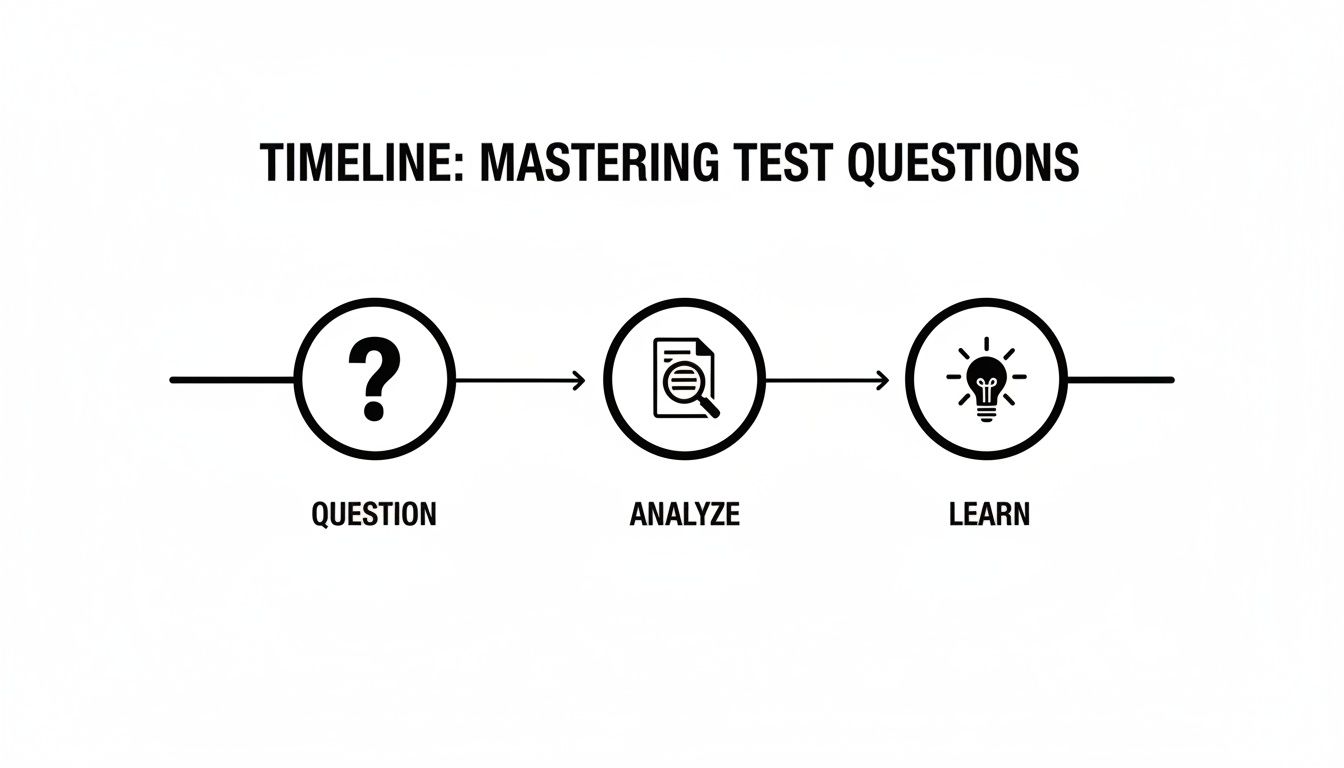
This question-analyze-learn loop is the engine that will power you to a passing score. And if you're looking to get even more prepared, it's worth learning about what comprehensive drivers education in Florida involves.
Proven Strategies to Use on Exam Day
Knowing the material is just one piece of the puzzle. The other, equally important piece is showing up on test day ready to perform under pressure. You’ve put in the hours with your study plan and taken a solid drivers license practice test; now it’s time to walk into the DMV with a calm, clear strategy.
Think of it this way: your performance on the actual exam is just as crucial as the time you spent studying. Success really boils down to having a good game plan—managing your time, handling those tricky questions, and keeping your nerves from getting the best of you.
Pace Yourself and Read Every Word
The Florida DMV gives you 50 questions to answer in 60 minutes. That works out to a little over a minute per question, which is more than enough time. Don't fall into the trap of rushing through it.
Instead, make it a rule to read every single question twice. This simple habit ensures you know exactly what’s being asked before you even glance at the answers. The DMV is known for using "distractors"—options that look right at first glance but have a small, critical detail that makes them wrong. Slowing down helps you catch these tricks. If you get stuck, just flag the question and circle back to it later.
Trust your gut. More often than not, your first instinct is the right one. Only change an answer if you’re absolutely positive you misread the question. Second-guessing is a surefire way to talk yourself out of a correct answer.
When in Doubt, Eliminate
For any question that leaves you stumped, the process of elimination is your best friend. It’s a total game-changer. Rather than searching for the right answer out of four options, flip your approach and start by tossing out the ones you know are definitely wrong.
By getting rid of even one or two obviously incorrect answers, you dramatically improve your odds. If you can narrow it down to just two choices, you’ve suddenly got a 50% chance of getting it right. That’s a whole lot better than a wild guess. Many find that using the best test prep center software helps sharpen this skill.
Keep Test-Day Jitters in Check
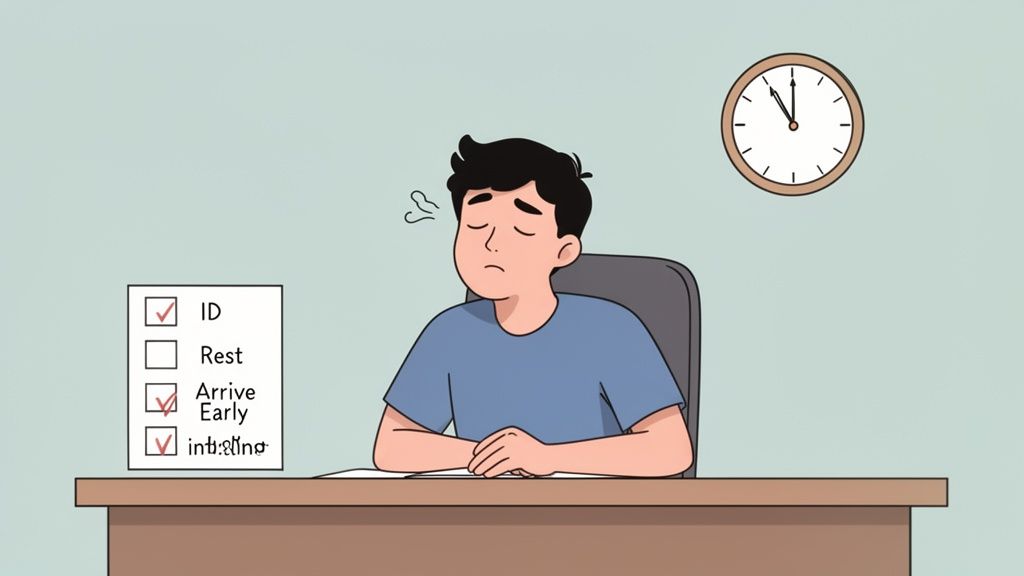
Feeling good physically and mentally on exam day can make a world of difference. It's easy to dismiss, but getting a good night's sleep and eating a solid breakfast will help you stay focused and calm. Plan to get to the DMV a little early to avoid that frantic, last-minute rush.
One of the biggest stress-inducers is scrambling for paperwork. Before you even walk out the door, double-check that you have all your required documents in hand.
- Get a Full Night's Sleep: Aim for at least 8 hours the night before.
- Eat Something: Never take a test on an empty stomach. Your brain needs fuel.
- Gather Your Paperwork: Have your ID and other forms ready to go.
- Think Positively: You've studied and practiced for this. You’re ready.
It’s worth remembering that driving exams can be tough. In the UK, for example, the pass rate for the practical test is only 46.3%, and the theory test is even lower at 45.2%. This just goes to show how vital preparation is for building the confidence and knowledge you need to succeed.
Got Questions About the Florida Practice Test? We've Got Answers.
As you get closer to exam day, it’s natural for a few questions to pop up. Making sure you have clear answers is the best way to walk into the DMV feeling prepared and confident. Let’s clear up some of the most common things people ask about using a drivers license practice test.
How Close Is the Practice Test to the Real Florida DMV Exam?
A well-designed practice test is about as close as you can get to the real thing without actually being at the DMV. Reputable tests are built directly from the official Florida DHSMV driver's handbook, so the topics, question styles, and even the level of difficulty are designed to match what you’ll see on test day.
Think of it like a full-dress rehearsal for a play. While the audience might be different on opening night, you've already run through the lines, blocking, and timing. You know exactly what to expect.
How Many Times Should I Be Taking a Practice Test?
It's less about the number of times you take a test and more about how well you're doing. A solid goal is to consistently hit a score of 90% or higher across a few different practice exams. Just retaking the same test over and over again won't do you much good—you'll end up memorizing the answers, not learning the rules of the road.
The real magic happens when you review your mistakes. Each wrong answer shines a light on something you haven't quite mastered yet, giving you a chance to fix it before it counts.
What Happens If I Don't Pass the Florida Written Test?
First off, don't sweat it too much—it happens. You can absolutely take the test again. The catch is that Florida makes you wait a certain amount of time between attempts, and you'll have to pay the exam fee each time you try.
This is exactly why preparing with a solid drivers license practice test is so important. It’s the smartest way to save yourself the hassle, extra cost, and stress of having to go back for a second round. It truly is the most direct path to passing on your first try.
Ready to walk into the DMV and ace your exam? The practice tests at BDISchool are built to feel just like the real Florida test, giving you the experience you need to pass with flying colors. Get started today at https://bdischool.com.
![Teen Driver Licensing Requirements in Florida [2026]](https://drivereducators.com/wp-content/uploads/emplibot/florida-license-requirements-hero-1773544196.avif)