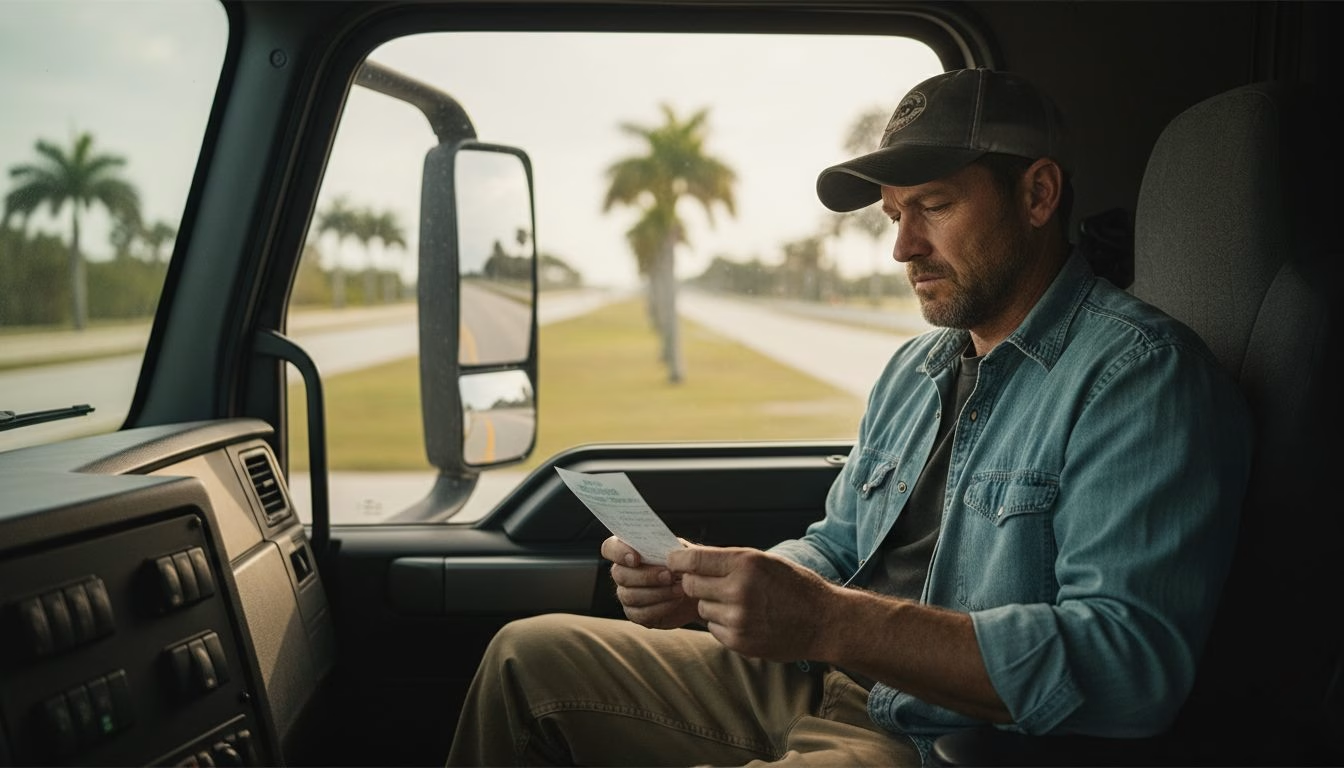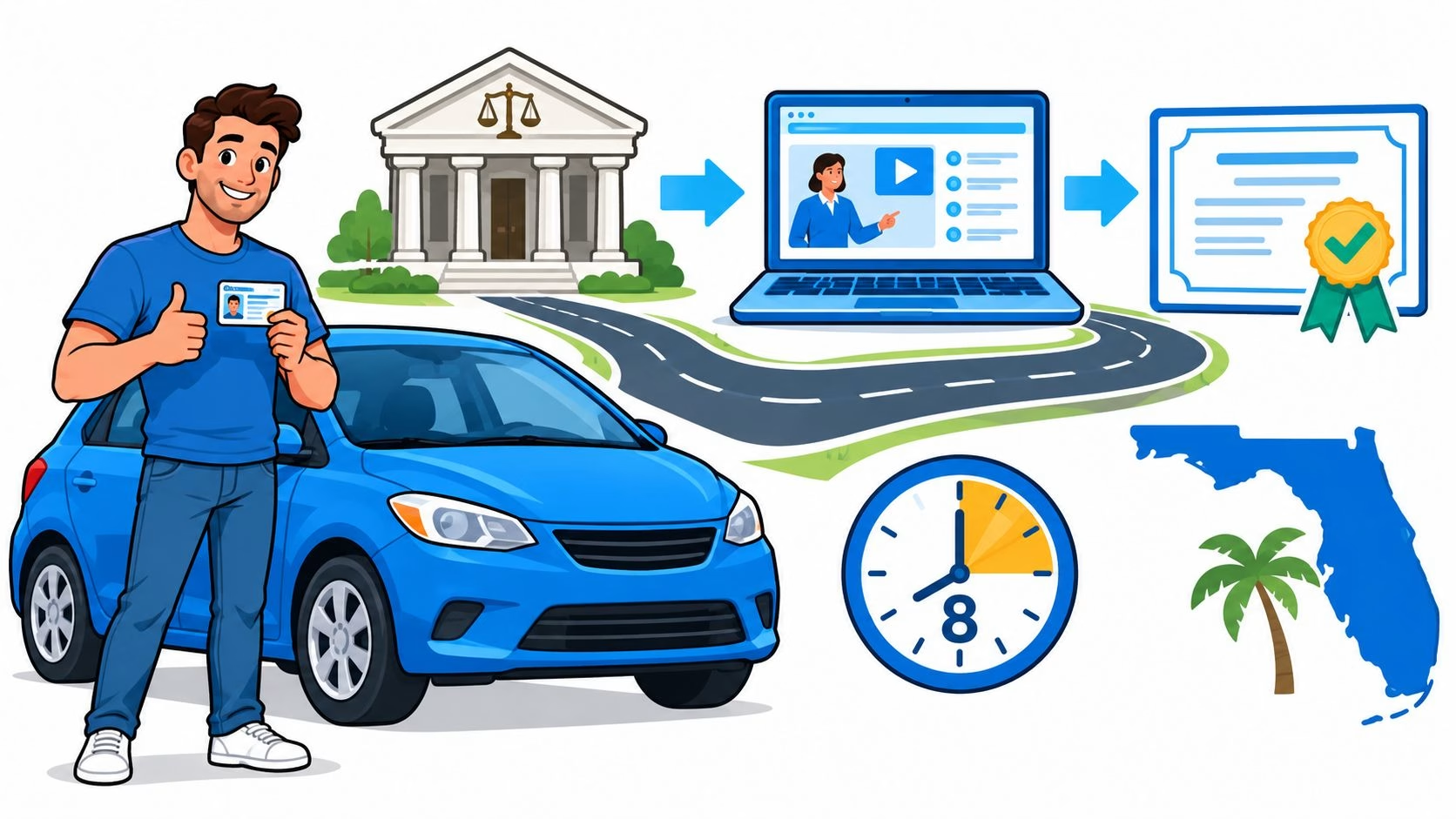
The DETS course in Florida is a 6-hour Driver Education Traffic Safety course. As of August 1, 2025, anyone under 18 who has never held a driver license from any state, country or jurisdiction must finish it before applying for a license in Florida.
This guide explains who must take DETS, how it fits into the learner’s permit steps, and what teens and parents should do next. Always confirm final details with the Florida Department of Highway Safety and Motor Vehicles (FLHSMV).
Key Takeaways
- Florida applicants under 18 who have never held a license must complete a 6-hour DETS course before applying.
- Applicants 18 or older take the TLSAE course instead, so the two courses stay separate.
- Some county school board DELAP classes can substitute for DETS, so ask your school first.
- DETS is only the first step: teens must also pass vision, hearing and knowledge tests and bring a notarized parental consent form.
- Course providers report completions to FLHSMV electronically, so a paper certificate is not required.
- Check every requirement with FLHSMV before you book a service center visit.
Table of Contents
- What is the DETS course?
- Who must take DETS in Florida?
- Can school classes replace DETS?
- How DETS fits into the learner’s permit steps
- How course completion gets reported
- What happens after the learner’s license
- Why the extra training matters
- Parent and teen checklist
- Our Perspective
- FAQ
- Sources
What is the DETS course?
Driver Education Traffic Safety (DETS) is a state-approved course for new teen drivers. FLHSMV describes it as a 6-hour course that meets or exceeds the Florida Department of Education Traffic Safety-Classroom 1900300 course description.
The course can happen in two ways. FLHSMV says it can be delivered in person or online. Because the state sets the course length, no course can legally promise a shorter version.
DETS focuses on how to drive safely, not only on passing a test. That is why the course matters for parents too, since the habits teens learn early tend to shape how they drive later.
Who must take DETS in Florida?
The rule depends on age and driving history. DETS applies to first-time drivers under 18, while older first-time drivers take a different course.
DETS or TLSAE: which one applies?
Traffic Law and Substance Abuse Education (TLSAE) is the course for first-time applicants age 18 or older. Providers that do not offer DETS may keep teaching their approved TLSAE course to people 18 and older. The table below keeps the two straight.
| Applicant | Course |
|---|---|
| Under 18, never held a license anywhere | DETS (6 hours) |
| 18 or older, never held a license anywhere | TLSAE |
Who the change does not affect
FLHSMV lists several groups the DETS rule leaves alone. They include applicants under 18 who already hold a valid out-of-state license transferring to Florida, and people who got a Florida learner’s license before August 1, 2025.
Teens who finished TLSAE early also get some room. Those under 18 who completed TLSAE before August 1, 2025 may use that certificate for one year after the completion date. If they do not get a Florida license within that year, they must take DETS.
Anyone under 18 who finishes TLSAE on or after August 1, 2025 needs DETS instead, unless an exemption below applies.
Can school classes replace DETS?
Yes, in some cases. Driver Education Licensing Assistance Program (DELAP) and high school driver education classes meet the requirements, and a successful DELAP student does not need DETS.
However, not every school takes part. Only some county school boards offer DELAP courses, so FLHSMV tells families to contact their local school board. Ask your school first, before you pay for a separate course.
How DETS fits into the learner’s permit steps
DETS is the first requirement, not the last. For a learner’s license, a teen must be at least 15, bring a signed and notarized Parental Consent Form, show proof of DETS completion, pass vision and hearing tests, and pass the Class E Knowledge Exam.
Here is the usual order of steps:
- Confirm the teen is at least 15 and has never held a license anywhere.
- Complete DETS online or in person, or finish an approved school DELAP class.
- Study the Official Florida Driver License Handbook for the knowledge exam.
- Pass the Class E Knowledge Exam through an approved option.
- Gather identity, Social Security number and address documents.
- Visit a service center with a parent, the consent form and the required fee.
The Class E Knowledge Exam
The exam has 50 multiple-choice questions about Florida traffic laws, safe driving practices and traffic controls, and a passing score is 40 correct answers, or 80 percent. A study routine helps, and our related driver guides cover study tips.
You have a few ways to test. Students of any age can test with an approved provider in a proctored, in-person setting, and students under 18 can test online if a parent or legal guardian proctors the exam.
Keep in mind that a retest can happen. FLHSMV may randomly select someone who passed through an approved provider for a no-fee, mandatory retest, and the learner license is issued after a passing score.
Documents and the service center visit
Parents often need the most time for paperwork. Step-parents may not sign the consent form unless they have legally adopted the minor child. If the teen took the test online, a signed and notarized Parent Proctoring Form is also required.
You will also need ID documents. Teens must show proof of identity, Social Security number and residential address, and FLHSMV lists acceptable documents at flhsmv.gov/WhatToBring.
How course completion gets reported
Teens do not need to carry a paper certificate. The provider sends completion details to FLHSMV electronically, and every driver license issuing office can see them.
Timing matters, so do not book your visit the same hour you finish. FLHSMV asks families to allow 24 to 72 hours for completions to post. FLHSMV also does not accept paper certificates for any licensing purpose.
What happens after the learner’s license
The learner’s license starts a supervised practice period. A licensed driver at least 21 years old must sit in the closest seat to the right of the driver.
Time-of-day limits apply too. Learners may drive only in daylight for the first three months, and until 10:00 p.m. after that.
Practice hours and the full license
Parents play a central role here. A parent, legal guardian or responsible adult over 21 must certify 50 hours of driving experience, including 10 hours at night. FLHSMV also offers a learner’s license driving log for tracking that time.
The timeline is set by state law. To qualify for a driver license, a teen must hold the learner’s license for 12 months or turn 18. A moving violation conviction can block the driver license for one year from the conviction date.
FLHSMV’s teen licensing page also lists the full-license limits. At age 16, driving is allowed only between 6 a.m. and 11 p.m., and at 17, between 5 a.m. and 1 a.m., unless the teen is driving to or from work or has a licensed driver 21 or older along.
Why the extra training matters
New drivers face real risk. The CDC reports that per mile driven, drivers aged 16 to 19 are nearly three times more likely than drivers 20 and older to be in a fatal crash, and inexperience is the leading cause.
The first year is the riskiest. Crash risk is highest during the first year a driver has a license. Graduated licensing exists for that reason, since it lets new drivers gain early experience under lower-risk conditions.
Parents can help beyond the paperwork. The CDC says parents can make a big difference in keeping teen drivers safe. Practice in varied conditions, talk through decisions out loud, and set clear rules before the first solo drive.
Parent and teen checklist
Use this list to stay organized before you visit a service center.
- Ask the high school whether it offers a DELAP class that replaces DETS.
- If not, choose a DETS course and set aside the full 6 hours across several sessions.
- Check with FLHSMV that your completion posted before you book a visit.
- Study the Official Florida Driver License Handbook for the 50-question exam.
- Get the Parental Consent Form signed in front of an agent or notary.
- Collect identity, Social Security number and address documents.
- Start a driving log on day one of the learner’s license.
Rules and fees can change. Review the FLHSMV teen licensing page before every step, and read our Florida course information for course options.
Our Perspective
We see the same pattern with many families: the course feels like a box to check, and the real learning starts in the car. DETS gives teens a shared vocabulary for safe driving, and parents can build on it during practice drives. Ask your teen to explain why a rule exists, not only what the rule says.
Our advice is to treat the 50 supervised hours as the main event. Practice at different times of day, in different weather, and on different road types. Stay calm, give short instructions, and review each drive afterward. That habit builds judgment, which is what keeps new drivers safe.
Finally, remember that your teen’s situation may differ from the general rules here. Confirm requirements with FLHSMV or your school board, and check your course’s state page for refund details before you register.
— The DriverEducators team
Ready to complete your course online, on your own schedule? Find your state’s course at DriverEducators.com or call 888-237-5669 (Mon-Fri, 9:00AM-5:00PM). Our courses are self-paced, mobile-friendly, and offered in English, Spanish and Portuguese.
FAQ
Is my 17-year-old required to take DETS if they never held a license?
Yes, in most cases. The rule covers anyone under 18 who has never held a license from any state, country or jurisdiction. Check with FLHSMV if your teen holds a transferring out-of-state license or finished a school driver education class.
Does my teen need to pass DETS, or just attend it?
FLHSMV says all first-time drivers under 18 must take and pass the DETS course. Plan time for the full course and review the material before you finish.
My teen took TLSAE last year. Is that still valid?
It may be. Teens under 18 who completed TLSAE before August 1, 2025 can use that certificate for one year after the completion date. After that, they need DETS, so confirm your dates with FLHSMV.
Can I take DETS online and does it count at the service center?
FLHSMV says the course can be delivered in person or online. Because providers submit completions electronically to FLHSMV, you do not need a paper certificate. See our Florida course page for details.
Sources
- Driver Education Traffic Safety (DETS) – FLHSMV
- DETS Course Frequently Asked Questions – FLHSMV
- Driver Improvement Schools – FLHSMV
- Licensing Requirements for Teens, Graduated Driver License Laws and Driving Curfews – FLHSMV
- Frequently Asked Questions – FLHSMV
- Class E Knowledge Exam & Driving Skills Test – FLHSMV
- License Classes, Endorsements & Designations – FLHSMV
- Learner’s License Driving Log – FLHSMV
- Crash and Injury Risks for Teen Drivers – CDC
- Graduated Driver Licensing – CDC