That sinking feeling in your stomach when you realize you’ve missed a court date is awful. But the absolute worst thing you can do right now is panic or ignore it. What happens in the next 24 to 48 hours is critical and can set the tone for how a judge views your case.
Instead of letting fear take over, you need a clear, methodical plan. Your immediate goal is to gather the facts and show the court this was a mistake, not an attempt to dodge your responsibilities.
Let’s be clear: people miss court for all sorts of legitimate reasons—a sick child, a work emergency, or just a simple, honest mistake with the calendar. You’re not the first person this has happened to. The key is to act quickly and responsibly.
Your First 24 Hours: A 3-Step Action Plan
The moment you realize your mistake, the clock starts ticking. Don’t wait. The court system moves forward whether you’re there or not, and consequences like a suspended license or a warrant for your arrest can happen fast.
Here’s a quick-reference checklist to guide your immediate actions. Follow these steps in order to get the information you need without making the situation worse.
Immediate Action Checklist After Missing Court
| Action Step | Why It’s Critical | Where to Go or Who to Call |
|---|---|---|
| Verify Case Status Online | This is the fastest way to see what happened in your absence. The online docket will show new entries like “Failure to Appear” or “Bench Warrant Issued.” | Your county’s Clerk of Court website. Look for a “case search” or “public records” portal. |
| Contact the Court Clerk | Speaking to a person confirms the online details, shows you’re being proactive, and helps you understand the official procedure for next steps. | The Clerk of Court’s office for the county where your case is being heard. Have your case number ready. |
| Check for a Warrant | This is the most urgent piece of information. An active warrant means you could be arrested at any time, even during a routine traffic stop. | The Clerk of Court can usually confirm this. If not, they will direct you to the county Sheriff’s Office. |
By completing this checklist, you’ll have a clear picture of your situation and can move on to fixing it.
First, Check Your Case Status Online
Before you even think about picking up the phone, your first move is to get online. Nearly every county Clerk of Court in Florida has a public website with a case search portal. This is your starting point for getting a real-time snapshot of your case.
You’ll usually need your full name, case number, or driver’s license number. Once you find your case, look for the most recent entries on the docket. You’re scanning for phrases like “Failure to Appear (FTA),” “Bench Warrant Issued,” or “Default Judgment Entered.” Knowing this before you call anyone puts you in a much better position.
This flowchart breaks down that initial process—moving from that moment of panic to proactive, logical steps.
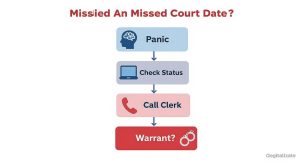
As you can see, gathering information is the crucial step that comes right after that initial “Oh no!” moment.
Next, Call the Court Clerk
With your online search results in hand, it’s time to call the Clerk of Court’s office. While the website gives you the basics, talking to a real person is essential for getting the full story and showing you’re taking this seriously.
Pro Tip: Be polite and prepared. The clerk isn’t a judge and can’t give you legal advice, but they are the gatekeepers of crucial information. They can tell you exactly what the judge ordered and what the official process is for getting back on the court’s calendar.
Have your case number ready and ask direct questions: “I’m calling about case number X. I see online I missed my court date. Can you confirm the current status?” and “Can you tell me if a warrant was issued?” This is a fact-finding mission, not a time to make excuses. If you’re unfamiliar with the general process, our guide on what to expect in traffic court can give you some helpful context.
Finally, Confirm if a Warrant Was Issued
This is, without a doubt, the most pressing question you need to answer. A bench warrant is an order from a judge for your arrest, plain and simple.
If a warrant is active, you are at risk of being arrested during any interaction with law enforcement. The clerk’s office can usually confirm this for you over the phone. If for some reason they can’t, they will point you to the right place, which is typically the county sheriff’s warrant division. Finding out is non-negotiable.
What Happens Right After You Miss Court?

Alright, so you’ve confirmed you missed the court date. The next step is to understand what’s likely happening behind the scenes, because ignoring it is the worst thing you can do. The consequences start piling up almost immediately, and getting ahead of them is the only way to avoid a much bigger headache.
The court system doesn’t take a Failure to Appear (FTA) lightly. Think of it as a domino effect—your absence triggers a standard, procedural response. While it’s not personal, the fallout can definitely feel that way, impacting your freedom, your wallet, and your ability to drive.
Let’s unpack the most immediate problems you could be facing.
The Bench Warrant: You’re Now on Law Enforcement’s Radar
The most serious and immediate outcome is a judge issuing a bench warrant for your arrest. This isn’t a maybe; it’s a direct order to any law enforcement officer to take you into custody and bring you before the court.
Having an active warrant means you could be arrested at any time. It could happen during a routine traffic stop for a broken taillight, at your home, or even at work. And don’t assume this is only for major crimes—a simple missed traffic hearing can absolutely lead to a bench warrant. Warrants don’t expire; they stay active until you or your attorney deal with them.
So, what do you do if there’s a warrant out for you?
- Be proactive. Don’t wait for them to find you. Taking the first step shows the court you’re trying to make things right.
- Talk to an attorney. A lawyer is your best bet here. They can often arrange a time for you to turn yourself in on your own terms, or they might even be able to file a motion to recall the warrant without you ever being arrested.
- Get ready for bond. You’ll almost certainly have to post a bond (or bail) to get released. This is just a financial promise that you’ll show up for all future court dates.
The Default Judgment: You Lost Without a Fight
For civil matters, which include most traffic tickets, missing your court date lets the judge issue a default judgment against you. In simple terms, this means the other side—the state or county—wins automatically because you weren’t there to present a defense.
A crucial legal outcome of not showing up is understanding a default judgment, as it essentially ends your chance to contest the ticket. You’re found guilty, and the court will likely impose the maximum fines and fees. You’ve lost your opportunity to negotiate, explain what happened, or even elect traffic school to keep points off your license.
The real problem with a default judgment is that it slams the door on your defense. You’re instantly guilty in the eyes of the law, and the penalties are set in stone. This often creates a chain reaction, and the next link in that chain is usually your driver’s license.
Driver’s License Suspension: Now You Can’t Legally Drive
In Florida, a Failure to Appear for a traffic violation almost always triggers an automatic driver’s license suspension. The court clerk simply notifies the Florida Department of Highway Safety and Motor Vehicles (DHSMV), and a hold is placed on your license. This is sometimes called a “D-6 suspension.”
The real danger here is that you might not even know your license is suspended until you get pulled over again. Driving on a suspended license is a whole new criminal offense, one that comes with its own steep fines and potential jail time.
If you think this might have happened to you, it’s critical to understand the process of dealing with a suspended license in Florida and what it takes to get reinstated. The longer you wait, the more complicated and expensive it gets to fix.
How to Get Your Case Back on Track
That sinking feeling you get when you realize you’ve missed a court date is awful, but it doesn’t have to be the end of the road. Missing your court date might feel like a final verdict, but it’s really just the start of a different process. The absolute key is to act fast and show the court your absence was a legitimate mistake, not a deliberate no-show.
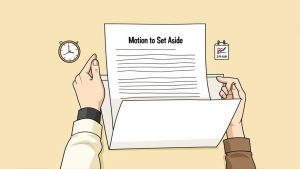
Your most important tool for this is a formal legal document called a Motion to Set Aside Default Judgment.
Think of this motion as your formal, written request for a do-over. You’re explaining to the judge exactly why you weren’t there and asking them to wipe the slate clean—to remove the default judgment and put your case back on the court’s calendar as if it never happened.

This isn’t just a simple apology letter. It’s a formal legal filing that you need to draft correctly, file with the court clerk, and then make sure the prosecutor’s office gets a copy. This is your official opportunity to explain what happened and ask for a second chance to deal with your ticket.
Filing a Motion to Set Aside the Judgment
Your motion has to be convincing and meet a pretty specific legal standard. Simply saying, “Oops, I forgot,” isn’t going to cut it. You have to provide a legitimate reason for your absence, and you’ll need to back it up with proof whenever possible.
The heart of your argument will be based on a legal concept known as “excusable neglect.” This basically means your reason for missing court was a genuine mistake or something totally out of your control—not just carelessness or an attempt to dodge your responsibilities.
So, what actually counts as excusable neglect? Courts have seen it all, but here are a few real-world examples that often hold up:
- A Documented Medical Emergency: This could be a sudden illness or an accident involving you or a close family member. You’ll need proof, like a note from the doctor or hospital admission paperwork.
- You Genuinely Never Got the Notice: If you can prove the court summons was sent to an old address or that there was some other clerical mix-up, that’s a strong argument.
- Serious Car Trouble or an Accident: A verifiable, major breakdown or a car crash on your way to the courthouse is a valid excuse. A police report or a receipt from the tow truck company is critical evidence here.
Believe it or not, just forgetting is one of the most common reasons people miss court. One national poll found that a staggering 37% of people who missed a hearing said they simply forgot. This is why simple things like text message reminders—which have been shown to reduce missed court dates by up to 21% in cities like New York—are becoming more common.
Crafting a Compelling Motion
When you write your motion, you need to be crystal clear about three things: your reason for being absent, why that reason qualifies as excusable neglect, and a statement confirming you have a legitimate defense for the original ticket. The judge wants to know that giving you another court date won’t just be a waste of everyone’s time.
A well-drafted motion is your best shot at fixing this. Keep it respectful and stick to the facts, and attach any proof you have. You want to show the judge that you take this seriously and that your failure to appear was a one-time, understandable mistake.
For instance, don’t just write, “I was sick.” Instead, be specific: “I was unable to attend the scheduled hearing on [Date] due to a sudden medical emergency, for which I received treatment at [Hospital/Clinic Name]. A copy of the doctor’s note is attached as Exhibit A.” Details and evidence are your best friends here. If you need more ideas on how to approach your case, our guide on how to fight a traffic ticket in Florida can provide more context.
Once you file the motion, the court will set a hearing date for a judge to review your request. At that hearing, you’ll get a chance to make your case. If the judge agrees with you, the default judgment will be canceled, any warrants will be recalled, and your case will get a brand new court date. You’ll have the second chance you were hoping for.
Why Hiring a Traffic Attorney Is a Smart Move
Trying to clean up the mess from a missed court date on your own can feel like performing surgery on yourself—sure, it’s theoretically possible, but the risks are sky-high. The legal system is its own world, filled with specific procedures, unwritten rules, and local customs. A traffic attorney lives and breathes this world every single day.
When you bring a legal expert into the picture, the whole dynamic changes. You’re no longer just another person with an excuse; you’re represented by a professional who speaks the language of the court, the prosecutors, and the judges. It’s not just about knowing the law; it’s about knowing the local players and how things really get done.
Navigating the System with an Expert Guide
An experienced local traffic attorney brings a level of insider knowledge to the table that you just can’t replicate. They know which arguments work with which judges and what kind of deals certain prosecutors are willing to entertain.
For example, a lawyer can often get on the phone with the prosecutor’s office long before you ever step back into a courtroom. They might negotiate to have the Failure to Appear (FTA) charge dropped entirely if you agree to a plea on the original ticket, potentially saving you from a separate criminal charge.
One of the biggest things they can do is handle that dreaded bench warrant. A good attorney can often file a motion to recall or “quash” the warrant, meaning you might avoid the stress and humiliation of turning yourself in or being arrested unexpectedly.
Having them act as your representative shows the court you’re taking this seriously, which can go a long way in tipping the outcome in your favor.
Securing a Better Outcome for Your Case
Beyond just fixing the immediate problem, a good attorney is focused on the best possible long-term result for you. That means looking past the missed court date and tackling the original traffic violation itself.
A skilled lawyer can help you deal with complicated scenarios, like understanding single-car accident claims and fault determination, which can otherwise lead to major legal headaches. They will scrutinize the evidence, find weaknesses in the state’s case, and negotiate from a position of strength. Their work often leads to better results, such as:
- Reduced Fines: Negotiating a much lower financial penalty.
- No Points on Your License: Arguing for a resolution that protects your driving record.
- Dismissal of Charges: Finding legal grounds to get the ticket thrown out completely.
The data backs this up. Even in complex immigration court, legal representation makes a huge difference. Statistics show immigrants with lawyers have a 96 percent attendance rate, and about 15 percent who miss a date successfully reopen their cases. This just goes to show the massive impact a legal professional can have.
Finding the Right Attorney for Your Situation
Getting the right help is critical. You don’t want just any lawyer; you want someone who specializes in traffic law in your specific county, because they’ll know the local court’s quirks inside and out.
Start by searching online for “traffic ticket attorneys” in your area. Look for lawyers with solid client reviews and a clear focus on traffic defense. Many will offer a free initial consultation, which is your opportunity to interview them.
Be ready to ask some direct questions:
- How much experience do you have with Failure to Appear cases in this courthouse?
- What’s your strategy for dealing with my bench warrant?
- Based on what I’ve told you, what are the possible outcomes?
- Can you give me a clear breakdown of your fees?
Hiring the right lawyer is an investment in protecting your license, your money, and your freedom. If you’re serious about your defense, it’s a smart move to at least have a conversation with one. For more info on your options, you might want to check out our guide on how you can contest a traffic ticket.
Protecting Your Driving Record for the Long Haul
https://www.youtube.com/embed/qoLa_F65mh0
Alright, you’ve dealt with the immediate fire drill of missing your court date. The warrant is cleared, and your case is back in the system. It’s easy to feel like the crisis is over, but honestly, the real work is just beginning. Now, you need to shift from short-term fixes to long-term damage control for your driving record.
A traffic conviction, especially one complicated by a failure to appear, isn’t just a one-time fine. It’s a black mark on your driving history that can follow you around for years. In Florida, where every ticket comes with points, each conviction inches you closer to a license suspension and practically guarantees a spike in your insurance premiums.
The Lasting Sting on Your Insurance and License
Let’s be real: insurance companies are all about assessing risk. When they pull your record and see a moving violation conviction—worse yet, one with a “Failure to Appear”—it screams “high-risk driver.” The result? A rate hike that can stick around for three to five years, easily costing you hundreds, if not thousands, of dollars over that time.
This is where you need to get strategic. Instead of just gritting your teeth and paying the fine, you have other moves to make. One of the best tools in your arsenal as a Florida driver is electing to attend a Basic Driver Improvement School (BDIS) course.
By completing a state-approved BDIS course, you can stop points from ever hitting your license for an eligible ticket. It’s a powerful signal to your insurance company that you’ve taken the situation seriously, which can save your rates from going through the roof.
Think of it this way: you can either accept the long-term financial hit or take a detour that keeps your record clean. It’s about actively managing the fallout from a mistake, not just passively accepting the consequences.
How Traffic School Can Be Your Get-Out-of-Jail-Free Card
Even if you goofed and missed your court date, traffic school is often still on the table. Once you’ve gotten your case sorted out and back on the calendar, you or your attorney can often negotiate with the judge. In many scenarios, the court will still allow you to elect traffic school as part of a new agreement.
This is particularly true if you had a legitimate reason for missing the date and you’ve been proactive about making things right. Completing a course from a provider like BDISchool shows the court you’re committed to being a responsible driver.
The rules for electing traffic school in Florida are pretty clear, but you have to follow them. You can typically use this option as long as:
- You haven’t taken a BDIS course in the last 12 months.
- You haven’t used this option more than five times in your life.
- Your ticket was for a non-criminal moving violation.
- You don’t hold a Commercial Driver’s License (CDL).
Finishing the course does more than just help you dodge points. It resets the story. It proves you invested your own time to become a safer driver, and that’s something both the court and your insurer will appreciate.
Comparing Your Long-Term Options
When you’re standing at this crossroads, the decision you make will directly affect your driving record and your bank account. Here’s a look at what those two paths really mean.
Consequences of a Traffic Conviction vs. Attending Traffic School
This table breaks down the real-world difference between just paying the ticket and completing a BDIS course. The choice becomes pretty clear when you see it side-by-side.
| Outcome | With Traffic Conviction | After Completing BDIS Course |
|---|---|---|
| License Points | Points get added, pushing you closer to a suspension. | No points are added to your license for that violation. |
| Insurance Rates | Almost certain to go up at your next renewal. | Premiums are far less likely to be negatively affected. |
| Driving Record | The conviction becomes a permanent part of your record. | Adjudication is withheld, keeping it off your public record. |
| Court Perception | You’re seen as simply accepting the penalty. | You’re viewed as taking a proactive step toward safer driving. |
Making the smart call after a missed court date is the final, and most crucial, step in this whole ordeal. By choosing to take a BDIS course, you can turn a messy situation into a chance to protect your license and your finances for years to come.
Got Questions About Your Missed Court Date?
It’s completely normal to feel overwhelmed and have a million questions racing through your mind after missing a court date. The confusion is real, but getting clear answers is the first step to sorting this out. We’ve been there with countless drivers, so let’s break down some of the most common worries we hear.
This is about more than just a quick fix. Understanding the situation fully helps you make smart decisions that protect you down the line.
How Long Does a Bench Warrant Last?
Here’s a dangerous myth we need to bust right away: a bench warrant does not just “expire” or fade away with time. That’s wishful thinking, and it’s completely false. A bench warrant stays active until you or a lawyer takes direct action to have it cleared by the court. It has no expiration date.
Think about that for a second. Years from now, you could get pulled over for something minor, like a broken taillight, and suddenly find yourself in handcuffs because of a warrant you’d long forgotten. The only way out is through. You have to face it, either by turning yourself in or having an attorney file a motion to get the warrant recalled.
A bench warrant is a permanent problem until you actively solve it. Ignoring it is a gamble that almost never pays off, and it usually results in an arrest at the worst possible moment.
Can I Just Pay the Fine to Make This Go Away?
If only it were that easy. While it seems like a simple solution, just paying the original ticket fine won’t do the trick if a bench warrant has already been issued for your Failure to Appear.
The court sees these as two separate problems. The first is your original traffic violation. The second, and more serious one, is your failure to show up to court. Paying the ticket might resolve the first issue, but the warrant for the second one remains active. You could pay the fine in full and still get arrested a week later. You have to address the Failure to Appear charge directly with the court clerk to get the warrant withdrawn.
Will a Missed Traffic Court Date Show Up on a Background Check?
Yes, absolutely. A Failure to Appear charge that leads to a bench warrant is a public record. That means it can easily pop up on background checks run by employers, landlords, or anyone else doing their due diligence.
Here’s how this can play out in the real world:
- Job Hunting: An active warrant is a massive red flag for employers. It can easily cost you a great job opportunity, as many companies won’t move forward with a candidate in that situation.
- Renting a Home: Landlords check public records to screen applicants. A warrant or a history of failing to appear in court can make you look like a risk, leading them to choose another tenant.
- Professional Licenses: If your career requires a professional license (think nursing, real estate, or commercial driving), even a seemingly minor mark on your criminal record can put that license in jeopardy.
What started as a simple speeding ticket can quickly spiral, creating serious and lasting problems in your life if you don’t handle it the right way.
Don’t let one mistake mess up your driving record or send your insurance premiums through the roof. BDISchool offers a state-approved, 100% online Basic Driver Improvement Course to help you avoid points on your license. Take back control by enrolling today at https://bdischool.com.