Your Ultimate Florida DMV Visit: How to Arrive Fully Prepared
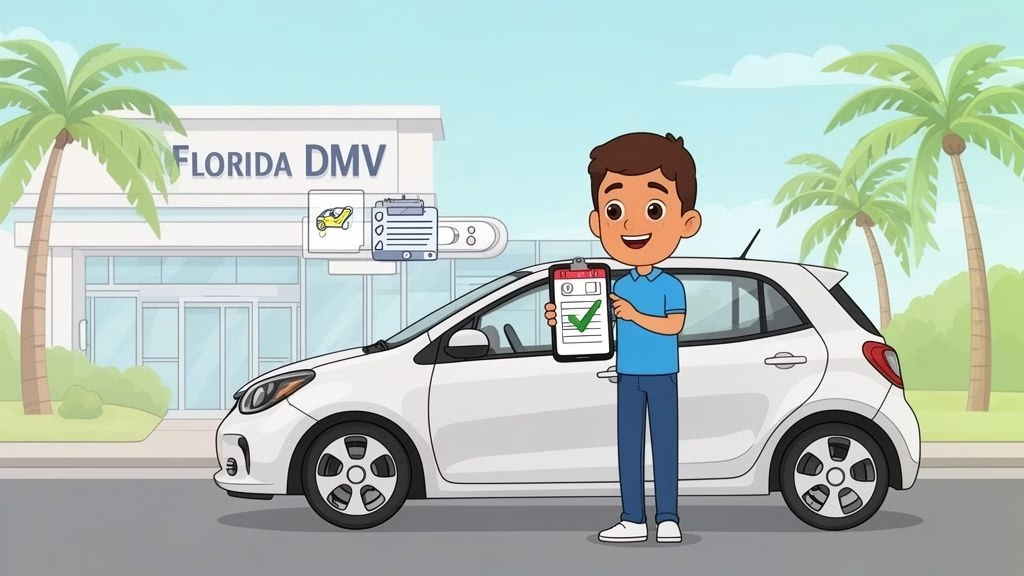
A visit to the Florida Department of Highway Safety and Motor Vehicles (FLHSMV), often just called the DMV, can feel like a major task. Whether you're a teen excited for your first permit, a new resident transferring your license, or a long-time Floridian handling a vehicle title, the secret to a quick, successful trip is preparation. Knowing precisely what to bring to the DMV eliminates the risk of being turned away and having to make a second visit. This guide acts as your ultimate, Florida-specific checklist, detailing every document and item needed for the most common transactions.
This listicle is designed to be your direct path to success. We will cover the specific requirements for:
- New driver licenses and learning permits
- REAL ID compliant credentials
- Teen licensing and graduated driver license (GDL) steps
- State-issued identification cards
- Vehicle registration and title transfers
Beyond just listing documents, we’ll provide actionable tips for making an appointment, understanding acceptable forms of payment, and what to do if you find yourself missing a required document. We will also touch upon when a BDI/Traffic School completion certificate is necessary, especially for drivers looking to satisfy court requirements or improve their driving record. This comprehensive breakdown will help you gather everything you need in one go, turning what could be a frustrating errand into a straightforward, stress-free success. Let's get you ready for your appointment.
1. Valid Government-Issued Photo ID
The cornerstone of any Florida Highway Safety and Motor Vehicles (FLHSMV) visit is your primary identification. This isn't just a formality; it's the fundamental document that proves you are who you say you are. Nearly every transaction, from renewing your license to applying for a REAL ID, begins with an agent verifying your identity through a valid, government-issued photo ID. Without it, your trip to the DMV will unfortunately be a short one.

This requirement is critical for security and fraud prevention. The state needs to ensure that licenses and ID cards are issued to the correct individuals, maintaining the integrity of official records. For first-time drivers, especially teens, this step is particularly important. While the process of gathering documents can seem daunting, understanding what qualifies is the first step. For a detailed breakdown of permit requirements, you can find a helpful guide on what you need to get your permit in Florida.
Acceptable Forms of Primary Identification
Not all photo IDs are created equal in the eyes of the FLHSMV. The document must be current and issued by a government agency. Here are the most commonly accepted forms:
- U.S. Passport or Passport Card: Both are considered primary forms of identification. This is a common option for those who travel internationally or do not yet have a state-issued ID.
- Original or Certified U.S. Birth Certificate: While not a photo ID on its own, it's often used as a primary document in combination with other items, especially for first-time applicants.
- Valid, Unexpired Driver's License or ID Card: A current license or ID from Florida or another U.S. state is perfect for renewals or address changes.
- Valid, Unexpired U.S. Military ID Card: Active duty, reserve, and retired military members can use their military ID.
- Certificate of Naturalization (Form N-550 or N-570): For naturalized citizens, this is a primary proof of identity.
Pro Tips for a Smooth Visit
To avoid any hitches, check your ID well before your appointment.
Crucial Tip: Always check the expiration date on your ID at least one week before your DMV visit. An expired ID, even by one day, will be rejected, forcing you to reschedule.
Keep your ID in a secure but easily accessible place. You'll likely need to present it at the initial check-in window and again to the agent handling your transaction. If you recently completed a Basic Driver Improvement (BDI) course to reinstate your license, double-check that the name on your ID exactly matches the name on your course completion certificate to prevent any discrepancies. Being prepared with the right identification is the single most important part of what to bring to the DMV.
2. Proof of Residency Document
After establishing your identity, the next critical step is proving you actually live in Florida. A Proof of Residency document is mandatory for nearly all driver's license and ID card transactions, including first-time applications, renewals, and address changes. The Florida Highway Safety and Motor Vehicles (FLHSMV) requires this to confirm your physical address, ensuring that state-issued credentials belong to actual Florida residents. Simply stating your address isn't enough; you must back it up with official documentation.

This requirement is a standard security measure to prevent fraud and maintain accurate residential records across the state. For new movers, this can feel like a hurdle, but it's a straightforward process once you know which documents are accepted. The key is timeliness; the document must be recent, typically issued within the last 60 days, to be considered valid. If you've recently moved, you can get more details on the process by exploring how to complete a Florida driver license change of address.
Acceptable Forms of Proof of Residency
The FLHSMV accepts a range of documents that show your name and Florida residential address. You must present two different proofs of residency from the list below, and they cannot be from the same source. Here are some of the most common options:
- Utility Bills: A recent electric, water, or cable bill is a primary choice. It must show your name and service address.
- Lease or Rental Agreement: A current and fully executed lease agreement for the property where you reside is a strong proof of residency.
- Financial Statements: Mortgage or property tax bills, or a recent bank statement that includes your address, are also accepted.
- Official Mail: Correspondence from a government agency, like the IRS or the Florida Department of Revenue, can serve as proof.
- Florida Voter Registration Card: This is another form of official documentation that confirms your registered address within the state.
Pro Tips for a Smooth Visit
Don't let a simple paperwork issue derail your DMV trip. A little preparation goes a long way.
Crucial Tip: Bring more than the required two proofs of residency. Having a third or even fourth backup document, like a recent pay stub or a different utility bill, can be a lifesaver if one of your primary choices is rejected for any reason.
Before you go, place all your utility bills and official mail in a designated folder. When paying bills online, download the PDF version of your statement, as printouts are generally accepted. If you've recently completed a Basic Driver Improvement (BDI) course, ensure the address you used during registration matches the address on your residency documents to avoid confusion, especially if the course was related to a license reinstatement. This attention to detail is a key part of what to bring to the DMV.
3. Social Security Number (SSN) or ITIN Documentation
After verifying your identity, the next critical piece of information the Florida Highway Safety and Motor Vehicles (FLHSMV) requires is your Social Security Number (SSN). This number is a key component of your official record, used for identity verification against federal databases and to maintain accurate driver history. Providing proof of your SSN is a mandatory step for nearly all driver's license and ID card transactions, including first-time applications, renewals, and REAL ID issuance.
This requirement is rooted in federal and state law to prevent fraud and ensure public safety. For non-U.S. citizens who may not have an SSN but are authorized to be in the country, an Individual Taxpayer Identification Number (ITIN) serves a similar purpose and is also accepted. Understanding which documents are valid and how to present them will make this part of your visit seamless. Without acceptable proof of your SSN or ITIN, the agent cannot proceed with your application.
Acceptable Forms of SSN/ITIN Proof
While you may have your number memorized, the FLHSMV requires a physical document to verify it. Simply writing it down on the application is not enough. Here are the most common documents used to prove your SSN or ITIN:
- Original Social Security Card: The most direct and preferred method. A laminated card is acceptable as long as it is legible and not altered.
- W-2 Form or 1099 Form: A recent tax form that displays your full name and SSN is a valid proof.
- Pay Stub: A printed pay stub showing your full name and SSN can be used.
- Official Letter from Social Security Administration (SSA): Any official correspondence from the SSA that states your SSN is acceptable.
- ITIN Documentation: An official letter from the IRS assigning your ITIN is required for non-citizen residents who use this number.
Pro Tips for a Smooth Visit
Having the right document is half the battle; presenting it correctly is just as important.
Crucial Tip: Do not bring a photocopy of your Social Security card. The FLHSMV requires the original document or another approved original form like a W-2. Photocopies will be rejected immediately.
If you cannot find your card, request a replacement from the Social Security Administration well in advance of your DMV appointment, as it can take time to arrive. Always double-check that the name on your SSN documentation is the same as the name on your primary identification. If you've had a legal name change, you must update your records with the SSA before visiting the DMV to avoid a mismatch that could halt your transaction. Having the correct SSN proof is a non-negotiable part of what to bring to the DMV.
4. Completed Application Forms (DL 44, DL 44E, or DL 43)
Arriving at the Florida Highway Safety and Motor Vehicles (FLHSMV) with a pre-filled application form is like having a fast pass for your transaction. These forms are the official record of your request, whether you're applying for a new license, replacing a lost one, or updating your information. An accurately completed form prevents delays, confusion, and potential rejection at the counter, making it a critical part of what to bring to the DMV.

Submitting an incomplete or incorrect form is a common reason for a prolonged DMV visit. The agent will have to return it to you for corrections, forcing you to step out of line and lose your place. By preparing the correct form in advance, you show the agent you are organized and ready, which often results in a smoother, faster process. For first-time drivers, this form is a key piece of the puzzle, alongside your other required documents.
Finding and Completing the Right Form
The FLHSMV provides different forms for various services. It's essential to identify and complete the one that matches your specific need. The main forms you'll encounter can be found on the official FLHSMV website.
- Form HSMV 71142 (DL 44): This is the application for a Driver License, Learner's License, or ID Card. It's used for original applications, renewals, and obtaining a REAL ID.
- Form HSMV 71054 (DL 43): You'll need this form to apply for a replacement (duplicate) driver's license or ID card if yours has been lost, stolen, or damaged.
- Electronic Form for Non-Citizens (DL 44E): While the physical DL 44 is standard, non-citizens without a Social Security Number may need to follow specific instructions or provide additional verification during their electronic application process.
Pro Tips for a Smooth Visit
To ensure your application is accepted without issue, meticulous preparation is key. A small mistake can lead to big delays.
Crucial Tip: Download and fill out your form at least a day before your appointment. Completing it electronically before printing ensures maximum legibility. Always use a black or blue ink pen for any physical signatures or last-minute additions.
Have a trusted friend or family member review your completed form to catch any errors you might have missed. If you recently took a Basic Driver Improvement (BDI) course, ensure the name on your application form is an exact match to your completion certificate. Bringing a blank copy of the form with you is a smart backup plan in case a major correction is needed on the spot.
5. Proof of Vehicle Insurance or Vehicle Registration
In Florida, a driver's license and vehicle operation are directly linked, which is why the FLHSMV requires you to show proof of financial responsibility. This means providing evidence of valid auto insurance or current vehicle registration for a vehicle you own. This requirement confirms that you are complying with Florida's mandatory insurance laws and helps maintain safety and accountability on the road. Without it, you may be unable to complete your transaction, particularly when obtaining or renewing a driver's license.
This step is a legal necessity designed to protect all drivers. Showing proof of insurance demonstrates you can cover damages in the event of an accident. When preparing for vehicle registration, it's essential to understand the documents you'll be presenting. For instance, knowing what a car title looks like can help you ensure your documentation is correct. Similarly, if you've misplaced your title, you'll need to address that first; you can learn more about replacing a lost car title in Florida to resolve the issue beforehand.
Acceptable Forms of Proof
Your proof must be current and clearly state the policy or registration period. While digital formats are increasingly accepted, having a physical copy is always a safe bet. The most common documents include:
- Insurance ID Card: The card issued by your provider (e.g., State Farm, GEICO, Allstate) showing your name, policy number, and effective dates.
- Insurance Policy Declaration Page: This document provides a detailed summary of your coverage, including the covered vehicle and policy period.
- Current Vehicle Registration Certificate: A valid Florida registration certificate for a vehicle you own is often sufficient, as it indicates that insurance was verified at the time of registration.
- Binder or Certificate of Insurance: A temporary document from your insurance company that serves as proof of coverage until the final policy is issued.
Pro Tips for a Smooth Visit
An expired insurance card is just as problematic as a forgotten one. A quick check before you leave home can save you a return trip.
Crucial Tip: Many service centers now accept digital insurance cards on your smartphone. However, it's wise to call your specific DMV location ahead of time to confirm they accept electronic proof. Always have a physical backup just in case.
Keep your insurance documents with your other required paperwork so you can present them all at once. If you recently completed a traffic school course for an insurance discount, bringing your completion certificate along with your insurance card can be helpful, although it's not required by the DMV itself. Ensuring your vehicle-related documents are in order is a key part of what to bring to the DMV for a successful visit.
6. Vision Test Appointment Confirmation or Proof of Recent Vision Exam
Clear vision is a non-negotiable requirement for safe driving in Florida, and the FLHSMV enforces this through mandatory vision tests. While all driver service centers offer on-site vision screening, bringing proof of a recent, qualifying exam from your own eye doctor can significantly speed up your visit. This is especially useful for individuals with known vision issues or complex prescriptions, as it pre-emptively addresses a critical licensing step.
The state's goal is to confirm that every driver meets the minimum vision standards, with or without corrective lenses. By having a licensed optometrist or ophthalmologist complete the required form beforehand, you provide the DMV agent with official, pre-verified documentation. This often allows you to bypass the in-office screening machine, saving time and potential complications. If you're wondering what to expect during your vision test, you might find a helpful guide to an eye check up useful.
Acceptable Forms of Vision Proof
To be accepted, your vision documentation must be recent and from a qualified professional. The FLHSMV provides a specific form for this purpose.
- Mature Driver Vision Test Form (HSMV 72119S): This is the official state form that must be filled out by a licensed physician, osteopathic physician, or optometrist in Florida or another state.
- A Statement on the Doctor’s Letterhead: Some offices may provide a signed letter with your visual acuity readings, which can also be accepted if it contains all the necessary information.
- Recent Corrective Lens Prescription: While not a substitute for the official form, having your current prescription on hand is wise, especially if your vision has recently changed.
Pro Tips for a Smooth Visit
Proper preparation regarding your vision test can make a real difference in your DMV experience.
Crucial Tip: The vision exam must have been completed within one year of your DMV appointment. Arriving with a form that is even a day over the one-year mark will result in it being rejected, forcing you to take the on-site test.
Always bring your corrective lenses-whether glasses or contacts-to your appointment, even if you have a completed form. An agent may still need to verify that you have them with you to add the restriction to your license. Submitting a vision form is a key part of what to bring to the DMV to demonstrate you meet all safety requirements before getting behind the wheel.
7. BDI/Traffic School Completion Certificate (When Applicable)
For many Florida drivers, a visit to the DMV is directly tied to a recent traffic violation. In these cases, a traffic school completion certificate isn't just another piece of paper; it's the official document that proves you've met a court or FLHSMV requirement. This certificate is your key to dismissing points from your driving record, reinstating a suspended license, or even qualifying for a valuable insurance discount. Showing up without it can render your appointment pointless, leaving the issue unresolved and risking further penalties.
The state mandates that specific courses be completed to address certain violations, ensuring drivers receive the proper education. For instance, a Basic Driver Improvement (BDI) course is often required to avoid points for a moving violation, while more intensive courses are needed for serious or repeat offenses. Bringing the correct certificate shows the FLHSMV agent you've taken the necessary steps to be a safer driver, allowing them to update your record accordingly. Similarly, first-time drivers must complete a specific drug and alcohol course, and understanding the details is crucial. You can find more information about this requirement on the 5-hour pre-licensing course page.
Common Types of Completion Certificates
Not all traffic school courses are the same. The certificate you bring must match the specific requirement you're trying to fulfill. Here are some common examples:
- Basic Driver Improvement (BDI) Course: This 4-hour course is the most common and is used to avoid points for a standard moving violation.
- Intermediate Driver Improvement (IDI) Course: This 8-hour course is often required for drivers who have had their license suspended or are deemed habitual offenders by the court.
- Aggressive Driver Course: A specialized course mandated for individuals cited for aggressive driving or road rage incidents.
- Mature Driver Course: A voluntary course for drivers aged 55 and older, which can lead to a significant insurance discount upon presenting the certificate to your provider.
- Defensive Driving Course (DDC): Often taken voluntarily for an insurance discount or required by a court for specific infractions.
Pro Tips for a Smooth Visit
Managing your certificate correctly is just as important as completing the course itself.
Crucial Tip: After completing your online course, immediately download and print your certificate. While some providers transmit completion to the FLHSMV electronically, this process can have delays. Always bring a physical or digital copy with you as undeniable proof.
Ensure the name on your certificate exactly matches the name on your driver's license and court records. Any discrepancy could cause the DMV agent to reject the document. If you've elected to take a BDI course, be mindful of your deadline; you must complete it and notify the Clerk of Court within the timeframe specified (typically 60-90 days) to avoid license suspension and a failed election. This certificate is a critical part of what to bring to the DMV if your visit is related to a traffic ticket.
7-Item DMV Documents Comparison
| Item | 🔄 Implementation Complexity | ⚡ Resource Requirements & Speed | ⭐ Expected Outcomes | 💡 Ideal Use Cases | 📊 Key Advantages |
|---|---|---|---|---|---|
| Valid Government-Issued Photo ID | Low 🔄 — straightforward verification; replacements can be lengthier | Low ⚡ to present; replacement may take days–weeks | ⭐⭐⭐⭐ — required for eligibility and fraud prevention | First-time applicants, renewals, reinstatements | 📊 Universally accepted; expedites processing and secures identity |
| Proof of Residency Document | Medium 🔄 — strict date/name requirements (within 60 days) | Moderate ⚡ — obtaining recent bills or lease may take billing cycles | ⭐⭐⭐ — proves domicile and prevents address fraud | New residents, address changes, voter registration | 📊 Flexible document types; necessary for accurate records |
| Social Security Number / ITIN Documentation | Medium 🔄 — official SSA/ITIN records required; replacements take time | Moderate–High ⚡ — SSA processing delays; privacy considerations | ⭐⭐⭐⭐ — links license to federal records; required for background checks | All license transactions; non-citizens using ITIN | 📊 Essential for record linkage and accurate enforcement |
| Completed Application Forms (DL 44 / DL 44E / DL 43) | Medium 🔄 — must be accurate, signed, and legible | Low ⚡ — free and can be pre-filled online; errors cause delays | ⭐⭐⭐ — speeds appointment when correct; prevents rejections | First-time licensing, replacements, non-citizen applicants | 📊 Reduces DMV time; available in multiple languages |
| Proof of Vehicle Insurance or Registration | Low–Medium 🔄 — must show current active coverage | Moderate ⚡ — request from insurer; digital acceptance varies | ⭐⭐⭐ — demonstrates legal compliance and financial protection | License issuance, registrations, insurance discount claims | 📊 Confirms compliance; may enable insurance savings |
| Vision Test Confirmation or Recent Exam | Low 🔄 — DMV test onsite; external exam optional (60 days) | Low–Moderate ⚡ — optometrist exam costs/time; DMV test immediate | ⭐⭐ — verifies visual fitness; may require corrective lenses | Drivers with vision concerns; mature drivers (55+) | 📊 Professional exams provide detailed records; can speed DMV visit |
| BDI / Traffic School Completion Certificate | Low–Medium 🔄 — must complete approved course; certificate issued electronically | Low ⚡ — self-paced online time investment (hours); instant electronic certificate | ⭐⭐⭐⭐ — enables point dismissal, reinstatement, insurance discounts | Court-ordered education, point dismissal, insurance discount eligibility | 📊 Automatically reported to FLHSMV; qualifies for discounts and reinstatement |
Drive Forward with Confidence and a Complete Checklist
Navigating a visit to a Florida Highway Safety and Motor Vehicles (FLHSMV) service center can feel like a significant hurdle, but it doesn't have to be a source of stress. The core of a successful, efficient trip lies in one simple principle: preparation. By understanding exactly what to bring to the DMV for your specific transaction, you transform a potentially frustrating experience into a straightforward task. This guide was built to be your single source of truth, demystifying the requirements for everything from your first learner's permit to a complex vehicle title transfer.
The journey to the service center counter begins at home. It starts with systematically gathering your documents, double-checking every detail, and organizing them for easy presentation. Remember the foundational "four pillars" of documentation that apply to most Florida transactions: proof of identity, proof of Social Security number, proof of residency, and the correctly completed application form. Each piece of paper serves a distinct purpose, collectively building a verifiable record of who you are and why you're there.
Your Final Pre-Visit Checklist: Key Takeaways
Before you walk out the door, run through this final mental checklist to ensure you've covered all your bases. Think of it as the last-minute review that solidifies your readiness.
- Document Consistency is King: The single most common point of failure is a name mismatch. Does your birth certificate name perfectly match your Social Security card and proof of residency documents? If you've had a name change due to marriage, divorce, or another legal action, you absolutely must bring the official documents (like a marriage certificate or court order) that create a paper trail linking your old name to your new one.
- Check Expiration Dates: A recently expired passport or an old utility bill can invalidate your entire application. Scrutinize every document you plan to bring, ensuring each one is current and valid according to FLHSMV standards. This simple five-minute check can save you hours of wasted time.
- Pre-Fill Your Forms: Download the appropriate application form from the FLHSMV website ahead of time. Filling it out neatly in black ink at your kitchen table is far less stressful than trying to complete it on a crowded clipboard while in a noisy waiting room. This also gives you time to look up any information you might not know offhand, such as your vehicle identification number (VIN).
- The BDI Certificate Connection: For many Florida drivers, a crucial document to bring is a Basic Driver Improvement (BDI) course completion certificate. If you're satisfying a court order for a recent traffic ticket, your DMV visit won't be complete without it. Having this certificate in hand proves you've met your legal obligation, allowing the clerk to clear the points from your record and finalize your case. It is a non-negotiable item if it applies to your situation.
Ultimately, mastering what to bring to the DMV is about taking control of the process. It's about respecting your own time and eliminating the variables that can lead to repeat visits. When you arrive with a complete, organized folder of documents, you project confidence and make the clerk's job easier, which in turn makes your entire visit smoother and faster. You are no longer just a number in a queue; you are a prepared individual ready for a successful transaction. With your paperwork in order, you can focus on the road ahead, secure in your legal driving status and ready for your next journey.
Ready to complete a court-ordered requirement or simply want to become a safer driver? BDISchool offers state-approved, 100% online Basic Driver Improvement courses that are self-paced and accessible 24/7. Visit BDISchool to enroll in minutes and get the completion certificate you need for your DMV visit, with direct reporting to the FLHSMV to make your process even simpler.