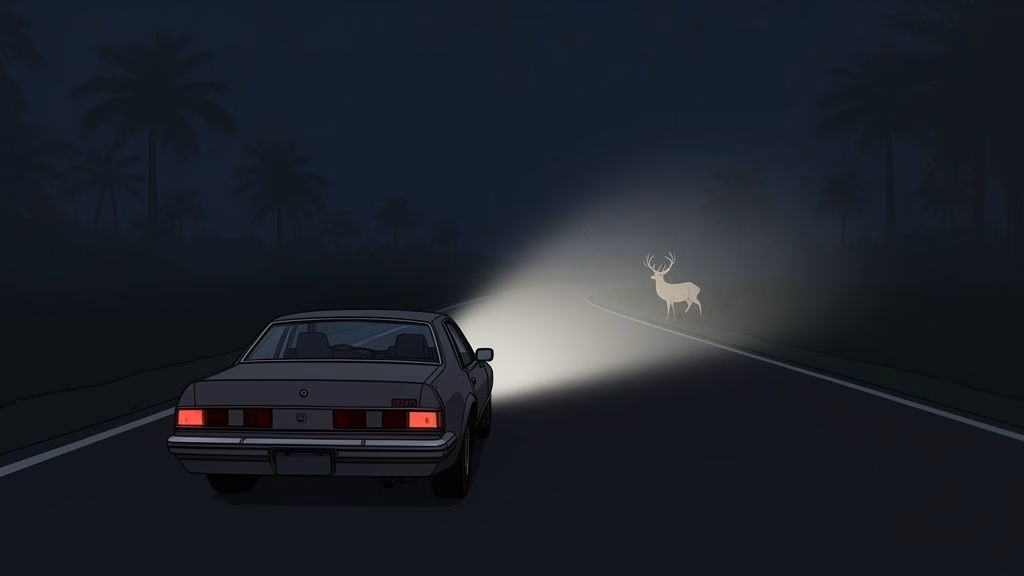
Ever hear the term "overdriving your headlights"? It's a phrase that gets tossed around in driver's ed, but what does it actually mean behind the wheel?
Simply put, you're overdriving your headlights when you're moving so fast that you can't stop within the distance your headlights illuminate. You're effectively driving blind, moving into a patch of darkness your car can't possibly stop in time to avoid.
The Core Conflict: Speed vs. Sight
Think of it like this: you're sprinting full-tilt down a dark hallway holding a small flashlight. If you run faster than the beam lights up the path ahead, you're going to slam into a wall you never even saw coming. That's a perfect picture of what happens on the road.
This isn't just a problem for daredevils on deserted highways. It can happen to any of us who accidentally create a dangerous mismatch between our speed, our visibility, and our car's stopping power. For Florida drivers, especially those taking a Basic Driver Improvement (BDI) course, mastering this concept is non-negotiable for staying safe at night.
The Key Elements at Play
The danger boils down to three factors that start working against you the moment your speed climbs:
- Headlight Reach: Your standard low beams typically light up about 160-250 feet of road. High beams push that out to 350-500 feet, but you can't always use them around other traffic.
- Thinking and Reacting: It takes the average driver about 1.5 seconds to spot a hazard, process it, and hit the brakes. If you're doing 60 mph, your car will have already traveled 132 feet before you even start to slow down.
- Braking Distance: This is how far your car skids or rolls after you've slammed on the brakes. It changes dramatically with your speed, the road conditions, and your vehicle's condition.
Add your reaction distance to your braking distance, and you get your total stopping distance. The problem is, this number can easily become much longer than the reach of your headlights. That gap is where the unexpected happens.
To make this crystal clear, let's break down the relationship between these components.
Understanding the Core Concept at a Glance
| Driving Component | What It Means in This Context | Why It's a Safety Factor |
|---|---|---|
| Visibility Distance | The stretch of road lit by your headlights (e.g., ~250 ft with low beams). | This is your entire field of view. Anything beyond it is an unknown hazard. |
| Reaction Distance | The distance your car travels in the time it takes you to see a danger and react. | At higher speeds, you cover a massive distance before your foot even hits the brake. |
| Braking Distance | The distance the car needs to come to a complete stop after the brakes are applied. | This distance increases exponentially with speed, not linearly. |
| Total Stopping Distance | Reaction Distance + Braking Distance. | If this number is greater than your Visibility Distance, you are overdriving your headlights. |
When the final number in that last row exceeds the first, you're in a dangerous situation.
Worse yet, research from the NHTSA shows that drivers consistently overestimate how much light they need, with poor headlight visibility contributing to at least 19% of single-vehicle nighttime crashes. Knowing when you should use your headlights is the foundation, but understanding this speed-to-sight ratio is what keeps you out of trouble when the sun goes down.
The Unforgiving Physics of Stopping at Night
To really get why overdriving your headlights is so dangerous, you have to think about what it takes to actually stop a moving car. It’s not instant. Far from it. Stopping is a process, a sequence of events that eats up precious time and distance—and it gets hungrier the faster you go.
This whole sequence is what safety experts call the total stopping distance. It isn't just about your brakes. It’s a dance between your brain, your body, and your car's mechanics.
The Three Stages of a Sudden Stop
Every single time you hit the brakes for an emergency, you go through three distinct phases. Understanding these is the first step to safer night driving.
- Perception Distance: This is the ground you cover from the moment your eyes spot a hazard to the second your brain actually processes it as a danger. It might feel instant, but it's not. Even at a moderate speed, this can take nearly a second.
- Reaction Distance: Once your brain sounds the alarm, you still have to act. The distance your car travels while your foot moves from the gas to the brake pedal is the reaction distance. For most drivers, that’s another fraction of a second lost.
- Braking Distance: This is the big one. It’s the space your car needs to grind to a halt after you’ve hit the brake pedal. Your speed, tires, and the road conditions have a huge say in how long this part of the journey is.
These three distances don't just add up—they multiply the danger. A little extra speed dramatically increases the braking distance you need. If you're curious about the math behind it, we break it down in our guide on how to calculate stopping distance.
Where Speed Overwhelms Sight
Let’s translate this into a real-world scenario. Say you’re cruising along at 60 mph on a dark road. A deer suddenly leaps into your path.
It takes the average driver about 1.5 seconds just to see the deer and react. In that brief window, your car has already barreled forward 132 feet.
That’s more than half the distance your low-beam headlights can even illuminate, and you haven't even started braking yet.
Now, add the braking distance. On a dry road, a typical car needs another 180 feet or so to stop from that speed. Your grand total to come to a complete halt? 312 feet.
Your low beams, however, only light up about 250 feet of road. That leaves a 62-foot blind spot—a stretch of pavement where you simply cannot stop in time for a hazard you can see. You’re driving blind.
This is the core of the problem, and this chart makes it painfully clear.

As you can see, the faster you go, the more your stopping distance outpaces your headlight range. This is exactly why managing your speed is the single most important thing you can do to stay safe when driving at night.
Recognizing the Warning Signs on the Road
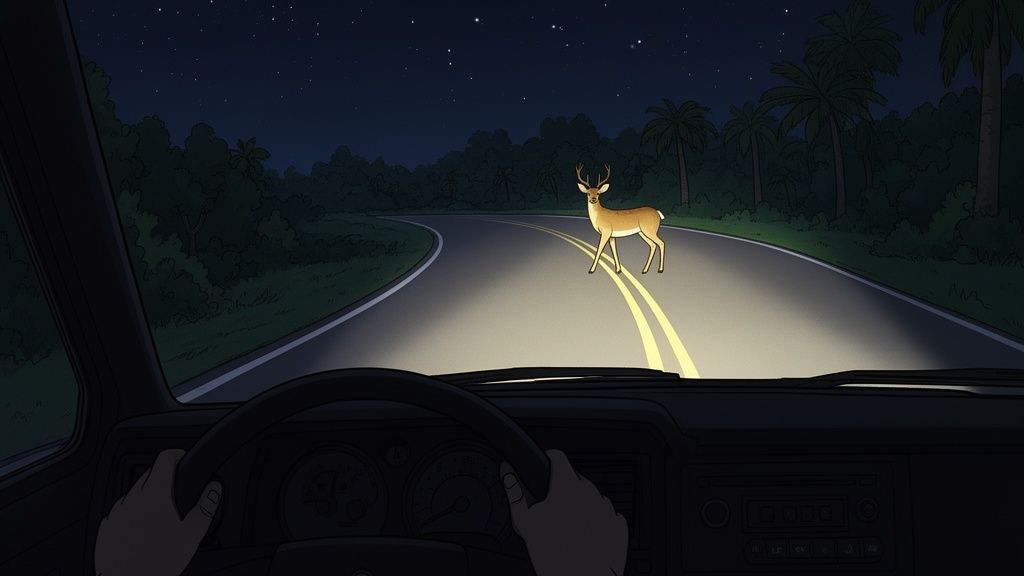
Knowing the physics behind overdriving your headlights is one thing, but actually catching yourself doing it on the road is a totally different skill. It’s a subtle feeling that can easily sneak up on you, especially on those familiar roads where you tend to autopilot. The real trick is learning to spot the specific visual cues that tell you you're moving too fast for what you can actually see.
The most common sign? A constant feeling of being surprised. Road signs, turns, or debris on the pavement seem to just "pop" into view at the last possible second. You feel like you're just reacting to whatever the road throws at you instead of anticipating what's next.
Driving Scenarios Where Risk Is High
Some situations are practically designed to get you into trouble. Think of these as red flags—immediate warnings to check your speed and sharpen your focus. Learning to spot these environments is a huge part of being a smart, defensive driver.
- Dark, Winding Roads: Picture a curvy country road at night. Your headlights shine straight ahead, but the road bends away into darkness. By the time your lights finally hit the curve, you might be carrying way too much speed to make the turn safely.
- Hilly Terrain: As you drive over the crest of a hill, your headlights point up into the empty sky for a moment, leaving the entire downward slope hidden in shadow. For a few critical seconds, you are driving completely blind.
- Inclement Weather: Rain, fog, and even smoke can slash your headlight range. A beam that normally reaches 250 feet on a clear night might only cut through 100 feet of a downpour. This means your safe speed has to drop, too.
In every one of these cases, your actual sight distance is a fraction of what it would be on a straight, dry road. If you don't adjust your speed, you're creating a serious, invisible danger for yourself.
Tuning Into Your Senses
It’s not just about what you see; your body often knows when something isn’t right. Pay attention to those gut feelings and physical sensations while you drive. They can be powerful clues that you're pushing the limits.
Think about it—are your shoulders tensed up? Are your hands gripping the wheel a little too tight? That's often a sign your brain is working overtime to process a fast-moving stream of limited visual information. It’s a classic symptom of going too fast for the conditions.
The most telling sign is feeling "behind" your reactions. If you see a pothole and only have time to brace for impact instead of swerving, you are moving faster than your perception-reaction time allows. This is the definition of overdriving your headlights.
Get into the habit of running a quick mental check. Ask yourself, "If a deer jumped out at the very edge of my headlights right now, could I stop in time?" If the answer isn't a confident, immediate "yes," it's time to ease off the accelerator. By learning to recognize these warning signs, you shift from being a passive passenger to an active, defensive driver who's truly in control.
How Modern Headlights Create New Challenges

It sounds strange, doesn't it? The idea that today’s brighter, more powerful headlights could actually introduce new dangers to night driving. But that's exactly what's happening. While advanced tech like LED and HID (High-Intensity Discharge) lights throw a crisp, white light that certainly helps one driver see farther, they can create a blinding glare for everyone else on the road.
This leads to a dangerous paradox. The very technology meant to make you safer can temporarily blind oncoming drivers, instantly forcing them into a situation where they are overdriving their headlights. When you get hit with that wall of light, your useful vision plummets to near zero for several critical seconds.
The Problem of Glare and Vehicle Height
This glare problem is getting worse, and it's largely fueled by two major trends in the cars we drive today: the incredible brightness of new headlight systems and the sheer number of SUVs and trucks on the road.
Think about it. When a taller vehicle’s powerful headlights line up perfectly with the eye level of a driver in a smaller sedan, the effect is completely overwhelming. And the problem isn't just about vehicle height; even misaligned headlights on a regular car can cause issues, which can happen from something as simple as loading up the trunk with heavy cargo or hitting a bad pothole.
When an oncoming car’s intense glare dazzles you, your ability to perceive hazards disappears. For a moment, your safe stopping distance is infinite because your sight distance has been reduced to nothing.
You're immediately forced onto the defensive. Instead of scanning the road ahead for hazards, you're just trying to protect your own vision and keep control of your car.
Your Best Defense Against Blinding Headlights
As a Florida driver, you know this scenario all too well. The best defensive driving tactic is surprisingly simple: when faced with overpowering headlights, shift your gaze down and to the right. Focus on the white line that marks the edge of your lane.
This simple trick accomplishes two critical things:
- Preserve Your Night Vision: By looking away from the direct light source, you stop your pupils from constricting too much. This helps your eyes recover much faster after the car passes.
- Maintain Your Lane Position: The white line becomes your guide, allowing you to stay safely in your lane without staring into the blinding glare.
This isn't just a minor annoyance; it's a growing safety concern. A 2018 evaluation of 424 different headlight variations found that a shocking 67% received a marginal or poor rating, citing either inadequate visibility or excessive glare. You can discover more insights about these headlight concerns and the growing issue of "headlight dazzling" that makes it so much easier to accidentally overdrive your headlights.
The Legal and Insurance Consequences in Florida
Overdriving your headlights isn't just a bad habit—it's a mistake that can have serious legal and financial consequences, especially here in Florida. What starts as a simple traffic stop can quickly escalate, affecting everything from your driving record to your insurance rates.
The core issue comes down to Florida's "basic speed law." This isn't about the number on the sign; it's about common sense. The law requires you to drive at a speed that's safe and reasonable for the conditions you're in. On a dark, rainy night or an unfamiliar country road, that safe speed is often much lower than the posted limit.
How Fault Is Determined After Dark
When a crash happens at night, police don't just look at the speed limit. They become investigators, trained to figure out if a driver was moving too fast for what they could see.
They'll analyze skid marks, examine the debris field, and assess vehicle damage to piece together what happened. If the evidence shows your stopping distance was longer than the reach of your headlights, you'll likely be found at fault. This can result in a citation for "Driving Too Fast for Conditions," even if you weren't technically speeding.
A ticket for overdriving your headlights is more than a fine. It’s an official record stating your speed was unsafe, and that piece of paper becomes powerful evidence for insurance companies when they decide who pays for the damage.
The Ripple Effect on Your Insurance
Being found at fault for overdriving your headlights sends shockwaves through your insurance. While Florida is a "no-fault" state for initial injury claims, that label can be misleading. It doesn't apply to property damage, and fault is still the single most important factor in determining who is financially responsible for repairs. It’s essential to understand what a no-fault accident means in detail.
An at-fault determination for unsafe speed almost always leads to:
- Skyrocketing Premiums: Expect your insurance rates to climb significantly after an at-fault crash.
- Claim Complications: If your driving is deemed negligent, your insurer might challenge or even deny parts of your claim.
- Personal Liability: You could be on the hook for any damages that exceed your policy's coverage limits.
It’s not just your own speed, either. Glare from other drivers' headlights is a huge, often underreported, factor in nighttime collisions. While UK statistics officially linked glare to 216 crashes in 2023, the real number is certainly higher. Some studies even suggest that headlight glare could be a contributing factor in as many as 12% to 15% of all traffic accidents—a sobering thought for anyone on the road after dark.
Florida Traffic Violations for Unsafe Speed
In Florida, several statutes can be used to cite a driver for overdriving their headlights. It isn't just one specific law, but a collection of rules related to maintaining a safe and prudent speed for the conditions. Here’s a look at the most common violations an officer might issue.
| Florida Statute | What It Prohibits | Potential Consequences |
|---|---|---|
| 316.183(1) | Unlawful Speed: Driving at a speed greater than is reasonable and prudent under the conditions, with regard to actual and potential hazards. This is the classic "basic speed law." | Fines, points on your license, and mandatory court appearances in some cases. |
| 316.183(4) | Driving Too Slowly: Driving so slowly that you impede the normal and reasonable movement of traffic, except when necessary for safe operation. This can apply if you're overly cautious to the point of being a hazard. | Fines and potential points on your license. |
| 316.185 | Special Hazards: Requires drivers to reduce speed when approaching hills, curves, intersections, or other special hazards. Driving at night is often considered a special hazard. | Increased fines and a determination of fault in an accident. |
| 316.1925 | Careless Driving: Driving without "due regard for the width, grade, curves, corners, traffic, and all other attendant circumstances." Overdriving headlights falls squarely under this. | Fines, points on your license, and potential driver education course requirements. |
Being cited under any of these statutes after a crash makes it very difficult to argue you weren't at fault. It's a clear signal to insurance adjusters that your actions contributed directly to the collision, making the financial and legal fallout that much worse.
Actionable Strategies to Stay Safe at Night
Knowing the theory behind overdriving your headlights is one thing, but avoiding it comes down to building smart, practical habits. This is where defensive driving stops being an abstract concept and becomes your most important tool for staying in control when the sun goes down.
These aren't complex maneuvers that take years to master. They're simple, conscious choices you make until they become second nature. By weaving them into how you drive at night, you create a crucial buffer of safety for yourself and everyone else sharing the road.
Master Your Speed and Following Distance
The most powerful safety feature in your car isn't a sensor or an alarm—it's your right foot. Slowing down is the single most effective way to keep your stopping distance safely inside the beam of your headlights. A great rule of thumb is to drive at least 10-15 mph slower at night than you would on the same road in daylight.
Slowing down naturally helps with the next crucial step: adjusting your following distance. We all learned the "3-second rule" in driver's ed, and it's fantastic for daytime driving. But at night, it just doesn't cut it.
The 4-Second Rule for Night Driving:
Give yourself at least a four-second gap between you and the car ahead. This extra cushion gives your brain more time to register what's happening, react to their brake lights, and stop smoothly—all within the area your headlights can actually illuminate.
That one extra second is a surprisingly effective safety net against the unknown. For a deeper dive into techniques like this, check out these essential night driving tips.
Prioritize Headlight Maintenance
Think of your headlights as your eyes on the road. If they're not in top shape, you're driving with impaired vision. That's why the proper maintenance of your vehicle's lighting system isn't just a suggestion; it's a non-negotiable part of staying safe.
- Keep Lenses Crystal Clear: Over time, plastic headlight lenses get hazy and yellowed from UV rays and road debris. This oxidation can block up to 50% of the light, which is a massive reduction in visibility. Clean them regularly, and if they look foggy, use a restoration kit to bring them back to life.
- Check Your Alignment: You don’t need to be in a major collision to knock your headlights out of alignment. A nasty pothole or a minor bump against a parking block can do it. When they're aimed too low, you're robbing yourself of precious distance. Aimed too high, and you're blinding other drivers. Get them checked by a mechanic once a year.
Use Your High Beams Intelligently
Your high beams are a game-changer, extending your view from around 200 feet on low beams to as far as 350-500 feet. They’re a critical safety tool, but they come with a responsibility.
Get in the habit of flipping on your high beams any time you’re on a dark, open road with no one ahead of you. The key is to be just as quick to flip them off. The moment you spot the headlights or taillights of another vehicle, switch back to your low beams to avoid dangerously blinding the other driver.
Frequently Asked Questions
How can I tell if my headlights are aimed properly?
There's a quick at-home test you can do. Park your car on a flat, level surface about 25 feet back from a garage door or a flat wall. Take a look at where the most intense part of your low-beam pattern hits the wall—it should be right at or just slightly below the physical height of the headlight bulbs on your car.
If the beams are pointing up into the sky or are noticeably uneven, you're likely blinding oncoming drivers. While the garage door test is a good starting point, the best and safest solution is to have a professional mechanic make the fine-tuned adjustments.
Does "overdriving your headlights" only happen at highway speeds?
Not at all. This is a common misconception. You can easily find yourself overdriving your headlights at much lower speeds, especially when bad weather rolls in.
Imagine you're driving at just 30 mph through dense Florida fog, and you can barely see 50 feet in front of you. Your stopping distance at that speed is going to be significantly longer than your visibility. The key is to always adjust your speed to what you can actually see, regardless of what the speed limit sign says.
Are those super-bright aftermarket LED bulb upgrades a good idea?
They often create more problems than they solve. The issue is that the headlight housing—the reflector and lens—is engineered specifically for the type of bulb it came with, usually a halogen.
When you drop a powerful LED bulb into a housing designed for a halogen, the light can scatter everywhere instead of being focused down the road. This creates a blinding, dangerous glare for other drivers and may not even improve your own visibility. For safety and legality, it's always best to stick with high-quality bulbs that are designed for your vehicle's specific headlight assembly.