Florida traffic school is a state-approved option for many drivers with an eligible moving violation to keep points from being added to their license and to help stop insurance rates from increasing. That matters because roadway risk is serious: 37,461 people died in U.S. traffic crashes in 2016, about 102 deaths per day.
If you’re reading this right after getting a ticket, you’re probably asking a few urgent questions at once. Do I have to pay right now? Can I keep points off my record? What course do I need? And how do I make sure I don’t miss a deadline?
The good news is that traffic school is usually much simpler than it sounds. For many Florida drivers, it’s less about punishment and more about using a clear process to protect your driving record, satisfy the court, and move on without creating a bigger problem.
That’s the lens to use for everything that follows. Traffic school can be helpful, but the guaranteed result is compliance. It helps you handle the ticket correctly. Whether it also changes your habits behind the wheel depends on how seriously you take the course.
Your Guide to Florida Traffic School
The moment a ticket lands in your hand, the process feels bigger than it is. Most drivers immediately think about points, insurance, and whether one mistake is about to follow them for years.
Traffic school gives you a practical path forward. In plain terms, it’s often the option that lets an eligible driver respond to a moving violation without accepting the worst administrative outcome.
What traffic school actually does
The most important thing to understand is this: traffic school is primarily a compliance tool.
That may sound less exciting than “become a dramatically better driver,” but it’s the honest answer. A state-approved course is designed to satisfy court or administrative requirements and, in many situations, help you avoid points being added to your license.
Practical rule: Take traffic school for the outcome it guarantees, not for promises nobody can guarantee.
That honesty matters because drivers often expect too much from a short course. Pennsylvania’s driver education framework shows how much more intensive full training can be, with 30+ hours of classroom theory and behind-the-wheel instruction in an approved program, which is far beyond the scope of a short compliance course for a ticket (Pennsylvania driver education program requirements).
Why that’s still valuable
A short course can still be very useful.
If you’ve received a ticket and you’re eligible, traffic school can help you:
- Protect your record: Keeping points off your license can prevent bigger problems later.
- Reduce financial fallout: Avoiding point-related consequences may help you avoid insurance increases.
- Close the loop properly: You satisfy the requirement instead of guessing your way through court paperwork.
If you want a practical example of the kind of course many Florida drivers use after a citation, a Florida traffic safety course for all drivers shows the typical format: online, self-paced, and focused on satisfying the requirement clearly.
The right mindset from the start
Think of traffic school as a reset opportunity, not a moral judgment.
You’re not signing up because you’re a terrible driver. You’re using an approved process to deal with a mistake efficiently and keep a minor violation from turning into a larger administrative and financial headache.
That makes the next step easier. Once you understand what traffic school is for, the rest of the process becomes much more manageable.
What Is Florida Traffic School
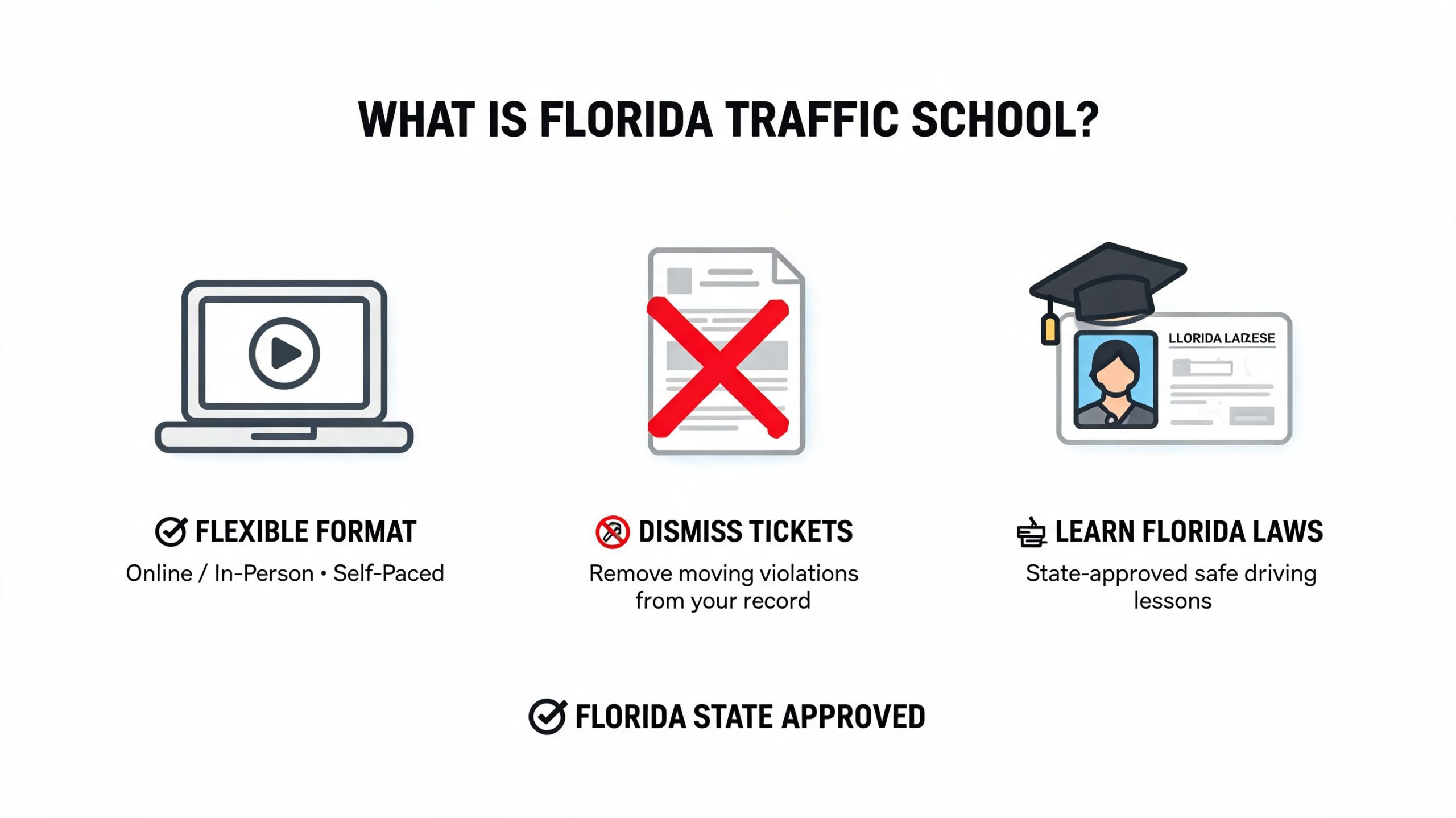
Florida traffic school is a state-regulated driver improvement course. It reviews traffic laws, safe driving habits, and the kinds of errors that commonly lead to tickets and crashes.
It helps to think of it as a structured refresher with a legal purpose. For many eligible drivers, it works like a reset button for a moving violation. You complete the approved course, satisfy the requirement, and protect your driving record from the usual point-related consequence.
Why states use traffic school at all
Traffic school didn’t appear out of nowhere. States use these programs because traffic safety is a large public problem.
NHTSA reported 37,461 traffic deaths in 2016, about 102 deaths per day, which helps explain why states use education and retraining as part of traffic safety policy (NHTSA roadway fatality figures cited here).
That same public safety logic shows up in other transportation settings too. The broader point is simple: education is one of the tools governments use when they want drivers to review risky behavior before it becomes a repeat pattern.
What you learn in a Florida course
A typical traffic school course focuses on the behaviors that often lead to citations and preventable crashes. That usually includes:
- Right-of-way rules: Who yields, when, and where drivers commonly make mistakes
- Speed awareness: Why speed affects stopping distance, judgment, and crash severity
- Defensive driving: How to create space, anticipate mistakes, and avoid chain-reaction decisions
- Distraction and attention: Why short lapses lead to real violations
- Attitude and decision-making: How impatience, stress, and routine driving habits affect judgment
If you’re unsure whether your ticket qualifies as the type of offense that leads drivers into this process, this overview of moving violations in Florida can help clarify the category.
Traffic school isn’t just about “passing a class.” It’s about showing the state that you completed an approved review of the driving behavior connected to the citation.
What traffic school is not
It’s not the same as full driver education for a new driver.
It’s also not a guarantee that someone will become safer just by clicking through lessons. The course creates the opportunity to review and correct behavior. What happens after that depends on the driver.
That distinction removes a lot of confusion. Traffic school is a targeted remedy for a specific problem. Once you see it that way, the process makes much more sense.
The Main Benefits of Attending Traffic School
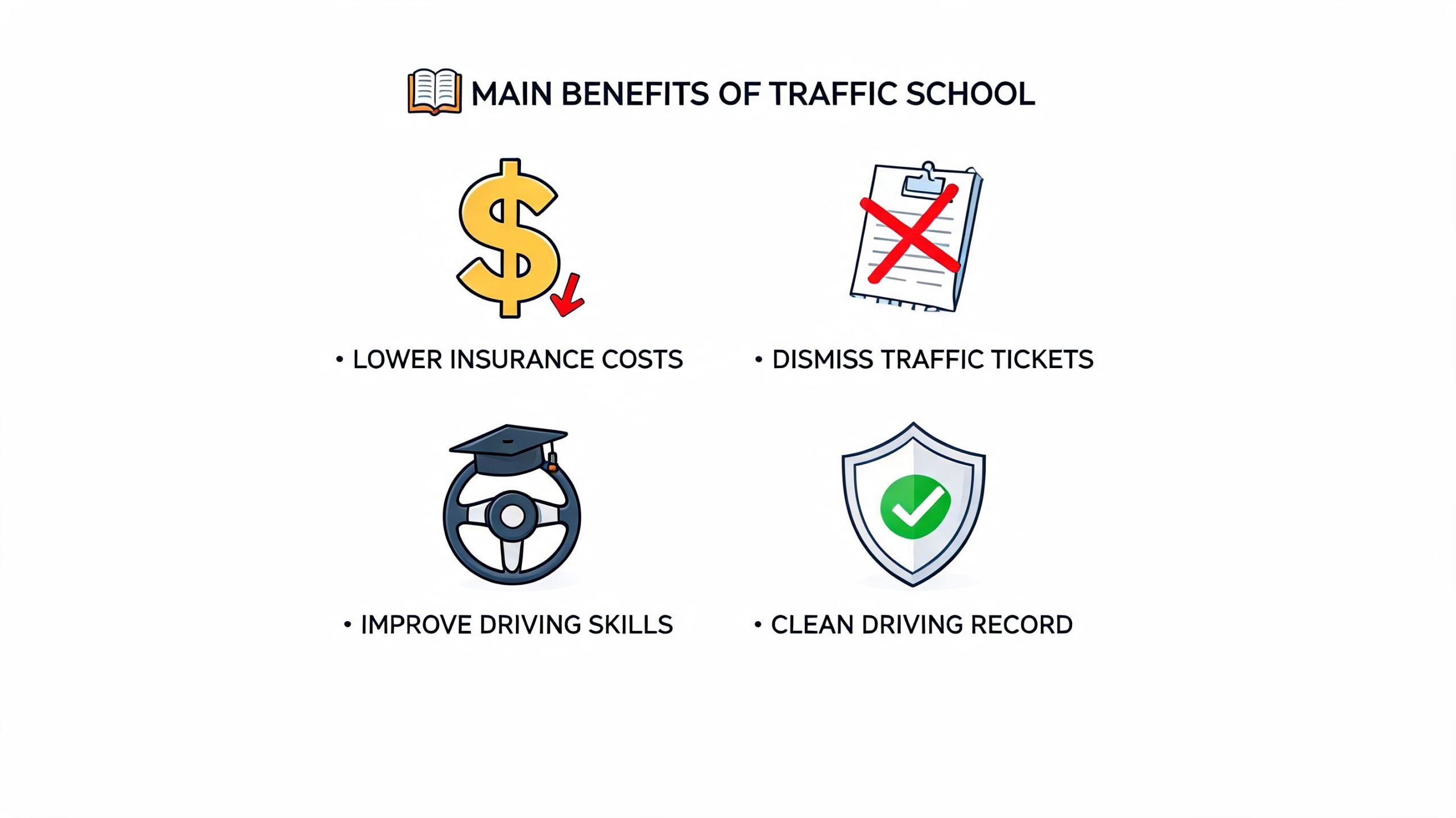
The strongest reason to attend traffic school is practical. It can help you contain the consequences of a ticket before they spread into other parts of your driving life.
Most drivers care about three things. Points, insurance, and court compliance. Traffic school sits right at that intersection.
Benefit one, protecting your license record
For an eligible moving violation, traffic school can prevent points from being added to your license. That matters because points don’t just sit on a record. They can affect how insurers and courts view your driving history.
A single ticket may feel minor. But many drivers take traffic school because they don’t want one event to become part of a larger pattern on paper.
If your main goal is exactly that, this guide to a Florida defensive driving course for point reduction is the kind of resource drivers often look for when deciding whether the course is worth the effort.
Benefit two, reducing the chance of higher insurance costs
Insurance is often the hidden issue behind a ticket.
Even when the fine itself is manageable, drivers worry about what happens afterward. Traffic school is appealing because it can help prevent the chain reaction that starts with points and ends with higher ongoing costs.
A ticket is rarely just a one-day problem. Drivers usually feel the real stress when they think about what it could do to their record and monthly bills.
Benefit three, satisfying a legal requirement
Sometimes the biggest benefit is simple. You need to complete the course because the court or judge requires it.
In that situation, traffic school isn’t optional strategy. It’s the step that closes the case correctly. Completing the right course on time can keep a manageable ticket from turning into a deadline problem.
Why the curriculum focuses on the same few behaviors
Traffic school courses don’t pick topics at random. They emphasize the driving behaviors most closely tied to serious outcomes.
NHTSA reported that speeding was involved in 12,151 fatalities in 2022, representing 29% of total traffic deaths. Among drivers involved in fatal crashes, 18% were speeding, and for drivers ages 15 to 20, the shares were 35% for male drivers and 19% for female drivers (NHTSA speeding data).
That’s why traffic school spends time on:
- Speed control
- Following distance
- Hazard recognition
- Decision-making under pressure
Those aren’t filler lessons. They’re the core behaviors tied to the kinds of mistakes that lead to both tickets and severe crashes.
Choosing the Right Florida Traffic Course
One of the most common points of confusion is that “traffic school” sounds like one single class. In practice, Florida drivers may run into several different course types depending on why they were sent there.
The right course depends on your situation, not your preference. Start with the reason you need the class. Was it a standard moving violation, a court order, an aggressive driving issue, or an insurance-related refresher for an older driver?
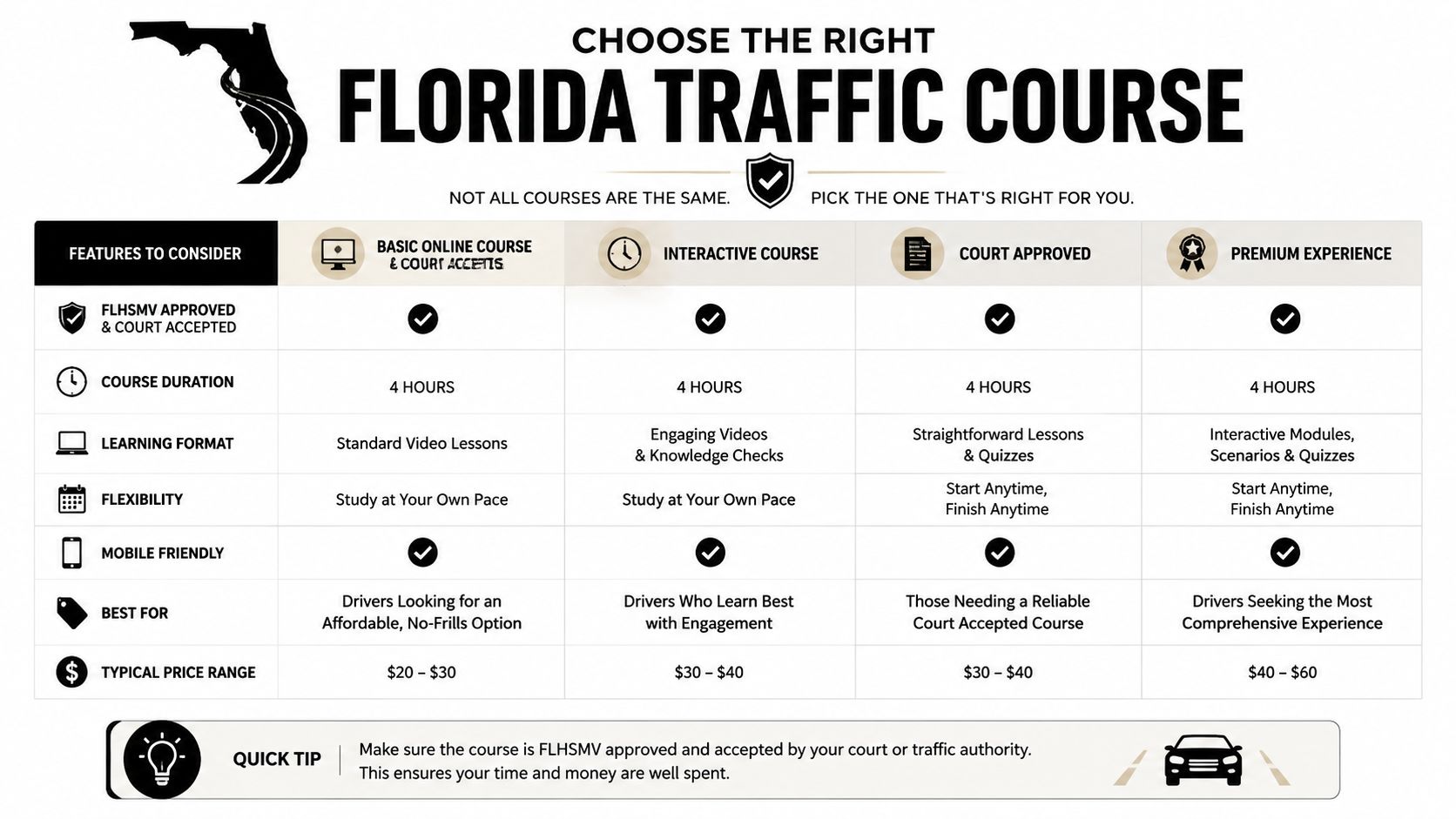
Four common Florida course types
Here’s a simple side-by-side view.
| Course | Typical use | What to know |
|---|---|---|
| 4-Hour Basic Driver Improvement (BDI) | Common for an eligible moving violation | Often chosen by drivers trying to avoid points after a ticket |
| 8-Hour Intermediate Driver Improvement (IDI) | Usually tied to a court order or more serious administrative need | More involved than the basic course |
| 8-Hour Aggressive Driver Course | Assigned when aggressive driving behavior is part of the issue | Focuses more directly on behavior and responsibility |
| 6-Hour Mature Driver Program | Usually taken by older drivers seeking a refresher or insurance-related benefit | Less about a recent citation, more about review and continued safety awareness |
How most drivers identify the correct course
The clerk, court notice, or referral paperwork usually tells you what category applies. If it doesn’t, don’t guess.
A basic rule works well here:
- If you got a standard moving violation and want the usual point-avoidance option, start by checking whether a 4-hour BDI course is the required path.
- If a judge specifically ordered a course, follow that wording exactly.
- If the paperwork mentions aggressive driving, don’t substitute a general class.
- If you’re taking a refresher for age-related insurance purposes, look for the mature driver format.
The wrong course can waste both time and money. “Traffic school” is a category, not a guarantee that every class satisfies every requirement.
What to compare before you enroll
Once you know the course type, compare providers on fit and logistics.
Look at:
- Approval status: The provider needs to be state-approved for the course you need.
- Delivery method: Online self-paced access is usually easier for working adults.
- Language availability: Important if you’re more comfortable learning in Spanish or Portuguese.
- Support access: If you hit a problem close to a deadline, live support matters.
- Certificate handling: You want clear information on how completion is issued and reported.
If you want to browse a course category designed for online completion, approved online traffic school options show the kind of format many Florida drivers prefer.
A simple decision example
Take two drivers.
One gets a straightforward speeding ticket and is trying to avoid points. That driver is usually looking at the basic course.
Another appears in court and receives a specific order to complete a longer program. That driver should not sign up for a standard 4-hour course just because it’s faster.
The lesson is simple. Match the class to the requirement first. Convenience comes second.
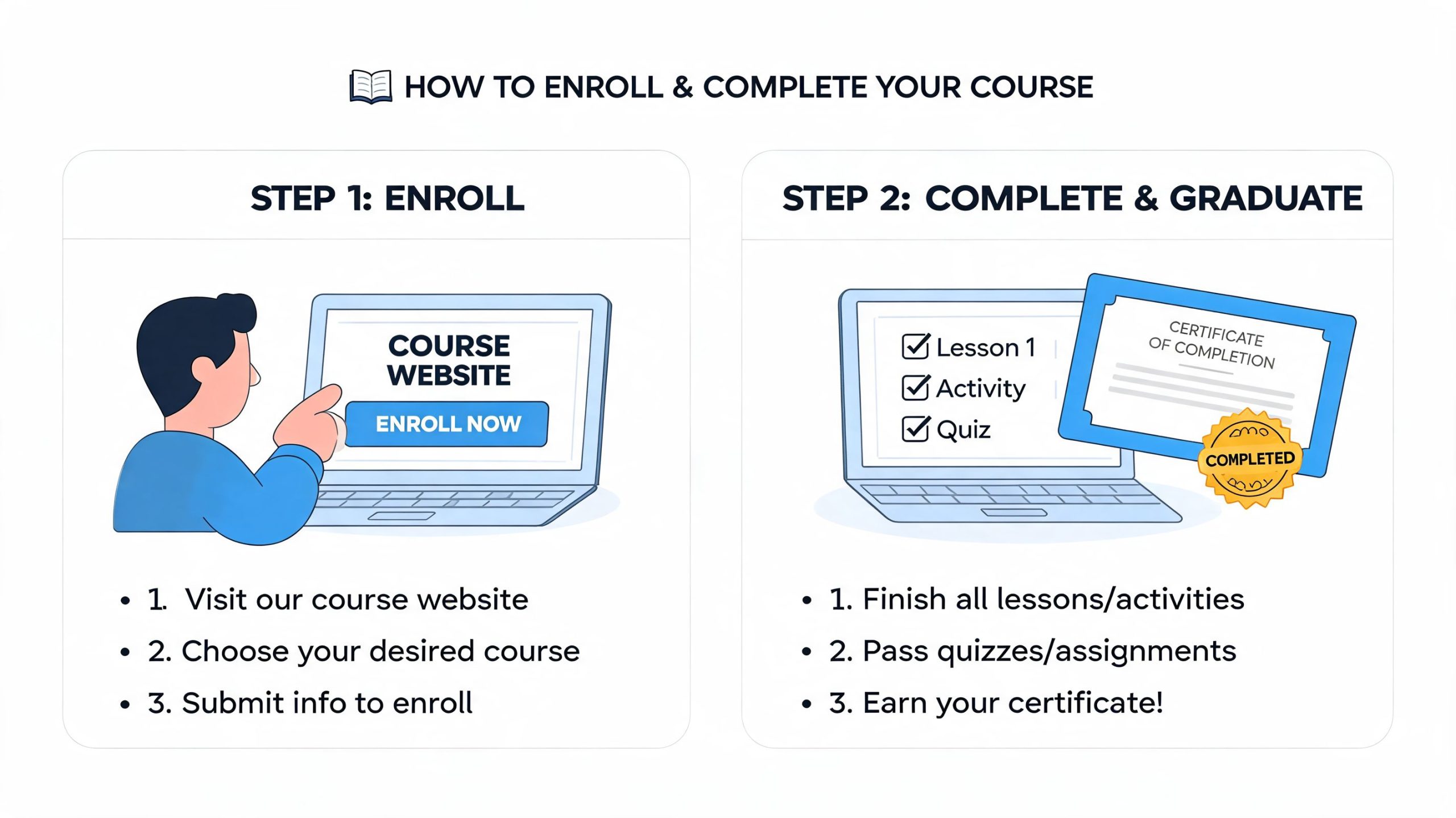
How to Enroll and Complete Your Course
Once you decide to use traffic school, the process becomes administrative. That’s good news, because administrative problems are easier to solve when you handle them in order.
The key is not to start with the course itself. Start with your ticket and your deadline.
Step one, respond to the citation
Florida drivers generally need to make their election through the county clerk process within the required deadline. Many drivers know this as the period in which they choose how to handle the citation.
In practical terms, that usually means:
- Review the ticket carefully
- Confirm you want to elect traffic school if eligible
- Pay the required fine and any applicable administrative amount through the proper court channel
- Keep records of what you submitted
If you wait too long, the problem shifts from “which course should I take?” to “did I miss my option entirely?”
Step two, verify the school before paying
This is the single easiest place to make a costly mistake.
The most important enrollment step is choosing a provider approved by the Florida Highway Safety and Motor Vehicles. The state maintains an official lookup process for approved traffic schools, and approval status determines whether the course counts for court or point-related purposes.
Step three, register for the correct course
After verification, enroll in the specific course your case requires.
At this point, check a few details before you begin:
- Your name and identifying information: Make sure it matches what the provider needs for reporting.
- Course type: Basic, intermediate, aggressive driver, or mature driver.
- Deadline fit: Make sure you have enough time to finish comfortably.
- Certificate process: Understand whether the provider reports completion directly, issues a certificate to you, or both.
One example of a Florida provider in this space is BDISchool, which offers online driver improvement courses in English, Spanish, and Portuguese and states that certificates are issued electronically.
Step four, complete the course and confirm reporting
Most online traffic school programs are self-paced, which helps if you’re fitting the course around work or family obligations.
That flexibility doesn’t remove the need to finish. Complete every lesson, pass any required assessments, and confirm that your completion was properly issued or reported.
Don’t assume “I finished the course” and “the state received proof” mean the same thing. Always verify the final administrative step.
A short completion checklist
Before you consider the matter closed, confirm these items:
- Election made: You chose traffic school through the proper court channel
- Correct provider selected: The school was approved
- Correct course finished: You completed the exact program your case required
- Proof handled: Certificate issuance or reporting was completed
- Records saved: You kept your receipt and confirmation details
That final check can spare you a lot of unnecessary follow-up.
Tips for Success and Choosing a Provider
Most drivers don’t struggle with the material. They struggle with timing, distractions, and picking a provider that turns a simple requirement into a confusing one.
The easiest way to avoid that is to choose for convenience and clarity, not just cost. Price matters, but it’s rarely the only factor that affects whether you finish on time.
What helps busy drivers most
Providers often compete on the parts of the experience that have nothing to do with traffic law and everything to do with completion.
When comparing schools, look for features such as 24/7 self-paced access, live phone support, and same-day certificate processing, since those features are commonly highlighted by providers serving deadline-driven students.
That kind of setup matters because real life gets in the way. A parent may need to study late at night. A shift worker may only have short windows on a phone. A driver close to a deadline may need support the same day.
A better way to compare providers
Use this checklist before enrolling:
- Check approval first: Marketing language doesn’t matter if the course isn’t approved for your purpose.
- Look for self-paced mobile access: If you can study from your phone, tablet, or laptop, it’s easier to finish.
- Ask about support hours: If a login or reporting issue happens, you need a human response.
- Confirm certificate timing: Fast processing can matter when the deadline is close.
- Review language options: English, Spanish, and Portuguese can make a real difference in comprehension.
Small habits that make completion easier
Drivers often overestimate how much uninterrupted time they’ll have.
Instead, try this:
- Start early: Don’t save the whole course for the last day.
- Break it up: Short sessions are easier to complete than one long sitting.
- Finish the admin step: After the course, verify reporting or certificate delivery.
- Save every confirmation: Screenshot receipts, emails, and completion notices.
A smooth traffic school experience usually comes down to one thing. Choosing a provider that makes finishing easy.
Florida Traffic School FAQ
Can traffic school make me a better driver
It can help, but that’s not the guaranteed outcome.
The guaranteed benefit is compliance. You satisfy the requirement and, when eligible, protect your driving record from points. Whether it changes your habits depends on your attention and follow-through.
Do I need to verify that a school is approved
Yes. Always.
If the provider isn’t properly approved for your purpose, finishing the course may not satisfy the court requirement or help with point-related outcomes.
Is online traffic school accepted
Online traffic school is commonly used because it fits busy schedules. What matters most is not whether it’s online, but whether the provider and course are approved for the requirement you’re trying to satisfy.
How do I know which course I need
Look at your citation paperwork, court notice, or clerk instructions.
If the notice gives a specific course requirement, follow that exactly. If it’s a standard eligible moving violation, the basic course is often the one drivers ask about first.
What if I miss my deadline
Contact the court or clerk as soon as possible.
Missing the deadline can affect your ability to use traffic school as intended. Don’t assume the issue will fix itself just because you completed part of the process.
Does traffic school erase the ticket
No. It’s better to think of traffic school as a way to handle the violation strategically.
The ticket still existed. The value of traffic school is in the administrative outcome, especially satisfying the requirement and protecting your record when you’re eligible.
Can I wait to choose a provider later
You can, but waiting creates risk.
If you postpone enrollment too long, you leave less room for course completion, support issues, or certificate handling. It’s safer to verify approval and enroll well before the deadline.
Is the shortest course always the best choice
No.
The best course is the one that matches your legal requirement. A shorter course is only useful if it’s the correct one for your case.
If you need a state-approved online option, BDISchool offers Florida traffic school courses designed for drivers handling tickets, court requirements, point concerns, or insurance-related needs. You can review the available course types, choose the one that matches your situation, and complete the process in a format that fits a busy schedule.