

Texas defensive driving is a six-hour driving safety course approved by the Texas Department of Licensing and Regulation (TDLR). Drivers most often take it to dismiss an eligible traffic ticket, and some take it for an insurance discount. You can take it online, but the order of the steps matters. In most ticket cases the court has to approve the course before you start.
Below, you’ll find who qualifies, the steps to follow, the documents the court expects, and what to ask your insurer. One note first: Drivereducators.com offers state-approved courses for Florida, not Texas. For a Texas ticket you need a TDLR-approved provider, and we explain how to check that.
- The Texas course is a six-hour, TDLR-approved program. Providers may offer it online or in person.
- For a ticket, get the court’s permission first. After approval you generally have 90 days to finish and file your paperwork.
- You usually can’t use it for dismissal if you took a dismissal course in the last 12 months or hold a CDL. Some serious offenses are excluded.
- Insurance discounts are set by each insurer, so ask yours before you enroll.
Table of Contents
- What a Texas defensive driving course is
- Who can take it for ticket dismissal
- Steps to dismiss a Texas ticket
- What defensive driving costs in Texas
- Can it lower your insurance?
- How to choose a Texas provider
- Our perspective
- Where Drivereducators.com can help
- Defensive driving habits worth keeping
- FAQ
- Sources
What a Texas defensive driving course is
In Texas, “defensive driving” and “driving safety course” mean the same program. TDLR describes it as a six-hour educational course built to improve road safety. The curriculum covers:
- Traffic laws
- Defensive driving strategies
- Impaired and distracted driving
- Sharing the road
- Mechanical malfunctions
- Litter prevention
It is not a driving test and it is not a license class. You are not behind the wheel. You work through lessons, quizzes and a final assessment at your own pace, in sessions that fit your schedule.
The idea behind the course is simple. The state’s own safety material describes defensive driving as a way to reduce hazards created by other people’s bad driving. Most of what the course teaches is habit: more following distance, scanning ahead, and planning an exit before you need one. If you want a plain-language primer on those habits, see what defensive driving is and why it matters.
Online or in person
TDLR says providers may offer the six-hour course online or in a classroom. An online course must be at least as secure as a traditional classroom course and must meet the same educational objectives. In practice, an online course that is TDLR-approved counts the same as a classroom session for the court or insurer.
Who can take it for ticket dismissal
Dismissal is the most common reason to take the course, and it depends on three things: your ticket, your driving history and your license type. Harris County’s justice court guidance is a clear example of how courts apply the rules. You are generally eligible if:
- You hold a valid Texas driver’s license.
- You have not taken a course for dismissal in the previous 12 months.
- You do not hold a commercial driver’s license (CDL).
- The court gives you permission before you start.
This answers a common question: how often can you take it? For dismissal, once in a 12-month window. Your court’s own page is the final word, because courts run the process.
Tickets that usually don’t qualify
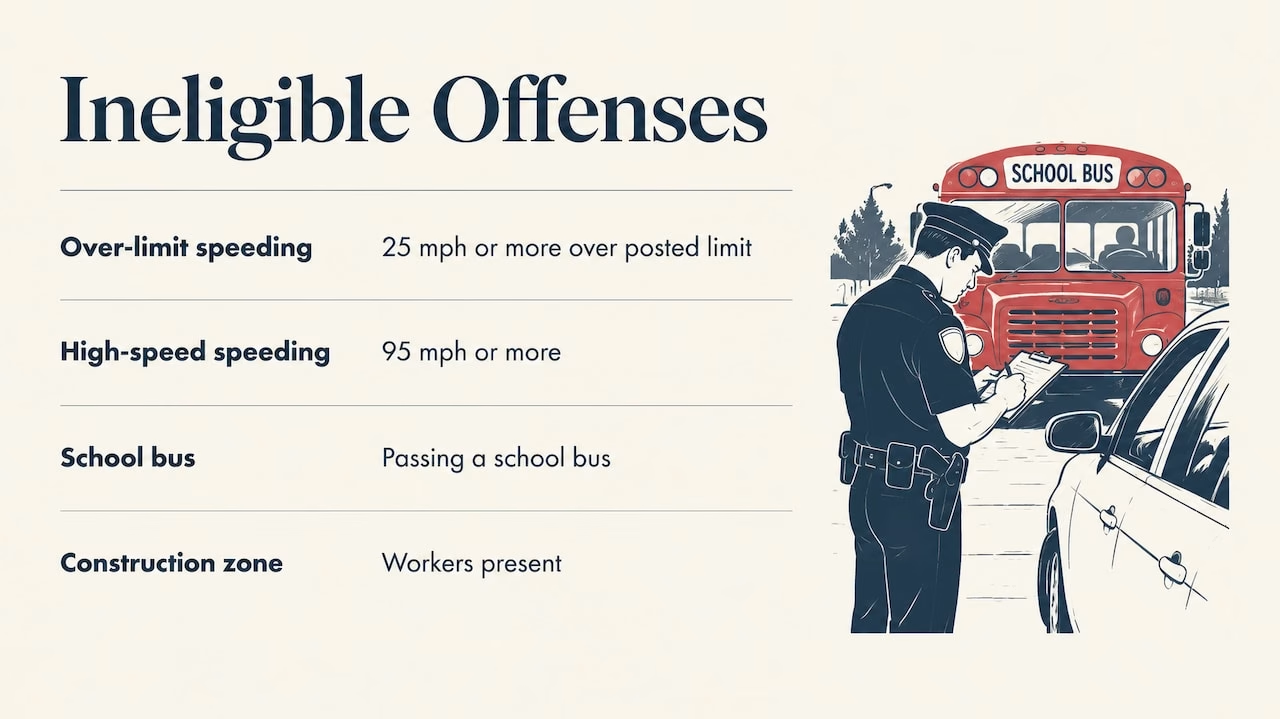
The same Harris County page lists offenses that are not eligible. They include speeding 25 mph or more over the posted limit, speeding at 95 mph or more, passing a school bus, and offenses committed in a construction zone with workers present. So a speeding ticket can qualify, but a very high speed usually will not.
If you are unsure, don’t guess. Call the clerk of the court on your citation or read its traffic page. Taking a course before you have permission can leave you with a certificate the court won’t accept.
Steps to dismiss a Texas ticket
Courts differ in the details, but the sequence is consistent across the courts we reviewed.
- Read your citation. Note the court, the appearance date and your ticket number.
- Request the course from the court. Under Harris County’s process, you plead guilty or no contest and ask for the course on or before your appearance date. The City of Houston’s municipal courts also tie the request to the arraignment date.
- Wait for approval. Town of Double Oak guidance says the court must first grant permission. Don’t start until you have it.
- Enroll with a TDLR-approved provider. Confirm the provider’s approval and that its course is the six-hour driving safety course.
- Finish within 90 days. After approval you generally have 90 days to complete the course and file the documents.
- File your paperwork. Submit the uniform certificate of completion, your driving record and an affidavit to the court.
The last step is yours to finish. The Town of Double Oak notes that a court-approved online course does not complete the legal process by itself. You are responsible for getting the certificate and returning the documents by the court’s deadline.
Documents you need
| Document | What it does |
|---|---|
| Certificate of completion | Proves you finished the course |
| Driving record | Shows the court your history |
| Affidavit | Your sworn statement that you meet the requirements |
Order the driving record early. Requesting it on the last day is how people miss deadlines, even when the course was done on time.
If you miss the deadline
If you don’t comply, one Texas ticket guide explains that the court notifies you to appear and show cause. If you don’t appear or show good cause, the court can enter judgment and require you to pay the fine. A court may extend the deadline for good cause, but ask before the date passes, not after.
What defensive driving costs in Texas
Texas sets a minimum price for the course, so you will see most providers clustered near the same base price. That is why price alone rarely separates one approved provider from another. Compare the total you will actually pay, and look at these items:
- The course fee itself.
- Any state-required materials charge.
- Whether the certificate is delivered electronically and whether delivery costs extra.
- Optional add-ons, such as a driving record order.
- A court reimbursement or administrative fee, which is separate from the provider’s price.
- The refund policy, in writing.
The course price is also separate from your fine and court costs. If the court dismisses the ticket after the course, you will usually still pay the court’s costs. Your court’s traffic page or the clerk will tell you the amount.
Can it lower your insurance?
Possibly. The Texas Department of Insurance says insurers may offer discounts for completing a defensive driving course, but each company sets its own terms and eligibility. So the discount isn’t automatic, and it isn’t the same everywhere.
Before you enroll for insurance reasons, ask your insurer or agent:
- Do you offer a discount for a defensive driving course?
- Which courses count, and must the provider be state-approved?
- How much is the discount, and how long does it last?
- What proof do you need, and where do I send it?
- Can I retake the course later to renew the discount?
Insurance and ticket dismissal are two separate uses of the same course. If you take it voluntarily for the discount, you do not need court permission. If you need a dismissal, you do. Don’t mix up the two. For a broader look at how insurers treat these classes, read whether a defensive driving class lowers insurance and defensive driving for car insurance discounts.
How to choose a Texas provider
Any provider can say “approved.” Verify it. Use this checklist:
- TDLR approval. Check that the provider is listed as approved by the state, and that the course is the six-hour driving safety course.
- Court acceptance. Ask the court or read its page. Some courts have their own instructions for the paperwork.
- Device support. You should be able to log in from a phone, tablet or laptop and pick up where you stopped.
- Language access. If English is your second language, ask whether the course is offered in Spanish or with read-along support.
- Certificate delivery. Find out how fast the certificate arrives and whether it is sent to the court or to you.
- Support and refunds. Look for a real phone number or chat and a clear refund policy.
- Pricing clarity. A page that lists every fee up front is a good sign.
Here is the practical point about timing. If your court deadline is close, a slower certificate can cost you more than any price difference.
Our perspective
We build online courses for a living, so we see the same pattern in every state. People rarely fail because the material is hard. They fail because of the process around it: starting before the court approved the course, missing the paperwork date, or choosing a provider the court didn’t recognize.
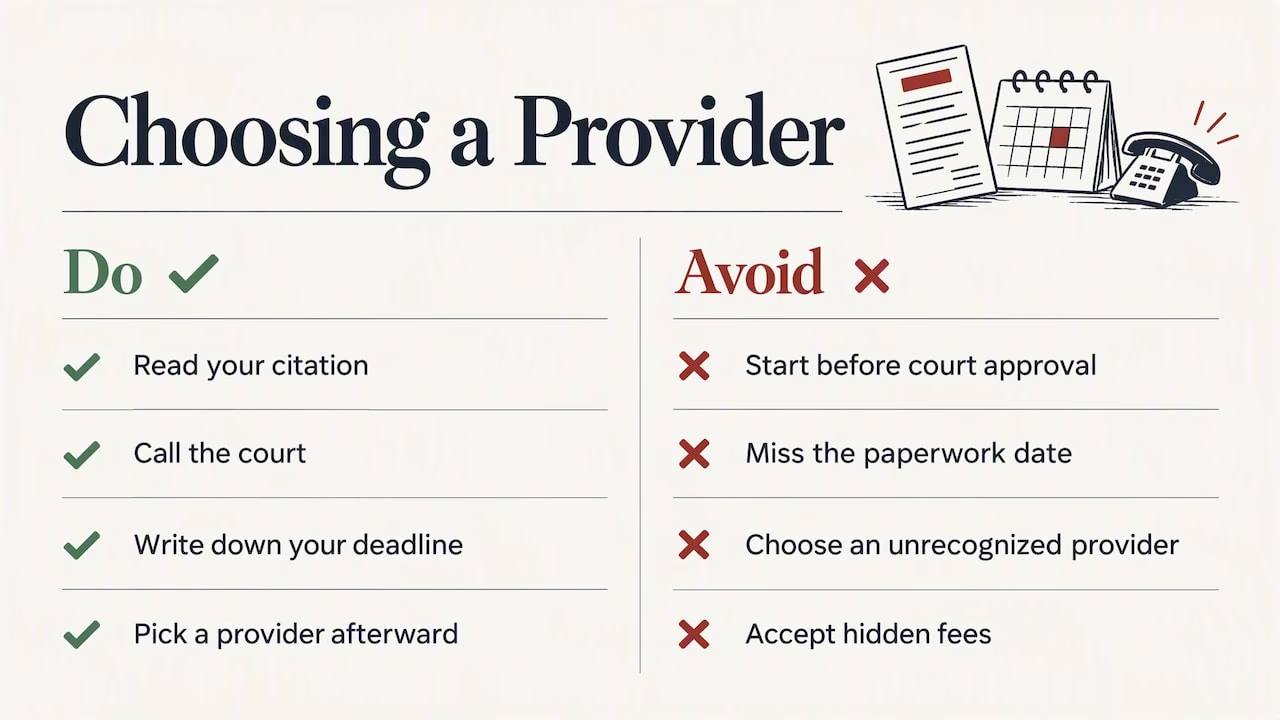
Our advice is to treat the course as the easy part. Read your citation, call the court, write down your deadline, and only then pick a provider. A course should be clear, mobile friendly and honest about fees. We develop our own curriculum in-house with certified educators and safety specialists, so that content follows the statutory requirements and real-world safety. We also publish a money-back guarantee and don’t charge hidden fees, because a stressed driver shouldn’t have to hunt for the fine print.
That’s the standard to hold any provider to, in Texas or elsewhere.
— User
Where Drivereducators.com can help
Our state-approved courses are for Florida. If you also drive in Florida, or you have moved there, we offer the Basic Driver Improvement course, the Driver Education Traffic Safety course, the Traffic Laws Substance Abuse Education course, the Mature Driver Insurance Discount course, the Wireless Devices Distracted Driver course and the Intermediate Driver Improvement course. You can see them all on our Florida courses page.
If you manage drivers, we also build custom fleet safety training for your company. For more background on how these courses work, start with our guide to defensive driving courses.
Defensive driving habits worth keeping
The certificate matters for the court, but the habits matter on the road. A few that the course reinforces:
- Keep a gap. Leave enough room to stop if the car ahead brakes hard, and add more in rain or heavy traffic.
- Scan ahead. Look well past the next car, to intersections, merging lanes and brake lights.
- Put the phone away. Distraction is one of the core topics in the curriculum, and the fix is to set the phone aside before you pull out.
- Never drive impaired or drowsy. Impairment is part of the course content for a reason.
- Expect mistakes from others. Assume the other driver may not see you, and leave yourself an exit.
For more, see our defensive driving techniques article. It is written with Florida roads in mind, but the habits carry over.
FAQ
How many times can I take defensive driving in Texas?
For ticket dismissal, courts generally don’t allow it if you took a dismissal course in the previous 12 months. Harris County’s guidance states this. You may take the course again for other reasons, such as an insurance discount, but check your insurer’s rules. Your court has the final say on dismissal.
How long is the course?
It is a six-hour course, and TDLR allows providers to offer it online. Online, you can usually split the time across several sessions. Allow time at the end for the final assessment and your certificate.
Can I take defensive driving for a speeding ticket?
Often, yes, if the ticket is eligible, you have no dismissal course in the last 12 months and you don’t hold a CDL. You also need the court’s permission first. Excessive speeds, such as 25 mph or more over the limit, are listed as ineligible by Harris County.
Do I need court approval before I start?
For a ticket dismissal, yes. Double Oak’s court guidance says the court must grant permission first. Request the course by your appearance date, then wait for approval before enrolling.
Will it lower my insurance rate?
It might. TDI says insurers may offer discounts and set their own terms. Call your insurer before you enroll to confirm that the discount exists and which courses it accepts.
Sources
- TDLR: 6-Hour Driving Safety Course
- TDLR: Curriculum Standards for Driving Safety Providers
- Harris County Justice Courts: Dismissal for Driving Safety Course
- Town of Double Oak: Driving Safety Course
- City of Houston Municipal Courts: Requesting a Defensive Driving Course
- Texas Department of Insurance: Auto insurance FAQ
- Texas Department of Insurance: Defensive Driving Take 5
- TicketDue: How to dismiss a Texas ticket with defensive driving
