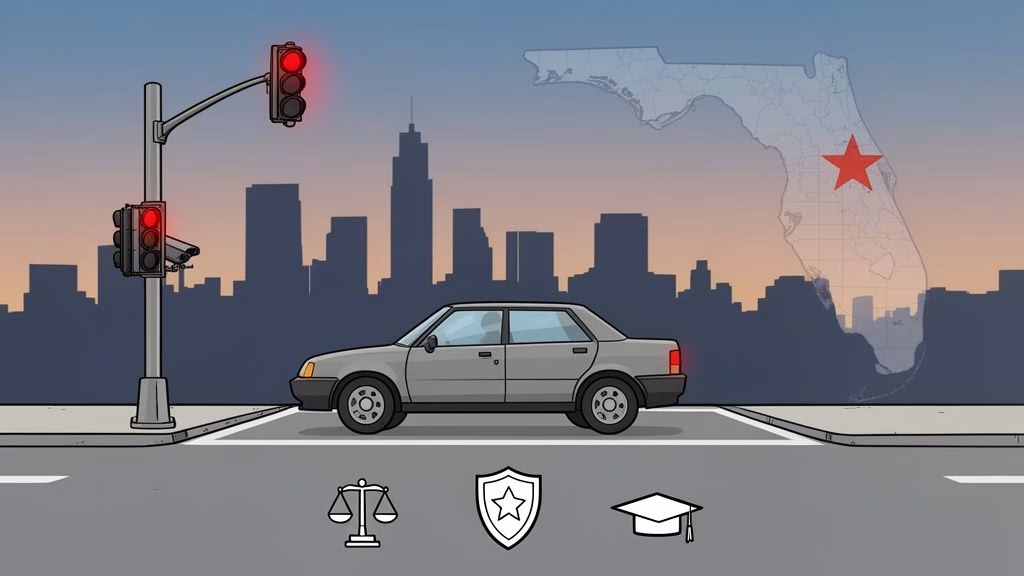
We’ve all seen them: those unassuming cameras perched at busy Tampa intersections. They’re part of the city’s red light camera program, an automated system designed to catch drivers who illegally enter an intersection after the light has turned red. The main goal here isn't just to hand out tickets, but to cut down on dangerous, high-impact crashes—especially the notorious T-bone collisions.
How Tampa Red Light Cameras Really Work

Think of a red light camera as an automated traffic monitor that never blinks. It’s there to enforce traffic laws when a human officer can't be, but its real job is to change our behavior behind the wheel and make some of the city's most hazardous intersections a little safer.
The whole point of Tampa’s program is to discourage drivers from making that split-second, and often dangerous, decision to gun it through a yellow or red light. Since running red lights is a leading cause of crashes in urban areas, these cameras serve as a constant reminder to obey the signal. The idea is to make stopping for red lights the default reaction, not the exception.
The Technology Behind the Flash
This isn't just a simple point-and-shoot camera. It’s a pretty sophisticated system that has to identify a violation in a precise sequence. It all begins with sensors embedded right into the pavement at the intersection's stop line.
These sensors act as an electronic tripwire. Once the traffic signal turns red, the system is armed. If a vehicle crosses over these sensors while the light is red, the camera gets the signal to capture the evidence.
When triggered, the system snaps two high-resolution photos and records a short video clip:
- The First Photo: This shot captures your vehicle just as it crosses the white stop line, with the red traffic light clearly visible in the frame.
- The Second Photo: This one shows your car already in the middle of the intersection, proving you continued through against the signal.
- The Video: A 12-second clip documents the entire event from start to finish, providing clear context and undeniable proof of the infraction.
This combination of evidence is what makes the system work. It proves not only that you entered on a red light but that you actually proceeded all the way through the intersection. For a deeper dive into how Florida handles these violations across the state, you can read our comprehensive guide on red light cameras in Florida.
It’s Not an Instant Ticket
A lot of drivers think that a camera flash automatically means a ticket is in the mail. That’s not how it works. Every single captured event goes through a two-step human review process before any notice is ever sent out.
First, the city's camera vendor, Verra Mobility, has a team that reviews the footage. They're trained to toss out obvious non-violations—things like a driver making a legal right-on-red after a complete stop or an emergency vehicle with its lights on.
If it looks like a legitimate violation, the evidence is then forwarded directly to the Tampa Police Department. Here, a sworn law enforcement officer makes the final call. They carefully review the photos and video to confirm that a violation actually happened. Only after this official verification is a Notice of Violation issued and mailed to the vehicle's registered owner.
How Florida Law Puts Red Light Cameras on Tampa's Streets
Those red light cameras you see around Tampa didn't just pop up overnight. They exist because of a specific legal framework that has been debated, challenged in court, and ultimately upheld by both state and local governments. If you drive in the city, knowing the rules behind these cameras is the first step to understanding why they're here to stay.
It all starts with a piece of state legislation called the Mark Wandall Traffic Safety Act. Passed back in 2010, this law is what gives cities and counties across Florida the green light to use automated cameras for red light enforcement. Before this act, camera programs were in a legal gray area, but this law created a statewide standard for how they could be used.
State Rules, Local Decisions
You can think of the Mark Wandall Act as the official rulebook for the entire state. It sets the ground rules, but it doesn't force anyone to play. It's up to individual cities like Tampa to decide if they want to get in the game.
And that's exactly what happened here. Tampa’s program operates under the authority of that state law, but the decision to have cameras rests solely with the Tampa City Council. They're the ones who approve, renew, or end the contract with the camera vendor, which is why the topic often sparks some pretty heated public debate.
That debate was on full display recently. In 2023, after a lot of back-and-forth, the City Council voted 4-3 to keep the red light camera program going for another five years. This decision was definitely fueled by the numbers: last year, the cameras issued over 79,000 tickets, which brought about $3.3 million in revenue to the city.
Supporters point to safety data, noting that over 80% of drivers who get a ticket don't get another one, suggesting the cameras work as a deterrent. On the other side, opponents call it a form of "greed," pointing to intersections they feel are "traps," especially on left turns with short yellow lights. You can get the full story on the renewal vote and the debate from this local news report.
The Supreme Court's Final Say
For a long time, the legality of these programs was constantly being challenged in court. The main argument against them was that letting a private, third-party company review the camera footage before it even got to the police was an illegal hand-off of law enforcement duties.
This created a lot of legal confusion for years, until the Florida Supreme Court finally weighed in and settled the matter for good.
In a landmark ruling, the court decided that using a private contractor to do the initial screening of potential violations is perfectly legal. The key, they said, is that the final call on whether to issue a ticket still has to be made by a certified law enforcement officer.
This decision was a massive turning point. It basically solidified the legal foundation for Tampa red light cameras and all similar programs across Florida. As long as an actual officer has the final say, the system is considered legally sound. This court backing is a huge reason why the cameras remain a common sight on our roads today. Of course, these cameras are just one aspect of traffic enforcement, and it always helps to stay current on all of Florida's state driving laws.
From Camera Flash to Ticket in Your Mailbox
That bright, unmistakable flash from a red light camera can make your stomach drop. If you’ve seen one in your rearview mirror, you know the feeling. But before you resign yourself to paying a fine, it’s important to understand what really happens next. A camera flash is just the beginning of a process, not the final word.
Not every flash leads to a ticket. The system is designed with several layers of review, both automated and human, to ensure that a violation notice is only sent when the evidence is crystal clear.
How the Camera Captures a Violation
When your vehicle crosses the solid white stop line after the light has already turned red, sensors in the pavement trigger the camera system. It doesn't just snap a single picture; it gathers a whole package of evidence.
- Two High-Resolution Photos: The first photo captures your car at the stop line, clearly showing the red light. A second photo is taken moments later, showing your car in the middle of the intersection, proving you continued through.
- A 12-Second Video: The system also records a 12-second video clip. This footage provides the full context of the event, showing your car's movement from start to finish.
This digital file is the first piece of the puzzle, but it has a long way to go before it becomes an official ticket.
The First Check: A Human Review
Before the Tampa Police Department ever sees the footage, it's sent to Verra Mobility, the private company that operates the camera system. Their team of trained technicians performs an initial review, essentially acting as a filter.
The key thing to remember is that a person is looking at your case from the very beginning. These reviewers are trained to throw out incidents that aren't clear violations. For example, if you stopped properly before making a legal right turn on red, or if an ambulance was coming up behind you, they'll likely dismiss it on the spot.
Only the events that appear to be genuine violations are passed along to law enforcement. This step saves the police a lot of time by weeding out obvious non-issues.
The Final Say: Tampa Police Department
Once an event is flagged by Verra Mobility, the evidence file is securely transmitted to the Tampa Police Department. Here, a sworn police officer makes the final call. This isn't a rubber-stamp approval; the officer conducts a thorough review to confirm that a violation of law actually occurred.
The officer looks for a few specific things:
- Was the light unequivocally red before the vehicle entered the intersection?
- Is the license plate on the vehicle clearly visible and legible?
- Are there any extenuating circumstances, like yielding to an emergency vehicle or following the direction of an officer at the scene?
A Notice of Violation is only issued after an officer confirms all these details and officially authorizes it. That notice is then mailed directly to the registered owner of the vehicle.
The table below breaks down the typical timeline you can expect after a camera captures a potential violation.
Red Light Camera Violation Timeline
| Stage | Description | Timeframe | Potential Cost |
|---|---|---|---|
| Notice of Violation | The initial notice is mailed to the vehicle's registered owner. This is a civil penalty, not a moving violation. | Within 30 days of the violation | $158 |
| Response Window | You have 30 days to either pay the fine or formally request a hearing to contest it. | 30 days from the mail date | N/A |
| Uniform Traffic Citation | If you don't respond within 30 days, the violation is converted to an official traffic ticket. | After the 30-day window expires | Increased fines + court costs |
| Points & Conviction | If you pay the Uniform Traffic Citation or are found guilty in court, points are added to your license. | Upon conviction | Points on your license and likely insurance hikes |
This timeline shows just how important it is to act quickly once you receive that first notice in the mail.
What to Do When the Notice Arrives
When that envelope arrives, you're officially on the clock. This first notice is for a civil infraction with a $158 fine. At this point, it’s not a moving violation, and it carries no points against your license. Think of it as a warning with a price tag.
You have a 30-day window to handle it. If you ignore it and miss that deadline, things get more serious. The violation automatically becomes a Uniform Traffic Citation, the same kind of ticket an officer would hand you on the roadside. The cost goes up, and a conviction will add points to your driving record, which almost always means higher insurance rates. To get a better handle on the potential outcomes, you can learn more about what happens when you get a traffic ticket in our complete guide.
The Financial and Safety Impact of Tampa's Program
Whenever the topic of Tampa's red light cameras comes up, two questions inevitably follow: Where does all that money go, and do they actually make our streets any safer? It's a fair question, as the program's impact is a mix of major financial figures and stated public safety goals.
First, let's follow the money. It's no secret the program brings in a lot of revenue, but those funds aren't just dumped into a single city slush fund. The system is set up to spread the proceeds across several key players, each tied into the larger traffic safety ecosystem.

This chart gives you a quick look at the journey of a violation, from the moment a camera flashes to the ticket landing in your mailbox. This efficient process is exactly how the city handles such a high volume of violations each year, which directly feeds into the program's large financial scale.
Breaking Down the Revenue Stream
The financial footprint of Tampa's red light camera program is massive. Since it kicked off back in 2011, the system has become a powerful financial engine designed to deter risky driving while also helping to fund safety initiatives.
In a single recent year, the city's 56 cameras stationed at 23 key intersections clocked over 100,600 violations. With the standard ticket price at $158, that activity generated a whopping $10.4 million. The money from these fines is then split several ways. From that total, the City of Tampa pocketed around $3.1 million in profit, but large chunks also went to the state, local hospitals, and the camera company itself. If you want to dig deeper, you can explore the detailed breakdown of Tampa's red light camera revenue to see the financial history.
This split is all laid out by state law. Here’s a rough idea of where your money goes when you pay that $158 fine:
- The State of Florida: A significant portion is routed to the state's general revenue fund.
- The City of Tampa: The city gets a share to help run the program and contribute to its general budget.
- Trauma Centers: A piece of the pie is specifically set aside for local trauma centers. Tampa General Hospital, for example, receives $500,000 to $600,000 a year to help treat victims of traffic crashes.
- The Camera Vendor: Verra Mobility, the company that owns and operates the camera tech, gets paid a fee for every ticket that gets paid.
Weighing the Safety Debate
While the revenue numbers are certainly eye-popping, the program's supporters always bring the conversation back to safety. The core argument is that the cameras' presence makes drivers think twice before punching it through a yellow light, which in turn reduces the number of dangerous T-bone and angle crashes.
The most powerful statistic proponents use is how the tickets affect driver behavior. The data shows that over 80% of drivers who get a red light camera ticket never get a second one.
This high rate of one-time offenders suggests that a single ticket is often enough to change a driver's habits for the better. Supporters see this as clear proof that the cameras are doing their primary job: making intersections safer.
Of course, critics aren't convinced. They often point to the huge revenue figures as the program's real motivation, arguing that some intersections might even have short yellow light times designed to "trap" drivers and issue more tickets. This ongoing "revenue vs. safety" debate is at the very heart of the controversy surrounding Tampa red light cameras.
Ultimately, the program is a mix of both. It generates millions that get reinvested into public services like trauma care, but it also has a measurable effect on deterring repeat offenders and encouraging safer driving at some of Tampa's busiest and most hazardous intersections.
Your Options After Getting a Red Light Camera Ticket
Getting a Notice of Violation from a Tampa red light camera in the mail is never a good feeling. But before you get too frustrated, take a breath. You have options, and what you decide to do within the first 30 days can make a huge difference to your wallet, your driving record, and even your insurance rates.
That official-looking envelope presents you with a choice. Let’s walk through the three paths you can take and what each one really means for you.
Path 1: Pay the Fine and Move On
The most straightforward route is to simply pay the $158 civil penalty. You can handle it online, send a check, or pay in person. Because this initial notice is just a civil penalty—not a moving violation—paying it at this stage means no points will be added to your driver's license.
This is definitely the path of least resistance. If you know you ran the light and just want the whole thing over with, paying the fine is a clean, quick solution. Just remember, you're admitting fault, and there are no takebacks once the payment is made.
Path 2: Contest the Ticket in Court
Think the ticket was a mistake? You absolutely have the right to fight it. To do this, you’ll need to formally request a hearing with the Hillsborough County Court. Be aware that this step converts the notice into a full-blown Uniform Traffic Citation, and you’ll have to make your case to a judge or magistrate.
Challenging a ticket isn't a walk in the park, but it can be done. Common arguments include:
- You weren't the one driving your car at the time of the violation.
- The yellow light interval was too short, leaving you no safe way to stop.
- You had to enter the intersection to avoid a crash or to make way for an emergency vehicle.
If you go this route, you need a solid game plan. For more detailed strategies, it's a good idea to research How to Fight a Red Light Camera Ticket in Tampa. Keep in mind, if you lose in court, you'll be on the hook for the fine, plus court costs. A conviction could also mean points on your license.
Path 3: Elect Traffic School to Avoid Points
For many drivers, this is the smartest play, particularly if the violation has already become a Uniform Traffic Citation. By choosing to complete a Basic Driver Improvement (BDI) course, you can keep the points off your license entirely.
Why is this so important? Points are what your insurance company sees. A single violation can cause your premiums to jump by 20-30%. By avoiding the points, you protect yourself from those long-term cost hikes and keep your driving record clean.
The process is simple. You just inform the court you're electing this option, pay the fine and any court fees, and then complete a state-approved 4-hour BDI course within the required time. For most people, an online traffic school course provides the most convenient way to meet this requirement right from home. Once you submit your completion certificate, the points are effectively dismissed.
And here’s something interesting—these courses seem to work. Data from Tampa's program shows that roughly 90% of drivers who get a ticket never receive a second one, and over 80% are one-time offenders. It's also worth noting that not every camera flash results in a fine; over the program's first ten years, police only issued citations for about 70% of the incidents they reviewed. These numbers show why a defensive driving course is such a valuable tool for Florida drivers—it helps you stay sharp, avoid points, and keep your insurance costs down.
Smart Strategies to Avoid Future Red Light Tickets

Let's be honest, the easiest red light ticket to handle is the one you never get. Developing a few key defensive driving habits will help you navigate Tampa's intersections with confidence, keeping your driving record clean and your money in your pocket.
Ultimately, it all comes back to the fundamentals of safe driving. The very same skills you'd learn in a BDI program—like anticipating traffic flow and avoiding aggressive moves—are what keep you from getting ticketed in the first place. When you make these habits second nature, you’re already ahead of the game.
Master the Dilemma Zone
We’ve all been there: you’re approaching a green light, and it suddenly flips to yellow. That split-second of indecision is what traffic experts call the "dilemma zone." It's that tricky spot where you feel too close to stop smoothly but maybe too far to clear the intersection before it turns red.
Slamming on the accelerator is a risky bet, and one that often ends with the flash of a camera. The smarter play is to anticipate the change. As you approach an intersection, especially if the light has been green for a while, ease your foot off the gas and hover it over the brake. This simple habit cuts down your reaction time, giving you the extra moment you need to make a safe, controlled stop.
Always drive as if a green light is about to turn yellow. This simple shift in mindset turns the dilemma zone from a moment of panic into a planned, safe stop, nearly eliminating the risk of running a red.
Perfect Your Right on Red
A surprising number of Tampa red light cameras catch drivers making illegal right turns. The common mistake? Treating the red light like a yield sign and rolling through the turn without coming to a complete stop. This is a cut-and-dry violation and easy pickings for the cameras.
To make a legal right turn on red, you have to do it by the book:
- Bring your vehicle to a complete stop behind the thick white stop line. Your tires must stop rolling entirely.
- Scan for "No Turn on Red" signs. These are often posted at intersections with tricky sightlines or heavy foot traffic.
- Yield to all oncoming vehicles and, just as importantly, any pedestrians who have the right-of-way.
- Only when the coast is completely clear should you proceed with the turn.
That initial full stop is what trips most people up. Just think of a red light like a stop sign—stop, look, and then go when it's safe.
Stay Alert and Aware
Beyond specific techniques, your overall situational awareness is your best defense. Distractions like your phone, fiddling with the radio, or getting lost in a conversation are a recipe for trouble, especially as you near an intersection. A focused driver is always a safer driver.
This is especially critical when you consider Tampa's history. Before the camera program kicked off in 2011, a staggering 50% of all red-light crashes in Hillsborough County happened right here within city limits. Data from the National Highway Traffic Safety Administration confirms that cameras make a difference, with crash rates at monitored intersections often dropping after installation.
Courses like the BDISchool Mature Driver course or Aggressive Driver course are designed to sharpen these exact skills, focusing on crash avoidance and right-of-way rules that are vital for safely navigating Tampa's streets. You can discover more about the official findings on red light camera effectiveness and their impact across the state.
Frequently Asked Questions About Tampa Red Light Cameras
Let's clear up some of the confusion around Tampa red light cameras. If you’ve got questions, you’re not alone. Here are straightforward answers to some of the most common things drivers want to know.
What Is a 3-Point Violation in Florida?
Think of points on your license like demerits. A "3-point violation" is a traffic offense serious enough to add three of these points to your driving record. Common examples include being ticketed by an officer for speeding up to 15 mph over the limit or running a red light.
These points stick around for three years and can cause a real headache, often triggering insurance rate hikes of 20-40%. It's important to know that the initial $158 red light camera notice is a civil penalty—it doesn't add points. But if you ignore it for 30 days, it escalates to a Uniform Traffic Citation, and that’s when a conviction will add those unwanted points to your license.
Do I Have to Pay a Red Light Camera Ticket if I Was Not Driving?
No, you don't. Florida law is clear: the person behind the wheel is the one responsible for the violation, not just the owner of the car. The notice is automatically sent to the registered owner, but that doesn't make you guilty.
If someone else was driving your car, you can fight the ticket by submitting an "affidavit of non-responsibility." This is a sworn legal statement where you declare you weren't driving. You'll need to name the actual driver so the citation can be reissued to the correct person.
What Is the Number One Driving Violation in Florida?
It's speeding, by a long shot. Speeding accounts for over 40% of all traffic tickets handed out across the state. The second most common violation? You guessed it—running red lights and stop signs.
This is precisely why you see such a heavy focus on these two infractions from both police patrols and automated systems like Tampa's cameras. They are leading causes of severe, often tragic, accidents. The enforcement is all about changing dangerous habits and making the roads safer for everyone.
Remember, the primary goal of the red light camera program is not just to issue tickets but to deter dangerous driving behaviors that lead to preventable crashes.
Can You Go to Jail for Running a Red Light in Tampa?
For a typical red light camera ticket, absolutely not. These are handled as civil infractions, much like a parking ticket. The only penalty is the fine.
However, the situation can get much more serious if running the red light was part of a bigger offense. If it was connected to reckless driving, for example, or caused an accident involving injuries, it could escalate into a criminal matter with far more severe consequences, potentially including jail time. But for the camera-issued ticket itself, it’s a financial penalty.
Are you facing a traffic ticket and worried about points on your license? The best way to protect your driving record is by taking a state-approved driver improvement course. BDISchool offers convenient, 100% online courses that are accepted by Florida courts to dismiss points and help you avoid costly insurance increases. Enroll today at https://bdischool.com and keep your record clean.