So, you got a traffic ticket and now you're wondering if you can just wait it out. It's a common thought, but here's the reality: when it comes to the statute of limitations on traffic tickets in Florida, the state generally has one year to prosecute you for most non-criminal moving violations. Think of it like a shot clock in basketball—the government has a limited window to formally bring the case against you.
But that clock doesn't just run out and let you off the hook.
Understanding Florida Traffic Ticket Deadlines
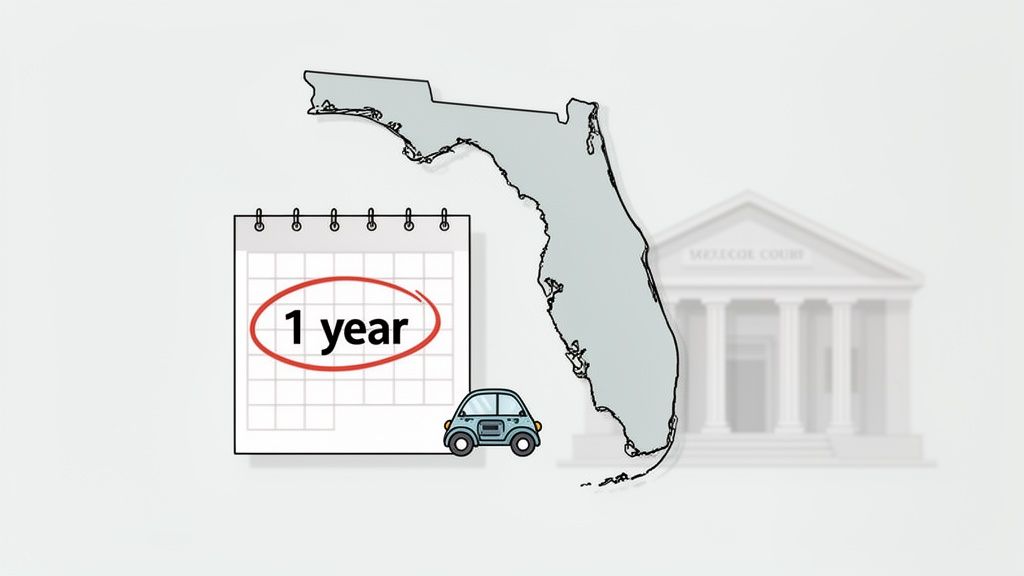
While that one-year timeline might sound like a potential loophole, it’s far from a get-out-of-jail-free card. This is just the deadline for the state to start the legal process. It doesn't mean your ticket magically vanishes after 365 days.
In fact, ignoring a ticket is one of the worst moves you can make as a driver. The real-world consequences of an unpaid citation can be serious and stick around for a long time, affecting everything from your driving privileges to your wallet. Getting a handle on these deadlines is the first step toward protecting your record.
Why The Clock Is Ticking For You, Too
Let's break it down with a common scenario. Imagine you're ticketed for going 15 mph over the limit on I-95. That's a non-criminal traffic infraction, which falls under that general one-year statute. But even if the state somehow misses its deadline to prosecute (which is rare), the Florida DMV can still add points to your license once the violation is on the books.
And this isn't a rare occurrence. In 2022 alone, Florida issued over 2.5 million traffic citations. That’s a lot of drivers facing this exact problem.
The real issue isn't just the court's deadline to file charges. It's the lasting stain on your driving record, which can lead to license points, sky-high insurance premiums, and other major penalties.
At the end of the day, dealing with a traffic ticket head-on is the only smart play. The choices you make right after getting that piece of paper will determine the final outcome. Instead of hoping the clock runs out for the state, you need to understand your options—whether that’s paying the fine, fighting the ticket in court, or signing up for traffic school to keep points off your license.
To get a full picture of what’s at stake, it’s helpful to understand what happens when you get a traffic ticket and why a quick, informed response is so critical.
To help you see where your citation might fit, here’s a quick breakdown of the different violation types in Florida and their corresponding time limits for prosecution.
Florida Traffic Infractions at a Glance
| Violation Type | Classification | Statute of Limitations |
|---|---|---|
| Speeding, Running a Stop Sign | Non-criminal infraction | 1 Year |
| Reckless Driving, DUI | Misdemeanor | 2 Years |
| Leaving the Scene of an Accident | Felony | 3 Years |
As you can see, the more serious the offense, the longer the state has to act. This table makes it clear why simply "waiting it out" is never a good strategy, as the consequences and timelines can vary significantly.
What the Statute of Limitations Means for Your Ticket
So, how does the statute of limitations on traffic tickets actually play out for the average driver? It’s definitely not a magic wand that makes your citation vanish.
Think of it more like a shot clock in basketball. The state has a fixed amount of time—in Florida, it's one year—to officially start the prosecution against you.
If the state files the charges within that one-year window, the game is on. You'll have to respond to the ticket just like any other, whether that means paying it, electing traffic school, or showing up in court. In most cases, this is exactly what happens, and the statute of limitations won't come into play.
The interesting part is what happens if they don't act in time. It’s rare, but if the state lets that one-year clock run out without filing charges, the statute of limitations suddenly becomes your best defense.
The Prosecution Clock vs. The DMV Record
This is where things can get a little tricky, and it's a critical point to understand. There are actually two separate clocks running: one for the court and one for the Florida Highway Safety and Motor Vehicles (FLHSMV).
The statute of limitations only applies to the court’s deadline to prosecute you. It has zero effect on the DMV’s ability to keep that violation on your driving record.
Even if a court dismisses your case because the statute of limitations expired, the violation itself can still haunt your official driving record. That means it could affect your license and insurance for years to come.
This is why you can never just ignore a ticket and hope it goes away. The administrative penalties tracked by the DMV operate on a totally different timeline from the court case.
How This Distinction Impacts You
Grasping this difference is essential for keeping your license clean. A violation that sticks to your DMV record, even without a conviction, can still trigger some serious headaches:
- Points on Your License: Too many points will lead straight to a license suspension.
- Increased Insurance Premiums: Insurance companies pull your driving record, and they'll raise your rates for violations, whether they were prosecuted or not.
- Future Complications: An old, unresolved ticket lingering on your record can cause big problems when you try to renew your license or if you get pulled over again.
At the end of the day, the statute of limitations is a legal defense you have to actively use in court—it isn't an automatic "get out of jail free" card. If you believe your ticket is past the deadline, you or your attorney must raise the issue before a judge. You can't just assume an old ticket has disappeared. It's always best to understand all your options, including how to properly contest a traffic ticket in Florida, to make sure the matter is truly closed.
Civil vs. Criminal Violations and Their Timelines
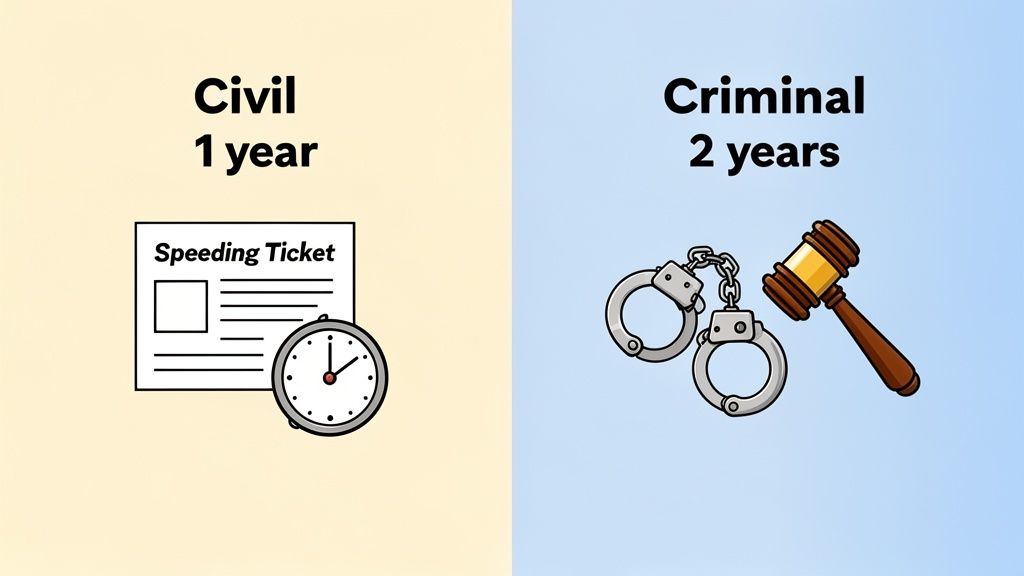
It's easy to lump all traffic tickets together, but in the eyes of the law, there's a world of difference between a simple speeding ticket and a serious offense like a DUI. This distinction is the key to understanding the statute of limitations on traffic tickets and just how serious the consequences can be.
Think of it this way: a minor foul in a basketball game gets you a small penalty, but a flagrant foul gets you ejected and maybe even suspended. Florida law treats traffic violations similarly, putting them into two distinct categories that operate on completely different timelines.
Civil Traffic Infractions
Most of the tickets drivers get in their lifetime will fall under this category. These are non-criminal violations, meaning the penalties are usually limited to fines and points on your license, not jail time.
Common examples include:
- Speeding: Going over the speed limit by less than 30 mph.
- Running a Red Light: Not stopping when you're supposed to.
- Improper Lane Change: Weaving or changing lanes without a signal.
For these everyday civil infractions, the state has one year from the day of the violation to start prosecution. This deadline covers the vast majority of tickets handed out on Florida roads. If you want to get into the nitty-gritty, you can learn more about what is a moving violation and see how these can add up.
Here's a key detail: that one-year clock is for the prosecution to begin. The violation itself can stay on your DMV record and affect your insurance rates long after the court's window to act has closed.
Criminal Traffic Offenses
Now we're moving into the big leagues. Criminal traffic offenses are far more serious and are treated as misdemeanors or, in some cases, felonies. The penalties here go way beyond a fine—you could be looking at probation, a revoked license, or even jail time.
Because the stakes are so much higher, the state gets a longer window to file charges. In Florida, the statute of limitations for misdemeanors is two years. This gives prosecutors double the time compared to a civil infraction, reflecting the seriousness of the offense.
For instance, a Reckless Driving charge is a misdemeanor. That means the state has two full years to come after you. It’s a stark reminder of how much more seriously the legal system views actions that put others in real danger.
Why Ignoring Your Ticket Is a Losing Strategy
It's a tempting thought, isn't it? Just toss that traffic ticket in the glove compartment, forget about it, and hope it goes away on its own. A lot of drivers operate under the myth that they can just wait out the statute of limitations on traffic tickets, treating it like some secret loophole.
Let me be clear: this is probably the worst thing you can do. What starts as a minor inconvenience can quickly spiral into a legal and financial nightmare.
An ignored ticket doesn't just fade into the past; it snowballs. The fine you see on that piece of paper is only the beginning. When you fail to respond, you trigger a whole series of penalties designed to get your attention—and trust me, you won't like them.
The Immediate Consequences of Inaction
When you ignore a ticket, you're doing more than just dodging a fine. You're failing to comply with a legal summons, and the system has a swift response for that.
- License Suspension: The first and most common hammer to fall is a suspended driver's license. The court will simply notify the FLHSMV that you didn't comply, and just like that, your driving privileges are gone until you sort things out.
- A Bench Warrant for Your Arrest: This sounds serious because it is. For more significant violations, or if you make a habit of not showing up to court, a judge can issue a bench warrant. That means your next routine traffic stop could end with you in the back of a police car.
- Multiplying Fines and Fees: That original fine? It's about to get a lot of company. Late fees, court costs, and fees to reinstate your license all start piling up. It’s not uncommon for a $150 ticket to balloon into a debt of several hundred dollars.
These aren't just empty threats used to scare you. This is standard operating procedure. The system is specifically designed to make ignoring a ticket far more painful than just dealing with it from the start.
Traffic tickets don't vanish like a bad dream just because time passes—their shadow lingers on your driving record and wallet far beyond the court's prosecution window.
The Long-Term Financial Damage
Even if you manage to dodge the immediate legal heat, the financial burn from an ignored ticket can last for years. Across major states like Florida, California, and New York, the government generally has 1 to 3 years to prosecute a minor traffic infraction. But the record of that violation sticks around on your record for 3-10 years, depending on how serious it was.
Let's take Florida as a real-world example. Minor moving violations have to be prosecuted within one year. However, they stay on your Motor Vehicle Record (MVR) for 3-5 years. During that "surcharge period," you can expect your insurance premiums to jump by 20-30% on average. For a deeper dive into how different violations affect your record in various states, AlfaInternational.com has some great insights.
It gets worse. Some counties will eventually hand over your unpaid ticket debt to a collection agency. Now, you’re not only dealing with the court but also with collectors, and that negative mark can tank your credit score. Suddenly, getting a loan for a car or a house just got a lot harder.
The takeaway here is simple: being proactive and handling your ticket is always the smarter, cheaper, and safer path.
Your 30-Day Action Plan For A Florida Ticket
That piece of paper in your hand—the traffic ticket—starts a clock. You have a critical 30-day window to make a decision, and what you do next matters. This isn't about the long-term statute of limitations; this is your immediate deadline to protect your driving record and avoid some pretty nasty consequences down the road.
You’re basically at a fork in the road with three distinct paths. Each one has its own outcome, so let's break them down. Choosing wisely in this first month is everything.
Understanding Your Three Core Choices
Navigating the court system can feel overwhelming, but your options really boil down to just three choices. You can either accept the penalty, fight the charge, or take a course to mitigate the damage.
- Pay the Fine: This is the path of least resistance, but it's also a direct admission of guilt. Once you pay up, you're accepting the points on your license, which almost always triggers an insurance rate hike.
- Fight the Ticket: If you're confident the citation was unfair or incorrect, you can plead not guilty and set a date for court. Just know that this route requires some real preparation if you hope to win.
- Elect Traffic School: For most common moving violations (non-criminal ones), you have the option to take a Basic Driver Improvement (BDI) course. For most drivers, this is the smartest move by a long shot.
Ignoring the ticket isn't an option. In fact, it’s the worst possible move you could make.
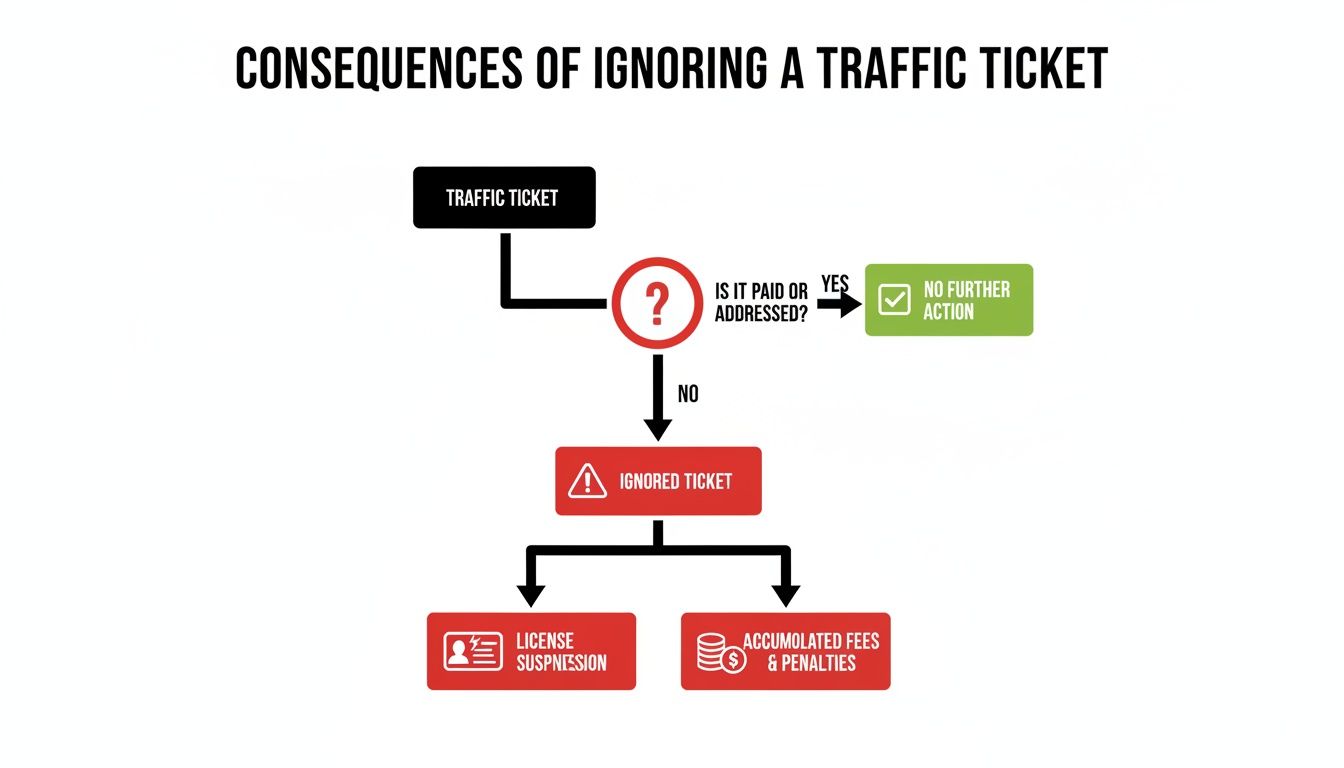
As you can see, doing nothing leads straight to a suspended license and a pile of extra fees. That’s exactly why making a proactive choice within your 30-day window is so important.
The Strategic Advantage Of Traffic School
For the vast majority of drivers, choosing to complete a BDI course is the clear winner. Why? Because when you successfully finish a state-approved course, the court withholds adjudication of guilt. In simple terms, this means you can keep the points off your permanent driving record.
The single biggest benefit of electing traffic school is that your insurance company cannot legally raise your rates or cancel your policy for that specific violation, as long as it wasn't related to a crash where you were at fault.
Think of it as a do-over. You avoid the financial sting of higher insurance premiums and, just as importantly, you prevent points from piling up and putting your license at risk. It’s a guaranteed positive outcome.
To help you visualize your choices, here’s a quick comparison of how each path affects you.
Your 30-Day Decision: Comparing Your Options
| Action | Points on Record? | Insurance Impact? | Best For… |
|---|---|---|---|
| Pay the Fine | Yes | Almost certainly an increase. | Drivers who don't mind points or higher rates and just want it over with. |
| Fight the Ticket | No, if you win. Yes, if you lose. | No increase if you win. Increase likely if you lose. | Drivers with a strong case and evidence to prove they weren't at fault. |
| Elect Traffic School | No! The points are withheld. | None! Rates cannot be raised for the ticket. | Most eligible drivers who want to protect their record and keep insurance low. |
This table makes it clear: unless you have a rock-solid case for court, traffic school offers the best protection for your license and your wallet.
Of course, fighting the ticket is still a valid option if you feel you were wrongly cited. Our guide on how to fight a traffic ticket in Florida can walk you through that process.
Since many tickets happen as a result of an accident, it’s also a good idea to know the essential steps and legal guidance after an accident. Being prepared for every situation on the road is the hallmark of a responsible driver.
Answering Your Florida Traffic Ticket Questions
Getting a traffic ticket can leave you with a lot of questions. What are the deadlines? What are my options? What does the law actually say? It's easy to feel overwhelmed.
Let's break down some of the most common questions Florida drivers have. We'll give you clear, straightforward answers to help you figure out the best move for your situation.
If The One-Year Statute of Limitations Passes, Is My Ticket Automatically Dismissed?
This is a huge misconception. The answer is a firm no—it's not automatic at all. The statute of limitations is a legal defense, not a magic "get out of jail free" card. You have to actively use it.
If the state files charges after that one-year clock has run out, it's on you or your lawyer to file a motion to dismiss the case on those grounds. The ticket won't just vanish from the system. In fact, the FLHSMV might still have a record of it, which could pop up and cause headaches with your license or insurance years later. Never assume an old ticket has simply disappeared.
The statute of limitations is a defense that must be raised. A ticket doesn't expire and disappear from the system automatically; you must take legal action to have it dismissed if the deadline has been missed by the prosecution.
This is a critical point. Doing nothing can lead to unexpected problems, like a hold on your license renewal or a complicated situation during a future traffic stop.
Can I Take A BDI Course For Any Traffic Ticket in Florida?
Taking a Basic Driver Improvement (BDI) course is a great way to keep points off your license, but it's not an option for every single ticket. There are some pretty strict rules you have to follow.
For starters, you can't elect to take a course if you’ve already taken one in the past 12 months. On top of that, Florida law limits you to using this option a total of five times in your entire life. It pays to be strategic about when you use them.
More importantly, BDI isn't available for certain violations at all. These include:
- Criminal Offenses: Serious charges like DUI or reckless driving are completely off the table.
- Commercial Licenses: If you got the ticket while driving a commercial vehicle, you're not eligible.
- Speeding Over 30 MPH: Tickets for flying 30 mph or more over the speed limit are generally excluded.
Before you sign up for anything, always double-check your eligibility with the clerk of court in the county where you got the ticket.
What Happens If I Get a Ticket in Florida But Live Out of State?
Thinking you can just ignore a Florida ticket because you live a few states away is a big mistake—one that will almost certainly catch up with you. Florida is part of the Driver's License Compact, which is basically an agreement between states to share driver information.
This means Florida will report your unpaid ticket to your home state's DMV. From there, your own state will likely take action, which could even mean suspending your license. You'll have to deal with the Florida ticket just like a resident would, either by paying it or contacting the county court to see about an approved online traffic school course. The good news is that out-of-state drivers are often given the same options.
How Do I Know If My Ticket Is Civil or Criminal?
The ticket itself is the best place to look. The vast majority of tickets are civil infractions, and they are usually marked as "non-criminal." For these, you don't have to go to court unless you decide you want to fight the charge.
Criminal traffic violations are a different story. They are much more serious, and the ticket will make that clear. If you're cited for something like a DUI, driving with a suspended license, or reckless driving, the citation will state that a court appearance is required. If you're ever unsure, the safest bet is to look up the statute number printed on your ticket or just call the clerk of court in that county for clarification.
Figuring out the rules around traffic citations can be confusing, but you don't have to handle it alone. BDISchool offers Florida state-approved online courses that make it simple to protect your driving record, avoid insurance hikes, and meet court requirements. Our self-paced, mobile-friendly programs in English, Spanish, and Portuguese let you learn whenever and wherever it works for you. Take control of your driving future and enroll today.