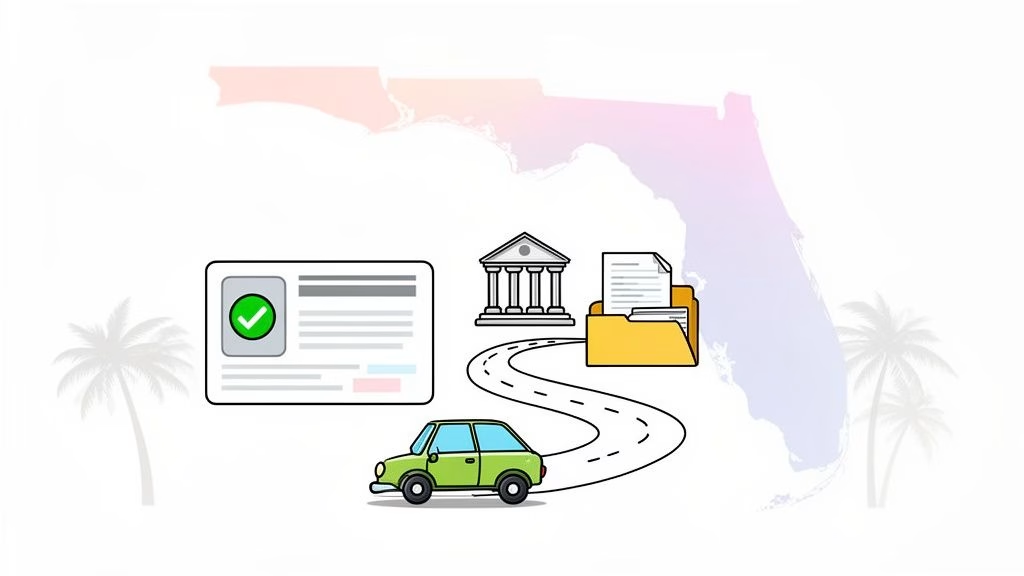
When your driver's license gets suspended, it can feel like your entire life is put on hold. Getting to work, taking kids to school, or just picking up groceries becomes a massive headache. This is where a Florida hardship license comes in—it's a critical lifeline that allows you to handle the essentials while your full driving privileges are on pause.
The key is understanding that a hardship license isn't a get-out-of-jail-free card. It's a restricted permit. Think of it less as getting your old license back and more as receiving a special pass with strict rules.
What Is a Florida Hardship License and Who Qualifies?
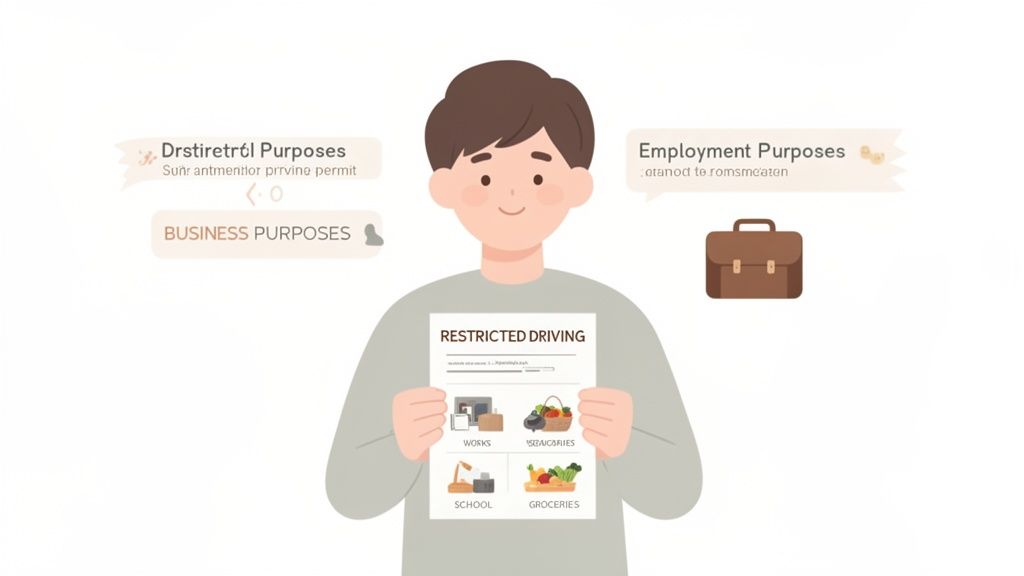
So, what exactly can you do with this restricted license? Florida offers two types, and the one you might qualify for depends heavily on the specifics of your suspension. Knowing the difference is your first step.
Understanding License Types
Most people who qualify will receive a Business Purposes Only (BPO) license. This is the more flexible of the two options. It allows you to drive for anything related to maintaining your livelihood—commuting to work, performing job-related duties, getting to school, attending church, or heading to a doctor's appointment.
Then there's the Employment Purposes Only (EPO) license, which is much more restrictive. Just as the name implies, it only lets you drive directly to your job and back home. That’s it. Because it’s so limited, it’s not as commonly issued.
A hardship license is a privilege, not a right. The Florida Department of Highway Safety and Motor Vehicles (FLHSMV) only grants them to people who can clearly prove that losing their driving privileges creates a serious, unavoidable burden on their life.
Who Is Generally Eligible?
Your eligibility is tied directly to why your license was suspended in the first place. Every situation is different, but the state wants to see you take responsibility before they’ll even consider your application. This usually means completing a specific course or action item. If you need more background, you can read our comprehensive guide on dealing with a suspended license in Florida.
To simplify things, here's a quick look at the most common reasons for suspension and the first step you'll need to take.
Florida Hardship License Eligibility At a Glance
This table breaks down the most frequent suspension scenarios and points you toward the mandatory first action required to begin the application process.
| Reason for Suspension | Typical License Type | Critical First Step |
|---|---|---|
| First-Time DUI | Business Purposes Only (BPO) | Complete DUI School and serve the required "hard suspension" period. |
| Too Many Points | Business Purposes Only (BPO) | Enroll in a 12-Hour Advanced Driver Improvement (ADI) Course. |
| Non-Driving Violations | Business Purposes Only (BPO) | Provide proof you've complied with the court and complete a driver improvement course. |
Think of this table as your starting point. Once you identify which category you fall into and complete that critical first step, you can move forward with gathering your documents and officially applying for the hardship license.
What to Do When Too Many Points Lead to a Suspension
It’s one of the most common ways people lose their driving privileges in Florida. A speeding ticket here, another one a few months later… and suddenly, a formal notice from the Florida Department of Highway Safety and Motor Vehicles (FLHSMV) shows up in your mailbox. Your license is suspended.
Florida’s point system is a straightforward tally of your driving missteps. Every moving violation adds points to your record, and if you hit a certain threshold within a set time, the state automatically suspends your license. For example, getting 12 points within a 12-month period triggers an immediate 30-day suspension. This is often the moment drivers frantically start researching Florida hardship licenses.
The good news? A suspension for points accumulation usually offers a more direct path back to driving than other, more serious offenses. You can typically get a Business Purposes Only (BPO) license, but there's a crucial first step you absolutely cannot skip.
The Mandatory Driver Improvement Course
Before the FLHSMV will even look at your hardship application, you are required by law to enroll in a state-approved 12-hour Advanced Driver Improvement (ADI) course. This isn't just a suggestion; it's a non-negotiable prerequisite.
Think of the ADI course as your good-faith gesture to the state. Completing it shows you’re taking your driving record seriously and are committed to becoming a safer driver. Without proof of enrollment, your application for a hardship hearing is dead on arrival.
Key Takeaway: Unlike suspensions for things like a DUI, a points-based suspension often allows you to apply for a hardship license right away. There’s typically no mandatory "hard suspension" period where you can't drive at all. This makes signing up for the ADI course your most urgent task.
Florida Statutes § 322.271 spells this out pretty clearly. If your license was suspended for getting too many points, you're generally eligible for a BPO hardship license as soon as you enroll in that ADI course. For more details on the legal side, you can review the specific hardship license requirements outlined by Ticket Shield.
Your Step-by-Step Action Plan
Once you wrap your head around the ADI requirement, the rest of the process is a clear-cut sequence of steps. Here’s exactly what you need to do to get back on the road for work and essential errands.
- Find and Enroll in an Approved ADI Course. Your first move is to find a provider officially approved by the FLHSMV. Don't just pick the first one you see online—double-check that it’s a legitimate, state-recognized school.
- Get Your Proof of Enrollment. As soon as you sign up, the school will give you an official enrollment certificate. This piece of paper is your golden ticket for the application process.
- Fill Out the Hardship License Application. You'll need to complete Form HSMV 78306, the "Application for Hardship License." Be meticulous. Any mistakes or missing information will cause delays or an outright denial.
- Gather All Your Documents. Along with your ADI enrollment proof and the application form, you’ll need your driver's license number, proof of your identity, and the required fee.
- Schedule and Attend Your Hearing. With your paperwork in hand, contact your local Bureau of Administrative Reviews office to schedule a hearing. An officer will review your entire case and make the final call on granting your BPO license.
The system is designed to be straightforward, but success is all in the details. By enrolling in your ADI course immediately and preparing your application with care, you give yourself the best shot at getting back behind the wheel for the trips that matter most. To better understand the system that led to this, check out our guide on how many points lead to a license suspension.
Meeting Requirements After a DUI Conviction
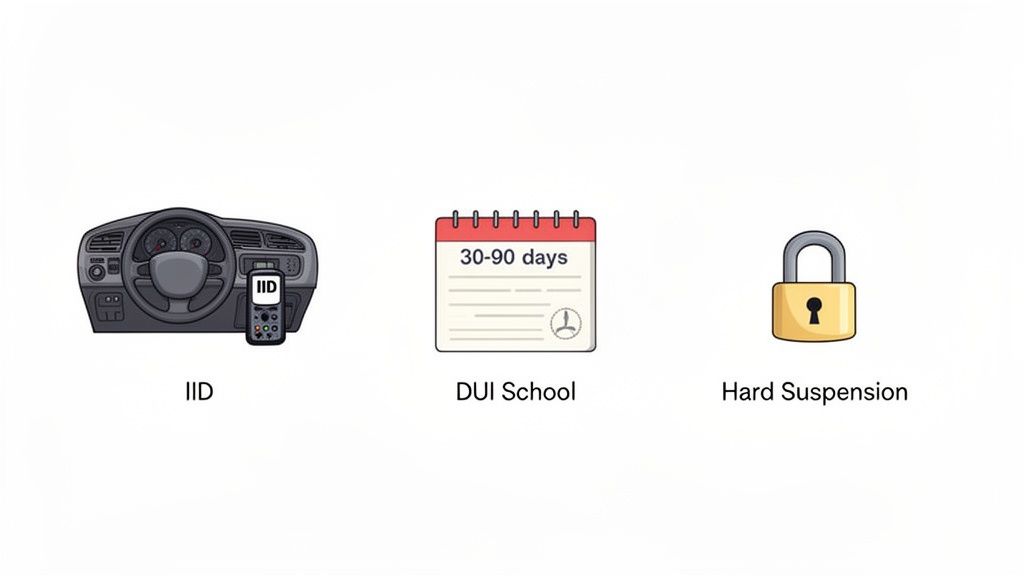
If your license was suspended because of a DUI, you're facing the toughest set of requirements for getting back behind the wheel, even on a limited basis. Unlike suspensions for too many points, a DUI conviction triggers a mandatory "hard suspension." This is a strict, no-driving period—no exceptions, no hardship license, nothing.
Think of it as a mandatory time-out from driving imposed by the state. How long you have to wait depends on the specifics of your case. For a first-time DUI in Florida, the law mandates a license revocation for six months to a year. The hard suspension portion of that is typically 30 to 90 days. Only after serving this blackout period can you even think about applying for a Business Purposes Only (BPO) hardship license.
Once that time is up, your path to a restricted license can begin, but it kicks off with two critical steps you absolutely cannot skip.
Completing DUI School and Other Requirements
Before the Florida Department of Highway Safety and Motor Vehicles (FLHSMV) will even look at your application, you have to enroll in and finish a state-approved DUI school. These courses are designed to drive home the serious risks of impaired driving and prevent it from happening again. You’ll need to show your certificate of completion as proof.
Beyond that, you might also be ordered to install an Ignition Interlock Device (IID) in your vehicle.
An Ignition Interlock Device is essentially a breathalyzer that's wired directly into your car's ignition. To start the car, you have to blow into the device. If it detects alcohol on your breath—even a very small amount—the engine won't turn over.
This device is mandatory for certain DUI convictions, especially if your Blood Alcohol Content (BAC) was high or if it's not your first offense. It’s the state’s way of ensuring you stay sober when you drive.
The BPO Application Roadmap After a DUI
After you've waited out your hard suspension and have your DUI school certificate in hand, you can start the BPO license application. Be warned: it's a much more involved process than for other types of suspensions. You’ll have to schedule a formal hearing at your local Bureau of Administrative Reviews office.
When you go to your hearing, you need to come prepared to make your case. Make sure you bring:
- Proof of DUI School Completion: The official certificate is non-negotiable.
- Proof of SR-22 Insurance: This shows you have the required high-risk insurance policy.
- Application and Fees: Bring the filled-out application form and be ready to pay all administrative fees.
- Evidence of Hardship: Just like with other hardship applications, you'll need to prove you need to drive with things like an employer's letter, school schedule, or medical appointment records.
A DUI carries a wide range of penalties, so understanding the full civil consequences of a DUI conviction is crucial as you navigate the process of getting back on the road.
Understanding Stricter Penalties for Repeat Offenses
It's incredibly important to know that the rules get much, much tougher for subsequent DUI convictions. While there's a clear (though difficult) path to a hardship license for a first offense, repeat offenses bring down the hammer.
A second DUI, for instance, could mean a hard suspension of at least one full year before you’re even eligible to apply. A third offense can result in your license being revoked for five years or longer. These escalating penalties show just how seriously the state takes repeat offenses and why responsible driving is so critical.
It's a frustrating, and frankly, pretty common scenario: you find out your driver's license has been suspended for something that has absolutely nothing to do with how you drive. For countless Florida drivers, this comes as a shock. Things like falling behind on child support or having unpaid court fines can lead to a complete loss of your driving privileges.
So, why does this happen? The state views your driver's license as a privilege, not an inherent right. Because of this, it's often used as a powerful tool to ensure people meet their other legal and financial responsibilities. When those obligations slide, the state can and will suspend your license to get your attention.
The good news? Getting a hardship license for these kinds of suspensions is often a much more direct process than it is for a DUI or a points-related case. Your main objective is to prove you're getting back on track.
The First Step: Proving You’re Making It Right
Before you even fill out a single form for a hardship license, your first move has to be tackling the root cause of the suspension. This isn’t about making promises; it’s about taking concrete, documented action to fix the underlying problem. The Florida Department of Highway Safety and Motor Vehicles (FLHSMV) needs to see that you're taking your obligations seriously.
For instance, if your license was suspended over unpaid court costs, you’ll need to march down to the Clerk of Court and get on a formal payment plan. They won't just take your word for it—you need official paperwork showing you're back in good standing.
The same goes for suspensions tied to child support. You must get in touch with the Florida Department of Revenue and get proof that you've either made payments or have an approved agreement in place. That piece of paper is your ticket to the next step.
The Bottom Line: With non-driving suspensions, the state is less concerned with your driving skills and more focused on your legal and financial accountability. Fixing the original issue is the absolute, non-negotiable first step.
Required Courses and Getting Your Application Ready
Once you have that official proof of compliance in hand, you’ll almost always be required to complete a 4-hour Basic Driver Improvement (BDI) course. This is a much shorter class than the advanced course required for point suspensions. You have to enroll in a state-approved BDI school before you can move forward with your hardship application.
After you've checked off those two crucial boxes—proving compliance and enrolling in the BDI course—you're finally ready to apply for a Business Purposes Only (BPO) hardship license at your local Bureau of Administrative Reviews office.
How This Is Different from Other Suspensions
Resolving a non-driving suspension has some clear advantages over other types. While every situation has its own quirks, here are the main ways it differs:
- No "Hard Suspension" Period: Unlike a first-time DUI, you typically don't have to wait out a mandatory "no driving whatsoever" period.
- No Ignition Interlock Device (IID): Since the suspension isn't related to alcohol, you won’t have to install a breathalyzer in your car.
- A Simpler Course: The 4-hour BDI course is a breeze compared to the much longer 12-hour Advanced Driver Improvement (ADI) or specialized DUI school programs.
This simpler path makes sense when you think about it. The state’s primary goal is to encourage you to meet your obligations, and the hardship license requirements are designed to support that. This isn't a rare problem; it affects a massive number of people. In just one fiscal year, the state sent notices to 21,751 minors alone for eligibility issues often tied to court or child support, as detailed in this state report on license eligibility. By taking the right steps in the right order, you can get this resolved and get back on the road for work, school, and other essential needs.
Your Step-by-Step Guide to the Application and Hearing
Let’s be honest, trying to get a Florida hardship license can feel like you’re trying to solve a puzzle with half the pieces missing. But once you understand the system and know what to expect, it’s a much more straightforward process. I’m going to walk you through everything, step-by-step, from getting your paperwork in order to making your case at the hearing.
The key to success here is all in the prep work. The Florida Department of Highway Safety and Motor Vehicles (FLHSMV) runs on specifics, not sob stories. Your job is to hand them a complete and compelling file that leaves no doubt about why you need to be able to drive.
Assembling Your Application Package
First things first: you have to gather all the required documents before you can even think about scheduling a hearing. Think of it as building a case file. If you miss a single piece of paper, you’re looking at delays or even an outright denial, so let’s get it right the first time.
Here's the checklist of what you'll absolutely need:
- Proof of Identity: Your Florida driver's license number is usually all they need, but have other state-issued ID handy just in case.
- Completed Application Form: This is the official Form HSMV 78306, the "Application for Hardship License." Fill it out completely and accurately.
- Proof of Course Enrollment: Depending on why your license was suspended, you'll need the completion certificate from your BDI, ADI, or DUI school.
- SR-22 Insurance Confirmation: If your suspension requires it (common for DUIs), you need proof from your insurance company that this special certificate has been filed with the state.
Proving Your Hardship Is Real
This is the most important part of your application. You have to prove that losing your license isn't just a major inconvenience—it’s something that genuinely prevents you from maintaining your life and livelihood. Simply saying, "I need to drive for work," won't cut it.
You need to back up your claim with hard evidence. Here’s what works:
- An official letter from your boss, printed on company letterhead, that clearly states your job duties, hours, and why driving is essential.
- Your current class schedule or school registration forms if you're a student who needs to get to campus.
- Medical records or letters from a doctor showing recurring appointments for you or a family member you’re responsible for.
Key Insight: The more official your documents look, the better your chances. A typed letter from a manager is infinitely more powerful than a scribbled note. Your goal is to make the hearing officer’s decision easy by giving them clear, undeniable proof.
For many people, the hearing itself can be intimidating. Before you get there, it’s a good idea to understand what an administrative license suspension hearing actually involves. This is where the state officially decides if your suspension holds up and if you even qualify for hardship consideration.
This flowchart gives you a visual on the general process for handling non-driving suspensions.
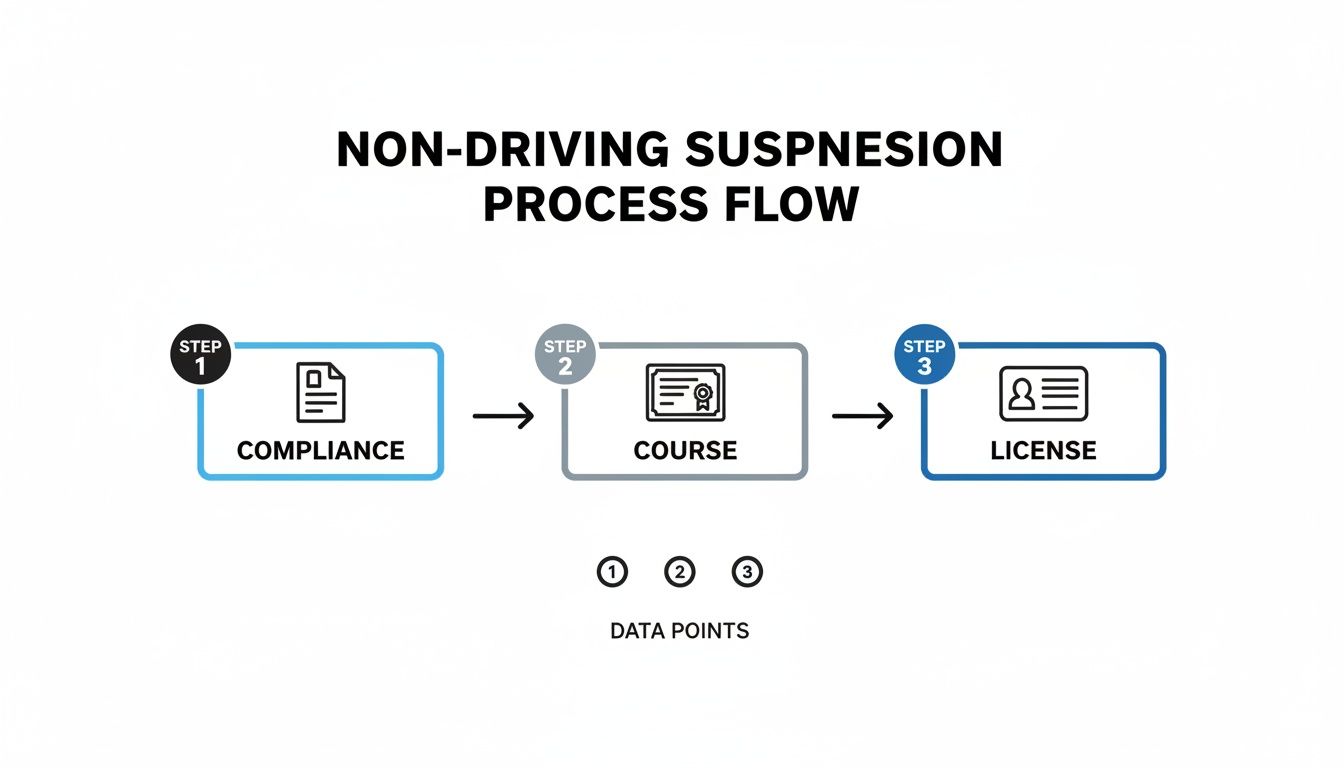
As you can see, dealing with the original issue is always the first step. Only then can you move on to the required driver improvement course and get back on the path to having your license reinstated.
Preparing for Your DHSMV Hearing
Once your application package is complete, it's time to schedule your hearing at a local Bureau of Administrative Reviews office. This is your chance to sit down with a hearing officer and explain your situation. Again, preparation is everything.
When you go, dress professionally and act respectfully. The hearing officer isn’t there to judge you; they’re there to apply the law. Be honest and direct when you explain why you need the hardship license.
Be ready to answer the classic questions: who, what, when, where, and why. For example, don’t just say "I need to drive for my job." Instead, say something like, "I am a project manager for ABC Construction, and my job requires me to drive to job sites in Orange and Seminole counties between 7 a.m. and 4 p.m. on weekdays to supervise my crews."
That level of detail, especially when backed up by your employer's letter, paints a very clear and credible picture. For a more detailed breakdown of the whole journey, take a look at our complete guide on how to https://bdischool.com/apply-for-a-hardship-license-in-florida/. When you follow these steps, you show the state that you're a responsible person who just needs a critical tool to keep your life on track.
Common Mistakes That Will Wreck Your Application
Getting a hardship license in Florida is more than just checking boxes; you have to be meticulous. I've seen countless people with a real need to drive get denied because of simple, avoidable mistakes. Knowing what these tripwires are ahead of time is your best defense.
The number one reason for rejection? An incomplete or inaccurate application. The Florida DHSMV doesn't bend the rules. One missing signature, a single blank field, or a wrong date can get your entire application tossed out, forcing you to start all over again.
Your Proof of Hardship Isn't Convincing Enough
This is a big one. You can't just tell the hearing officer you need to drive; you have to prove it with solid documentation. They need official proof, not just your word.
- The Mistake: Handing them a quickly scribbled note from your boss that just says, "Jane needs her car for work."
- The Pro Tip: Get a formal letter, printed on company letterhead. It needs to lay out your specific job title, your required work hours, and have your manager explain exactly why driving is essential for you to keep your job.
See the difference? One is a casual request; the other is a documented, professional necessity. That’s what the hearing officer needs to see.
Messing Up the Courses or Insurance
It’s not enough to just take any driving course—you absolutely have to take the right one. If you have a suspension for too many points, a basic 4-hour driver improvement class won't cut it. You'll need the 12-hour Advanced Driver Improvement (ADI) course. Double-check with the DHSMV to confirm which course your specific situation requires.
Crucial Reminder: Letting your SR-22 insurance lapse is a fatal mistake. Your insurance provider is required by law to report the lapse to the state immediately. This will trigger a brand new, often tougher, license suspension, and you’ll be right back at square one.
Finally, don't forget that a hardship license is a privilege, not a right. Getting another traffic ticket while driving on your restricted license is the fastest way to lose it. Keeping a perfectly clean driving record isn't just a good idea—it's a non-negotiable condition of keeping your limited driving privileges.
Your Questions About Florida Hardship Licenses, Answered
Losing your license is stressful, and the process of getting it back can feel confusing. Let's clear up some of the most common questions people have when they're trying to get a hardship license in Florida.
How Long Does It Take to Get a Hardship License in Florida?
This is a "it depends" kind of answer. Once you’ve submitted a perfect application package, you can usually expect a hearing to be scheduled within about 30 days. If the hearing officer gives you the green light, you might even walk out with your restricted license that very same day.
But there's a catch. This timeline doesn't start until after you've served any mandatory "hard suspension" period—that's the time you absolutely cannot drive, no exceptions. For a first-time DUI, for instance, you have to wait a full 30 days before you can even begin the application process.
Where Can I Drive With a Business Purposes Only License?
Think of a "Business Purposes Only" (BPO) license as a lifeline, not a free pass. Its whole purpose is to let you handle the absolute necessities of life so you can keep things from falling apart.
So, what does that actually mean? You can typically drive for things like:
- Getting to and from your job.
- Traveling to classes if you're a student.
- Driving to a doctor's or dentist's appointment.
- Attending your place of worship.
- Making essential trips for groceries or prescriptions.
What you can't do is use it for social trips. Driving to a bar, a friend's house for a party, or a movie theater is a fast way to violate the terms of your BPO license and land in even more trouble.
The Bottom Line: A BPO license is for maintaining your life and livelihood. If a trip isn't directly tied to your work, health, education, or basic survival needs, it’s probably off-limits.
What Is SR-22 Insurance and How Long Do I Need It?
This one trips a lot of people up. An SR-22 isn't actually an insurance policy. It's simply a certificate, a piece of paper your insurance provider files with the state of Florida to prove you have the legally required liability coverage.
If you've been convicted of a serious offense like a DUI, you'll likely need to keep this SR-22 on file for three straight years. This is non-negotiable. If you let your insurance policy lapse for even a day, your provider is required by law to tell the FLHSMV, and your license will be suspended all over again.
At BDISchool, our state-approved courses are designed to help you meet the requirements for getting back on the road safely and responsibly. Fulfill your court or FLHSMV obligations with our convenient, self-paced online programs. Learn more at https://bdischool.com.