A calm drive doesn't start when you merge into traffic. It begins before you even turn the key. Creating a simple pre-drive ritual can completely change your mindset, reducing stress from the get-go and setting you up for a much smoother ride.
This is all about simple, powerful habits. Think about adding a ten-minute buffer to your travel time, checking the traffic before you're stuck in it, and doing a quick mental reset. These small actions ensure you start your journey with a clear, focused mind.
Building Your Foundation for a Calm Drive
Rushing out the door with a scattered mind is a surefire recipe for a stressful drive. Every little delay feels like a major frustration. But when you build a foundation of preparation, you become more resilient to whatever Florida’s busy roads throw your way.
Think about it: heading out onto I-4 during rush hour is a different experience when you're mentally prepared for it. Knowing the traffic is heavy beforehand lets you adjust your route, pop on a longer podcast, or just accept the reality of the commute. You’ve removed the element of surprise, which is often what triggers that initial spike of anger and stress.
Create Your Pre-Drive Ritual
Your ritual doesn’t have to be complicated. The point is to create a consistent routine that tells your brain it's time to focus and stay composed. A simple mental checklist is all you need:
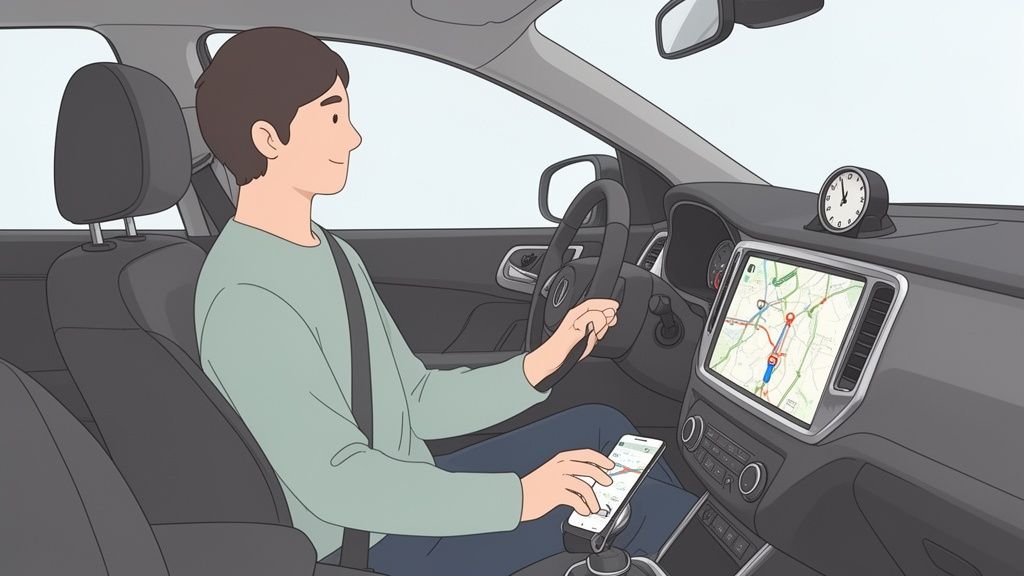
- Check traffic and weather: A quick look at a navigation app gives you a real-time picture of your route. No more stressful surprises.
- Adjust your environment: Get your mirrors, seat, and steering wheel just right. Cue up your calming playlist or podcast before you put the car in drive.
- Add a buffer: This is a game-changer. Always plan to leave 10-15 minutes earlier than you think you need to. It's one of the single most effective ways to kill the anxiety of being late.
These aren't just feel-good tips; they're core components of a proactive driving mindset. By controlling these small variables, you're already applying https://bdischool.com/defensive-driving-techniques/ that prioritize both safety and composure.
The goal is to create a calm baseline. When you start your trip feeling relaxed, you have a much greater capacity to handle unexpected events without reacting emotionally.
Use Quick Mental Resets
Physical preparation is only half the battle. If you're bringing stress from work or home into the car with you, it's going to find its way into your driving. A quick mental reset before you pull out of the driveway can make a world of difference.
One powerful technique is progressive muscle relaxation. Before starting the engine, just take 60 seconds to tense and then release different muscle groups. Start with your feet and work your way up. You'll be surprised at how much physical tension you were holding without even realizing it.
This stuff works. A study of commercial drivers found that a staggering 91% believe stress negatively impacts their driving, which just underscores how critical these coping strategies are.
If you're looking for more ways to manage driving stress, it's worth exploring other non-pharmacological methods. There are many evidence-based ways to reduce anxiety without medication that can help you build a calmer state of mind, both behind the wheel and in everyday life.
Mastering In-the-Moment Calming Techniques

You know the feeling. Another driver cuts you off, or traffic on I-4 grinds to a complete stop, and instantly your body tenses up. Your heart pounds, your knuckles go white on the wheel, and any rational thought flies out the window. That’s your fight-or-flight response kicking into high gear.
This is the exact moment you need a practical, immediate way to regain control before that flicker of frustration becomes full-blown road rage. These aren’t complex psychological tricks—they’re simple tools you can deploy the second you feel that spike of stress.
Practice Controlled Breathing
Your breath is your most powerful—and most portable—calming tool. When we get stressed, our breathing gets shallow and quick, which just screams "panic!" to our brain. Forcing yourself to slow it down sends the opposite signal: everything is okay, you're in control.
The "4-4-4" or box breathing technique is perfect for driving. It's incredibly simple and discreet enough to do at a red light without anyone noticing.
- Breathe in slowly through your nose for a count of four.
- Hold that breath for a count of four.
- Breathe out slowly through your mouth for a count of four.
Just repeating this cycle three or four times can make a world of difference. You'll literally feel your heart rate start to come down. This isn't just wishful thinking; it's a physiological reset. Deep, deliberate breathing like this activates the parasympathetic nervous system, which is your body’s built-in "chill-out" mechanism.
Studies have shown that controlled breathing can drop a person's breathing rate by 25.3% and significantly improve heart rate variability after a stressful event. It's no surprise these are the exact kinds of techniques taught in Florida-approved BDI School courses to help drivers manage that instant fight-or-flight reaction. Discover the research on stress modulation techniques.
Use Sensory Grounding
When your mind is replaying what that other driver just did, grounding yourself in the here and now can stop the anger from spiraling. The idea is to anchor yourself to the present by focusing on physical sensations, which makes it much harder for those frustrating thoughts to keep their grip.
Instead of fuming about the car that just merged without a signal, shift your attention to something tangible.
- Feel: Pay attention to how your hands feel on the steering wheel. Is it smooth? Textured? Can you feel the slight vibration from the engine?
- Look: Pick one thing and just look at it. The exact shade of blue of the car ahead. The details on a billboard. Anything neutral.
- Listen: Put on some mellow music or an engaging podcast. Or, just tune into the low hum of your engine and the sound of the tires on the asphalt.
These little actions redirect your brain and give it something else to do besides being angry.
Here are a few simple, actionable techniques you can use the next time you feel your temperature rising behind the wheel.
Immediate Calming Techniques for Drivers
| Technique | How to Do It | Primary Benefit |
|---|---|---|
| Box Breathing | Inhale for 4 seconds, hold for 4, exhale for 4. Repeat. | Physically lowers heart rate and blood pressure. |
| Grip and Release | Tightly grip the steering wheel for 5 seconds, then completely relax your hands. | Releases physical tension held in the shoulders and arms. |
| Sensory Focus | Name 3 things you can see, 2 you can hear, and 1 you can feel. | Pulls your mind out of an angry thought loop and into the present. |
Mastering a few of these techniques gives you a reliable toolkit for staying calm, no matter what the road throws at you. For a deeper dive, check out these quick, science-backed methods to calm down fast.
Changing How You Think About Road Stress
Let's be honest: how you think about a stressful situation on the road completely changes how you react. A driver who cuts you off could be an aggressive jerk, or they could just be a person who made a simple, thoughtless mistake. The story you tell yourself in that split second makes all the difference between a calm drive and a full-blown case of road rage.
This is where cognitive reframing comes in. It’s a fancy term for a simple idea: consciously changing your point of view. It's about catching those automatic, negative thoughts and rewriting the script your brain defaults to in frustrating moments. This mental shift is your most powerful tool for keeping anger from taking the wheel.
Rewriting Your Internal Script
Think back to the last time another driver really got under your skin. What was the first thing that popped into your head? For most of us, it sounds something like this:
- The Negative Thought: "That person cut me off on purpose! They have no respect and think they own the road."
- A Calmer Reframe: "Wow, they must be really lost trying to find their exit. Or maybe they're rushing to a family emergency."
The second response isn't about letting bad drivers off the hook. It's about taking the personal attack out of the equation. When you stop seeing yourself as the target, the anger tends to fizzle out almost immediately. You can't control what other drivers do, but you have 100% control over your own reaction.
This isn't just pop psychology; it has real, physical benefits. When you're stuck in that infamous Florida traffic, staying calm is a literal lifesaver. Studies show that relaxation techniques can dramatically slash your stress response by lowering your heart rate and boosting your heart rate variability (HRV)—a key sign that your body is in a calm state. It’s no surprise that state-approved courses, like the Aggressive Driver Course, often weave these mindfulness techniques right into their defensive driving lessons. Learn more about the physiological effects of relaxation on driving stress.
Practical Reframing on the Go
Putting this into practice takes a little conscious effort at first, but it quickly becomes a habit that can transform your commute. The next time you feel that familiar spike of frustration, try running through a different set of questions in your head.
Instead of getting hung up on what you think the other driver's intentions are, switch your focus to what really matters: your own safety. Your goal isn't to teach them a lesson; it's to get where you're going in one piece, with your peace of mind intact.
Let’s look at a couple of all-too-common scenarios:
- Someone is tailgating you: Your gut reaction might be anger or anxiety. Reframe it: this is now a safety problem you need to solve. Your new goal is simply to create more space. Gently ease off the gas or, when it's safe, move over and let them go on their way.
- Someone is camping in the left lane: It’s maddening, for sure. But instead of fuming behind them, just assume they’re either lost, confused, or completely unaware of the law. Be patient, look for a safe opportunity, and pass on the right when you can.
This shift in thinking is a cornerstone of managing your emotions behind the wheel. If you find these situations especially tough, it might be helpful to dig into the roots of that stress. Our guide on how to overcome driving anxiety offers some great strategies for handling these feelings before they get out of hand. When you change your thoughts, you really do change your entire driving experience.
How to Navigate Aggressive Drivers Safely
We’ve all been there. You’re cruising along, and suddenly, a car is glued to your bumper, or someone weaves through traffic like they're in a video game. It's unnerving, and it can turn a peaceful drive into a heart-pounding mess in seconds.
When you cross paths with an aggressive driver on a Florida road, your first instinct might be to react. But your top priority isn't to teach them a lesson or "win" the encounter—it's to keep yourself and your passengers safe. Fighting fire with fire only makes a bad situation worse, dramatically increasing the risk of a confrontation or a crash.
The best, most effective thing you can do? Just create space.
If a driver is tailgating you, resist the urge to brake-check or speed up. As soon as it’s safe, simply change lanes and let them go by. The goal is to get out of their way, removing yourself from their aggressive bubble as quickly and calmly as possible. This isn’t giving in; it’s smart, defensive driving.
Prioritize De-escalation and Avoidance
It's tempting to honk, gesture, or stare them down, but that's like throwing gas on a spark. Engaging with an angry driver, even with just a glance, can be seen as a challenge. You need to keep your focus entirely on your own driving and the road ahead.
Here's how to do that effectively:
- Avoid Eye Contact: Looking over at an enraged driver makes it personal. Keep your eyes forward and on your path.
- Resist Retaliation: Flashing your high beams or laying on the horn is only going to escalate things. Let their poor behavior be their problem, not yours.
- Lock Your Doors: It’s a simple, preventative measure that provides an extra layer of security, especially when you're stopped in traffic.
Your reaction in that first moment is everything. This quick decision tree shows how a small shift in your mindset can completely change the outcome.
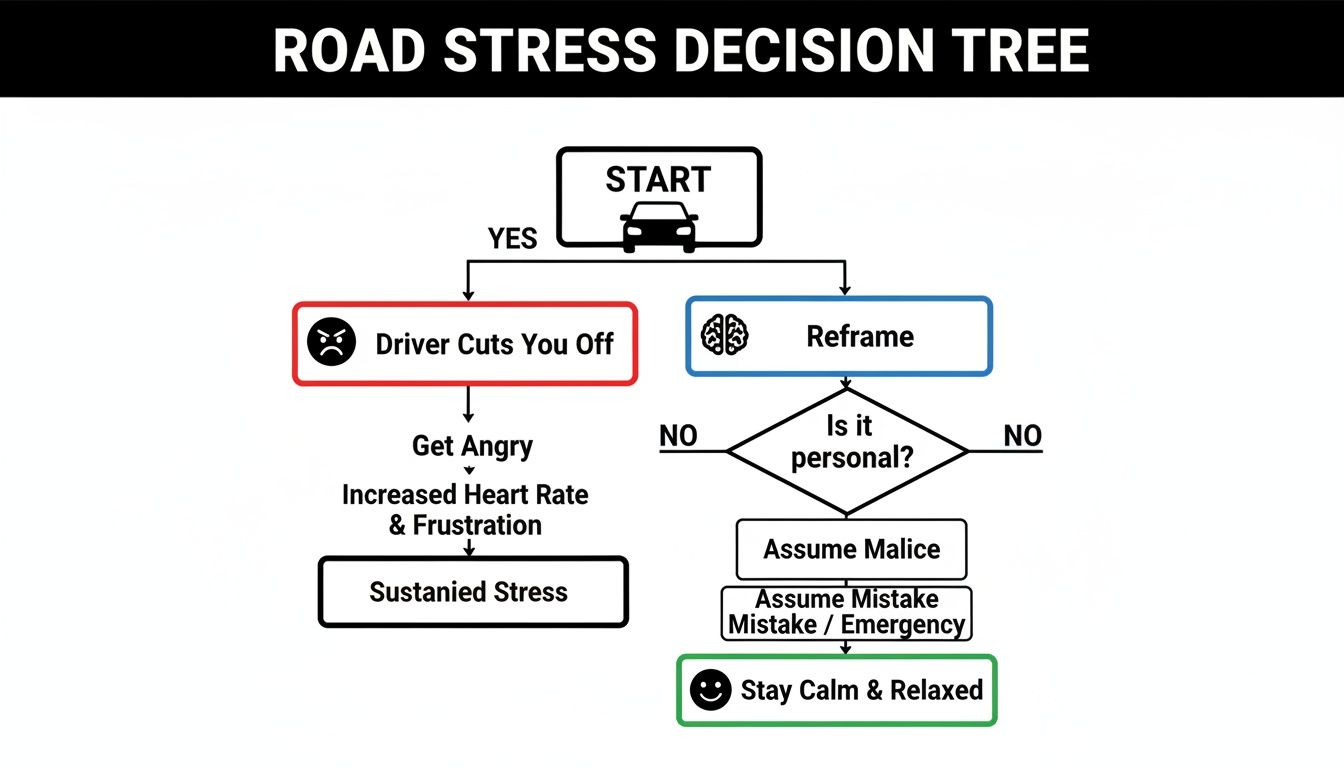
As you can see, choosing to reframe the situation and let it go immediately diffuses your stress. Holding onto anger just keeps that cortisol pumping. For a deeper dive, check out our guide on how to handle aggressive drivers for more detailed strategies.
Reporting Dangerous Drivers in Florida
Sometimes, a driver's actions go beyond simple aggression and become a genuine danger to everyone on the road. In those moments, reporting them is the right call. But you have to do it safely.
Your safety comes first. Never attempt to dial or text while driving. If you need to make a report, pull over somewhere safe or ask a passenger to make the call. Your primary job is to drive.
To report a dangerous or aggressive driver in Florida, you can dial *FHP (that’s *347) from your phone to reach the Florida Highway Patrol.
Try to have the following details ready:
- The vehicle's make, model, and color
- The license plate number (even a partial one helps)
- Your location and which way the car was headed
- A clear description of what they were doing (e.g., "swerving between lanes at 90 mph," "forcing cars off the road").
By focusing on de-escalation first and reporting only when necessary (and safe!), you can protect yourself and help keep Florida’s roads safer for everyone.
Staying Calm in High-Stress Driving Scenarios
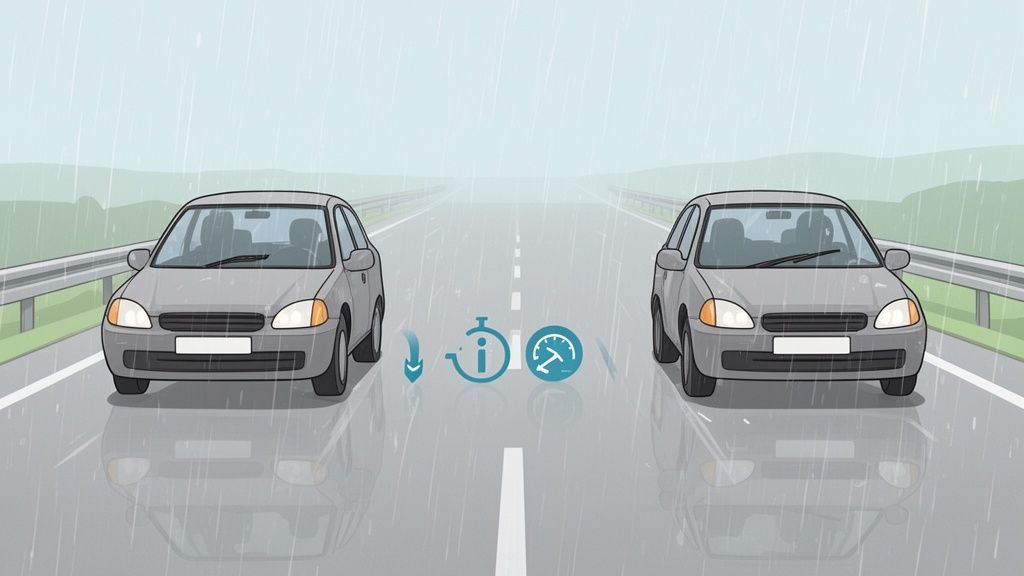
The basic tools for calm driving are great, but let's be honest—different situations call for different game plans. The kind of patience you need for a parking lot on I-4 is worlds away from what you need to navigate a torrential downpour on the Palmetto Expressway.
Think of it like having a specialized toolkit. Instead of one hammer for every problem, you can grab the right tool for the job. Knowing how to adapt your approach is what keeps you in control and prevents stress from boiling over when the road gets tough.
Navigating Rush Hour Gridlock
Stop-and-go traffic is the ultimate test of patience. The endless cycle of braking, creeping forward, and feeling trapped can fray anyone's nerves. The secret here isn't trying to get there faster; it's accepting the reality of the situation and making it less miserable.
Instead of staring at the bumper in front of you and fuming, shift your focus to what you can control inside your car. This is a perfect opportunity to:
- Get lost in a story. Fire up an engaging podcast or an audiobook. When your mind is following a compelling narrative, the traffic jam fades into the background.
- Use the downtime for deep breaths. When you’re at a standstill, it’s a perfect moment to practice the "4-4-4" breathing technique. Just a few rounds can do wonders for your nervous system.
- Stop the lane-hopping habit. Weaving between lanes is a high-stress, low-reward game. It rarely saves you more than a minute or two but skyrockets your risk of a fender-bender. Pick a lane and commit.
Surviving rush hour is all about mental acceptance. You can't change the traffic, but you can absolutely change how you react to it. Fighting reality just burns your energy and makes you angry.
Driving in Severe Florida Weather
A sudden afternoon thunderstorm is a Florida staple. One minute it's sunny, the next the roads are slick and visibility is near zero. This is a time to dial up your awareness, not your anxiety. When the skies unload, your entire focus needs to shift to safety and deliberate, careful actions.
First thing's first: create space. Immediately increase your following distance to at least four to five seconds behind the car ahead. Wet pavement demands more stopping distance. Next, slow down—way down. The posted speed limit is for a perfect, sunny day, not a blinding rainstorm.
One of the biggest hazards in a Florida downpour is hydroplaning, which is when your tires lose their grip on the water-covered road. To avoid it, stay out of the far-right lanes where water tends to pool, and make all your movements—steering, braking, accelerating—smooth and gentle.
Managing Long Trips and Highway Hypnosis
Long, straight drives down I-75 or across Alligator Alley bring on a totally different beast: mental fatigue. "Highway hypnosis" is a very real, very dangerous state where the monotonous road lulls you into a daze, severely slowing your reaction time.
To fight it, you have to break the monotony on purpose.
Plan a stop every 90 minutes to two hours, no matter how awake you feel. Pull over, get out of the car, stretch your legs, and walk around for a few minutes. It's a simple act that completely resets your focus. Changing up your audio—switching from your music playlist to a talk radio show or even just enjoying the silence—can also work wonders for keeping your brain engaged.
Got Questions About Staying Calm on the Road?
Even with a solid game plan, you're bound to have questions when you're working on staying cool behind the wheel. Let's tackle some of the most common ones we hear from Florida drivers, from what to do in a moment of panic to understanding just how serious aggressive driving is here in the Sunshine State.
What Should I Do If I Feel a Panic Attack Starting While Driving?
This is a scary situation, but having a plan is everything. The moment you recognize the signs—your heart is pounding, you can't catch your breath, you feel dizzy—your one and only job is to get off the road safely. Don't try to tough it out.
Signal, and find the nearest safe spot to pull over. It could be a gas station, an empty parking lot, or the shoulder of the road. Get the car into park, turn on your hazard lights, and just breathe.
Now, you can work on getting grounded:
- Box Breathing: A classic for a reason. Inhale slowly for a count of four, hold for four, exhale for four, and hold again for four. This simple rhythm can work wonders on a racing heart.
- Use Your Senses: Pull your mind back to the present. Name five things you can see around you, four things you can physically feel (the texture of the steering wheel, your clothes), and three things you can hear.
- Take Your Time: Don't rush back onto the road. Stay put until you feel the physical symptoms ease up and your head is clear. If it helps, call a friend or family member to talk you through it.
A panic attack behind the wheel feels overwhelming, but your pre-made plan is your lifeline. The goal is always to stop driving, manage the moment, and only continue when you're truly ready.
How Can Traffic School Actually Help with Driving Anxiety?
Most people think of traffic school as just a way to deal with a speeding ticket, but a good course is so much more than that. A state-approved Basic Driver Improvement (BDI) course in Florida is designed to rebuild your confidence by sharpening your defensive driving skills.
Anxiety often stems from feeling out of control. A BDI course gives you that control back. It teaches you how to anticipate what other drivers might do, manage hazards before they become emergencies, and handle everything from a sudden downpour to a tailgater. You're not just learning the rules; you're learning the strategy of safe driving.
When you replace that feeling of uncertainty with proven skills, your anxiety naturally starts to fade. Knowing exactly what to do when things get hairy is incredibly empowering and makes you feel more like a capable pilot than a passenger.
What Are the Real Penalties for Aggressive Driving in Florida?
Florida takes aggressive driving very seriously, and the consequences are much more than a slap on the wrist. The state has laws specifically designed to crack down on this behavior.
A conviction for aggressive careless driving means steep fines, points on your license, and a mandatory date with a judge. Just one incident can add three or four points to your license. If you accumulate 12 points in 12 months, you're facing a 30-day license suspension.
And if things escalate into a road rage incident? You could be looking at criminal charges for reckless driving, assault, or battery. A first-time reckless driving conviction alone can cost you up to $500 and include jail time. These aren't just minor penalties—they can completely disrupt your life, which is a powerful reason to always keep your emotions in check.
At BDISchool, we know that confident drivers are calm drivers. Our Florida-approved courses are built to equip you with the practical skills you need to handle any road with composure. Whether you need to dismiss a ticket, get an insurance discount, or just want to feel more in control behind the wheel, we're here to help. Find the right course for you and start your journey to a more peaceful drive today.