Getting that letter in the mail saying your Florida driver's license is suspended is a gut-punch. It's stressful, but I promise you, there's a clear path to getting back on the road. It all boils down to figuring out why you were suspended, checking off all the state's boxes, and paying the reinstatement fee.
Let's walk through it.
Why Was My Florida Driver's License Suspended?
Before you can fix the problem, you have to know exactly what it is. The Florida Department of Highway Safety and Motor Vehicles (FLHSMV) has a specific reason for taking away your driving privileges, and your entire reinstatement plan hinges on that single piece of information.
Your official suspension notice is the best place to start, but let's be honest, the legal language can be a bit dense. Generally, suspensions fall into two main buckets: things you did while driving and things that have nothing to do with driving at all.
Common Triggers for License Suspension
It's a common misconception that only dangerous driving leads to a suspension. While that's certainly one reason, many drivers are caught off guard by other issues that can put their license on ice.
Here are some of the usual suspects I see all the time:
- Point Accumulation: This is the classic one. Rack up too many points from traffic tickets in a set period, and you'll trigger an automatic suspension. If you're fuzzy on the details, our guide on how the Florida points system works breaks it all down.
- Failure to Comply or Appear: Simply forgetting to pay a traffic ticket or skipping a court date is a fast lane to a "D6 suspension." This is one of the most common reasons for suspension in Florida.
- Unpaid Financial Obligations: This is a big one. It covers everything from failing to pay court-ordered child support to not settling a civil judgment from a car accident.
- Lack of Insurance: Florida law is strict about this. If you let your auto insurance lapse, even for a short time, you can expect a suspension notice.
Suspension vs. Revocation vs. Cancellation
The terminology the FLHSMV uses really matters, so it's crucial to know the difference.
A suspension is temporary. Think of it as your license being put in a "time-out." Once you've met all the requirements, you can get it back.
A revocation is far more serious. This is a long-term termination of your driving privilege, often for major offenses like a DUI or being labeled a Habitual Traffic Offender (HTO). Reinstating a revoked license is a much more difficult and lengthy process.
A cancellation usually happens when there was a mistake on your initial license application or some other administrative error.
The key takeaway here is that a suspension has a clear path to getting your license back. A revocation, on the other hand, means your license is gone for a legally required period. After that time is up, you essentially have to start over from scratch and reapply.
The Impact of Debt-Based Suspensions
It's important to recognize that a huge number of suspensions in Florida have nothing to do with bad driving and everything to do with money. The state’s system of suspending licenses for unpaid fines and fees has impacted hundreds of thousands of people.
In fact, as of 2023, over 700,000 Floridians had suspended licenses, and most of those were due to an inability to pay. It creates a vicious cycle: you can't drive to work to earn money to pay the very fines that got your license suspended. It's a systemic issue with real economic consequences—a 2019 study estimated Florida lost $491 million in consumer spending because of it. You can read more about Florida's debt-based suspension crisis on finesandfeesjusticecenter.org.
This is why your first move is always to identify the exact cause. Once you know if you're dealing with points, a fine, or an insurance issue, you can start building your personal game plan to get your license reinstated.
Building Your Personal Reinstatement Checklist
Alright, you know why your license is suspended. Now comes the part where we turn that knowledge into a concrete plan of action. The key here is to stop looking at this as one giant, overwhelming problem and start breaking it down into a series of smaller, totally manageable tasks. Think of it as building a to-do list that gets you back on the road.
Your most valuable ally in this process is the official Online Driver License Check from the Florida Highway Safety and Motor Vehicles (FLHSMV). This isn't some generic advice column; it's a free, real-time look into the state's system that tells you exactly what you need to do. It's your personalized blueprint for getting your license back.
Our job is to take that official blueprint and turn it into a simple, step-by-step checklist you can start working on today.
Start with Your Official Requirements
Once you pull up your status on the FLHSMV site, you'll see a list of requirements. Don't let it intimidate you. The next step is to organize these items into a logical workflow.
Your personal checklist will probably be a mix of the following common requirements:
- Paying Outstanding Fines: This usually involves unpaid traffic tickets or court fees. The portal will tell you exactly which county clerk’s office you need to pay.
- Satisfying Financial Responsibilities: This one pops up for more serious issues, like a DUI or being in an accident without insurance. It almost always means you'll need to get an SR-22 certificate. An SR-22 isn't insurance—it's just a form your insurance company files with the state to prove you have the required liability coverage.
- Completing Mandated Courses: The state often requires you to complete a specific driver improvement course. This is their way of ensuring you've addressed the behavior that led to the suspension in the first place.
The image below breaks down the different ways your driving privileges can be restricted. It’s important to know the difference.
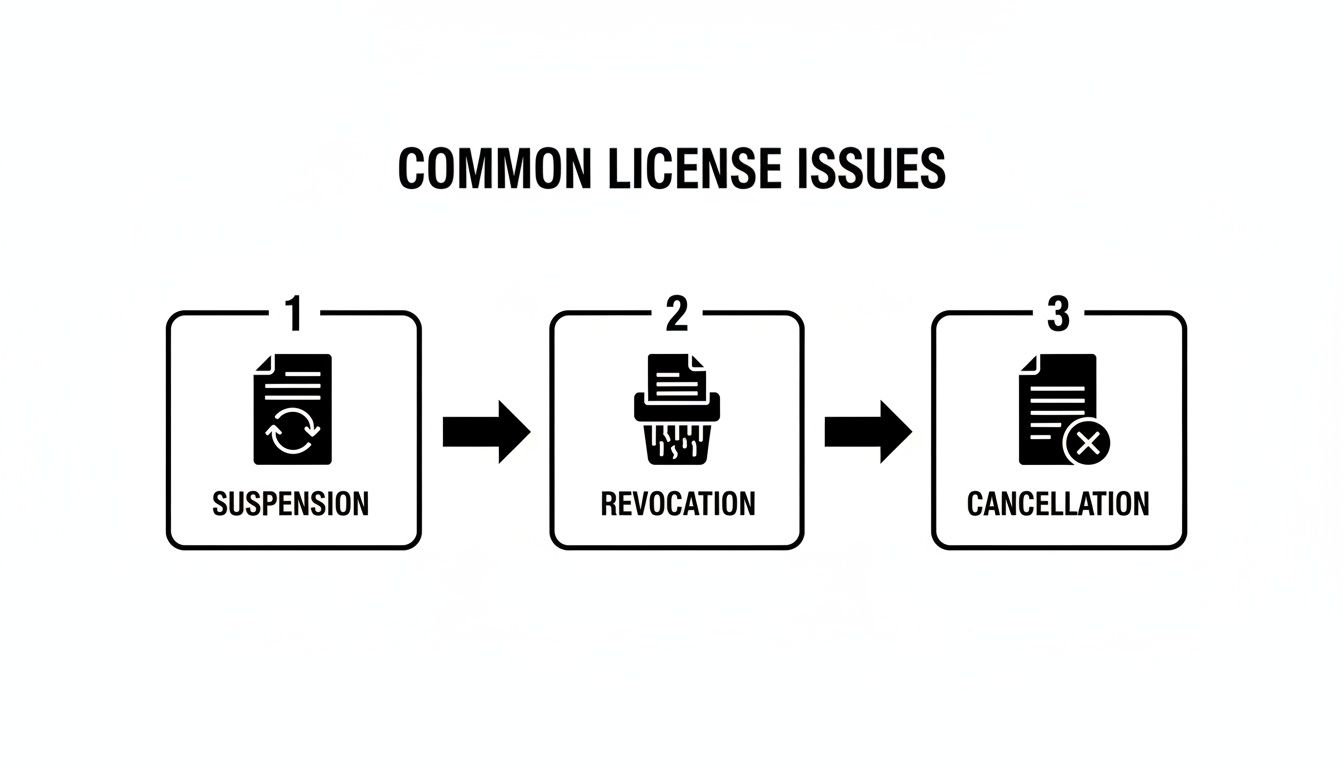
Understanding if your license is suspended, revoked, or canceled is critical because each status has a very different path to reinstatement.
Identifying the Right Driver Improvement Course
A driver improvement course is one of the most common requirements you'll see on a reinstatement list. But here's the catch: you can't just take any course. The FLHSMV or the court that handled your case will specify the exact program you need based on your violation.
Enrolling in the wrong one is a classic mistake. It won't count toward your requirements, wasting both your time and money. Before you sign up for anything, double-check your official requirements to see which course applies to you.
Different situations call for different courses, and BDISchool offers state-approved online versions for all of them. Here’s a quick look at how they typically line up with various requirements.
Common Florida Driver Improvement Course Requirements
| Course Name | Course Length | Common Reasons for Requirement | Key Benefit |
|---|---|---|---|
| Basic Driver Improvement (BDI) | 4 Hours | Point-related suspensions; traffic ticket point avoidance. | Satisfies state/court order, prevents points on your record. |
| Intermediate Driver Improvement (IDI) | 8 Hours | Judge-ordered for more serious moving violations. | Fulfills specific judicial requirements for reinstatement. |
| Advanced Driver Improvement (ADI) | 12 Hours | Required for Habitual Traffic Offenders (HTO); applying for a hardship license. | A mandatory step for regaining driving privileges after major offenses. |
Taking the correct course is non-negotiable. With a state-approved provider, your completion certificate is sent to the FLHSMV electronically, which is one less thing for you to worry about.
To get the full story behind your suspension, it often helps to see the big picture. You can learn more about how to check your Florida driving record in our detailed guide.
Building Your Actionable Checklist
Now, let's put it all together. Grab a pen and paper or open a new note on your phone. Based on the official requirements from the FLHSMV, create your own clear, numbered list.
For example, say your license was suspended for getting too many points and also letting your insurance lapse. Your personal action plan might look something like this:
- Check FLHSMV online to confirm every single requirement.
- Call my insurance agent to get a new policy and request they file an SR-22 form with the state.
- Sign up for the 4-hour BDI course online since it's required for my point suspension.
- Complete the course and get the electronic certificate sent to the FLHSMV.
- Pay the final reinstatement fee through the state's online portal once everything else is cleared.
See how that works? You’ve just transformed a confusing mess into a clear, manageable path forward. Each item you cross off is a real, tangible step toward getting back behind the wheel.
Tackling the Reinstatement Fees and Payment Plans
Let's get straight to the biggest roadblock for most people trying to get their license back: the cost. It’s rarely just one simple fee. You’re often looking at a pile-up of court fines, potential collection agency charges, and the official state reinstatement fee itself. The total can feel overwhelming, but some recent changes in Florida law have finally created a realistic path forward.
The exact amount you’ll owe comes down to why your license was suspended in the first place. Every violation carries its own set of costs, and they can add up faster than you’d think.
Breaking Down the Costs
Getting a handle on the fee structure is your first move. While every situation is different, the costs typically fall into a few main buckets:
- Court Fines and Fees: These are the original penalties from the traffic ticket or violation. They have to be paid to the Clerk of Court in the county where it all went down.
- State Reinstatement Fee: This is a separate charge paid directly to the FLHSMV after you’ve handled everything else. The standard fee is $45, but it jumps for more serious issues—a DUI-related suspension, for instance, comes with a $130 reinstatement fee.
- Collection Agency Costs: If your fines went unpaid for a while, the county may have passed the debt to a collection agency. They tack on their own fees, which can be a hefty percentage of what you originally owed.
It’s easy to get tangled in this web of payments. The key is to focus on the court fines first. You can't even think about paying the state reinstatement fee until the county court gives the all-clear.
A New Lifeline: Statewide Payment Plans
For too long, the inability to pay a mountain of fines all at once trapped countless Floridians in a cycle of debt and suspension. Thankfully, the state has recognized this isn't working and has rolled out some major reforms.
A huge change arrived in 2022 with the passing of HB 397. This law is a game-changer. It allows you to set up a monthly payment plan with the county Clerk of Court for your outstanding fines and fees. This means you don't need to have every penny on hand to start the reinstatement process.
Key Insight: Under this law, you can get on a payment plan that requires a monthly payment of either $25 or 2% of your annual income divided by 12—whichever is greater. This makes the financial recovery part of the process actually attainable.
Once you’re officially on an approved payment plan, the Clerk can give the FLHSMV the "D6 clearance." This is the green light that allows you to reinstate your license, even as you continue making your monthly payments.
How to Take Action and Set Up Your Plan
So, how do you make this happen? It starts with being proactive.
- Find the Right County: Your driving record or suspension notice will tell you which county's Clerk of Court holds your debt.
- Contact the Clerk's Office: Get in touch with them directly. Most counties have information right on their websites about setting up payment plans for traffic fines.
- Ask About the Program: When you call or visit, ask specifically about payment plan options available under the new state law. They’ll give you the forms and instructions you need.
Don't sit back and wait for the court to find you. Taking the first step shows you're serious about fixing the problem and is the single fastest way how to reinstate a suspended license in Florida when money is tight.
These reforms are making a real difference. In Miami-Dade County, a special Task Force, backed by American Rescue Plan funds, has helped drive a massive 73% reduction in suspended licenses since 2022. By clearing old cases and making reinstatement more affordable, these programs have saved residents $4 million in collections fees and put thousands back on the road legally. You can learn more about these successful Florida license reinstatement reforms.
Tackling Your Required Driver Improvement Course
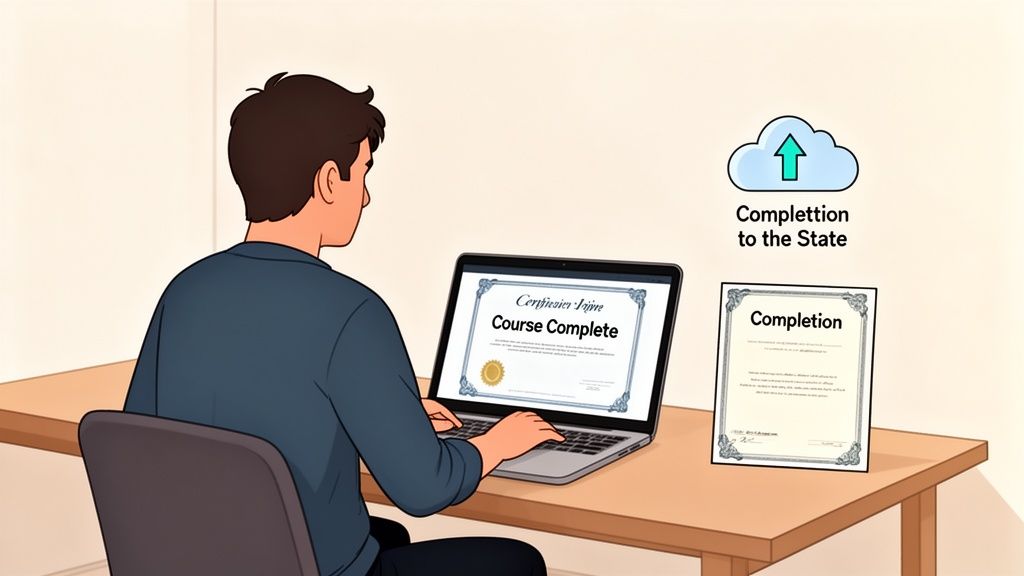
If a driver improvement course is on your reinstatement checklist from the FLHSMV, consider it a mandatory stop on your road back to driving. This isn't just busywork; it's the state or a court's way of ensuring you understand what led to the suspension and are ready to be a safer driver.
Thankfully, getting this done is far more straightforward than it used to be. The most important thing to do first is to confirm exactly which course you need. Don't guess. Your suspension notice will spell it out, and taking the wrong one is a surefire way to waste both time and money.
Which Course Is Right for You?
The course you’re assigned is tied directly to the violation that caused your suspension. They aren't one-size-fits-all, and each is tailored to address specific driving behaviors and patterns.
- 4-Hour Basic Driver Improvement (BDI): This is the most common one. You’ll often see it required for point-related suspensions or as an option to satisfy a standard traffic ticket.
- 8-Hour Intermediate Driver Improvement (IDI): A judge usually orders this for more serious moving violations. It’s a definite step up from the basic course, diving deeper into defensive driving techniques.
- 12-Hour Advanced Driver Improvement (ADI): This is for the most serious cases. It's typically required if you've been labeled a Habitual Traffic Offender (HTO) or if you're trying to get a hardship license.
Here’s a critical piece of advice: The course must be approved by the Florida Department of Highway Safety and Motor Vehicles (FLHSMV). If you sign up for an unapproved program, it simply won't count, and you'll have to do it all over again.
Why Online Courses Are the Smart Choice
Forget about trying to squeeze a stuffy classroom course into your already packed schedule. State-approved online providers have completely changed the game, offering a flexible and efficient way to meet this requirement.
When you’re juggling work, family, and everything else involved in getting your license back, this flexibility is huge. A reputable online school like BDISchool lets you complete the course on your own time, from anywhere, using a computer or even your phone. You can break the material into smaller chunks instead of losing an entire Saturday in a classroom.
You can learn more about the different Florida driver improvement courses online to see which one matches your state notice.
The Power of Electronic Reporting
Here's a pro tip that can save you a world of frustration: look for a provider that offers automatic electronic reporting. This single feature can dramatically speed up your reinstatement.
It's a simple but powerful process:
- You finish your online course.
- The school instantly sends your completion data directly to the FLHSMV.
- The state’s system is updated, often within 24 to 48 hours, showing you’ve met the requirement.
This direct line of communication cuts out a huge potential delay. The old way involved you getting a paper certificate and figuring out how to deliver it to the right office, which could easily add days or weeks to the process. When your main goal is figuring out how to reinstate a suspended license in Florida quickly, instant verification is everything.
Once that course completion is on your record with the state, you’re one major step closer to getting back behind the wheel. Always save a copy of your certificate for your own files, just in case. Now you can confidently move forward to the final phase: paying your fees and officially getting reinstated.
How to Finalize Your Reinstatement with the FLHSMV
Alright, you've made it this far. You've navigated the courses, squared away the fines, and sorted out your insurance. Now for the final hurdle: making it official with the Florida Highway Safety and Motor Vehicles (FLHSMV). This is where all your hard work pays off and you get your valid driver's license back in your wallet.
The path you take from here depends entirely on why your license was suspended in the first place. Some drivers can wrap everything up online in a few minutes, while others will need to head to a local service center. Knowing which route is yours is the key to avoiding a headache.
Choosing Your Submission Method: Online vs. In Person
The fastest and most convenient route is always the state's MyDMV Portal. For a lot of common issues, like suspensions from unpaid tickets or a brief insurance lapse, you can simply log on and pay your final reinstatement fee. If you’ve already checked off all the other requirements, this is your quickest ticket back to driving legally.
But not everyone gets to take the easy way out. You'll almost certainly need to show up in person for more complicated situations.
An in-person visit is usually mandatory if you are:
- Reinstating after a DUI suspension.
- Applying for a hardship license.
- Dealing with a license that has been physically expired for a long time.
- In any situation that requires the state to see multiple original documents.
If you’re on the fence about which category you fall into, check your status online first. It could save you a pointless trip. For a complete walkthrough, take a look at our guide on how to see if your Florida license is suspended.
Preparing for Your Visit to a Service Center
If you have to go in person, your success hinges on preparation. Showing up empty-handed or with the wrong paperwork is a surefire way to get sent home and have to come back another day. Think of it as a mission: get all your documents together ahead of time, have them organized, and be ready to present them.
Here’s what your "go-bag" for the service center should contain:
- Proof of Identity: Your original birth certificate or a valid U.S. passport.
- Proof of Social Security Number: Your actual Social Security card or a W-2 form will work.
- Proof of Florida Residency: You'll need two documents showing your current address. A utility bill, lease agreement, or bank statement are perfect examples.
- Proof of Compliance: Don't forget copies of everything you’ve completed! This includes your course completion certificate, SR-22 insurance form, and any receipts showing you've paid your fines.
A critical tip from my experience: Always bring the original documents, but keep a set of copies for yourself. You'll be glad you have them if anything gets misplaced.
Exploring Year-Round Assistance Programs
Florida knows that the cost of reinstatement can be a huge roadblock for many people. To help, the state has started looking beyond one-time events and toward more permanent support systems. A great example is the Drive for Success Pilot Program, which evolved from the popular "Operation Green Light" events.
Instead of waiting for an annual event, this program offers year-round assistance in certain counties. It allows people to get their licenses reinstated after making just the first payment on an installment plan, rather than needing the full amount upfront. The impact of this approach is clear: previous Operation Green Light events collected $2.7 million and helped nearly 10,000 drivers become eligible for reinstatement. The pilot program aims to make that kind of success an everyday option for those struggling financially. You can find more details on the Drive for Success program from FL Clerks.
Once you've submitted your final paperwork and paid the state's fee—whether online or at the counter—your status will be updated. In most in-person cases, you'll walk out with your new license right then and there, officially and legally back on the road.
Common Questions About Getting Your License Back
Going through the reinstatement process can feel overwhelming, and it’s completely normal to have a lot of questions. Let's break down some of the most frequent concerns drivers have when they’re trying to get back behind the wheel.
How Long Does This Actually Take?
Honestly, the timeline for reinstating a suspended license in Florida is all over the map. It really depends on your specific circumstances.
If you're dealing with something straightforward, like a single unpaid ticket and a reinstatement fee, you could potentially sort it all out online in less than an hour. But for more complex situations—say, you need to complete a driver improvement course, fulfill a court order, or wait out a mandatory suspension period for a DUI—you could be looking at several weeks or even months.
My best advice? Start tackling your reinstatement checklist right away. Knocking out an online course, for instance, is something you can do quickly. Just make sure you pick a school that reports your completion electronically to the FLHSMV to avoid any unnecessary delays.
What About a Hardship License?
A hardship license lets you drive for essential purposes only, like getting to work, school, or the doctor. It's a lifesaver for some, but it's definitely not a given. Eligibility is strict and hinges on why your license was suspended in the first place and what your overall driving record looks like.
Heads Up: If you have convictions for certain serious offenses, you're likely out of the running for a hardship license. Applying usually means a formal application, an administrative hearing with the FLHSMV, and often requires completing a 12-hour Advanced Driver Improvement (ADI) course just to be considered.
What's This SR-22 Thing All About?
It’s easy to get confused here. An SR-22 isn't actually insurance—it's a certificate from your insurance company to the state, proving you have the minimum required liability coverage.
You’ll typically need an SR-22 on file for more serious violations, such as:
- Driving under the influence (DUI)
- Causing a crash without insurance
- Racking up too many points on your license
The catch is you have to keep this SR-22 filing active, usually for three straight years, with zero gaps in your insurance. If your policy lapses, even for a single day, your insurance company is legally required to tell the FLHSMV, and your license will get suspended all over again.
What if I Just Drive Anyway?
Don't do it. Driving on a suspended license in Florida is a criminal offense, and the consequences get severe, fast.
A first offense is a second-degree misdemeanor, which can mean fines and jail time. A second offense is a first-degree misdemeanor with stiffer penalties. By the third time, you could be facing a third-degree felony, which carries up to five years in prison and a five-year license revocation. It’s never, ever worth the risk. Following the proper steps for how to reinstate a suspended license in Florida is the only smart way forward.
If a driver improvement course is on your to-do list, you need a state-approved school you can trust. BDISchool offers fully online, self-paced courses and we report your completion directly to the FLHSMV. This helps you check that box and move on with the process. Get started with the right course today at https://bdischool.com.