
You’ve received another moving-violation ticket, and your first concern is probably the fine. But if there are earlier convictions on your record, the more important question is whether this citation could push you toward habitual traffic offender status in Florida.
Don’t guess from the tickets in your glove compartment. Check the state’s record, separate convictions from unresolved charges, and choose your next step before paying or electing traffic school. A course can help an eligible driver protect their record, but it isn’t a substitute for legal advice when a designation is close.
Florida’s Two Paths to Habitual Traffic Offender Status
Florida designates a driver as a habitual traffic offender (HTO) when the official driving record meets either of two conviction thresholds within a five-year period, not just because the driver has received repeated tickets, under Florida Statutes section 322.264. Those thresholds are three qualifying serious convictions arising from separate acts, or 15 convictions for moving traffic offenses for which points may be assessed.
Florida habitual traffic offender thresholds
| Pathway | Qualifying offenses | Count required | Time window |
|---|---|---|---|
| Serious-offense pathway | Vehicular manslaughter, DUI, felony involving a motor vehicle, driving while suspended or revoked, leaving a crash involving death or injury, operating a commercial vehicle while disqualified | 3 convictions from separate acts | Within 5 years |
| Point-based pathway | Moving traffic offenses for which points may be assessed | 15 convictions | Within 5 years |
Serious offenses can establish the designation sooner
The serious-offense pathway covers more than impaired driving. It also includes license-related convictions, qualifying motor-vehicle felonies, and failure to stop and render aid after a crash involving death or injury.
The separate-acts requirement matters. Don’t assume that several charges listed under the same incident automatically establish separate qualifying acts. Match each conviction to the event that produced it.
Comparable convictions under federal, out-of-state, or municipal laws can also count. A Florida-only folder of tickets may therefore leave out entries that matter to the state’s determination.
Ordinary moving violations can also qualify
The point-based pathway is the surprise for drivers who associate habitual-offender status only with serious criminal conduct. A driver with no criminal record can still accumulate qualifying moving-violation convictions.
This is a conviction count, not a total-points calculation. Counting points alone won’t tell you whether you’re approaching this pathway.
The comparison graphic provides a visual reminder to track both categories.
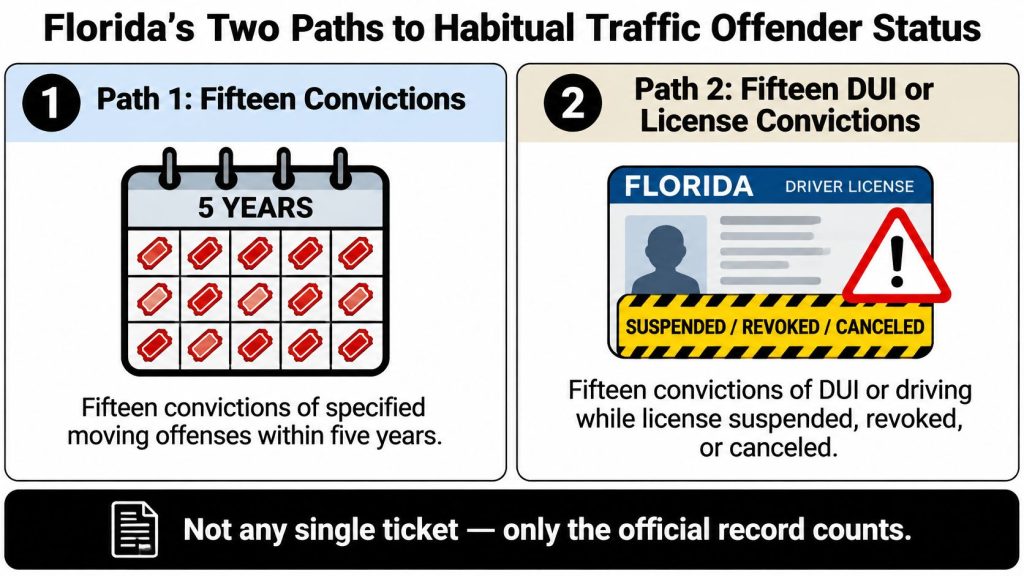
Correction to the graphic: Its DUI or license-conviction label is incorrect. Use the serious-offense threshold in the table, not the graphic’s label.
Record checkpoint: Don’t wait for a designation notice to start counting. Review the official record while you still have time to address a pending citation and get advice.
Your opinion of a ticket’s seriousness doesn’t determine its effect. The offense classification, conviction entry, and timing do. If either category looks close, make the record review your immediate priority.
How to Check Your Florida Driving Record
Get your official FLHSMV driving record, not just an insurance summary or a collection of court receipts. The FLHSMV suspension and revocation guidance describes the HTO categories and notes that point records generally remain on the driving record for at least five years from disposition.
Use the Florida driving record check guide to organize the request. Keep the record beside the court dispositions for any entry you don’t recognize or understand.
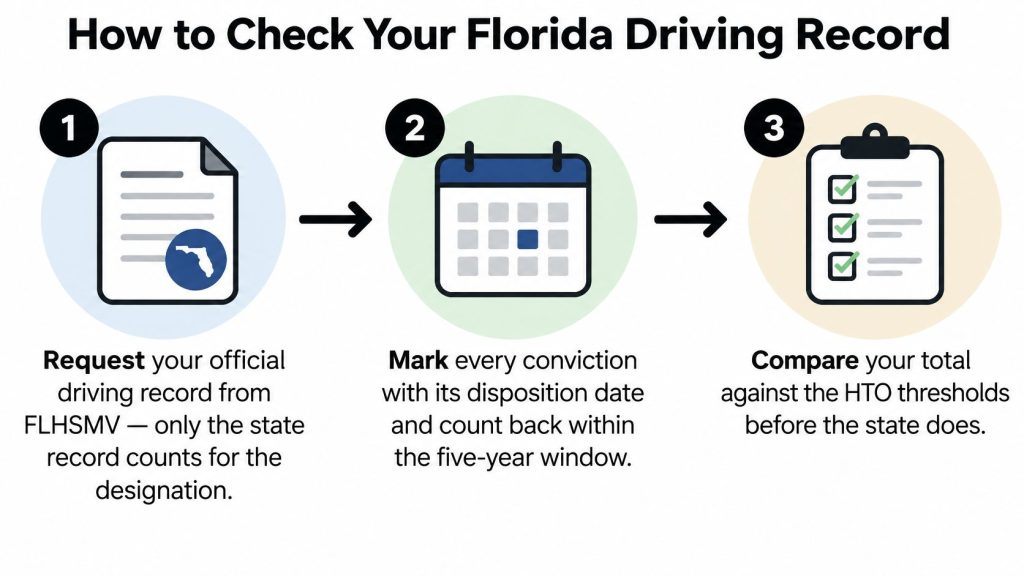
This visual summarizes the basic review process.
Build a conviction worksheet
-
Request the official record. Use the state record as your starting point because that’s the record used for designation. Save a copy so you can compare it with later updates.
-
Mark conviction and disposition dates. Count back through the applicable lookback period for an initial review. Don’t substitute the day you received the ticket for the disposition date, and don’t assume today’s count resolves an earlier designation.
-
Classify each entry. Separate serious qualifying offenses from point-eligible moving convictions. Put unclear entries in a review column rather than guessing what a shorthand offense description means.
-
Match serious convictions to separate acts. Add an incident date or case number beside each entry. Multiple charges from the same incident need closer examination before you treat them as independent qualifying acts.
-
Total qualifying moving convictions. Count convictions, not the number of points assigned. Keep unresolved citations on a separate list because they aren’t yet the same thing as recorded convictions.
-
Check other jurisdictions. Look for out-of-state and municipal entries that may match Florida’s qualifying categories. Don’t exclude an entry merely because a different jurisdiction uses different terminology.
Verify before drawing conclusions
A duplicate entry, an incorrect disposition, or a misunderstood offense description can change your assessment. If something looks wrong, obtain the underlying court record and ask the appropriate agency how to request a correction.
A reassuring result means you’re below both conviction thresholds, haven’t received a designation notice, and have confirmed your current license status. It doesn’t mean you can ignore an unresolved ticket or another restriction.
Use the video alongside your documents, not instead of checking the official entries.
If your count is close, contact a licensed Florida attorney before deciding how to resolve another citation. Bring the record, notices, and court dispositions so the attorney can assess actual entries rather than your recollection.
Real Driver Cases That Show How Designation Happens
These are hypothetical scenarios, not reports about actual drivers. They show why an apparently manageable ticket history deserves a running record check.
Hypothetical case A follows a commuter’s ticket history
Say a commuter accumulates 15 point-eligible moving convictions over four years. Each ticket feels isolated: an inconvenient stop, a payment, then back to work.
The driver never creates a conviction timeline. By the time the final entry appears, the record looks very different from the driver’s memory of occasional minor mistakes.
An earlier review could have prompted action on a pending citation. If eligible, the driver could have considered a state-approved course to avoid points associated with that citation, while confirming the election’s effect with the clerk.
That’s different from buying a course afterward and expecting old convictions to disappear. Prevention depends on eligibility and timing, not holding a completion certificate.
Hypothetical case B follows separate serious incidents
Consider another driver whose hypothetical timeline begins with a DUI conviction in January. A later, separate incident produces a driving-while-suspended conviction in September.
A further serious qualifying conviction, from another incident the following June, completes the scenario within two years. The driver doesn’t need a long collection of ordinary moving violations for the serious-offense pathway to become relevant.
The contrast is clear: one driver’s record develops through repeated routine citations, while the other’s qualifying history can develop within months. Neither driver’s belief that they’re generally careful changes the recorded convictions.
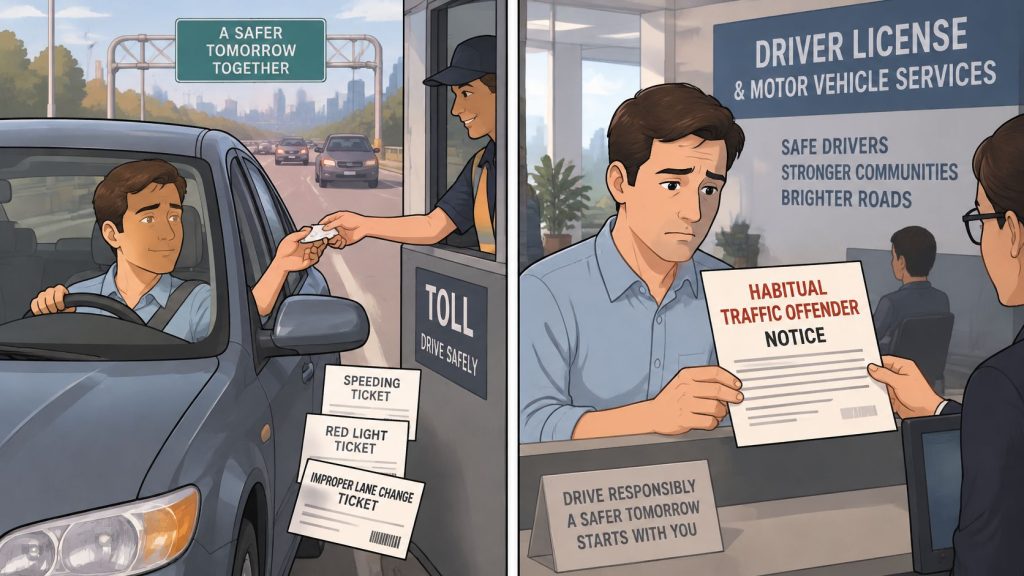
The image illustrates the difference between treating tickets as isolated events and confronting their combined consequences.
A useful timeline shows what the court recorded, when it recorded it, and which incident produced the conviction.
Don’t count separate charges from the same act as separate qualifying incidents without review. Equally, don’t combine distinct incidents just because the court handled their cases together.
Draw your own timeline with incident dates, conviction dates, offense types, and case numbers. Leave space for unresolved citations so you can see the decisions still ahead of you.
What an HTO Designation Costs You on the Road
Florida requires revocation of a designated habitual offender’s driving privilege, with a general minimum five-year barrier to relicensing, subject to limited statutory relief; driving on Florida highways during an HTO revocation carries third-degree felony exposure, as described in the Florida House statutory guidance on suspended and revoked driving.
That’s not an ordinary ticket consequence. You’re dealing with loss of driving privileges and the possibility of a new criminal case if you continue driving.
A later drive creates a separate problem
The underlying convictions may already be resolved when the state issues the designation. Paying those cases doesn’t authorize you to drive during the revocation.
A trip to work, a grocery run, or a drive to collect a child still involves operating a vehicle. Don’t treat a necessary trip as an exception to a restriction.
Your practical response should address transportation immediately. Arrange rides, use available transit, and tell anyone who depends on you for driving that you can’t continue until your legal authority is confirmed.
Respond to the notice with documents
- Stop driving immediately. Don’t assume you have permission because you intend to challenge the designation.
- Confirm the effective date in writing. Keep the notice and obtain your current license-status information.
- Collect the supporting records. Save the convictions, dispositions, and correspondence connected to the designation.
- Ask a licensed Florida attorney about relief. Have the attorney assess the actual record and applicable statutory options.
- Separate education from authorization. Completing a course doesn’t itself restore your driving privilege.
Limited relief isn’t the same as automatic reinstatement. Read the Florida hardship license rules guide to prepare questions, but don’t treat general information as approval to drive.
Driving rule: A course certificate, an appointment, or a pending request isn’t permission to get behind the wheel.
Avoid planning around a quick fix. Your attorney may need to examine both the designation and the underlying cases, while you still need a workable way to get to work and appointments.
The best time to protect your ability to drive is before the state issues the revocation. Once a notice arrives, the priority changes from managing a ticket to complying with the restriction and evaluating lawful relief.
Point Suspensions That Lead to Designation
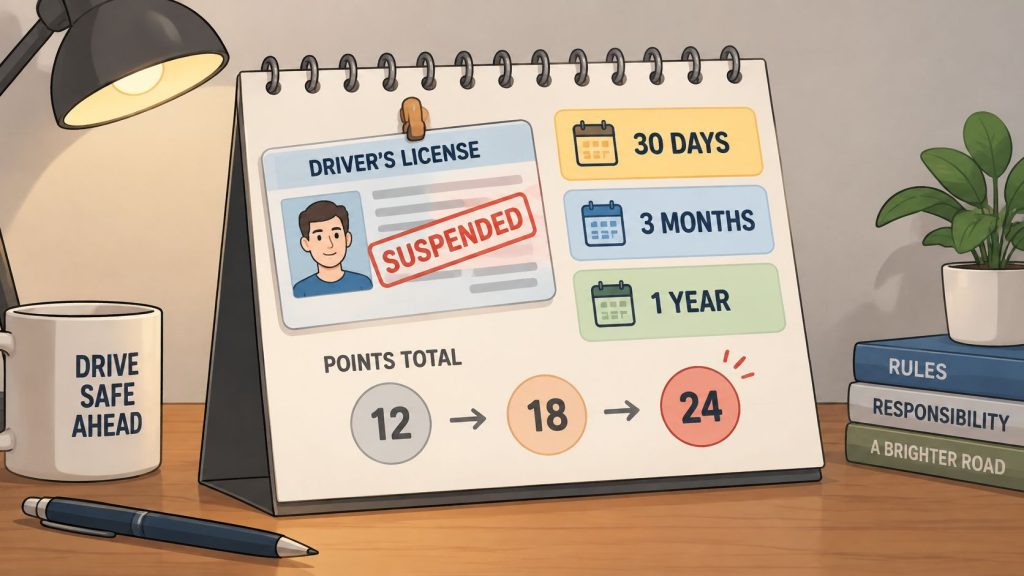
Florida point totals and suspension lengths
| Points accumulated | Window | Suspension length |
|---|---|---|
| 12 points | Within 12 months | 30 days |
| 18 points | Within 18 months | 3 months |
| 24 points | Within 36 months | 1 year |
The FLHSMV driver improvement schools guide sets those suspension thresholds and requires Advanced Driver Improvement (ADI) for drivers suspended for accumulated points, as a non-DUI HTO, or by court order. It also states that ordinary Basic Driver Improvement (BDI) election generally must be made within 30 days of receiving the citation, with one election in any 12-month period and no more than five elections in 10 years.
Points and HTO convictions aren’t interchangeable
A point suspension doesn’t automatically establish HTO status. The point system measures accumulated points, while the HTO pathways focus on qualifying convictions.
Still, a point suspension is a clear reason to stop treating tickets separately. Continuing to drive while suspended can introduce a different kind of qualifying offense into your record.
Use the guide to points and Florida license suspension to distinguish the point calculation from your conviction worksheet. Keep both calculations, because each answers a different question.
The calendar image reinforces why dates belong beside every entry.
Match the course to the requirement
BDI is aimed at drivers who have recently received a moving violation. ADI serves a different purpose, so don’t enroll in a basic course when your notice requires advanced instruction.
Before making a course election, assemble this checklist:
- Citation date and deadline. Copy them from the citation and court instructions into your calendar.
- Conviction and point information. Record the offense and its point treatment rather than assuming every ticket has the same effect.
- Earlier election dates. Check your history against the election limits before registering.
- Court or agency requirements. Confirm the required course type and how completion must be submitted.
Missing the election window can remove an option you might otherwise have had. Don’t confuse the deadline to elect traffic school with any separate deadline the court gives you to finish it.
You control when you review the ticket, contact the clerk, and begin an eligible course. Use that control early, rather than trying to recover an expired option after another conviction posts.
Register for a Driver Improvement Course Before Designation
Two point-eligible convictions inside the window is a running count, not a surprise letter. If you are still under both HTO thresholds and the clerk will let you elect traffic school, register for Basic Driver Improvement now. Confirm eligibility first, then use the open citation while it still gives you a choice.
A qualifying course protects a record you can still change. Convictions already on the record stay there. An HTO designation already in place stays in place.
Action by record status
| Record status | Action |
|---|---|
| One or two point-eligible convictions in the window | Register for a Basic Driver Improvement course now, after confirming election eligibility |
| Count near a serious threshold | Get licensed Florida legal advice before taking any course |
| Designation notice received | Stop driving and ask a licensed Florida attorney about statutory relief |
Choose instruction that fits your actual status
The course is titled Florida’s Basic Driver Improvement Course, also called Florida Four-Hour Traffic School. BDI School is a Florida HSMV-approved Basic Driver Improvement School. The course is state-approved and meets all requirements set by the Florida DMV. It is aimed at drivers who recently received a moving violation.
Review the Basic Driver Improvement course, register through the course catalog, or compare the DriverEducators course options against your court or agency instructions.
Match the course to the order in front of you. A recent moving violation and a suspension or advanced-course order are different jobs. The four-hour course does not answer an order that names a different program.
Register with your documents beside you
-
Check the record before choosing. Clear uncertain entries and confirm your status matches the action in the table. If a serious conviction is on the record, get legal advice before you treat traffic school as the fix.
-
Compare your situation with the decision table. An eligible citation, a count near a serious threshold, and a designation notice call for different responses. Enrollment does not replace an attorney consultation you already need.
-
Confirm the course and election process. Follow the clerk’s instructions for that citation. Registering with a school and electing traffic school with the court are separate tasks.
-
Enter accurate registration details. The registration form asks for your name, driver license number, and email address. Those details generate the completion certificate, so match them to your documents before you submit.
-
Complete the course and preserve proof. Elect inside the election window, finish by the court’s completion deadline, and keep the certificate. Confirm any required submission. Enrollment by itself does not close the case.
Keep an election log next to your conviction worksheet. Write down the citation, election date, course, completion date, and where you sent the certificate.
That log shows whether a later citation is still eligible. It also gives the clerk a paper trail if anyone questions what you finished.
Questions drivers ask before enrolling
Can traffic school remove an HTO designation?
No. A basic course will not cancel a revocation or delete the convictions behind it. A designated driver needs a lawyer to review the record and any statutory relief.
Should I register before checking with the clerk?
Confirm eligibility and the election procedure first. Register the same day so the completion deadline is not a rush job.
Does being below the HTO thresholds mean my license is valid?
No. Other suspensions or restrictions can still apply. Check the actual license status. Do not infer it from the HTO count.
What should I do if I don’t understand an offense on my record?
Get the court disposition and have the entry reviewed. Guessing that an offense is harmless, or that a course will cover it, is a bad basis for a licensing decision.
Make the decision while you still have options
Act before a designation notice arrives, while an eligible citation is still a choice rather than a revocation response. Check the running count, confirm the procedure, and finish the course on time.
Use driver improvement for what it does: better driving habits and protection of a record that still qualifies. Legal help covers the record that no longer does.
BDISchool offers Florida’s state-approved Basic Driver Improvement Course for drivers responding to recent moving violations. If you can elect traffic school, visit BDISchool to register and start before the citation deadline closes that option.