Florida drivers aged 55 and older can qualify for an insurance premium reduction after completing a course approved by the Florida Department of Highway Safety and Motor Vehicles, but each insurer sets the exact amount. So why do so many pages quote a savings figure as if Florida law guarantees it for every policy?
That gap is where drivers lose money and time. You take a course, expect a set percentage off your total bill, then discover your carrier applies a different percentage, to different coverages, starting on a different date.
Don’t guess. The Florida mature driver insurance discount is real, but it’s controlled by a statute, an approved course, and your insurer’s filed rating plan. Get all three right before you enroll, get the percentage in writing, and submit the certificate before renewal.
Who Qualifies for the Florida Mature Driver Discount
Can you qualify at 55? Yes. You don’t need to wait until 60 or 65, and you don’t need a citation to use this pathway.
Under Florida Statutes §627.0652, an insured whose principal vehicle operator is at least 55 years old qualifies for an “appropriate reduction” in premiums after successfully completing a motor vehicle accident prevention course approved by the Florida Department of Highway Safety and Motor Vehicles. The statute covers liability, personal injury protection, and collision coverages.
The Two Tests You Must Pass
Age alone isn’t enough. Approval alone isn’t enough either.
First, the driver aged 55 or older must be the principal operator of the vehicle on the policy. Second, the course must be approved for this statutory purpose. A generic safety class that isn’t approved won’t create eligibility, however useful the lessons feel.
Notice what the statute does not do. It sets no statewide percentage and names no dollar figure. Insurers file their own rates, rating schedules, or rating manuals, so your savings depend on your company and your policy. The reduction itself is long-standing Florida law. What it is worth on your specific policy is what your insurer’s filing says it is, which is why two 55-year-old drivers with different carriers can complete the same course and see different reductions.
Eligibility by Driver Situation
| Driver situation | Qualifies for the reduction? | What to do |
|---|---|---|
| Principal operator aged 55 or older, approved course completed | Yes, under Florida Statutes 627.0652 | Send the certificate to the insurer |
| Principal operator under 55 | No, the statute covers drivers 55 and older | Take the course for a safety refresher only |
| Age 55 or older, generic safety class | Not unless the course is approved for this purpose | Confirm approval before enrolling |
| Age 55 or older, approved course, insurer not yet notified | Yes, once the insurer receives the certificate | Submit it and request written confirmation |
Practical rule: If your name isn’t listed as principal operator, fix the policy record before you argue about the discount.
Before you pay for any course, run this three point checklist.
- Age confirmed: You’re 55 or older and listed as principal operator.
- Approval confirmed: The course is approved for the mature driver statutory purpose.
- Insurer confirmed: Your carrier will apply the certificate to your policy and tells you how to submit it.
If any answer is no, stop and resolve it first. Completing the wrong course costs you the fee and the time, and a certificate your insurer can’t apply saves you nothing.
Choosing an Approved Course Over a Citation Course
If you’re 55 or older and you don’t have a citation to resolve, choose the Mature Driver Discount course, not a citation course. That’s the decision rule.
The FLHSMV education courses page distinguishes the mature driver insurance course from citation related driver improvement courses. FLHSMV says drivers over 55 may take the Mature Driver Discount course for a possible insurance discount, while drivers electing Basic or Advanced Driver Improvement courses after a citation generally must make that election within 30 days of receiving the citation.
Mature Driver Course Compared With Citation Courses
| Course | Who it is for | Election deadline | Main purpose |
|---|---|---|---|
| Mature Driver Discount course | Drivers aged 55 and older | Not tied to a citation | Insurance discount and safety refresher |
| Basic Driver Improvement course | Drivers electing after a citation | Within 30 days of the citation | Traffic violation procedures and record consequences |
| Advanced Driver Improvement course | Drivers electing after a citation | Within 30 days of the citation | Traffic violation procedures and record consequences |
The purpose drives everything else. A citation course deals with a traffic violation procedure and related record consequences. The mature driver course is an insurance discount and safety refresher pathway.
If you’ve received a recent citation, don’t assume the mature driver course satisfies the court or FLHSMV. Confirm which course is required before enrolling, because the wrong election can leave the citation unresolved. Read the requirements for an approved driver education course and match the course title to your actual obligation.
What to Look for at 55 Plus
Look for four features, in this order.
- State approval: The provider is listed through Florida’s official driver improvement resources for the mature driver discount.
- Six hour format: The course fits the state approved structure without turning into a multi day commitment.
- Online self paced study: You can pause, resume, and study on your own device and schedule.
- Electronic certificate: You receive proof you can send to your insurer without waiting for mail.
BDISchool’s Mature Driver Course is a six hour refresher with study material in English, Spanish and Portuguese. Still confirm with your carrier that it accepts that course for your policy, since insurer acceptance is at the insurer’s discretion.
Verify approval before paying. Check the provider listing, then call your carrier and ask one direct question, will you accept this exact course title for my mature driver reduction? Get the answer documented.
How to Claim Your Insurance Discount in Seven Steps
Don’t treat enrollment as the finish line. The discount starts when your insurer processes an acceptable certificate, not when you click register.
Florida’s FLHSMV mature driver discount insurance courses page states that Florida law authorizes drivers who are 55 or older to complete an FLHSMV approved Mature Driver or Senior Citizen Discount course under Florida Statutes section 627.0652, and after successfully completing the course the driver may give the completion certificate to the auto insurer to request a premium discount. Each insurance company determines the discount amount, so confirm exact savings before enrolling.
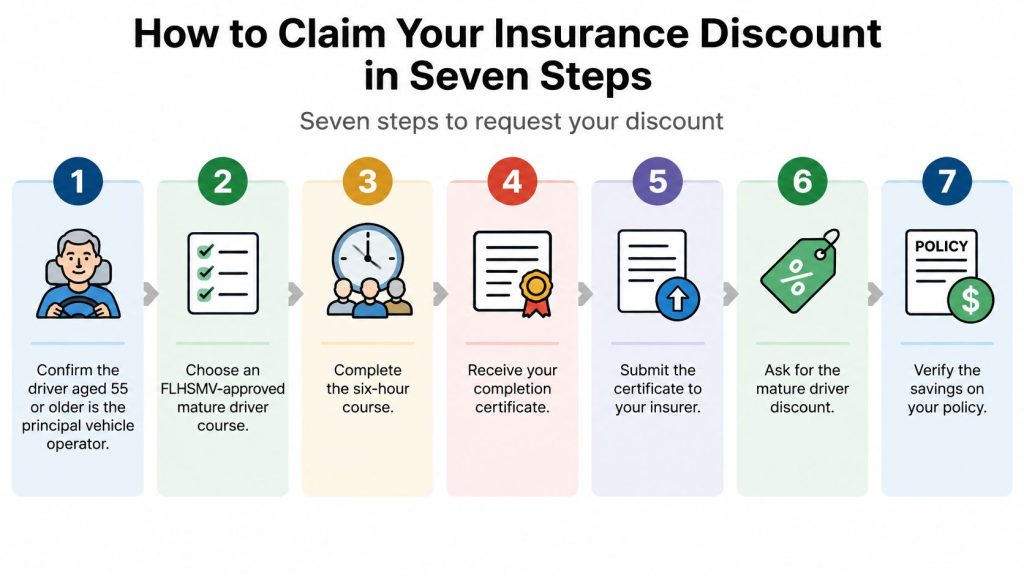
The Seven Steps
-
Confirm principal operator status. Check your declarations page and confirm the driver aged 55 or older is the principal vehicle operator. If a younger household member is listed, the statutory test points to the wrong driver and the carrier can deny the reduction.
-
Choose an FLHSMV approved course. Before this step, confirm approval for the statutory purpose on the course page or with your carrier. A six hour approved course fits the statute, while an unapproved class gives you education without the certificate your insurer needs. Review how a defensive driving course to lower insurance is positioned, then verify the title matches the mature driver purpose.
-
Register with exact policy details. You must complete a registration form before using the course, which asks for your name, driver license and email address, and this information generates your completion certificate at the end. Type your name and license number exactly as they appear on your policy, because a mismatch stalls processing.
-
Complete the course online at your own pace. Work on any device and use the language that helps you learn best, English, Spanish or Portuguese. Don’t rush the defensive driving material just to reach the certificate, since the refresher is part of the value.
-
Download and save the certificate immediately. Save the file, print a copy if you can, and keep the email confirmation. If the insurer asks for resubmission, you’ll have proof ready instead of hunting through accounts.
-
Give the certificate to your insurer. Follow your carrier’s submission procedure, through its portal, email, agent, or mail. Ask whether the school reports completion to your carrier and what else the carrier needs. We don’t sell or share information collected on the site with outside third parties, except as necessary to fulfill a request, such as reporting course completion to an insurance carrier.
-
Request written confirmation and verify the result. Ask for the discount percentage, eligible coverages and effective date in writing. Then check the revised declarations page after processing and compare it with the quote you were given.
The common slip is sending the certificate after renewal. You completed the work, but you delayed the savings into the next policy period.
Do step seven even if the agent sounds confident on the phone. A verbal promise doesn’t correct a billing error. A dated email or revised declarations page does.
Mistakes That Block or Shrink Your Discount
The most common problem is simple. Your insurer doesn’t recognize the certificate.
That usually means the course isn’t approved for the statutory purpose, or you took the wrong course type for your situation. Drivers assume any defensive driving certificate counts. It doesn’t.
Discount Problems, Causes and Fixes
| Symptom | Likely cause | Fix |
|---|---|---|
| Insurer does not recognize the certificate | Course not approved for the statutory purpose or wrong course type | Confirm the course title and approval before enrolling |
| No discount at renewal | Certificate sent late or never submitted | Submit before renewal and check the declarations page |
| Smaller discount than expected | Assumed a guaranteed percentage | Get the insurer’s percentage in writing |
| Discount does not apply | Younger driver listed as principal operator | Correct the principal operator on the policy |
| Processing stalls | Name or license number differs from the policy | Match the registration details to the declarations page |
Which Fix Takes One Call
Three fixes usually take one phone call. Confirming the course title and approval, getting the percentage in writing, and asking where to send the certificate are all carrier questions you can resolve before enrollment.
Name and license mismatches are also quick if you catch them at registration. Compare every character against your declarations page before you start. Correcting a certificate later costs more time.
Changing the principal operator is different. That’s a policy change, and your insurer may need to reissue documents or adjust rating details for the vehicle. Make that change before you submit the certificate, not after a denial.
The smaller than expected discount deserves a blunt answer. If you assumed a percentage you saw in an advertisement, you built your expectation on the wrong number. Your carrier’s filed percentage for eligible coverages is the only percentage that matters for your bill.
Don’t wait for renewal to investigate. Send the certificate as soon as it’s issued, confirm receipt within a few business days, and request the effective date. If the revised declarations page doesn’t show the change, escalate with your written confirmation in hand.
What the Discount Covers and What It Is Worth
The law promises an opportunity for a reduction on specific coverages. It does not promise a fixed percentage off your entire insurance bill.
Under Florida Statutes §627.0652, insurers’ filed rating plans must provide an “appropriate reduction” for liability, personal injury protection, and collision coverages when the vehicle’s principal operator is an insured aged 55 or older who successfully completes a Florida Department of Highway Safety and Motor Vehicles approved motor vehicle accident prevention course. The statute does not establish one statewide percentage.
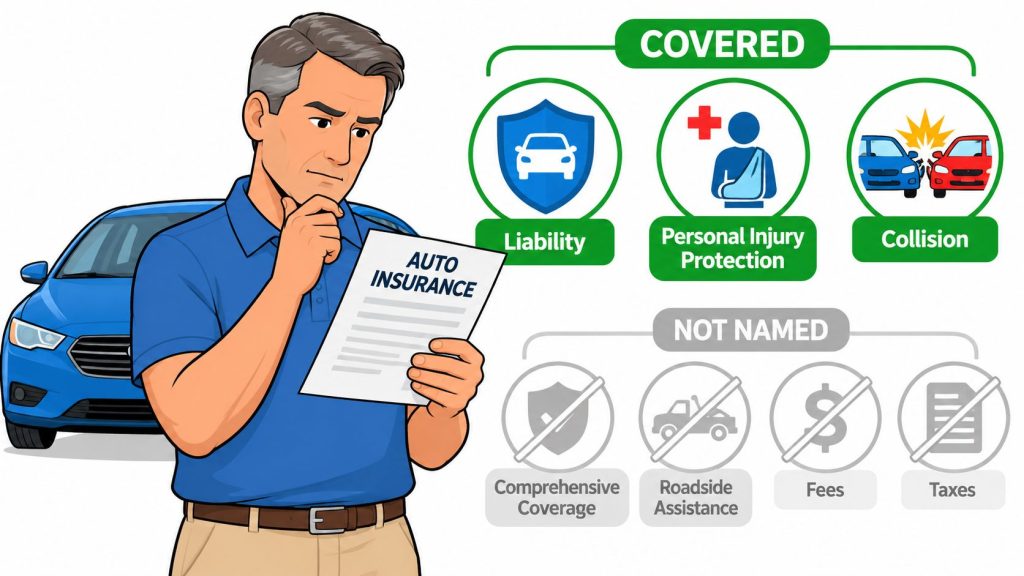
Covered and Not Named
The named coverages are the core of the calculation.
- Liability: Included in the statutory reduction.
- Personal injury protection: Included in the statutory reduction.
- Collision: Included in the statutory reduction.
- Other coverage, roadside assistance, fees and taxes: Not named in that list, so don’t assume the percentage touches them.
That distinction explains most disappointment. A driver expects, for example, a percentage off the total premium shown at checkout. The insurer applies its filed percentage only to eligible coverage components, and the final saving looks smaller.
Ask your carrier to identify the exact premium base it will use. Then review broader strategies for how to lower car insurance rates so you separate this statutory reduction from other discounts, deductible changes, or coverage adjustments.
What Moves Your Real Savings
Your actual savings depend on the insurer’s approved rating manual, your coverage limits, vehicle, territory, claims history, and other underwriting variables. Two neighbors aged 62 can complete the same approved course and receive different dollar savings because their policies aren’t built the same way.
Higher eligible premiums generally produce larger dollar savings at the same percentage. Lower limits, or a policy where much of the cost sits in coverages not named in the statute, produce a smaller result.
Do the math on eligible coverages only: Eligible premium times your insurer’s written percentage equals your estimated annual saving.
A Hypothetical Worked Example
Say a driver aged 55 or older pays a $1,800 annual premium. Of that total, $1,400 is attributable to liability, personal injury protection and collision.
At a hypothetical 5% filed reduction, the saving is $70 a year, because $1,400 times 5% equals $70. At a hypothetical 10% filed reduction, the saving is $140 a year.
Notice what didn’t happen. The driver didn’t save 5% or 10% of $1,800. The formula applied the percentage to eligible coverages only, not the total bill.
Use your own declarations page figures and your insurer’s written percentage to run the same calculation before enrolling. Ask for the percentage, eligible coverages, effective date, and submission procedure rather than assuming an advertised course guarantees a specific premium reduction.
Treat the renewal declarations page as the test. If the eligible coverage premiums changed for other reasons, ask the carrier to show the mature driver reduction as its own line or rating factor. You want proof the certificate changed the price, not a vague assurance that it’s in the system.
Enroll in an Approved Course Before Renewal
If you’re 55 or older and an approved course fits your calendar, enroll before your next renewal. Timing is the difference between savings on the next bill and savings you chase after the bill is already issued.
In 2025, the Florida Department of Highway Safety and Motor Vehicles reported that insurance discount eligibility was available to drivers over age 55 who completed the Mature Driver Discount course. Don’t wait for a better statewide percentage to appear, because your carrier sets your amount.
Follow the seven steps above for the claim process, and give yourself enough time to finish, receive the certificate, submit it, and confirm receipt. If you’re planning your schedule, check the expected defensive driving course hours so you can finish within the six hour maximum without cramming.
The course is self paced, so you can study in shorter sessions around work, family, and medical appointments. That’s the practical advantage of online study. You get the refresher and the certificate without committing to a classroom date across town.
Confirm refund and cancellation terms on the course page before paying. We make a full refund to a student who requests cancellation of the enrollment contract within thirty (30) calendar days from the date of purchase, including weekends and holidays, and who has not completed the course or obtained a certificate of completion.
Start with the two enrollment options, BDISchool courses and Driver Educators courses. Pick the approved mature driver course, confirm it with your carrier, and start now so your certificate reaches the insurer before renewal.
If you’re 55 or older, don’t leave an approved course discount unclaimed because you weren’t sure which certificate your insurer would accept. BDISchool offers Florida focused online driver education you can register for and start on your own schedule, so you can complete the right course and submit your certificate before renewal. Visit BDISchool today, choose the mature driver option that fits your policy, and request written confirmation of your savings from your carrier.