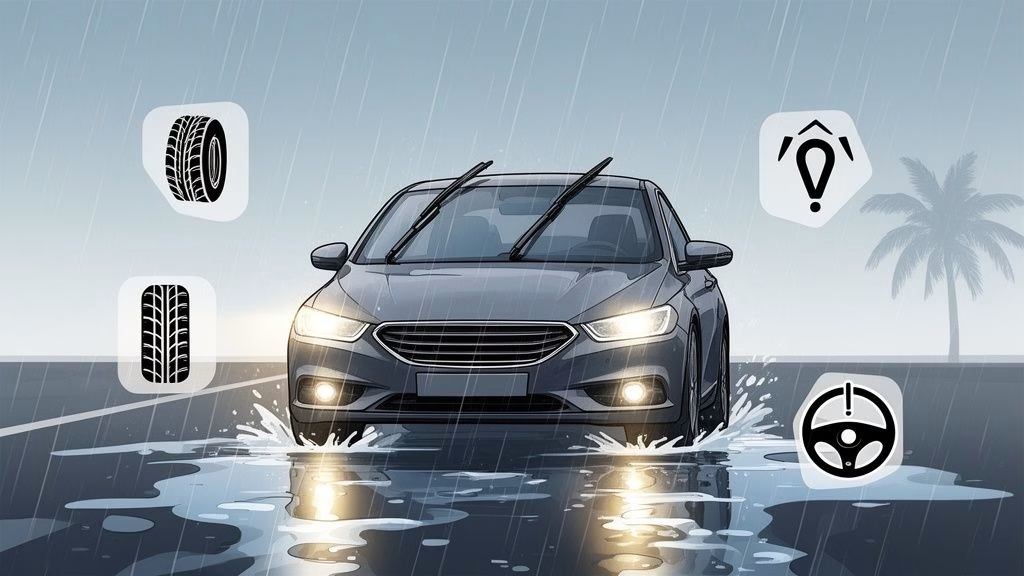
Florida's sudden downpours can transform a routine drive into a high-stakes challenge, demanding more than just a basic awareness of the weather. Wet roads are a primary factor in thousands of accidents annually, not just because of slick surfaces, but because they expose critical weaknesses in both driver habits and vehicle readiness. The combination of reduced visibility, significantly decreased tire traction, and the unpredictable actions of other drivers creates a hazardous environment where a minor mistake can have major consequences.
This guide moves beyond the obvious "slow down" advice. We are providing a detailed, actionable list of driving safety tips for rain that covers everything from proactive vehicle maintenance and advanced defensive driving techniques to handling specific Florida road hazards like flash floods. Whether you're a new teen driver or a seasoned commuter navigating a daily storm, mastering these strategies is essential for your protection. This comprehensive list will equip you with the skills and confidence needed to navigate even the heaviest rainfall safely, turning reactive fear into proactive control. Think of this as your essential checklist for becoming a more resilient, aware, and prepared driver in any weather condition you may face on the road.
1. Reduce Speed and Increase Following Distance
Adjusting your speed and following distance is the single most effective defensive action you can take when driving in the rain. Water on the pavement acts as a lubricant between your tires and the road surface, dramatically reducing traction and grip. This loss of friction means your vehicle needs significantly more distance to come to a complete stop, making sudden braking extremely hazardous.
The National Highway Traffic Safety Administration (NHTSA) consistently highlights speed as a primary factor in weather-related crashes. When roads are wet, your vehicle’s tires have to work harder to channel water away and maintain contact with the asphalt. High speeds can overwhelm the tire treads, leading to hydroplaning where the vehicle essentially skims on a thin layer of water with a complete loss of steering and braking control. This is why a substantial speed reduction is a non-negotiable part of safe rainy-day driving.
Why It's a Critical Safety Tip
This practice directly addresses the two biggest dangers of wet-road driving: reduced tire traction and decreased driver visibility. By slowing down, you give your tires a better chance to maintain contact with the road. By increasing your following distance, you create a crucial safety buffer, giving yourself more time to perceive a hazard, react, and brake safely without skidding. Data from Florida Highway Safety and Motor Vehicles indicates that proper speed reduction is a key factor in preventing up to 30% of rain-related accidents.
Actionable Steps for Implementation
- Treat Speed Limits as a Maximum: During rain, the posted speed limit is not your target. A safe rule of thumb is to reduce your speed by at least one-third on wet roads and by half in heavy downpours.
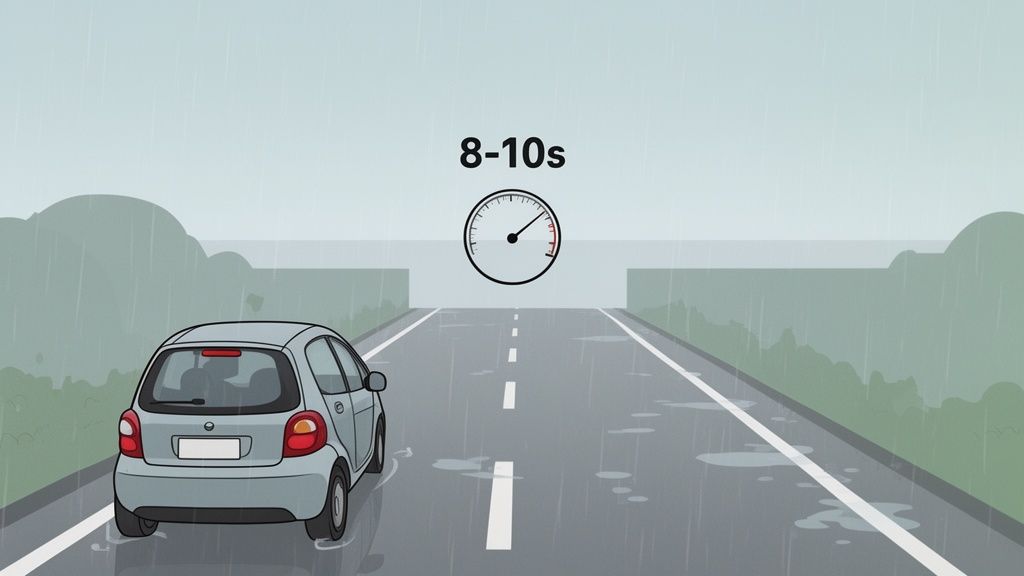
- Use the "Second Count" Method: To establish a safe following distance, pick a fixed object ahead, like an overpass or a sign. When the vehicle in front of you passes it, start counting "one-one-thousand, two-one-thousand…" until you pass the same object. In rain, this count should be at least 8 to 10 seconds.
- Disable Cruise Control: Never use cruise control on wet roads. If you start to hydroplane, cruise control will want to maintain speed, potentially causing you to accelerate and lose control when the tires regain traction.
- Teach Others: Make this a core lesson for new or teen drivers in your family. Their inexperience makes them especially vulnerable to overestimating their vehicle's capabilities in poor weather.
2. Ensure Proper Tire Tread and Tire Maintenance
Your tires are your vehicle's only connection to the road, and their condition is paramount for safe driving in the rain. Tire treads are specifically designed with deep grooves to channel water away from the tire's surface, allowing it to maintain a firm grip on the pavement. When these treads become worn, they lose their ability to evacuate water effectively, dramatically increasing the risk of hydroplaning and loss of control.
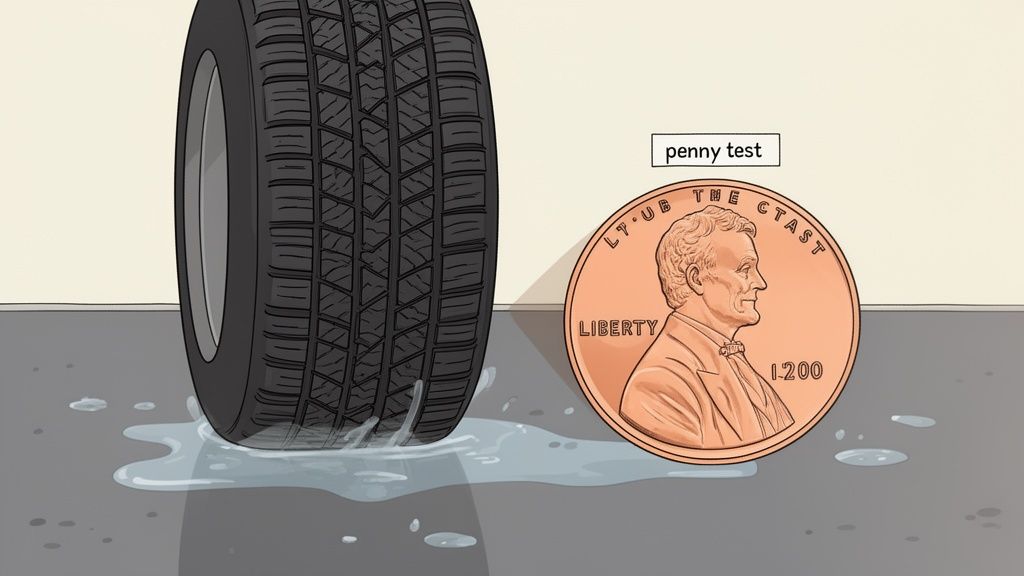
Beyond just driving techniques, vehicle readiness is crucial for safety in rainy conditions. For instance, ensuring your tires are properly maintained and your lights are functional can be verified with a thorough pre-trip inspection. Proper tire inflation and alignment are just as critical as tread depth. An underinflated tire can't maintain its shape, reducing the contact patch with the road and compromising handling. Similarly, misaligned tires wear unevenly and can pull the vehicle to one side, a dangerous tendency that is magnified on slick surfaces.
Why It's a Critical Safety Tip
This practice directly addresses the root cause of hydroplaning: the failure of a tire to displace water. Good tread depth ensures water is channeled away, while correct inflation maintains the tire’s optimal footprint for maximum grip. The NHTSA reports that proper tire maintenance can reduce wet-weather accidents by a significant margin. In a state like Florida, with its frequent and intense rain, this aspect of vehicle care is not just a recommendation; it's a critical safety requirement. You can get more comprehensive guidance on our page about Florida vehicle maintenance.
Actionable Steps for Implementation
- Perform the Penny Test: Insert a penny into your tire's tread with Lincoln's head upside down. If you can see all of his head, your tread depth is below the legal minimum of 2/32 of an inch and needs immediate replacement.
- Check Tire Pressure Monthly: Use a reliable pressure gauge to check your tires when they are cold. Inflate them to the manufacturer's recommended PSI, which is typically found on a sticker inside the driver's side door jamb, not on the tire itself.
- Rotate Tires Regularly: Rotate your tires every 5,000 to 8,000 miles to ensure they wear evenly. This extends their life and maintains balanced handling.
- Inspect for Uneven Wear: Visually inspect your tires for signs of uneven wear, which could indicate an alignment or suspension problem that needs professional attention.
3. Use Headlights Properly and Improve Visibility
Rain, mist, and road spray create a grey, low-contrast environment that significantly reduces visibility for all drivers. Activating your headlights, even during daylight hours, is a simple yet profoundly effective measure to counteract this. It's not just about what you can see; it's about ensuring other drivers can see you, cutting through the visual noise of a downpour to prevent collisions.
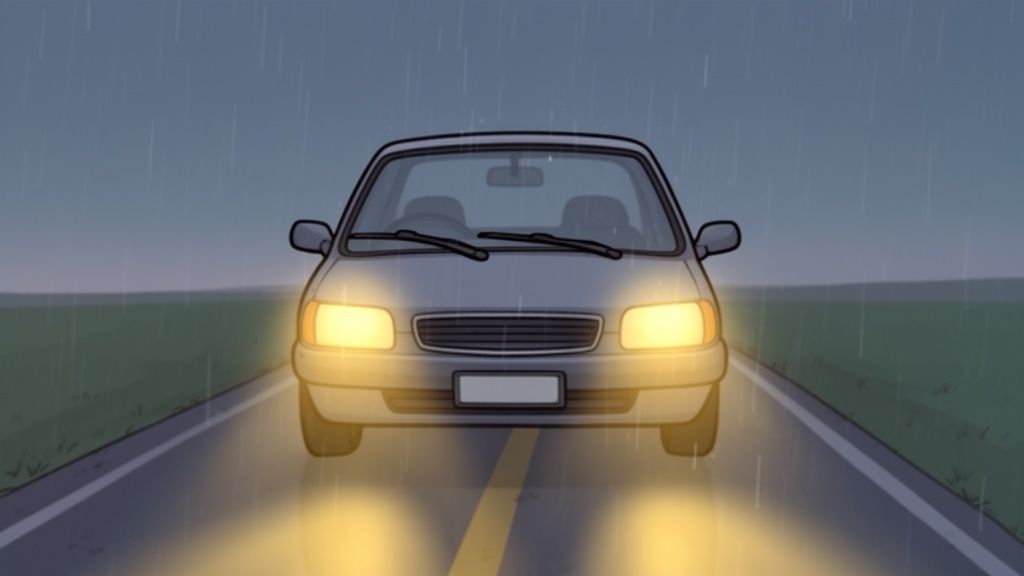
The practice of using headlights in adverse weather is so critical that many states, including Florida, have laws requiring them whenever windshield wipers are in use. Traffic safety data consistently shows that this simple action makes vehicles more conspicuous from a distance, giving surrounding drivers more time to react. Insurance industry studies also confirm that proper lighting use correlates with a reduction in multi-vehicle accident claims during inclement weather.
Why It's a Critical Safety Tip
This tip directly addresses the danger of decreased visibility, a leading contributor to rain-related accidents. Properly functioning headlights, taillights, and wipers work together as a system to maintain a clear line of sight and announce your vehicle's presence on the road. Forgetting to turn on your lights can make your car, especially if it's grey or silver, nearly invisible against a backdrop of wet asphalt and rain. This is a fundamental component of proactive, defensive driving in poor conditions.
Actionable Steps for Implementation
- Activate Lights Immediately: Turn on your low-beam headlights as soon as rain begins, no matter the time of day. Never rely on automatic daytime running lights, as they don't always activate the taillights.
- Avoid High Beams: Never use your high beams in rain or fog. The intense light reflects off the water droplets, creating a wall of glare that severely impairs your vision.
- Maintain Your Wipers: Replace windshield wiper blades every 6 to 12 months, or as soon as they start to streak or squeak. Consider premium blades if you live in a region with frequent heavy rain.
- Use Your Defroster: Rain increases humidity and can cause your windows to fog up from the inside. Use your vehicle's defroster and A/C to quickly clear your windshield and maintain visibility. You can learn more about the specific rules for when you should use your headlights on bdischool.com.
4. Avoid Sudden Braking, Practice Smooth Control Inputs, and Prevent Hydroplaning
Driving in the rain demands finesse, not force. Abrupt steering, hard braking, or sudden acceleration can easily overwhelm your tires' limited grip on wet pavement, leading to a dangerous skid. The key is to make all your control inputs smooth and deliberate, a technique that professional race car drivers use to maintain maximum traction in all conditions. By anticipating your moves far in advance, you can apply gradual pressure to the pedals and gentle movements to the steering wheel, keeping the vehicle stable and under control.
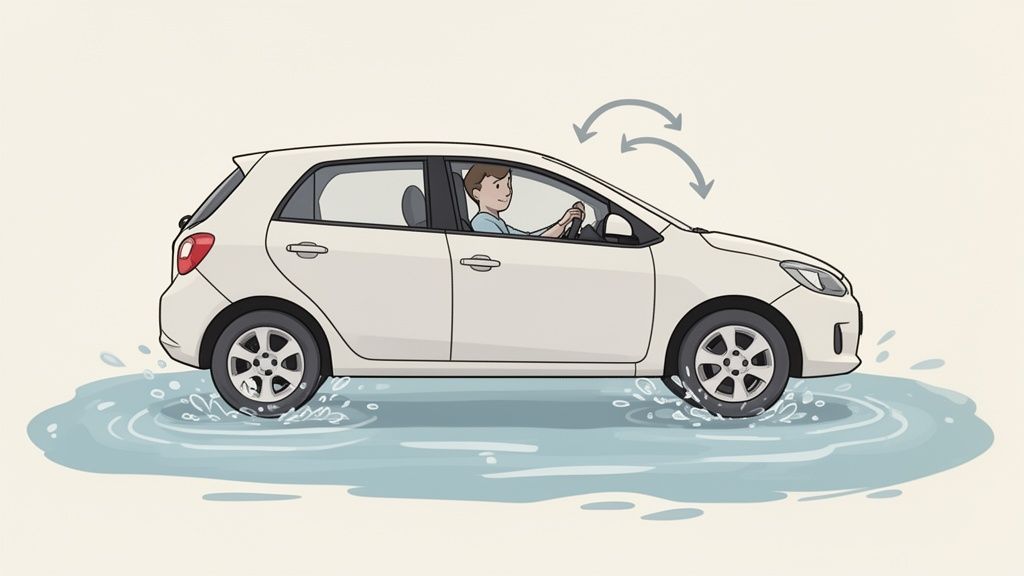
This smooth approach is your best defense against hydroplaning, a hazardous situation where your tires ride on a thin layer of water instead of the road surface. This can happen at speeds as low as 35 mph with enough standing water, resulting in a complete loss of steering and braking. The NHTSA attributes a significant number of weather-related incidents to hydroplaning, reinforcing the need for cautious and smooth vehicle operation. Fleet safety programs that train drivers on smooth control inputs have seen accident reductions of up to 40%.
Why It's a Critical Safety Tip
This practice directly counters the physics of reduced friction on wet roads. Every sudden action you take, whether it's braking, turning, or accelerating, demands more grip than your tires may have available. Smooth inputs keep the vehicle's weight balanced and prevent the tires from breaking traction. In the event you do start to hydroplane, a calm and smooth response is essential to regaining control. Panicking and slamming on the brakes will only make the situation worse. Understanding what is hydroplaning and how to react is a vital component of safe driving in the rain.
Actionable Steps for Implementation
- Anticipate and Act Early: Look far down the road to see traffic lights, stop signs, and curves well in advance. This gives you time to slow down or change lanes gradually.
- Brake with Gentle Pressure: Apply slow, steady pressure to the brake pedal to come to a stop. If your vehicle has an Anti-lock Braking System (ABS), do not pump the brakes; press firmly and let the system work.
- Steer with Precision: Make steering adjustments small and smooth. Avoid jerking the wheel, especially when changing lanes or navigating turns.
- React Calmly to Hydroplaning: If you feel the vehicle start to hydroplane, do not brake or turn the wheel sharply. Ease your foot off the accelerator and keep the steering wheel straight until you feel the tires regain contact with the road.
5. Maintain Extra Caution on Curves and Bridges During Rain
Navigating curves and crossing bridges requires extra diligence in rainy conditions, as these road features are hotspots for traction loss. The physics of turning already puts lateral force on your tires, and when combined with the lubricating effect of rainwater, the risk of skidding or losing control increases significantly. Bridges and overpasses, often made of concrete or steel, cool faster than asphalt roads and can become exceptionally slick.
Traffic data frequently shows a spike in single-vehicle accidents on curves during inclement weather. For instance, accident clusters are often noted on major Florida highways like I-75 and I-95 during seasonal storms. The combination of speed, standing water on banked turns, and sudden steering inputs creates a perfect storm for hydroplaning. Similarly, highway departments across the U.S. post specific warnings like 'Slippery When Wet' for bridges because they are known high-risk zones.
Why It's a Critical Safety Tip
This targeted caution is vital because curves and bridges fundamentally alter a vehicle's handling dynamics on wet surfaces. Unlike straightaways, curves require continuous steering input, which can easily overwhelm the limited grip of your tires. Bridges are prone to water accumulation and can have different surface friction than the road leading up to them, catching unsuspecting drivers off guard. A sudden change in traction while turning or braking is a primary cause of spinouts and loss-of-control accidents.
Actionable Steps for Implementation
- Brake Before the Turn, Not In It: The most crucial action is to reduce your speed before you enter a curve. Braking while actively turning puts immense stress on your tires and is a common trigger for skids on wet pavement.
- Make Smooth, Gentle Inputs: Avoid jerky steering or abrupt acceleration and braking. Steer through the curve with a smooth, deliberate motion to maintain maximum tire contact and stability.
- Heed All Warning Signs: Pay close attention to signs indicating curves or bridge conditions. Treat signs like 'Bridge May Ice' or 'Slippery When Wet' as direct and immediate commands to reduce your speed further.
- Avoid Lane Changes: Never change lanes while navigating a curve or crossing a bridge in the rain. This maneuver destabilizes the vehicle and drastically increases the risk of losing control.
- Be Aware of Pooled Water: Water tends to collect on the edges and banked sections of curves. Position your vehicle to avoid these deeper patches where hydroplaning is most likely to occur.
6. Avoid Distractions and Maintain Full Attention on Road Conditions
Driving in the rain demands your undivided attention. The combination of reduced visibility, decreased traction, and the unpredictable actions of other drivers creates a high-stakes environment where even a momentary lapse in concentration can be catastrophic. Distractions like cell phones, complex infotainment systems, or even intense conversations significantly impair your ability to perceive and react to rapidly changing road conditions.
The National Highway Traffic Safety Administration (NHTSA) has extensively documented the dangers of distracted driving, noting that the risk of a crash multiplies in adverse weather. When your brain is occupied with a secondary task, your reaction time slows, and your field of awareness narrows. This "inattention blindness" means you might not see a pooling of water on the road, a vehicle braking suddenly ahead, or a pedestrian obscured by spray, making this one of the most critical driving safety tips for rain.
Why It's a Critical Safety Tip
This practice is essential because rain already consumes a significant portion of your cognitive bandwidth. Your focus is split between navigating, managing vehicle speed, monitoring for hydroplaning risks, and peering through a rain-streaked windshield. Adding any distraction on top of these demands overloads your ability to drive safely. Data from the insurance industry shows that drivers who use a phone while driving in the rain are over 300% more likely to be involved in an accident, as their reaction time can be delayed as much as if they were legally intoxicated.
Actionable Steps for Implementation
- Go into "Silent Mode": Before you start your engine, put your cell phone on silent and store it out of sight and reach, such as in the glove compartment or a bag in the back seat.
- Set It and Forget It: Pre-program your navigation, music, and climate controls before you begin driving. Adjusting these systems while on a wet road diverts your focus at a critical time.
- Manage Your Passengers: Politely ask passengers to minimize conversations or loud noises during heavy downpours or particularly challenging driving conditions to help you concentrate.
- Avoid In-Car Multitasking: Postpone eating, drinking, or personal grooming until you have safely reached your destination. These activities take your hands off the wheel and your eyes off the road.
- Combat Fatigue: Fatigue is a major internal distraction. If you feel tired on a long trip in the rain, pull over at a safe location like a rest stop to take a break.
7. Know When to Pullover or Delay Travel During Severe Rain
Sometimes the most crucial driving decision involves not driving at all. In severe weather conditions like torrential downpours, thunderstorms, or flash flood warnings, visibility can drop to near zero, and roads can become impassable in seconds. Recognizing when the risk is too high and choosing to pull over or delay your trip is a sign of a mature, safety-conscious driver. This proactive choice avoids putting yourself and others in an unnecessarily dangerous situation.
The principle is simple: if you cannot clearly see the road edges, other vehicles, or potential hazards at a safe distance, you are driving blind. Continuing under such conditions exponentially increases the risk of an accident. The National Weather Service's "Turn Around, Don't Drown" campaign highlights the deadly risk of misjudging water depth, a common scenario in Florida's sudden, intense storms. This makes postponing travel or finding a safe place to stop not just a good idea, but a potentially life-saving one.
Why It's a Critical Safety Tip
This practice is the ultimate defensive maneuver against the most extreme weather. It directly counters the dangers of severely limited visibility, hydroplaning, and unpredictable road flooding. When rain is so heavy that your windshield wipers at their highest speed cannot keep the glass clear, your ability to react to sudden events is compromised. Data from emergency services shows a dramatic spike in accidents during the first 15-30 minutes of a severe downpour, precisely when many drivers attempt to "push through" the storm.
Actionable Steps for Implementation
- Check Forecasts Proactively: Before any long trip, or even a daily commute during Florida's rainy season, check the weather forecast. If severe thunderstorms are predicted for your travel time, consider delaying your departure.
- Identify a Safe Haven: If caught in a sudden downpour, immediately look for a safe place to pull over, such as a rest area, a well-lit parking lot, or a wide, stable shoulder far from moving traffic. Do not stop on the travel portion of the road or under an overpass.
- Signal Your Presence: Once you have pulled completely off the road, turn on your emergency hazard lights (flashers). This significantly increases your visibility to other drivers who may still be navigating the poor conditions.
- Stay Secure and Informed: Remain in your vehicle with your seatbelt fastened. Use this time to check weather updates on your phone and inform anyone waiting for you about your delay. For more information, you can learn more about driving safety during severe weather in Florida.
8. Stay Alert for Other Drivers' Errors and Adjust Defensive Positioning
Driving safely in the rain isn't just about managing your own vehicle; it's about anticipating the unpredictable actions of others. Poor visibility and reduced traction affect everyone, and not all drivers will adjust their habits accordingly. Proactive, defensive driving means maintaining constant awareness of surrounding traffic and positioning your vehicle to create escape routes in case of a sudden hazard caused by another driver.
This approach shifts your mindset from simply operating your car to managing the space around it. Commercial fleet safety directors and defensive driving instructors consistently emphasize this as a critical survival skill. By assuming other drivers might make mistakes, like braking too late or changing lanes without looking, you give yourself the time and space needed to avoid being part of a chain-reaction collision, which is a common occurrence on wet Florida highways during a downpour.
Why It's a Critical Safety Tip
This practice directly counters the heightened risk of multi-vehicle accidents in bad weather. When one driver loses control or makes a poor decision, it can quickly cascade into a larger incident. By maintaining 360-degree awareness and keeping your options open, you avoid getting boxed in. Insurance industry data consistently shows that drivers with strong situational awareness are involved in fewer preventable accidents, highlighting the effectiveness of this defensive strategy.
Actionable Steps for Implementation
- Create Escape Routes: Avoid driving directly alongside other cars for extended periods. Stagger your position in traffic so you always have an open lane to move into if the car ahead stops suddenly.
- Master the "No-Zone": Stay out of the large blind spots of trucks and buses, often called the "No-Zone." A good rule is: if you can't see the truck driver in their side mirror, they absolutely cannot see you.
- Scan Your Mirrors Constantly: Check your rearview and side mirrors every 5-8 seconds. This helps you build a mental map of the traffic around you, so you know who is approaching quickly or lingering in your blind spot.
- Assume You Are Invisible: Never rely on other drivers seeing you. Always signal your intentions early and ensure you have ample space before changing lanes or turning, making this one of the most vital driving safety tips for rain.
8-Point Comparison: Driving Safety Tips for Rain
| Safety Measure | Implementation Complexity 🔄 | Resource & Cost ⚡ | Expected Effectiveness ⭐ | Ideal Use Cases 💡 | Key Advantages 📊 |
|---|---|---|---|---|---|
| Reduce Speed and Increase Following Distance | Low — simple behavioral change | Minimal — no equipment | ⭐⭐⭐⭐⭐ — large reduction in collision risk | Heavy rain, highways, reduced-traction conditions | Increases reaction time; lowers crash severity |
| Ensure Proper Tire Tread and Tire Maintenance | Medium — periodic checks & service | Moderate–High — replacement & service costs | ⭐⭐⭐⭐⭐ — prevents hydroplaning and improves braking | Wet climates, long trips, seasonal maintenance | Improves grip/braking; extends tire life |
| Use Headlights Properly and Improve Visibility | Low — habit and minor maintenance | Low — bulbs/wipers replacement | ⭐⭐⭐⭐ — markedly improves visibility | Daytime rain, dusk/dawn, limited-visibility conditions | Makes vehicle more visible; low-cost safety gain |
| Avoid Sudden Braking, Practice Smooth Control Inputs | Medium — skill & practice required | Low — training time; possible practice sessions | ⭐⭐⭐⭐ — maintains control; reduces skids | Standing water, high speeds, ABS-equipped vehicles | Preserves traction; reduces hydroplaning risk |
| Maintain Extra Caution on Curves and Bridges During Rain | Low–Medium — anticipatory driving | Minimal — attention and speed management | ⭐⭐⭐⭐ — lowers curve/bridge-specific incidents | Bridges, banked turns, unfamiliar roads | Prevents loss of control in high-risk sections |
| Avoid Distractions and Maintain Full Attention | Medium — habit change & enforcement | Minimal — device settings; policies | ⭐⭐⭐⭐⭐ — large reduction in distracted-related crashes | All rain driving, complex traffic, long trips | Enhances hazard detection and response time |
| Know When to Pullover or Delay Travel During Severe Rain | Low — decision-making judgment | Variable — time cost; safe shelter may be needed | ⭐⭐⭐⭐⭐ — eliminates exposure to extreme risk | Torrential rain, flash floods, severe weather warnings | Removes driver from dangerous conditions entirely |
| Stay Alert for Other Drivers' Errors and Adjust Defensive Positioning | Medium–High — continuous vigilance | Minimal — attentional demand | ⭐⭐⭐⭐ — reduces involvement in multi-vehicle incidents | Dense traffic, mixed-skill roads, highway situations | Maintains escape routes; mitigates others' mistakes |
Turn These Tips into Lifelong Driving Habits
Navigating Florida's rain-slicked roads requires more than just knowing what to do; it demands a fundamental shift in your driving mindset. The techniques we've covered, from meticulously maintaining your tires to consciously increasing your following distance, are not just isolated actions. They are interconnected components of a comprehensive defensive driving strategy. True mastery comes when these practices transition from conscious effort into automatic, ingrained habits.
Think of it as building a robust safety net. Each tip adds another layer of protection. Reducing your speed gives you more time to react, while ensuring your headlights are on makes you more visible to others. Avoiding sudden braking prevents skids, and knowing when to pull over entirely could be the most critical decision you make. These aren't just rules for a rainy day; they are principles of control, awareness, and proactive decision-making that serve you in all driving conditions. The goal is to make these driving safety tips for rain so second-nature that you apply them without a second thought.
From Knowledge to Instinct: Your Action Plan
Transforming information into habit requires deliberate practice. Start by making a conscious effort to implement one or two of these tips every time you drive in the rain.
- Before You Drive: Make a habit of checking your wipers and tire pressure before a predicted storm, not during it. A five-minute check in the garage can prevent a dangerous failure on the highway.
- On the Road: The next time it drizzles, actively focus on doubling your following distance. Count the seconds between the car ahead of you passing a fixed point and when you pass it. Aim for a full five to six seconds.
- Embrace New Technology Safely: As vehicle technology evolves, so do driving dynamics. For instance, regenerative braking in electric vehicles can feel different on wet surfaces. Understanding these nuances is crucial, and a helpful first-time EV driving guide can bridge the knowledge gap for those new to electric cars, ensuring safety regardless of the powertrain.
By consistently applying these principles, you are not just reacting to the rain; you are anticipating its effects and preemptively mitigating the risks. This proactive approach is the hallmark of a truly skilled and safe driver, protecting not only yourself but everyone you share the road with. Your commitment to mastering these skills demonstrates a respect for the inherent dangers of wet-weather driving and a dedication to arriving safely, every single time.
Ready to solidify these skills and potentially lower your insurance premiums? Enroll in a state-approved Basic Driver Improvement course with BDISchool. Our engaging online curriculum is designed to turn these essential driving safety tips for rain into lifelong habits. Visit BDISchool to start your journey toward becoming a more confident and defensive driver today.