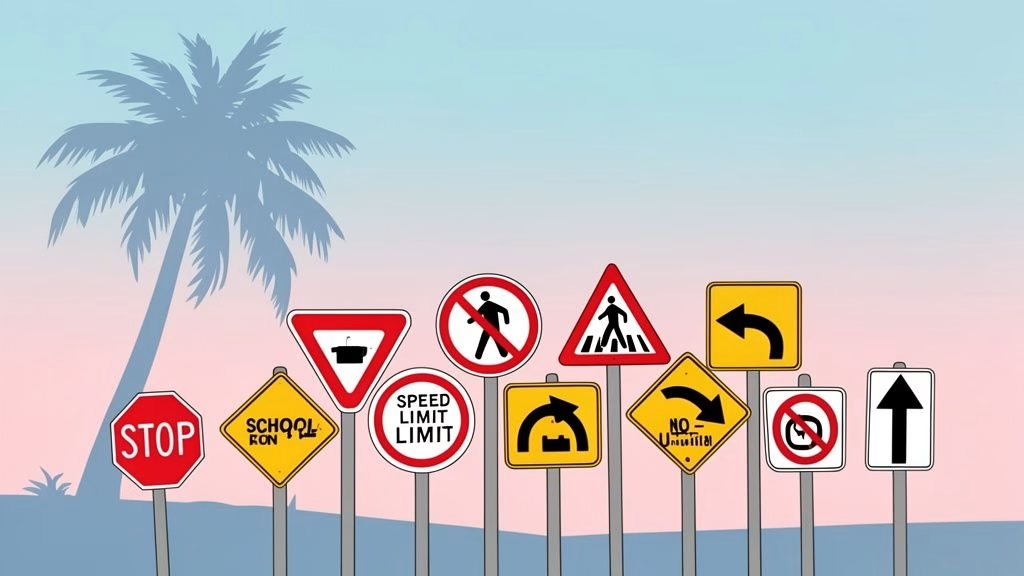
Navigating Florida's roads safely starts with a simple but crucial skill: understanding the language of traffic signs. From the unmistakable red octagon of a stop sign to the subtle warnings of a yellow diamond, each sign is a critical instruction designed to prevent accidents and keep traffic flowing smoothly. For new drivers seeking their first license, experienced drivers needing a refresher, or those looking to dismiss a ticket with a BDI course, mastering these symbols is non-negotiable.
This comprehensive guide breaks down the 10 most common traffic signs and meanings you'll encounter on Florida's highways and neighborhood streets. We go beyond simple definitions, providing practical scenarios, Florida-specific laws, and actionable tips to help you not only pass your driver's test but also become a more confident and defensive driver. Think of this as your practical playbook for responding correctly and safely to every sign you see.
Throughout this guide, we will explore the critical information conveyed through each sign's unique shape, color, and symbols. We will cover regulatory signs that enforce laws, such as speed limits and stop requirements, as well as warning signs that alert you to potential hazards ahead, like sharp curves or school zones. By understanding the immediate action required for each sign, you'll be better equipped to protect yourself, your passengers, and others on the road. Let's decode the signs that keep our communities safe, one symbol at a time.
1. Stop Sign (Red Octagon)
The Stop sign is arguably one of the most recognizable and critical of all common traffic signs and meanings. Its distinct red, eight-sided shape is a universal command for drivers to bring their vehicle to a complete and total halt. This sign is a regulatory sign, meaning it is a legal requirement to obey it. The primary purpose is to control traffic flow and prevent collisions at intersections where cross-traffic is present.
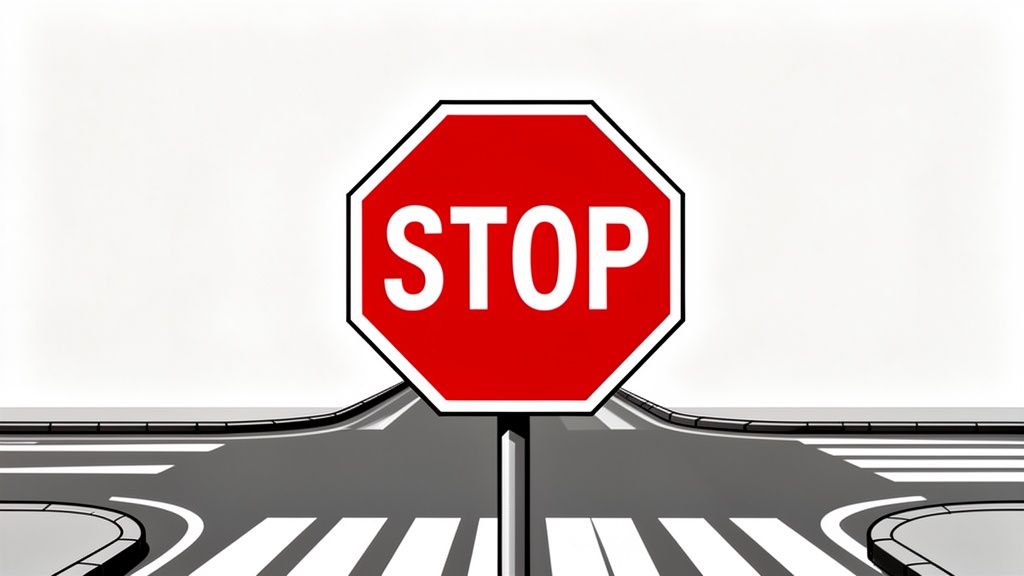
Drivers must stop before the marked white stop line on the pavement. If no line is present, you must stop before the marked crosswalk. If neither is present, the stop must be made at a point where you have a clear view of approaching traffic but before entering the intersection itself.
How to Respond and Key Scenarios
Properly navigating a stop sign is a fundamental skill emphasized in any Florida BDI course. It’s more than just slowing down; it’s a systematic safety check.
- Complete Stop: The law requires your wheels to cease all rotation. A "rolling stop" where the vehicle slows but never fully stops is a common traffic violation that can lead to a ticket and points on your license.
- Scanning the Intersection: After stopping, you must look for other vehicles, pedestrians, and cyclists. The recommended practice is to look left, then right, and then left again before proceeding. This ensures you check the closest lane of traffic just before you move forward.
- Right-of-Way Rules: Understanding who goes first is crucial. At a four-way stop, the first vehicle to arrive and stop has the right-of-way. If two vehicles stop simultaneously, the driver on the right has the right-of-way.
Florida-Specific Note: Failing to obey a stop sign in Florida can result in a fine and 3 points on your driving record. This is a common violation that leads drivers to seek a Basic Driver Improvement (BDI) course to avoid points and insurance increases.
2. Yield Sign (Red and White Triangle)
The Yield sign is a distinct, downward-pointing triangle with a red border and white center. It is a crucial regulatory sign that requires drivers to slow down and give the right-of-way to traffic on the intersecting road or traffic that is already in the roundabout. Unlike a stop sign, a complete stop is not mandatory, but drivers must be prepared to stop if necessary to avoid a collision. Its primary purpose is to manage traffic flow safely at merge points and less busy intersections.
When approaching a Yield sign, you must slow down and check for any pedestrians, cyclists, or vehicles in your path or approaching from another direction. You may only proceed once the way is clear. This sign is commonly found where a smaller road meets a main road, on highway entrance ramps, and at the entry to modern roundabouts.
How to Respond and Key Scenarios
Properly yielding is a dynamic action that requires constant awareness and good judgment, a key topic covered in any comprehensive traffic school course. It’s about safely integrating into the flow of traffic without disrupting it.
- Slow Down and Be Prepared to Stop: As you approach, reduce your speed and scan the traffic you are merging into or crossing. Your primary responsibility is to avoid interfering with the vehicles that have the right-of-way.
- Check All Directions: Look for vehicles and pedestrians from all relevant directions. At a roundabout, this means looking to your left for vehicles already circulating. On a highway on-ramp, this means checking your mirrors and blind spots for traffic in the lane you intend to enter.
- Judge Gaps in Traffic: You must wait for a safe gap in the traffic flow before proceeding. Proceeding too soon and forcing another driver to brake suddenly is a violation and can cause a serious accident.
Florida-Specific Note: Failure to yield the right-of-way is a common cause of accidents in Florida, particularly at intersections and on highway ramps. A violation can result in a fine and 3 points on your driving record, often prompting drivers to take a BDI course to mitigate the consequences.
3. Speed Limit Sign (White Rectangle)
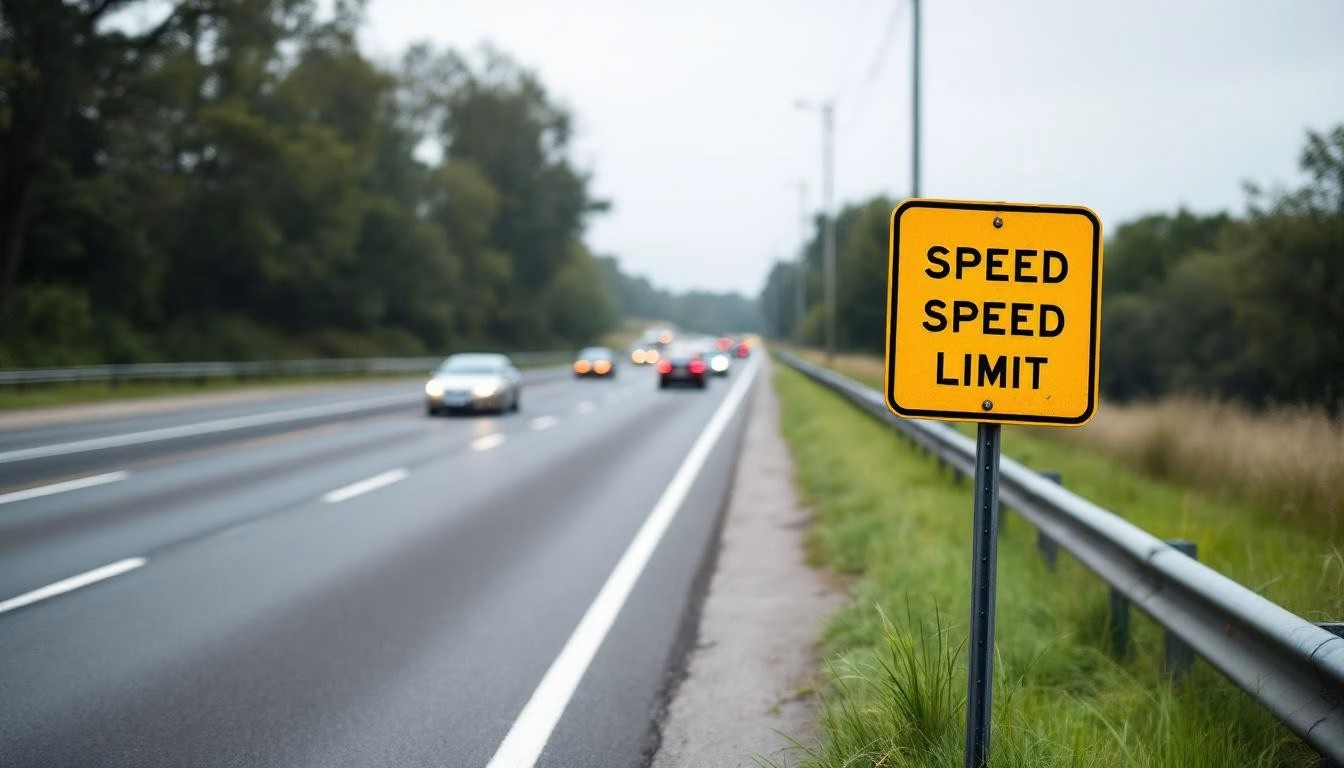
Among the most frequently encountered common traffic signs and meanings are the Speed Limit signs. These white rectangular signs display the maximum legal speed, in miles per hour (mph), that a vehicle can travel on a particular stretch of road under ideal conditions. As regulatory signs, they are legally enforceable, and their primary purpose is to enhance safety by establishing a reasonable and safe speed based on road design, traffic volume, and area characteristics.
Speed limits are not arbitrary; they are determined by traffic engineering studies. In Florida, you will see them vary significantly, from 15-20 mph in school zones during active hours to a maximum of 70 mph on certain interstate highways. Urban and residential areas typically have lower limits, such as 25 or 30 mph, to protect pedestrians and account for increased traffic density.
How to Respond and Key Scenarios
Adhering to posted speed limits is a cornerstone of defensive driving, a key topic covered in any comprehensive traffic school curriculum. It involves more than just reading the number on the sign.
- Maximum, Not a Target: The posted speed is the maximum speed allowed in perfect conditions. Drivers must reduce their speed in adverse weather like rain or fog, or during heavy traffic. Driving the speed limit when conditions are poor can still be considered reckless.
- School and Construction Zones: Be extra vigilant for signs indicating reduced speeds in school or construction zones. These limits are strictly enforced to protect vulnerable pedestrians and workers, often coming with significantly higher fines for violations.
- Adjusting for Flow: While you should not exceed the speed limit, driving significantly slower than the flow of traffic can also be hazardous. The goal is to maintain a safe, consistent speed that aligns with both the posted limit and prevailing traffic conditions.
Florida-Specific Note: Speeding is one of the most common traffic violations in Florida. Exceeding the speed limit by 16 mph or more can result in 4 points on your driving record. A Florida BDI course is often the best option to prevent these points from affecting your insurance rates.
4. One-Way Sign (White Arrow on Black Rectangle)
The One-Way sign is a crucial regulatory sign used to manage traffic flow and prevent dangerous head-on collisions. Its design is a black rectangle with a prominent white arrow indicating the single, mandatory direction of travel. This sign is essential in complex urban environments like downtown Miami or Tampa, multi-level parking garages, and on divided highway access roads where traffic must move in a uniform direction.
When you see a One-Way sign, you are legally required to proceed only in the direction of the arrow. Turning against the arrow is a serious moving violation. These signs are often accompanied by other visual cues, such as white arrow markings painted on the pavement, to reinforce the direction of traffic.
How to Respond and Key Scenarios
Navigating one-way streets is a key topic in traffic school because it demands heightened situational awareness, especially in unfamiliar areas. The sign dictates not just your path but also your positioning for turns.
- Entering a One-Way Street: When turning onto a one-way street, you should complete the turn into the lane closest to you. For example, when making a left turn onto a one-way street, you should end up in the far-left lane.
- Situational Awareness: Always be on the lookout for One-Way signs before entering a new street or making a turn. They are often posted on both sides of the street at the intersection to ensure visibility. Planning your route in advance can help you anticipate one-way systems.
- Handling a Mistake: If you accidentally turn the wrong way onto a one-way street, do not reverse into the intersection. Pull over, stop as soon as it is safe, turn on your hazard lights, and wait for a safe opportunity to turn around or proceed to the next street to correct your route.
Florida-Specific Note: Driving the wrong way on a one-way street in Florida is a serious offense that can result in a significant fine and 3 points on your driving license. This violation underscores the importance of observation, a skill heavily emphasized in a Florida BDI course to prevent future incidents.
5. Yield to Pedestrians Sign (White Pedestrian Symbol on Red Triangle)
The Yield to Pedestrians sign is a critical regulatory sign designed to protect the most vulnerable road users. Its inverted red triangle shape, featuring a white pedestrian symbol, commands drivers to slow down or stop to allow pedestrians to cross the road safely. This sign is a clear reminder that in designated areas like crosswalks, pedestrians always have the right-of-way. It is commonly found near school zones, parks, university campuses, and busy urban intersections.
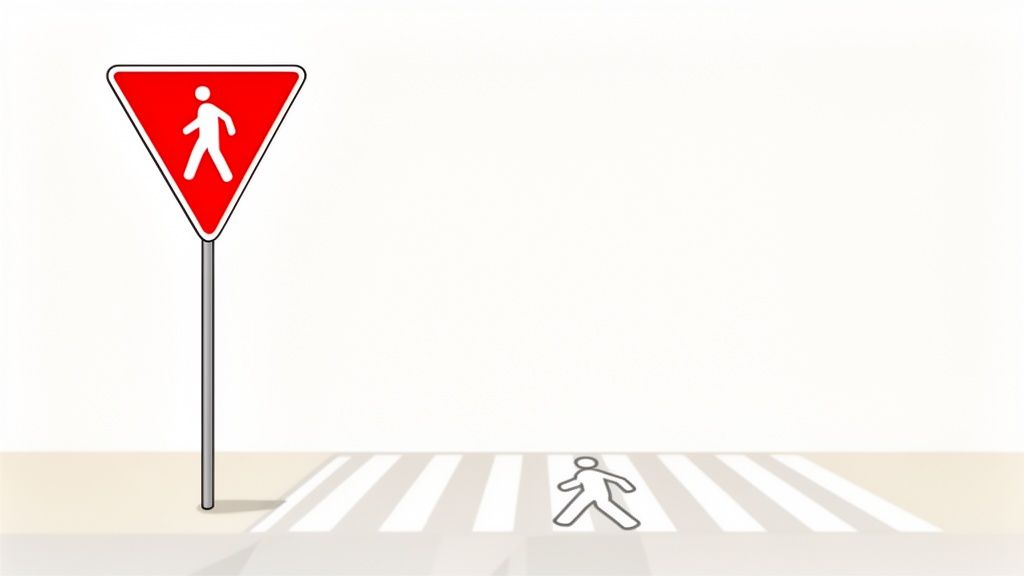
Unlike a stop sign, yielding doesn't always require a complete stop. However, you must be prepared to stop if a pedestrian is in or approaching the crosswalk. The core purpose of this sign is to create a safer environment where vehicle and foot traffic intersect, significantly reducing the risk of pedestrian accidents.
How to Respond and Key Scenarios
Understanding how to properly yield is a key component of defensive driving and is often a focus in Florida BDI courses. It requires vigilance and a proactive mindset.
- Scan and Prepare: As you approach this sign, actively scan the sidewalks and crosswalk ahead for any pedestrians. Reduce your speed so you have ample time to stop if necessary. This is especially important in areas with high foot traffic, such as downtown districts or near playgrounds.
- Give Ample Space: If a pedestrian is in the crosswalk, you must come to a complete stop well before the white lines. Wait for them to clear your lane and the next one before proceeding. Never try to drive around them or rush them across the street.
- Right Turns on Red: Be extra cautious when making a right turn at an intersection with a pedestrian crossing. Even if vehicle traffic is clear, you must yield to anyone using the crosswalk before completing your turn.
Florida-Specific Note: Under Florida law, failing to yield to a pedestrian in a crosswalk can lead to a significant fine and 3 points on your driving license. This violation underscores the importance of pedestrian safety, a topic thoroughly covered in any state-approved Basic Driver Improvement (BDI) course.
6. Do Not Enter Sign (White Text on Red Rectangle)
The Do Not Enter sign is one of the most critical regulatory signs, delivering a clear and absolute prohibition. Its bold red, rectangular shape with a horizontal white bar and the words "DO NOT ENTER" indicates that vehicle traffic is not allowed to proceed into that specific roadway, ramp, or area. This sign is essential for preventing dangerous wrong-way driving situations that often lead to severe or fatal head-on collisions.
You will typically find this sign at the end of one-way streets, at the top of highway exit ramps to prevent drivers from entering the wrong way, and at the entrance to restricted zones like airport service roads. Ignoring this sign creates an immediate and extreme hazard for yourself and every other driver traveling in the correct direction.
How to Respond and Key Scenarios
Understanding and immediately obeying a Do Not Enter sign is a non-negotiable part of safe driving. Unlike other signs that may involve judgment, this one is an absolute command.
- Immediate Action: If you encounter this sign, do not proceed forward under any circumstances. Safely stop and find an alternative route. This might mean turning onto a different street or re-routing your trip.
- Accidental Entry: If you mistakenly pass a Do Not Enter sign and realize you are driving the wrong way, pull over to the shoulder or a safe location as quickly and cautiously as possible. Stop your vehicle, turn on your hazard lights, and wait for a safe gap in traffic before carefully turning around or backing out.
- Navigational Awareness: Pay close attention when using GPS, especially in unfamiliar areas. A navigational error could direct you toward a one-way street or an exit ramp. Always cross-reference GPS instructions with visible traffic signs.
Florida-Specific Note: Entering a roadway marked with a Do Not Enter sign is a serious violation in Florida. It can lead to a moving violation ticket, fines, and 3 points on your driving record. This offense is frequently discussed in Florida BDI courses due to its high potential for causing catastrophic accidents.
7. No Parking Sign (White 'P' with Red Circle and Slash on White Rectangle)
The No Parking sign is a regulatory sign that clearly indicates where drivers are prohibited from leaving their vehicles unattended. It typically features a white rectangular background with the letter 'P' (for parking) inside a red circle with a red slash through it. The primary purpose of these common traffic signs and meanings is to maintain traffic flow, ensure access for emergency vehicles, and manage street-side congestion in busy areas.
These signs are often accompanied by additional information specifying the restriction. This can include arrows indicating the direction of the no-parking zone, specific times or days the rule is in effect (e.g., '7 AM – 9 AM'), or warnings about towing. Unlike moving violations, a parking ticket is a non-moving violation, but it can still lead to significant fines and the inconvenience of having your vehicle towed.
How to Respond and Key Scenarios
Understanding and obeying parking regulations is a key component of responsible driving, though it may not be as heavily emphasized as navigating intersections in a Florida BDI course. It requires careful observation.
- Read the Full Sign: Always take a moment to read all the text on and around the sign. Restrictions can be highly specific, such as during rush hour on urban streets or during school pick-up times near a loading zone.
- Observe Curb Markings: Painted curbs often supplement parking signs. In many areas, a red curb means no stopping or parking at any time, often near fire hydrants or bus stops. A white curb may indicate a short-term passenger loading zone.
- Identify the Zone: Look for arrows on the sign. An arrow pointing in one direction indicates the restriction applies from the sign onward in that direction. A double-headed arrow means the restriction applies on both sides of the sign.
Florida-Specific Note: Parking in front of a fire hydrant is illegal in Florida, even if a sign is not present. Illegally parking can result in fines that vary by municipality, and in designated tow-away zones, you will also be responsible for expensive towing and storage fees.
8. Right of Way/Intersection Priority Signs
Right-of-way signs are a critical category of common traffic signs and meanings that govern the flow of traffic at intersections, particularly where standard controls like traffic lights are absent or malfunctioning. These regulatory signs, including the Yield and Four-Way Stop signs, communicate which driver has the legal priority to proceed, thereby preventing confusion and potential collisions. Their purpose is to establish a clear and predictable order for vehicles, pedestrians, and cyclists sharing the road.
Understanding these rules is essential for defensive driving. Whether approaching a busy roundabout or a residential four-way stop, knowing when to yield and when to proceed is a fundamental skill for maintaining safety and order on the road.
How to Respond and Key Scenarios
Navigating intersections requires a firm grasp of right-of-way principles, a core topic in any reputable Florida traffic school. These rules dictate the safe and legal sequence of movement.
- Yielding: When you see a Yield sign, you must slow down and be prepared to stop to let other traffic (vehicles, pedestrians, or cyclists) pass before you proceed. This is common when merging onto a highway or entering a roundabout, where you must yield to traffic already in the circle.
- Uncontrolled Intersections: In the absence of any signs or signals, the rule is to yield to the vehicle on your right. If a traffic signal is out, it should be treated as a four-way stop.
- Four-Way Stops: These intersections require a specific protocol. The first vehicle to arrive and make a complete stop has the right-of-way. Beyond just identifying the signs, understanding the underlying rules is vital; for instance, knowing who has the right of way at a 4-way stop is crucial for safe navigation, especially if two cars arrive simultaneously.
Florida-Specific Note: Florida Statute 316.123 explicitly outlines the rules for yielding. A failure to yield right-of-way violation can result in a significant fine and 3 points on your driving license, often compelling drivers to take a BDI course to mitigate the consequences.
9. School Zone Speed Limit Signs (White Rectangle with Yellow/Black School Zone Marker)
School Zone Speed Limit signs are a critical hybrid of regulatory and warning signs, designed to protect the most vulnerable pedestrians: children. These signs combine a standard white rectangular speed limit sign with a yellow, pentagon-shaped school crossing marker. This alerts drivers that they are entering a designated school zone where a significantly reduced speed limit is enforced during specific hours to ensure student safety.
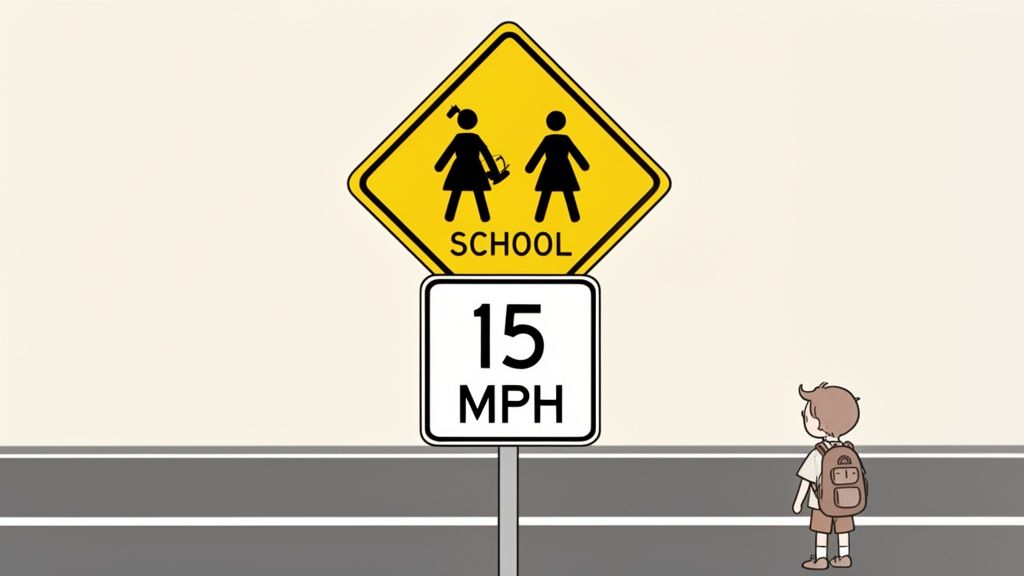
The primary purpose of these signs is to lower vehicle speeds dramatically in areas with high child foot traffic, such as near elementary schools during morning drop-off and afternoon pickup. The reduced speed gives drivers more time to react to unpredictable situations, like a child darting into the street. These are among the most strictly enforced traffic signs, with zero tolerance for violations.
How to Respond and Key Scenarios
Navigating a school zone correctly requires heightened awareness and strict adherence to the posted rules. A Florida BDI course will emphasize that these zones carry severe penalties for a reason.
- Heed the Hours: School zone speed limits are only active during specified times, which are usually posted on the sign. Often, flashing lights will accompany the sign to indicate when the lower speed limit is in effect. You must reduce your speed to the posted limit (typically 15-20 mph in Florida) when these lights are flashing or during the listed hours.
- Constant Vigilance: Even if you don't see children, you must slow down when the zone is active. Children can be unpredictable, and a lower speed is your best defense against a potential tragedy. Be prepared for sudden stops from school buses or parents dropping off students.
- Understand the Calendar: These speed limits generally apply only on days when school is in session. They are typically not enforced during summer vacation or on holidays, but always be cautious.
Florida-Specific Note: Speeding in a Florida school zone results in doubled fines and increased points on your driving record. This is a very common and serious violation. Many drivers who receive a ticket for this offense enroll in a Basic Driver Improvement (BDI) course to prevent the severe consequences on their license and insurance premiums.
10. Dangerous Curve/Sharp Turn Warning Signs (Yellow Diamond)
Dangerous curve or sharp turn signs are critical warning signs that alert drivers to an upcoming change in the road's alignment that requires a reduction in speed. Presented on a yellow diamond, these common traffic signs and meanings use a black arrow to depict the direction and severity of the bend. Their primary purpose is to give drivers advance notice to slow down, preventing loss of control, skidding, or running off the road.
These signs are frequently seen on rural roads, mountain passes, coastal highways like Florida's A1A, and highway exit ramps where the curve is much tighter than the preceding road. Ignoring this warning, especially at high speeds or in poor weather, is a common cause of single-vehicle accidents. Sometimes, an advisory speed plaque is posted below the sign, suggesting a safe speed for navigating the turn.
How to Respond and Key Scenarios
Properly navigating a curve is a core component of defensive driving. The key is to adjust your speed before you enter the turn, not while you are in the middle of it.
- Reduce Speed Before the Turn: The most crucial action is to slow down to a safe speed as you approach the curve. Braking hard mid-turn can upset the vehicle's balance and lead to a skid.
- Maintain a Steady Path: Steer smoothly through the curve, keeping your vehicle centered in your lane. Avoid sudden steering adjustments or acceleration, which can cause the tires to lose traction.
- Be Aware of Conditions: In wet or icy conditions, the risk of skidding increases dramatically. You must reduce your speed even more than the advisory speed suggests to maintain control. Be extra cautious on Florida's rural state routes after a rainstorm.
Florida-Specific Note: In Florida, many accidents on roads like US-19 in the Tampa Bay area or on tight rural highway exits occur because drivers misjudge the severity of a curve. A BDI course emphasizes that these warning signs are not mere suggestions but are based on engineering assessments of the road's limits.
10 Common Traffic Signs: Meaning Comparison
| Sign | 🔄 Implementation Complexity | ⚡ Resource Requirements | 📊 Expected Outcomes | Ideal Use Cases | ⭐ Key Advantages | 💡 Tips |
|---|---|---|---|---|---|---|
| Stop Sign (Red Octagon) | Low — standard installation and placement | Low — signpost and periodic maintenance | High ⭐⭐⭐ — greatly reduces right-angle collisions when followed | Uncontrolled intersections, residential streets, rural crossings | Clear, unambiguous mandate that prioritizes safety | Always come to a full stop; look left‑right‑left before proceeding |
| Yield Sign (Red & White Triangle) | Low — simple placement at merges/roundabouts | Low — sign only; enforcement improves compliance | Moderate ⭐⭐ — improves flow but depends on driver judgment | Highway on‑ramps, roundabout entries, lower‑priority junctions | Smooths traffic flow while retaining safety | Slow gradually, scan all lanes, be prepared to stop |
| Speed Limit Sign (White Rectangle) | Low — routine signposting; may include variable messages | Low hardware cost; enforcement increases resources | Variable ⭐⭐ — effective when enforced and adjusted for conditions | Urban/residential streets, highways, school zones | Provides clear numerical legal limit for drivers | Treat limit as max; reduce speed for weather or hazards |
| One‑Way Sign (White Arrow on Black Rectangle) | Low–Medium — signage plus pavement markings recommended | Low — signs; moderate for reconfigurations | High ⭐⭐⭐ — prevents head‑on collisions if obeyed | Urban grids, parking garages, airport/hospital drives | Organizes traffic flow and prevents wrong‑way travel | Check arrows and pavement markings before entering unfamiliar areas |
| Yield to Pedestrians Sign (Red Triangle with Pedestrian) | Low — placed near crosswalks and schools | Low — signs; may add flashing lights or crossing guards | High ⭐⭐⭐ — protects vulnerable road users when respected | School crossings, parks, downtown pedestrian zones | Emphasizes pedestrian priority and reduces injuries | Always yield to pedestrians in crosswalks; do not turn on red if they are present |
| Do Not Enter Sign (White Text on Red Rectangle) | Low — standard regulatory placement at prohibited entries | Low — sign only; pairing with one‑way aids clarity | High ⭐⭐⭐ — strongly prevents wrong‑way entries and serious crashes | Highway ramp exits, restricted areas, opposite ends of one‑ways | Unambiguous prohibition with immediate safety impact | If encountered, do not proceed; find an alternate route or safely reverse |
| No Parking Sign (Red Slash over P) | Low — signposting with optional timed restrictions | Low — sign cost; enforcement (tickets/towing) adds resources | Moderate ⭐⭐ — keeps lanes clear; relies on enforcement | Fire hydrants, bus stops, rush‑hour curb zones, hospital entrances | Manages curb use and preserves emergency access | Read time restrictions carefully and photograph signs if unsure |
| Right of Way / Intersection Priority Signs | Medium — may involve multiple signs/signals and clear layout | Medium — signs, possible signal coordination and education | High ⭐⭐⭐ — reduces intersection confusion when understood | Complex intersections, signal outages, four‑way stops, merges | Clarifies priority rules and supports defensive decisions | When uncertain, yield; study state right‑of‑way rules and signal outage procedures |
| School Zone Speed Limit Signs (with School Marker) | Low–Medium — may include flashing beacons and timing controls | Medium — signs, flashing lights, enforcement during hours | Very High ⭐⭐⭐ — substantially reduces child injury risk when enforced | School entrances, drop‑off/pick‑up areas, pedestrian crossings | Strong legal and community support; higher penalties deter violations | Slow to posted school speed even if no children visible; watch flashing lights |
| Dangerous Curve / Sharp Turn Warning (Yellow Diamond) | Low — warning placement ahead of curves; optional chevrons | Low — signs; additional pavement markings or barriers raise cost | Moderate–High ⭐⭐/⭐⭐⭐ — effective if drivers reduce speed appropriately | Rural winding roads, coastal highways, mountain passes | Provides advance hazard notice to prevent loss‑of‑control crashes | Reduce speed before entering the curve; avoid braking mid‑turn, lower speed more when wet |
Putting Knowledge into Action: Drive Smarter and Safer Today
Throughout this guide, we have journeyed through some of the most fundamental visual cues on our roadways. We've deconstructed the immediate commands of regulatory signs like the Stop Sign and Do Not Enter sign, which demand absolute compliance to prevent collisions. We've also explored the nuanced directives of signs like the Yield Sign, which require you to assess traffic flow and cede the right-of-way, a critical skill in dynamic driving environments.
Understanding these common traffic signs and meanings is the first, most crucial step. However, true road mastery extends beyond simple memorization. It involves integrating this knowledge into a proactive, defensive driving mindset. It’s about seeing a yellow diamond-shaped Dangerous Curve sign not just as a warning, but as a direct instruction to reduce your speed before you enter the turn, check your lane position, and anticipate potential hazards around the bend. It’s about internalizing the message of a School Zone sign so that slowing down becomes an automatic, non-negotiable action, protecting the most vulnerable among us.
From Recognition to Reaction: Building Driving Instincts
The ultimate goal is to shorten the gap between seeing a sign and executing the correct, safe maneuver. This transition from conscious thought to instinctual reaction is what separates an average driver from a great one. Think about the signs we've covered and their practical implications:
- Proactive Scanning: Don't just look at the road immediately in front of you. Actively scan for signs far ahead. Spotting a Speed Limit sign early gives you ample time to adjust your speed gradually and safely, avoiding sudden braking.
- Situational Awareness: A One-Way sign is more than just a direction; it's a piece of a larger puzzle. It informs you about the expected flow of traffic, the layout of intersections, and where potential threats (like a wrong-way driver) are least expected but most dangerous.
- Hazard Anticipation: Warning signs are your best allies in defensive driving. They tell you what's coming before you can see it. By internalizing their meanings, you train your brain to prepare for sharp turns, pedestrian crossings, or changing road priorities well in advance.
Key Takeaway: Effective driving isn't about reacting to emergencies; it's about using the information provided by traffic signs to prevent those emergencies from ever happening.
Beyond the Signs: A Holistic Approach to Safety
Mastering road signs is a pillar of safe driving, but it's one part of a larger safety ecosystem. Your ability to respond to a sign is directly linked to your vehicle's condition. A perfectly understood Stop Sign is useless if your brakes are failing. To truly drive smarter and safer, it's not enough to just know the rules; your vehicle must also be in top condition. For guidance on ensuring your car meets safety standards, consult a comprehensive vehicle safety inspection checklist. This ensures your car can perform the actions that traffic signs command, from stopping abruptly to navigating a slick corner safely.
This commitment to continuous learning and preparation is what defines a responsible driver. Whether you are a new driver building foundational habits, a seasoned motorist looking to dismiss a ticket and lower insurance rates, or simply someone dedicated to improving your skills, reinforcing your knowledge is always a valuable investment. The more you understand the language of the road, the more confident and capable you become behind the wheel, ready to navigate Florida's bustling streets and highways with skill and precision.
Ready to turn your knowledge of common traffic signs and meanings into certified proof of your driving skill? BDISchool offers state-approved online courses, including the 4-hour BDI, designed to help you dismiss points, earn insurance discounts, and become a more confident driver. Enroll at BDISchool today and take the next step toward safer, smarter driving.